Private Equity Search Fund Buyers vs Traditional PE for Small Business Acquisitions
Search funds install founders as CEOs while PE firms keep them at arm's length.

The search fund model was conceived at Harvard Business School in 1984 and refined substantially at Stanford's Graduate School of Business. Its practitioners call it "entrepreneurship through acquisition," or ETA: rather than building a company from scratch, a talented individual acquires one and runs it.
The mechanics are straightforward. A searcher raises a small pool of capital from a group of investors to fund a full-time search for a company to acquire. Per Stanford's 2024 study, that initial raise typically falls in the low hundreds of thousands of dollars, drawn from a median of 15 investors. This is not an institutional fund; it is a concentrated, relationship-based syndicate.
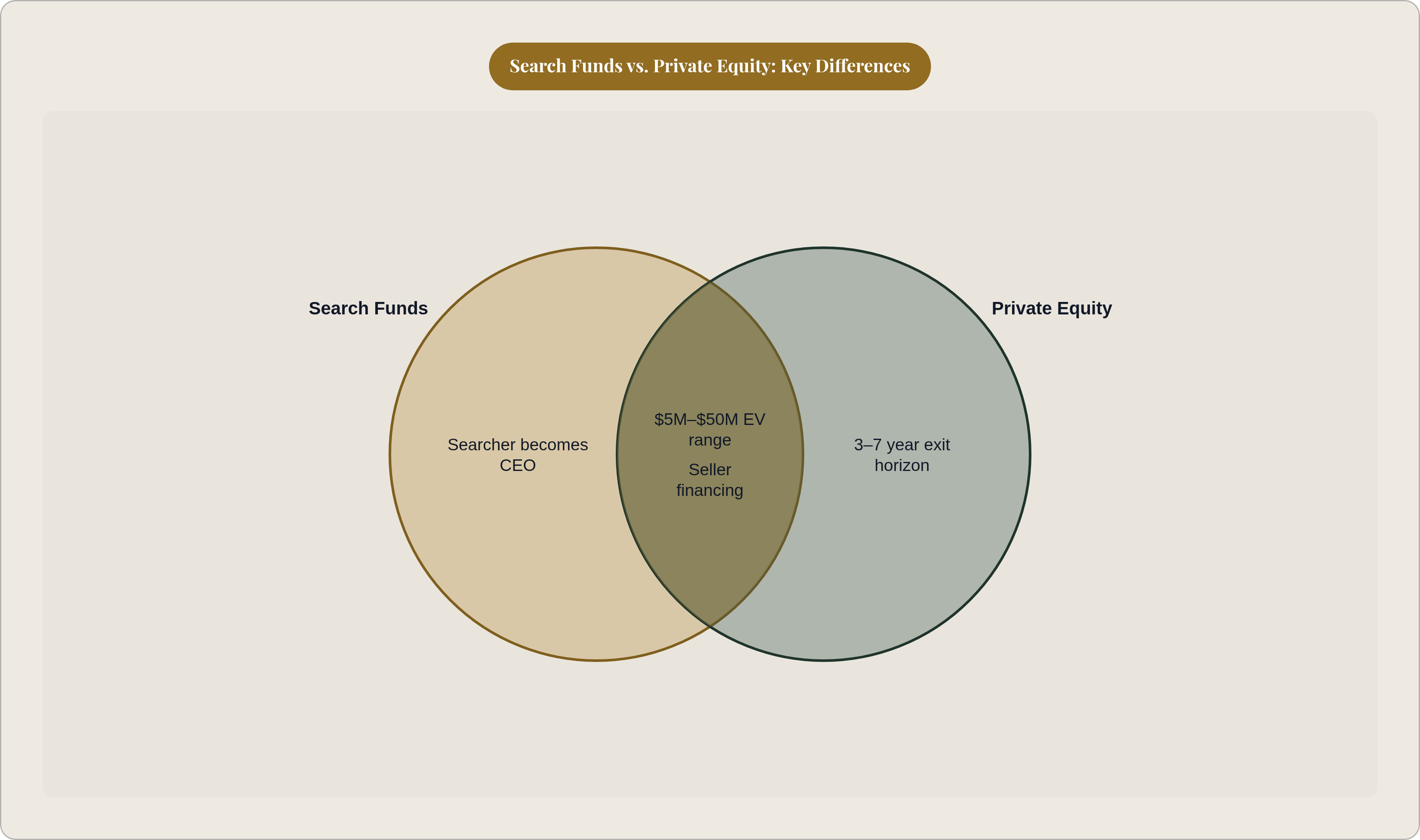
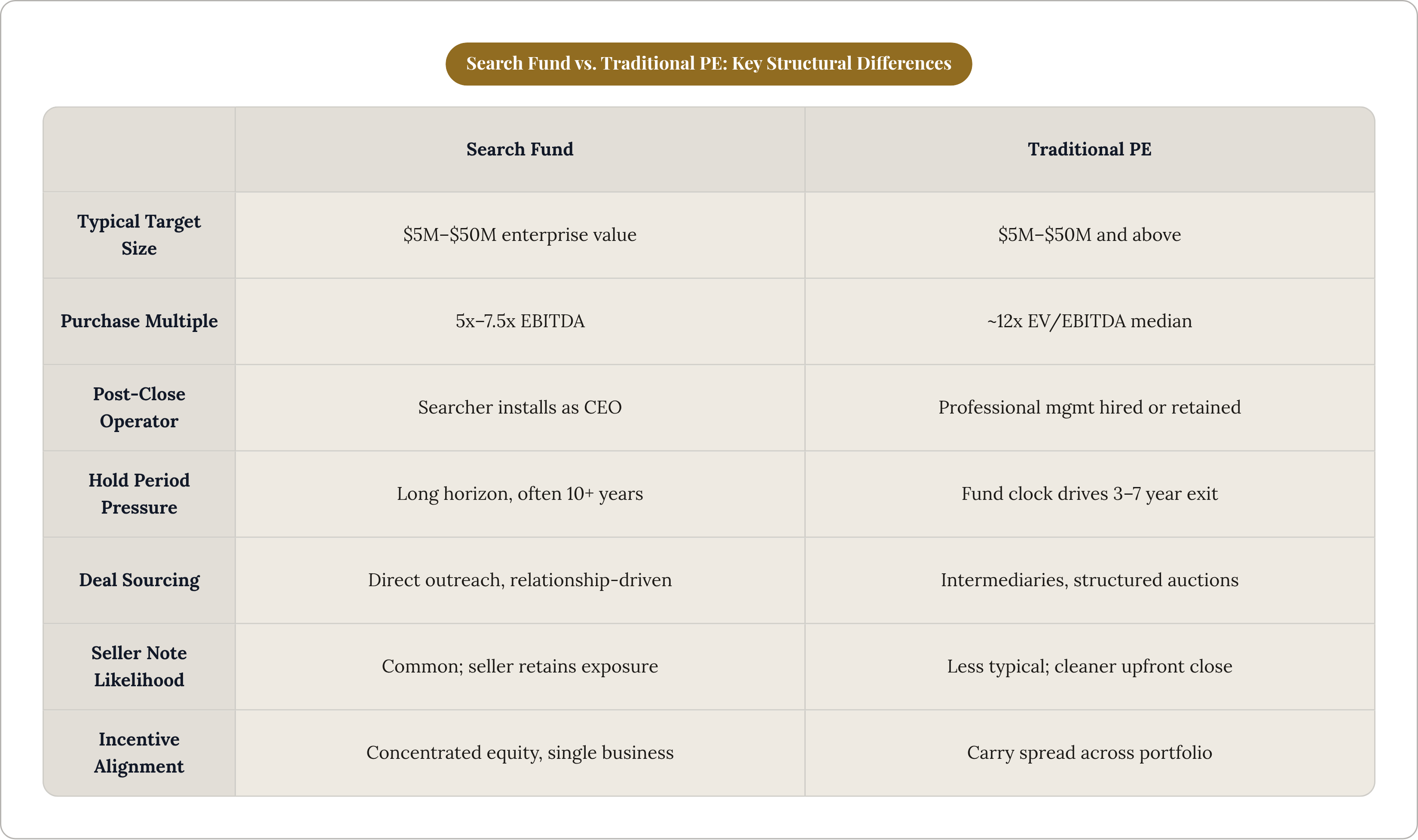
The target profile is specific: companies with enterprise values between $5 million and $50 million and EBITDA of $1.5 million to $5 million, the classic owner-operated lower-middle-market business that has grown beyond startup volatility but remains beneath the floor of most institutional capital. Once a target is identified, the same investor group provides acquisition capital. The median purchase price in Stanford's 2024 study was approximately $14.4 million, rising to $16 million in the 2026 iteration.
The searcher's role after close is the most distinctive feature of the model. They install themselves as CEO, not as a fund manager placing a bet from a distance, but as the person who will answer the phone, manage the team, and live with the consequences of every operational decision. Their equity stake reflects this reality. The median searcher holds roughly 25% equity at acquisition, with upside to the low-to-mid thirties percent through performance and time-vesting milestones. Their personal financial outcome is directly correlated with the business's long-term health, not averaged across a portfolio.
The search-to-close timeline typically runs 18 to 24 months. For sellers planning a transition window, that is a practical constraint worth incorporating from the outset.
How Traditional Private Equity Approaches the Same Market
Private equity firms operate from a structurally different premise. A PE firm raises a fund, typically structured as a limited partnership pooling capital from institutional and high-net-worth investors, then deploys that capital across multiple portfolio companies. The fund has a defined life, and investors expect capital returned within a fixed horizon, generally three to seven years. That clock starts running at acquisition and shapes everything that follows.
Deal sourcing at most PE firms runs through intermediaries: investment banks, M&A advisors, and business brokers who run formal auction processes with multiple competing bidders. Proprietary outreach exists, but it is less common, particularly at smaller fund sizes.
PE firms typically hire or retain professional management after close rather than installing the deal-maker as operator. The acquirer remains a financial sponsor at arm's length, governing through board seats and reporting structures rather than daily involvement. That distance is not inherently a flaw; it produces a different post-close experience for the business and its people, and whether that difference matters depends entirely on what the seller is trying to accomplish.
Lower-middle-market PE firms, those targeting businesses in the $5 million to $50 million enterprise value range, occupy the same general size band as search funds. Within that band, a seller may encounter genuine competition between these two buyer types, and the differences between them are more consequential than they first appear.
Many PE firms pursue a platform-and-add-on strategy: acquire a larger platform company, then bolt smaller acquisitions onto it. If a seller's business is purchased as an add-on, it may be absorbed into a larger entity with different priorities. Brand, culture, and management team continuity are not guaranteed in that scenario, and sellers who care about those things should press for specifics before any letter of intent is signed.
How Purchase Price and Deal Structure Actually Compare for Sellers
The multiple gap between search fund and PE buyers is real. Search funds have historically paid in the 5x to 7.5x EBITDA range, per Stanford's 2024 data. PitchBook's 2025 data puts the median PE buyout transaction at 12.0x EV/EBITDA. That gap looks decisive until you examine what the median actually reflects: it skews toward mid-market and larger transactions, not the lower-middle-market where most small business sales occur.
For businesses generating $1.5 million to $5 million in EBITDA, a competitive PE offer and a strong search fund offer may be closer than the headline multiples suggest, particularly in off-market transactions where no auction has established a clearing price.
Structure often matters as much as multiple, and this is where sellers frequently miscalculate. Seller financing frequently appears in search fund deals, and 60% of boomer owners report openness to it, per research on small business ownership transitions. That openness deserves scrutiny rather than passive acceptance. A seller note means retained financial exposure to the buyer's operational performance post-close. If the searcher struggles, the seller feels it directly. That exposure needs to be priced and structured with specificity, not accepted as boilerplate.
Earnouts appear on both sides of the table. For sellers remaining involved post-close, they can represent meaningful upside. For sellers seeking a clean exit, they are deferred uncertainty. The distinction between those two outcomes should be negotiated explicitly rather than left to post-close interpretation.
PE deals sometimes offer equity rollover: the seller retains a stake in the continuing business and participates in future value creation. This can be financially attractive; it also delays full liquidity and ties the seller's remaining upside to a buyer they no longer control.
The 60% seller-financing openness figure matters because it signals that a meaningful segment of sellers are not purely price-maximizing. A well-structured search fund offer, with favorable terms around legacy, transition, and involvement, can compete against a nominally higher PE bid when the seller's priorities extend beyond the wire transfer amount. Whether the gap between offers justifies whatever comes after close is the question most sellers never actually quantify.
What the Post-Close Experience Looks Like Under Each Buyer Type
The post-close experience is where structural differences become human ones, and where sellers who focused exclusively on purchase price often find themselves surprised.
Under a search fund, the searcher becomes CEO and runs the business directly. Their equity stake, potentially reaching 30 to 35%, only pays off if the business performs over time. There is no portfolio to average across, no fund clock creating pressure to sell in four years. Search fund investors frequently prefer holding a performing business for a decade or more. The incentive structure points toward stewardship rather than extraction.
That alignment is genuine, but incentive structure and operational competence are not the same thing. Anyone who has watched a promising searcher founder in year two knows the difference. The model creates the right conditions; it does not guarantee execution.
Under traditional PE, the fund clock is running from day one. Every operational decision occurs against the backdrop of a future sale, and value creation is pursued with that exit in mind. The quality of that value creation varies substantially across sponsors: some PE firms bring genuine operational expertise and meaningful growth investment; others focus primarily on cost reduction and margin expansion. Sellers should probe this directly rather than accepting a fund's own characterization of its approach, because most firms will not volunteer which orientation they actually default to.
The platform question deserves careful attention from any seller considering a PE offer. A seller whose business is acquired as an add-on may find that the brand, culture, and team they spent decades building get absorbed into something larger with different priorities. In some cases, that accelerates growth. In others, it erases the thing the seller spent thirty years constructing. These outcomes are not equivalent, and the time to develop a preference is before signing, not after.
Employee continuity is often the seller's most emotionally charged concern. A searcher-CEO's success depends directly on retaining institutional knowledge and key relationships, creating an organic incentive to preserve what's working. PE firms have less individual-company attachment, though many take talent retention seriously as a value driver. The question worth asking any buyer directly: who stays, and who decides?
Post-close involvement expectations should be negotiated explicitly with either buyer type. Transition periods are common under both structures, but length, nature of role, and compensation are all negotiable and should be specified before anything is signed.
How Each Buyer Type Sources Deals and What That Means for How Sellers Are Approached
Search fund sourcing is predominantly direct and relationship-driven. Searchers conduct outreach to owner-operators through phone calls, email, and professional networks, frequently before those owners have formally decided to sell. A relationship with a searcher can develop over months or years before a transaction surfaces. This can feel personal and low-pressure; it can also mean a seller accepts a first offer without ever testing the broader market, which is a different kind of risk that tends to go unacknowledged.
PE firms source predominantly through intermediaries, running structured auction processes that typically produce higher competitive tension on price. The tradeoff is process intensity, advisory fees, and the exposure that comes with formally marketing a business.
The sourcing landscape is shifting. Search funds are increasingly findable through intermediated channels; the proportion of search fund deals closed on organized buyer-seller platforms has grown meaningfully in recent years. Searchers are no longer exclusively pursuing off-market outreach.
The practical implication is simple: the only way to know whether any offer reflects fair market value is to run a structured process that surfaces competing interest. Accepting whoever found you first is a common default, not a deliberate exit strategy.
Which Businesses Are Genuinely a Better Fit for a Search Fund Buyer
Search funds are purpose-built for a specific business profile. The archetype is a stable, cash-flowing, owner-operated business with an identifiable niche: not a turnaround candidate, not a venture-backed growth story, not a business whose revenues are inseparable from the seller's personal relationships. A solid operation that needs a capable new operator at the helm, and little else changed.
The financial profile that attracts searchers is EBITDA in the $1.5 million to $5 million range, below the floor where most institutional PE bothers to look. Businesses with limited customer concentration and recurring or repeat revenue are particularly attractive. Industries where a capable generalist CEO can add value without years of specialized technical training tend to fit: professional services, light manufacturing, distribution, software, healthcare services.
Seller characteristics matter as much as business characteristics. Sellers who care about what happens to the business after they leave, who want a real handoff rather than a check and a goodbye, who are open to seller financing as part of the structure, tend to find the search fund model congruent with what they actually want. The seller who is purely maximizing upfront liquidity and wants a fast, clean exit is less likely to find a searcher the right fit.
Traditional PE tends to be a better avenue when the business sits at the high end of the lower-middle-market or beyond, when a strong existing management team is already in place and the incoming-CEO model adds little, when the seller wants maximum upfront liquidity without a seller note, or when the seller is interested in rolling equity into a platform's future growth.
The hardest cases to advise are sellers who are genuinely uncertain about their own exit objectives. Fit cannot really be determined before the seller has clarity on their own priorities, and most sellers underestimate how much that internal work matters. It needs to happen before any buyer conversation begins.
How the Search Fund Industry's Growth Changes What Sellers Should Expect
The search fund universe has expanded dramatically. Stanford GSB now tracks 862 traditional search funds in the United States and Canada. A record 94 traditional search funds launched in 2023, and formation held near record highs through 2025.
The searcher profile has broadened as well. Female searchers reached 17% in recent cohorts. Ethnic diversity expanded to roughly 47% non-white. Management consulting has overtaken private equity as the most common professional background among searchers, with PE veterans falling from over a quarter of the cohort to approximately 18%. This shift has real implications for sellers: incoming CEOs increasingly bring operating and advisory experience rather than purely financial engineering instincts. The stereotype of the finance-background searcher installing a generic operational playbook is less representative than it once was, though it has not disappeared.
More searchers means more cold outreach to owner-operators. Sellers who haven't thought carefully about buyer type will increasingly find themselves on the receiving end of searcher approaches and should have a framework for evaluating them rather than defaulting to whoever called first.
Volume does not equal quality. As formation accelerates, the range of searcher experience, investor backing, and fund sophistication widens considerably. The model has a strong aggregate track record; individual funds vary enormously. A seller needs to evaluate the specific person and the backing behind them, not the model's general reputation.
What Search Fund Returns Tell Sellers About Searcher Incentives, and What They Don't
Per Stanford's 2026 study, search funds as an asset class have generated an aggregate IRR of 33.9% and a 4.75x return on investment. These are strong numbers, strong enough that investor demand for the model continues to grow.
What the aggregate figures conceal is worth examining. A Yale School of Management case study tracking 23 funds found a mean fund-level MOIC of just 2.80x, suggesting that aggregate benchmarks and individual investor experience can diverge meaningfully. The model works in aggregate; individual outcomes are heterogeneous, sometimes dramatically so.
For sellers, the more useful insight from the return data is structural rather than numeric. The search fund return engine depends on acquiring quality businesses at lower-middle-market prices and growing them over a long hold. A searcher's personal upside, up to 30 to 35% equity, only pays off if the business performs. This is a meaningfully different incentive structure than a PE fund manager whose carry is spread across a portfolio; concentrated, long-horizon equity aligns the searcher's interests with the business's performance in a way that diversified portfolio management cannot replicate.
There is also a multiple arbitrage component that deserves acknowledgment. Search fund target companies rarely go through formal auction processes, and the searcher's return model is partly built on acquiring businesses before sellers understand what competitive tension looks like. This is not an indictment of search fund buyers; it is simply a reason to understand your own market position before accepting any offer, from any buyer type.
How Sellers Should Actually Evaluate and Compare Offers from Both Buyer Types
The first mistake most sellers make is accepting the first buyer who approaches them without knowing whether that offer reflects fair market value. The second is evaluating offers purely on headline price while ignoring structure, post-close obligations, and alignment with their own exit priorities. Both mistakes are common; neither is inevitable.
A structured process, whether through an M&A advisor, an investment banker, or a buyer-matching platformlike Succession AI, which connects founder-led businesses to a network of vetted buyers, surfaces search fund and PE buyers simultaneously and creates the competitive tension necessary to understand what the market will actually pay.
When evaluating a search fund buyer, sellers should ask: How is the acquisition funded, and who are the investors? What in your professional background specifically prepares you to run this business? What is your investment horizon, and under what conditions would you consider an exit? What does the seller note look like, and what happens to it if performance deteriorates? What is your plan for key employees in the first 90 days?
When evaluating a PE buyer, the parallel questions are equally important: Is this business being acquired as a platform or as an add-on? What does your value creation playbook look like, and can you show me examples from comparable portfolio companies? What is your target exit timeline, and what happens to management and culture through that transition? If you're offering equity rollover, what does the cap table look like and what governance rights come with it?
Non-financial terms deserve explicit negotiation in any deal: transition period length and compensation, the seller's ongoing role if any, treatment of key employees, and any restrictions on the seller's future activities. These terms often matter more to sellers than the incremental difference in purchase multiple, yet they are routinely treated as afterthoughts. That is a negotiating error most sellers only recognize in hindsight, when the leverage is gone and the documents are signed.