Letter of Intent Negotiation Tactics for Sellers
The binding clauses in an LOI favor buyers while price stays negotiable.

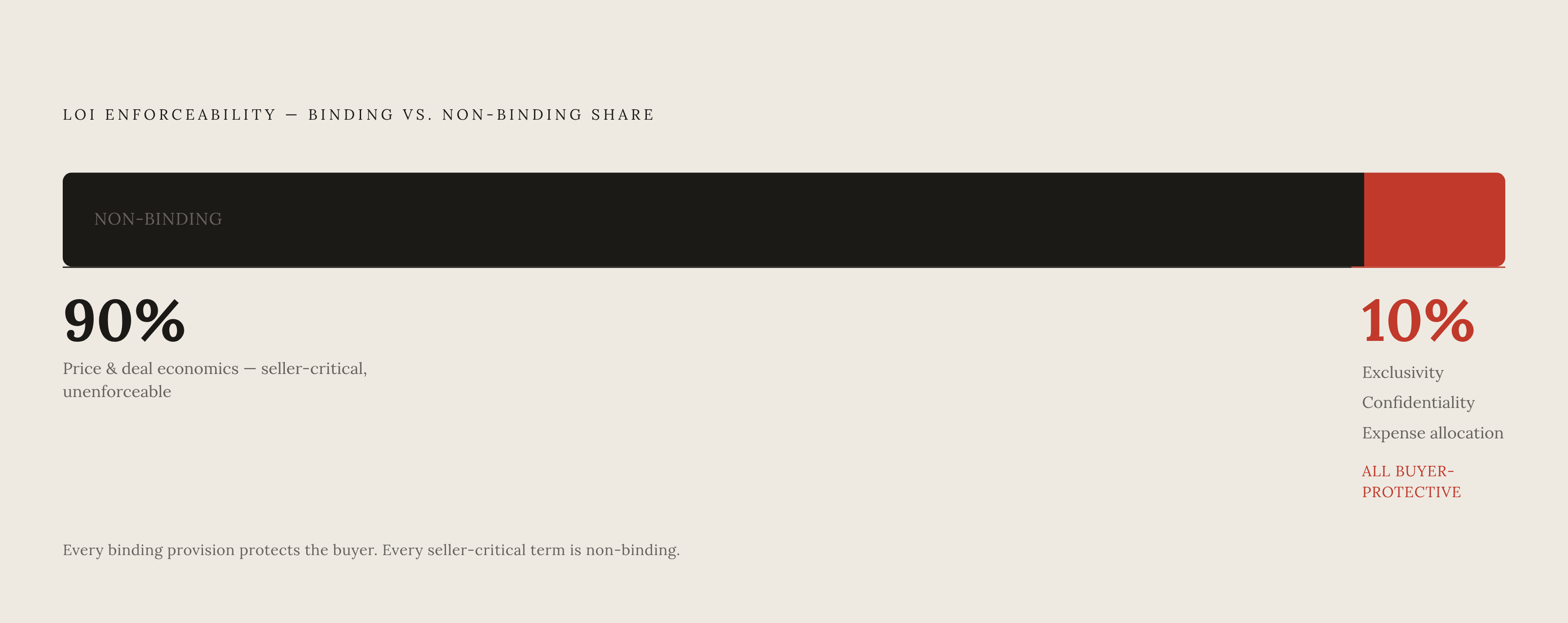
Here's what trips up almost every seller I've worked with: they see "non-binding" stamped across the top of the letter of intent and they relax. Understandable, since most of the document is exactly that. Something like 90% of a typical LOI creates no enforceable obligation whatsoever; it's a statement of intent, waiting on a definitive agreement nobody's drafted yet.
But look at the other slice. That's where the teeth are. Exclusivity binds you. Confidentiality binds you. Expense allocation, meaning who eats the legal bills if the whole thing falls apart, binds you too. Notice something about that list? Every one of those provisions protects the buyer. Price, structure, the economics you'll actually be living with after the wire lands, all of that sits in the non-binding pile, free to be renegotiated the moment diligence turns up anything the buyer can use as ammunition.
Sit with that for a second, because it should bother you. And there's a sharper wrinkle underneath: courts don't always respect a "non-binding" label when the surrounding conduct says otherwise. Texaco found this out the hard way against Pennzoil over a preliminary agreement to buy Getty Oil; a Texas jury looked past the paperwork's label, weighed the conduct around it, and came back with a verdict in the billions. Every M&A lawyer alive has cited that case at some point. And yet sellers keep signing LOIs full of loose language anyway, because somewhere along the way someone told them it's "just an LOI" and costs nothing to leave vague. Precision here is armor, not a drafting nicety. Since the binding structure already tilts toward the buyer, the only real fix is insisting the non-binding sections get just as much specificity as the binding ones do. Buyers resist that insistence constantly, and understanding why is worth its own detour.
Why buyers push for vague LOIs and why sellers should resist
Buyers like short LOIs. Broad strokes, general language, "we'll work out the details in the purchase agreement." That's not sloppiness. It's a strategy, and it works more often than it should. Once exclusivity is signed and diligence opens the books, information starts flowing one direction, toward the buyer, and leverage rides along with it. Whatever gets left fuzzy at LOI stage gets settled later, in a document the buyer's counsel drafted, at precisely the moment the seller has the least room left to push.
Sellers want the opposite: an LOI thick with specifics, negotiated while there are still cards to play. Unless the business has something genuinely hard to replace, proprietary tech, a brand nobody else can touch, an exclusive territory, leverage peaks right here, at signing, and slides downhill for the rest of the process. This isn't a hunch or a rule of thumb passed around at conferences. It's how information asymmetry behaves in any negotiation: right now, the buyer knows less about your company than they ever will again, and knowing less leaves them with less to argue.
Time is the other lever they reach for. Buyers want to blow through the LOI fast and get into diligence, where the balance tips their way. Good deal counsel exists partly to slow that down, to drag every material term into daylight before signature instead of letting the seller get hurried along with "let's just sign and sort the rest out later." That urgency serves exactly one side of the table. Sellers who feel rushed should stop and ask, plainly, who benefits from the rush.
The terms sellers must lock down before signing
Start with price. Everything downstream follows from it. A fixed number protects the seller; a range, or a formula tied to "diligence findings," protects the buyer. An LOI reading "$5 million to $7 million, subject to buyer's findings" settles at $5 million nearly every single time, because everything that happens after signing pushes the number down and almost nothing pushes it up. Add-backs get challenged. Run-rate margins get reframed. Expenses the seller genuinely considered one-time get disputed. None of that requires bad faith on the buyer's part; a soft price mechanism invites this behavior on its own, good intentions or not. The bar worth holding: fixed price at signing, any adjustment spelled out in the LOI itself, not deferred to a conversation that hasn't happened.
Deal structure gets skipped more than it should, and it matters just as much. Asset sale versus stock sale can swing after-tax proceeds by a real, sometimes uncomfortable margin, through tax exposure and liability exposure both. Plenty of LOIs never touch the subject, and the seller only discovers the intended structure once the purchase agreement lands on the desk. Nail this down early. It isn't a detail to save for later; it's the floor everything else stands on.
Working capital deserves its own paragraph, because it's where sellers quietly bleed money without noticing. Buyers expect a "normal" level of working capital delivered at close, and if the real number comes in short, price drops dollar for dollar against it. A vague peg, especially one drafted entirely on the buyer's terms, can cost six figures without anyone raising their voice. Push the LOI to spell out exactly how the peg gets calculated. Ask about a collar too, a band around the target inside which ordinary swings trigger no adjustment. These fights are winnable at LOI stage. They get brutal once the purchase agreement shows up with the buyer's version of "normal" already baked into the draft.
Escrow and indemnification run the same playbook. A lot of LOIs skip escrow entirely, and the seller only learns about a large holdback once the purchase agreement arrives, by which point LOI-stage leverage is gone. Pin down early: claim period length, liability cap, escrow amount, whether a deductible or basket applies before claims can even be made, and which reps count as "fundamental" and therefore carry higher, sometimes uncapped, exposure. Settle these at LOI stage and the seller walks in with a known ceiling on post-close risk instead of an open-ended one.
Then there's the stuff people treat as afterthoughts and really shouldn't. A real estate lease, a post-close employment or consulting arrangement for the seller, seller carryback financing: the core terms belong in the LOI, not the purchase agreement. For a lease, that's duration, rent, escalators, right of first refusal. For employment, title, duties, term, comp. For seller financing, payment schedule, interest rate, collateral, guarantees. Leave these for later and you've handed them straight to the buyer's drafters.
Exclusivity: the concession that changes the power balance
Exclusivity is the single biggest concession in the whole document, and it's the one sellers seem to think about least. Grant it, and the seller stops marketing the business, stops fielding other calls, commits to one buyer, all before diligence has told anyone whether that buyer will actually close. The buyer, meanwhile, can walk away almost any time they want, cleanly. If the deal dies after exclusivity, the seller restarts a process that can look tainted to fresh buyers wondering why the last one fell through. That asymmetry alone is reason enough to fight over duration.
And the gap between what buyers ask for and what sellers should agree to isn't subtle. Buyers routinely open with 45 to 120 days. Sellers should generally land closer to 30 to 45; seller-favorable LOIs tend to cap it right there to keep the process moving. Naming that gap out loud in the room gives a seller something to push against, instead of guessing at what counts as reasonable.
Watch for automatic extensions buried in the clause, the kind that renew the window without a fresh conversation. If one gets granted at all, cap it at a single extension rather than an open series. Better yet, tie exclusivity to milestones, so a missed diligence checkpoint ends it automatically. That guards against buyers who drag the process out to run the clock and extract concessions through fatigue rather than anything they actually found. A deadline-enforcement clause does similar work: miss the date, lose the exclusivity, no discussion needed.
Treat exclusivity duration as negotiable as price, because it is exactly that negotiable. Sellers who wave it through as boilerplate are giving away protection nobody made them give away.
Earnouts: what the payout data says sellers should know before accepting one
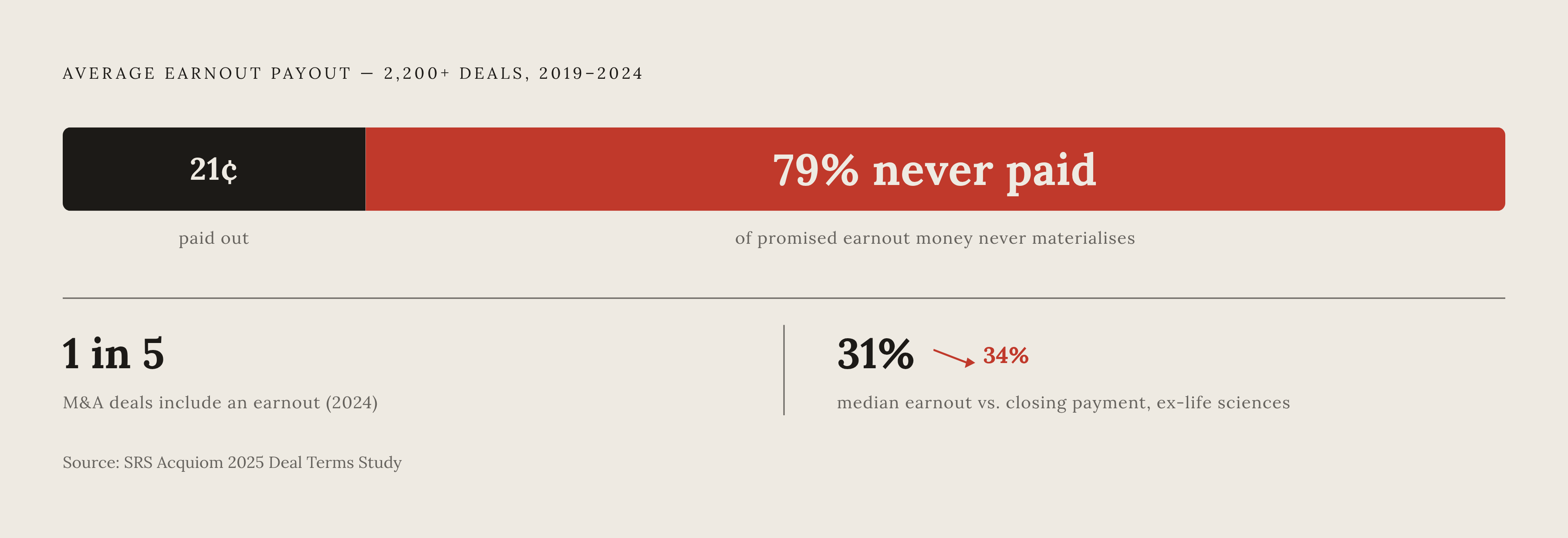
Here's a number worth sitting with. SRS Acquiom's 2025 Deal Terms Study, tracking more than 2,200 deals from 2019 through 2024, found the average earnout pays out around 21 cents on the dollar. Flip that around: something like 79% of promised earnout money never shows up. That's not a handful of unlucky sellers. That's the structural default.
Which is exactly why deal counsel keeps repeating the same line: avoid earnouts where you can, push for cash at close instead. Earnouts add cost, more negotiation, more drafting, more surface area to fight over later, and they raise the odds of post-closing litigation, since the seller no longer runs the business that determines whether the earnout actually pays. They still show up in roughly one in five M&A deals as of 2024, but outside life sciences the median earnout fell to 31% of closing payments, down from 34% the year before. That drop isn't noise. It's sellers, in a competitive buyer market, successfully pushing more of the consideration into cash at close rather than deferred, buyer-controlled payments. Same leverage this whole piece keeps circling back to, just showing up in aggregate deal data instead of one negotiation at a time.
If an earnout can't be avoided, the LOI is where the seller negotiates the terms that decide whether it survives contact with reality. Push for metrics that are objective and easy to verify: revenue, net sales, not EBITDA, not integration milestones, not product targets the buyer effectively controls once they own the company. After closing, the buyer runs the business; without covenants protecting the seller's actual ability to hit the number (decision rights over budget, staffing, product priorities tied to the metric), the seller is betting on someone else's discipline. Put the formula itself in the LOI, worked example and accounting basis included, rather than leaving it for the purchase agreement to define. And watch for the acceleration trap: most deals exclude earnout acceleration if the buyer sells the business before the earnout period ends. That default favors the buyer, and it doesn't fix itself. Someone has to negotiate it away on purpose.
How retrades happen and what makes sellers vulnerable to them
A retrade is when the buyer comes back after signing and asks to cut the price or change terms, usually mid-diligence or right before closing. It happens often enough in the lower middle market that sellers should plan for it rather than treat it as a rare betrayal. When the cut lands, it's typically a moderate percentage off the headline number, not a collapse, which is precisely what makes the tactic worth trying from the buyer's side.
Common triggers: a working capital shortfall found in diligence, customer concentration that looks worse up close than from a distance, quality-of-earnings adjustments, disputed add-backs, missed projections during the exclusivity window. But it isn't always about a genuine new fact. Sometimes it's just leverage, timing, and psychology, a buyer testing whether a seller who's already granted exclusivity and mentally moved on will swallow a lower number rather than restart the whole search.
That's exactly why sellers are weakest at retrade time. Exclusivity is granted, diligence is underway or finished, other buyers have scattered to other deals. Restarting costs real time and leaves a mark on how the market reads a deal that already fell apart once. Which loops back to everything above: a precisely negotiated price, a defined working capital peg, clear adjustment mechanics, a short exclusivity window, all of it shrinks the room a buyer has to work with when they try a retrade. Treat every vague term in the LOI as a lever waiting to be pulled, because experienced buyers sometimes leave things vague for exactly that reason. If a retrade does happen, the real question is whether the new terms reflect an actual finding or a negotiating tactic dressed up as one, and having someone experienced in the room to tell the difference matters more than people expect. Sellers negotiating alone tend to fold faster under manufactured urgency than sellers with backup in the room.
How to enter LOI negotiations with leverage intact
Everything above assumes the seller has leverage somewhere to spend. So where does it actually come from? Competitive tension among buyers, more than any single clause in the document. A seller talking to one buyer has no alternative to walk toward, and without an alternative there's no real leverage, no matter how tightly the LOI gets drafted. The best outcomes come from running an actual process, several buyers engaged at once, each aware the others are in the room. That awareness alone changes the terms on offer and how hard buyers push to rush the LOI through.
Preparation matters on its own, separate from headcount at the table. Clean, well-documented financials take a chunk of the buyer's diligence leverage away before diligence even starts, since there's less ambiguity left to challenge add-backs against. Knowing your own working capital norms before the negotiation begins means proposing the peg from a position of knowledge, not reacting to whatever number the buyer's team drops on the table. And knowing your own walk-away point on exclusivity duration ahead of time stops the kind of concession that gets made under pressure, in the room, simply because nobody drew the line beforehand.
None of this tends to happen by accident, and it rarely goes well without someone who's done it before in the room. Buyers show up with deal teams who do this for a living; sellers without equivalent representation are negotiating from a structural hole before the conversation even opens.
The LOI window doesn't stay open long, and it shuts the moment the ink dries. While it's open, sellers hold something they won't get back once diligence starts: a buyer who knows less about the business than they'll ever know again. Every term locked in during that window rides through to closing, whether it was fought for or given away by default. How a seller spends those few weeks decides almost everything that comes after.