Confidential Information Memorandum Structure and Best Practices
How to structure a CIM so buyers compete for your deal.

A Confidential Information Memorandum carries a company from an anonymous, one-page teaser to a real conversation with a buyer who's signed an NDA and wants the full picture. On its own, the document rarely closes a deal, but it makes a buyer want to fight for the company, and how the document gets built decides whether that fight ever happens.
A Confidential Information Memorandum typically opens with an executive summary that frames the investment thesis, then moves into business overview, products or services, market and competitive positioning, operations, management team, and financial performance with historical statements and projections. That sequencing matters because each section builds on the last: the executive summary creates the hook, the operational and market sections validate it, and the financials convert intellectual interest into a conviction that the company is worth pursuing. A buyer who finishes a well-sequenced CIM should feel they understand the business well enough to submit a credible bid and motivated enough to compete for the opportunity.
What sections and sequencing should a CIM include to move a buyer from initial interest to wanting to compete for the deal?
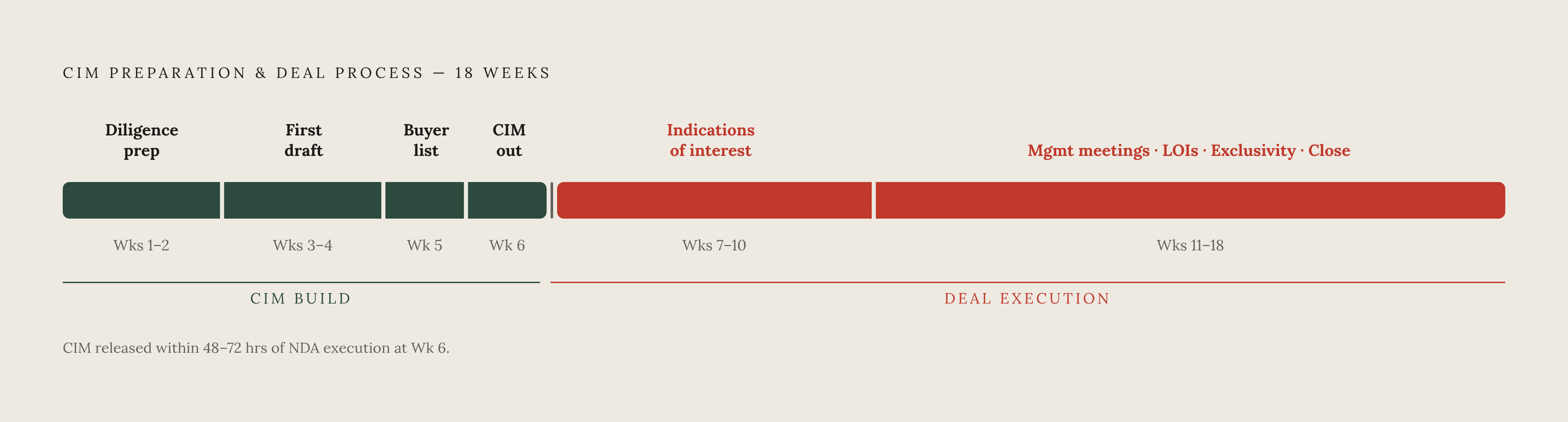
Most sell-side processes run six to twelve months, mandate to close. The CIM itself gets built in the first six weeks, and that surprises almost every owner I've worked with. It happens under real pressure the whole way through.
Weeks one and two go to interviewing the operator, pulling financials, working through customer concentration. By weeks three and four a senior associate has a first draft, usually 50 to 80 pages for a middle-market deal, and the lead managing director reviews it with the seller's CEO and CFO in the room. Week five is buyer-list season. Week six, the teaser goes out, NDAs come back, and the CIM gets released, often within 48 to 72 hours of NDA execution. Indications of interest land over weeks seven through ten. Weeks eleven through eighteen cover management meetings, LOIs, exclusivity, close.
So what does that timeline actually mean for the seller sitting across the table in week one? It means the document gets written fast, faster than most owners are prepared for. Sellers who've already got three clean years of financials, documented customer relationships, and a thought-out growth story walk in with a real head start. The ones who struggle are scrambling to assemble basic data after the engagement letter's already signed, and by then the clock started running without them.
Why the CIM's structure is a narrative arc, not a checklist
The format has shifted. What used to be a dense Word document is now, in most cases, a slide deck, and that matters more than it sounds like it should. Slide-based pacing forces a buyer through the story in a sequence someone actually designed. A wall of text can't do that; it just sits there waiting to be skimmed.
Buyer screening data shows sophisticated buyers follow a consistent order: size and margins first, then investment thesis, then market dynamics, everything else after. So the opening pages are load-bearing, full stop. Miss a buyer's attention there and they don't circle back looking for what they skipped.
Build it like a case. Some sections exist to establish credibility. Others exist to expand how much upside a buyer thinks is on the table. Still others exist just to get ahead of the objection that would otherwise kill a bid before anyone's even made one. Treat every section as equally weighted, or worse, as a box to check, and the document starts reading like a compliance filing instead of an argument. Buyers notice the difference by around page four.
The executive summary and investment highlights — the section that decides whether the rest gets read
If there are two sections where a banker spends the bulk of the strategic thinking, it's the executive summary up front and the financial performance section at the back. Everything between those two exists to support them.
Investment highlights usually run five to eight bullets, and each one has to be specific and quantified. A weak highlight reads: "market-leading business with strong growth potential." That sentence describes half the businesses in America and tells a buyer nothing at all. A strong one names a market position, a market size paired with its actual growth rate, a concrete mechanism behind the upside. The difference is whether a buyer can check the claim, or just has to take it on faith.
The executive summary itself runs one to two pages and distills mission, core metrics, and thesis into language built around benefit, not mere description. This is where a buyer forms their first instinct on price, whether sellers realize it or not. A clear, internally consistent summary keeps a buyer from anchoring low before they've even reached the numbers. Owners often treat this section as an afterthought, something to draft once the "real" content is finished, but it probably deserves more editorial time than any other page in the deck.
Company overview, products, and operations — establishing what the business actually is
The company overview covers the orienting facts: history, legal structure, locations, subsidiaries, the basic model. None of it is glamorous, but a buyer needs this scaffolding before anything downstream makes sense.
The products and services section carries more weight than sellers expect. It has to cover categories, actual differentiation, target segments. For service businesses that means walking the end-to-end delivery process and being blunt about the revenue model, fixed-price or time-and-material, and how deep the capability actually runs. The section's real job is showing why a competitor can't just take the same customer next quarter.
Operations lays out supply chain, facilities, key systems, quality controls, and this is where a specific buyer worry gets addressed without anyone naming it out loud: can this business run without the founder standing in the middle of it? For founder-led companies, which make up a large share of the middle market, key-person risk is often the single biggest concern in the room. A well-built operations section shows process maturity and people who know how to run things, with evidence of judgment rather than a list of activities someone typed up. These sections aren't glamorous, but they set up the financial section that follows, and a buyer who understands how the business actually operates is a buyer who trusts the margins on the next page.
Market analysis and competitive positioning — making the case for the business's place in a growing opportunity
TAM, SAM, SOM. The acronyms are familiar; the execution is where most CIMs fall apart. Market size claims need credible third-party backing behind them. A number that looks like someone typed a big figure onto a slide because it sounded impressive is one of the fastest ways to lose a sophisticated buyer in the first read.
The competitive landscape section has to show where the company actually sits: switching costs, sources of advantage, how real the moat is. Strategic buyers read this looking for synergy and expansion logic. Financial sponsors read the same page asking something else entirely, whether cash flows hold up under a leveraged structure. Same section, two different exams happening at once.
This is also where a company's size gets reframed. A sub-scale company sitting in a fragmented, growing market can look like a platform play, a foothold for further acquisition. That same company, described inside a saturated or shrinking market, looks like a laggard fighting for scraps. The business hasn't changed; the frame has. And the frame matters financially, because a larger, faster-growing market supports a higher multiple assumption than a stagnant one ever will.
Customer and revenue analysis — the section buyers use to stress-test the financial story
This is where the story gets checked against itself. Revenue mix by geography, product, and segment shows a buyer where the money actually comes from, and whether that lines up with their own thesis for the deal.
Customer concentration gets scrutinized hard, for good reason, since heavy dependence on a handful of accounts is probably the most common discount trigger in middle-market deals. Three customers at sixty percent of revenue, and a buyer prices that risk in whether the seller addresses it or not.
Cohort data, retention curves, churn, backlog: these are the numbers that tell a buyer whether revenue is actually recurring and stable, beyond simply appearing on a P&L. For founder-led businesses these metrics are often under-tracked, scattered across spreadsheets nobody built for this purpose, and organizing them before CIM prep even starts saves weeks later, not days. Pipeline data and signed contract backlog matter here too, since they bridge what the business has already proven to what the next section is about to project. Well-organized customer data does something else worth naming: it cuts the volume of follow-up diligence questions, and that's the difference between a process that keeps moving and one that stalls out waiting on data requests nobody answered fast enough.
Management team — the section that answers whether the business survives the transaction
Qualifications, tenure, domain expertise, track record: standard content, but the real question underneath all of it is simpler. Does this business survive the transaction?
The org chart matters as much as the bios, because it shows depth. Is there a bench under the founder, or does every real decision run through one person's inbox? Financial sponsors weight this section heavily, harder than strategics tend to, because a leveraged buyout depends on believing the existing team can execute a growth plan with the founder somewhere else on a Tuesday.
For businesses where the owner is deeply embedded in sales or key customer relationships, this section needs honest handling, not a glossy rewrite. Transition plans, earnout structures, post-close roles: these can live here or in the growth strategy section, but somewhere they need to address the concern before the buyer raises it first. Order matters, because a buyer who spots key-person risk on their own, with zero mitigation story anywhere in the document, prices it in harder than one who read the seller's plan for it up front. A strong management section does one more thing quietly: it makes the projections in the next section feel executable instead of aspirational.
Financial performance — the section where the investment case is proven or lost
Three years of income statements, balance sheets, cash flow statements, at minimum, plus EBITDA bridges, unit economics, and a forecast with assumptions stated plainly enough that a buyer can trace the logic step by step without guessing.
None of that can exist in isolation. The assumptions need to match the market section, the customer section, the management section that came before. A growth forecast built on geographic expansion, sitting next to a management section with nobody who's ever run an expansion, is exactly the kind of inconsistency that makes a sophisticated buyer either discount hard or walk away entirely.
Private equity firms screen for minimum EBITDA thresholds before reading anything else in the document, so positioning that line clearly and early is a functional choice, not just a formatting one. Every number in the CIM, not just this section, should get reviewed by the CFO and controllers before release, because buyers cross-reference the financials against everything else in the deck looking for a gap.
One thing the CIM deliberately never does: state a valuation ask. That's on purpose, because leaving price open lets each buyer build their own model and land on their own number. This is exactly the mechanism that turns one interested party into three or four competing ones instead of a single take-it-or-leave-it offer. A financial section that's clean, consistent, and paired with a credible growth story is the engine behind that competitive tension.
Growth strategy and risk factors — the sections that separate a credible CIM from a promotional one
Growth strategy covers the expected ground: expansion plans, product pipeline, unentered geographies, add-on acquisition targets. What separates a credible version from a promotional one is restraint. The assumptions have to line up with everything that came before, and a hockey-stick projection with no operational backing doesn't just weaken this section; it undermines trust in every section around it.
Framing the upside as achievable with investment, rather than guaranteed outright, tends to land better with buyers who've read a hundred of these decks already and know exactly what hand-waving looks like on a page.
Risk factors deserve the same honesty. No business exists without risk, and buyers know that walking in. The real question is whether the seller names it first, with a mitigation story attached, or leaves the buyer to find it during diligence. Risks disclosed up front build credibility. Risks that surface for the first time in diligence, ones that should've been sitting on page 40 of the CIM the whole time, tend to reopen price conversations everyone thought were closed. Here is where the tone of the whole document gets judged, honestly, as an honest case for the business or a pitch with the rough edges sanded off.
The appendix — the section most sellers underinvest in and sophisticated buyers rely on most
Appendices run long. Thirty to fifty pages isn't unusual, and the length is the point. Customer-level revenue breakdowns, equipment lists, contract summaries, detailed financial schedules: the raw data underneath every claim made earlier in the document lives here.
A well-organized appendix does something buyers notice fast: it lets them and their advisors answer their own follow-up questions instead of routing everything back through the banker one email at a time. Constant back-and-forth over data gaps slows a deal down, and worse, it signals disorganization at exactly the moment a seller needs to look buttoned-up. An appendix that anticipates the questions a serious buyer will ask keeps momentum on the seller's side of the table.
One caveat: sensitive material, full customer contact lists, account-level pricing, proprietary algorithms, tax returns, doesn't belong here. That goes into the NDA-protected data room after an LOI is signed, not before. The appendix is where a seller's professionalism becomes most visible to the buyers who go deepest into the document, and it's also, frankly, the section most owners spend the least time on relative to how much sophisticated buyers lean on it.
How buyer type shapes which sections carry the most weight
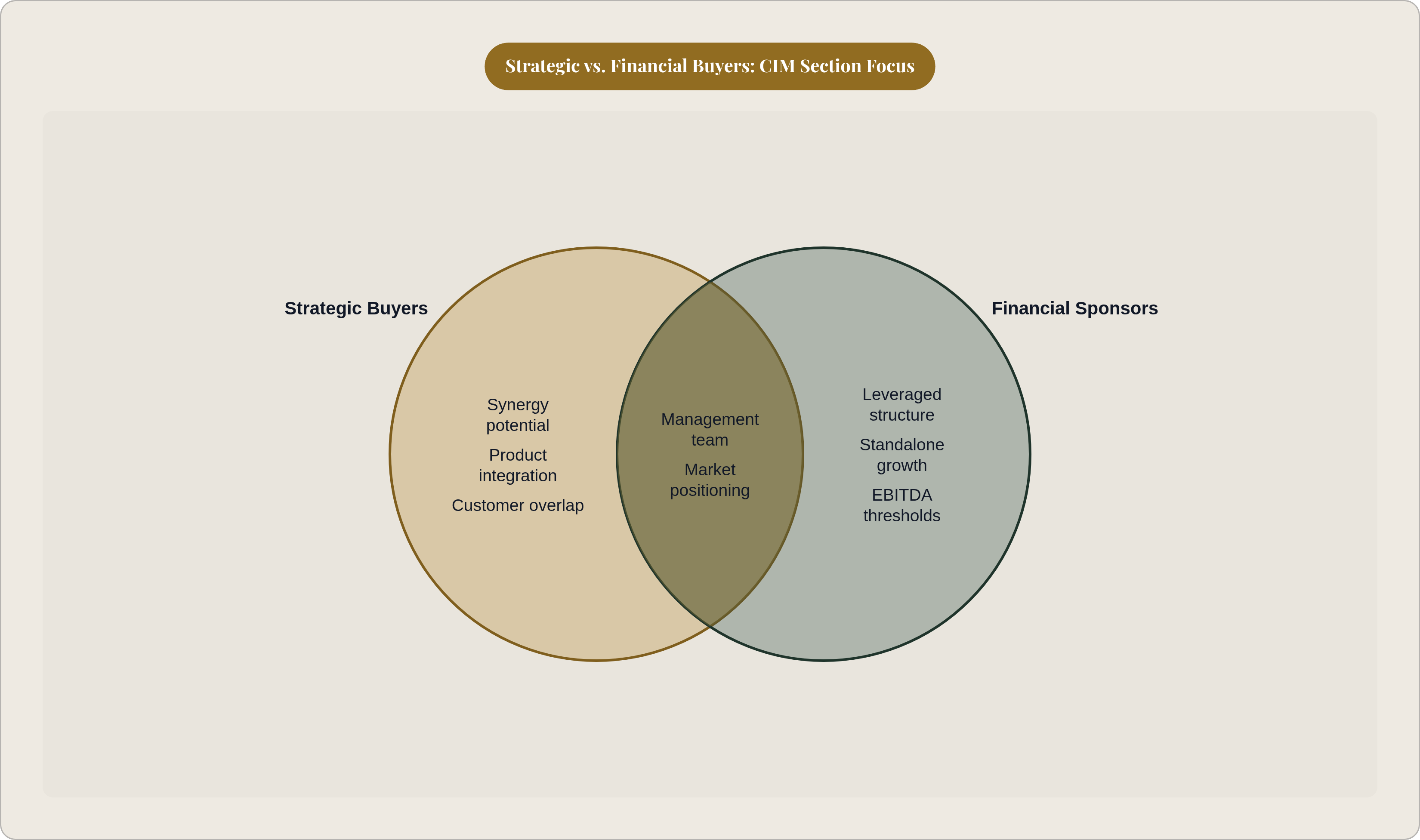
Different buyers read a CIM through different lenses. Understanding that difference changes how a seller should prepare the whole document, not just tweak a slide here or there.
Strategic buyers, companies already operating in the space, focus on market position, synergy potential, product integration, customer overlap. For them the market analysis and competitive positioning sections carry outsized weight, because they're asking a different question than a financial buyer would: does this fit into what we already do?
Financial sponsors are underwriting something else entirely: standalone growth prospects, strength of the management team, whether cash flow supports a leveraged structure. For them, management and financial performance matter more than anything else on the page.
Some advisors go further and prepare version-specific emphasis: same core document, different section weighting or supplemental slides depending on whether the recipient is a strategic or a sponsor. The buyer list itself, built in parallel during those first weeks, shapes which version of the story needs to land hardest for which audience. First-time sellers rarely see how differently these two buyer types read the exact same pages, and that blind spot is often where a seller quietly gives up leverage they didn't know they had to begin with.
Confidentiality controls that protect the seller throughout the process
None of this works without a gate in front of it. No CIM moves to a buyer without a fully executed NDA, and that's the baseline.
Beyond the NDA, distribution controls matter more than most sellers expect going in. Read-only access through a virtual data room, watermarking each copy with the recipient's name or email so a leak traces back to its source, access logs recording who viewed what and when, expiry settings that discourage someone forwarding the deck six months after the fact. These measures aren't dramatic on their own, but together, they're what keeps a process contained long enough to actually run its course, and that matters more than it sounds like it should. If word leaks that a company's for sale before anything's signed, employees start job hunting, customers start shopping competitors, suppliers start tightening terms. The whole structure of the CIM, and the confidentiality built around it, exists to keep that story from getting told before the seller is ready to tell it themselves.