Strategic Buyers vs Private Equity for Sub-$50M Exits
Private equity dominates sub-$50M exits, but strategic buyers may pay more.

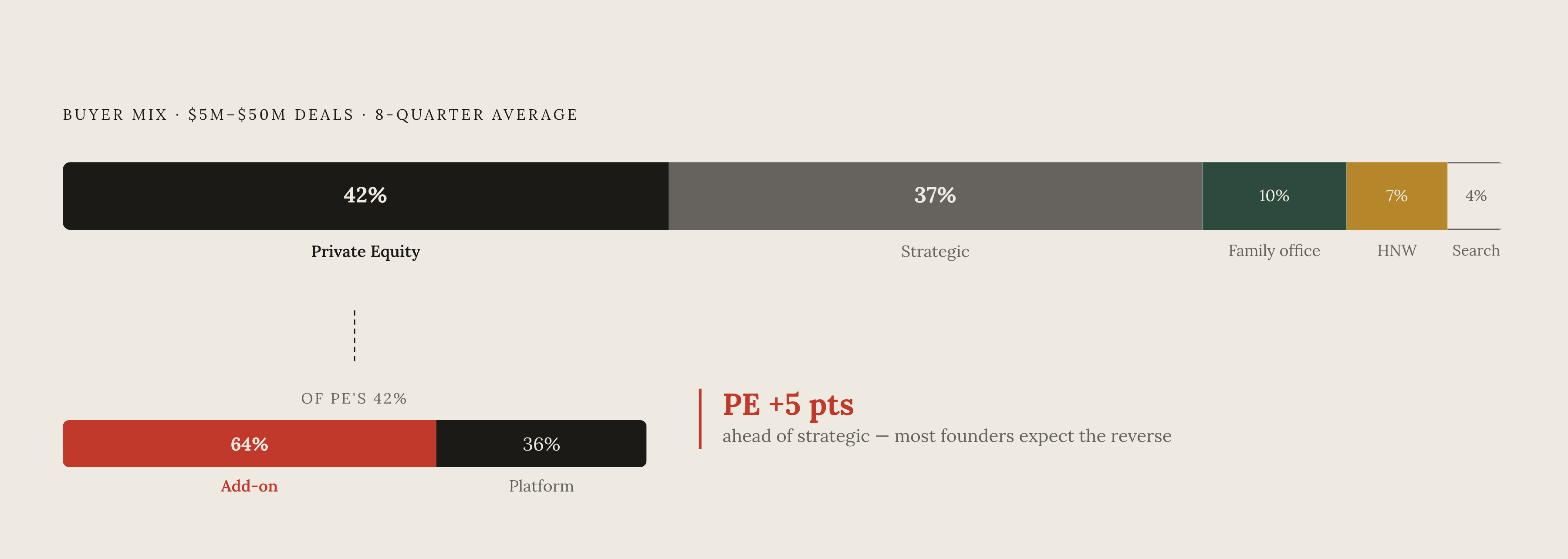
The first surprise for many founders is who shows up. Private equity accounted for 59% of all transactions in the $5M–$50M space, with 64% of those acquisitions structured as horizontal add-ons, per the IBBA's Market Pulse Report. Over an eight-quarter average, PE captured 42% of deal flow in this range versus 37% for strategic buyers. That lead is not recent; it is structural, and it has been building for years.
Within the segment, PE firms concentrate activity in the lower middle market transaction range, primarily through add-on acquisitions inside larger platform strategies. A founder running a business of this size is statistically more likely to receive a serious inquiry from a PE add-on buyer than from a corporate strategic acquirer. Most go to market expecting the opposite. But what if that assumption is costing founders leverage before they even begin?
The buyer pool is also broader than the PE-versus-strategic binary. Family offices, high-net-worth individuals, and search funds have each increased buy-side activity in 2025. At the smaller end of the spectrum, motivations diversify further: the IBBA data shows that in deals closer to the smallest deal range, a meaningful share of buyers are effectively acquiring employment for themselves. Conflating motivations across deal sizes produces poor decisions, because those motivations also determine what a buyer will pay, how they will structure a deal, and what a founder's life looks like after close.
What Each Buyer Type Is Actually Trying to Accomplish
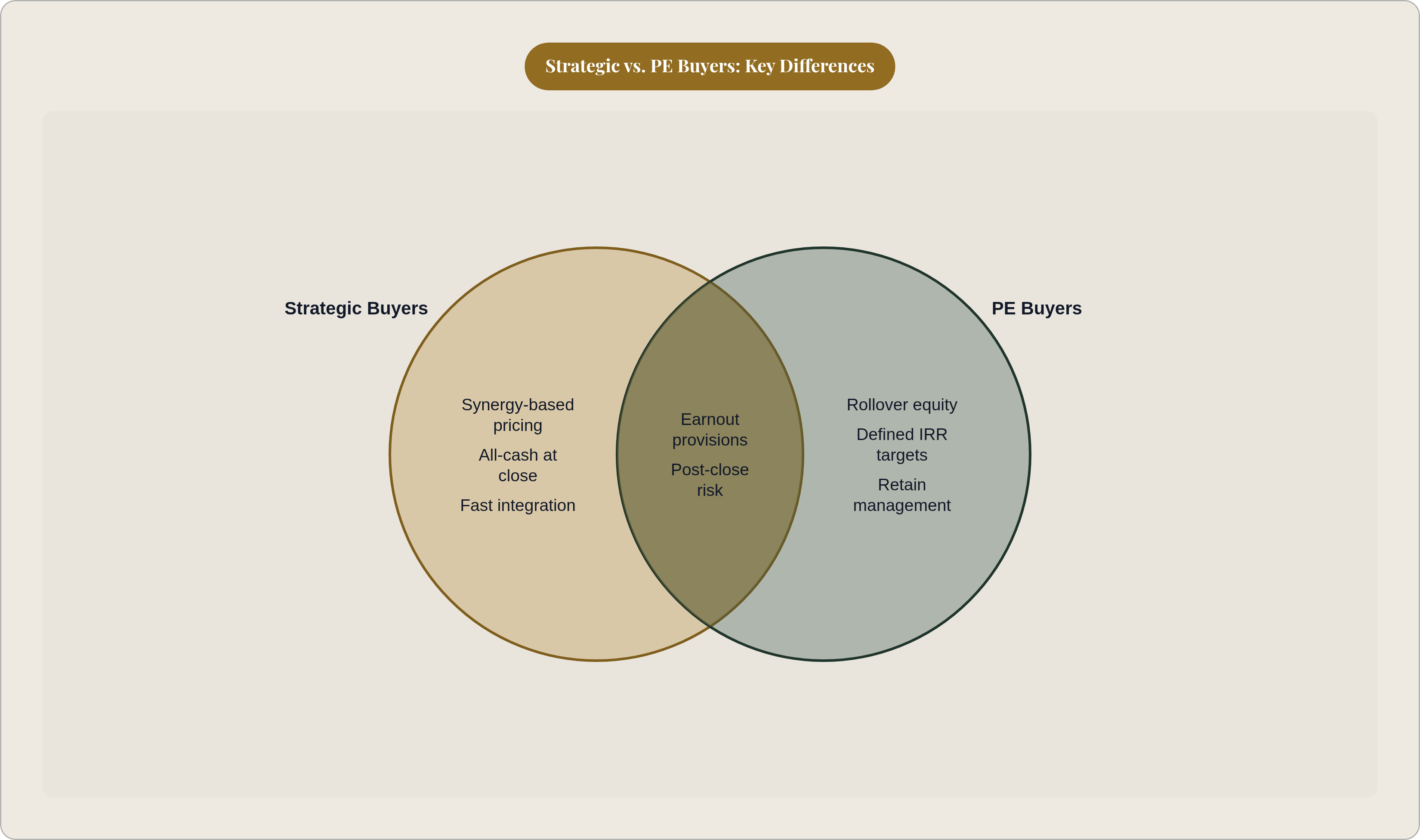
Strategic buyers are acquiring to strengthen something they already have. Revenue synergies, cost elimination, customer access, market entry, talent, intellectual property, competitive removal: the calculus is based on what the acquired business is worth inside their existing operations, not on its standalone value. That distinction creates both the strategic premium and the strategic complication. Decision-making involves more internal stakeholders, moves slower, and produces outcomes that are harder to predict than most founders expect walking in.
PE buyers are solving a fundamentally different problem. PE firms raise funds with defined return targets, typically in the high-teens to mid-twenties IRR range, and finite hold periods. Every acquisition decision works backward from a projected exit. The dominant sub-type in this segment, the add-on buyer, is acquiring to build scale inside an existing portfolio company. The founder's business does not become an independent entity; it becomes a piece of something larger already in motion, governed by a thesis the founder had no part in writing.
Platform acquisitions function differently again. Here, the PE firm is acquiring a business to serve as the foundation of a build-and-sell strategy, the anchor around which further acquisitions are assembled. Different role, different relationship, different risk profile for the founder.
The buyer's actual problem, not their category label, is what determines fit. It is also worth considering whether a founder can even identify which problem a buyer is solving without asking directly — and whether the answer they receive reflects reality or a prepared pitch.
How Each Buyer Type Arrives at a Number, and Where the Ceiling Comes From
The strategic premium is real, and it is conditional on things the seller often cannot verify until it is too late to matter. A strategic buyer can justify a higher price when synergies reduce their effective cost of ownership. If a financial buyer might offer 8x EBITDA, a strategic buyer with $5 million in eliminable duplicate costs could rationalize paying closer to 12x and still be acquiring at an effective 7x on the combined entity. That logic holds only when the strategic buyer can actually capture the synergies, and only when they elect to share some of that value with the seller rather than keeping it entirely. What the seller believes the synergies are worth and what the buyer is willing to pay for them are almost always different numbers. The gap between those two figures is where deals quietly fall apart, usually after months of exclusivity.
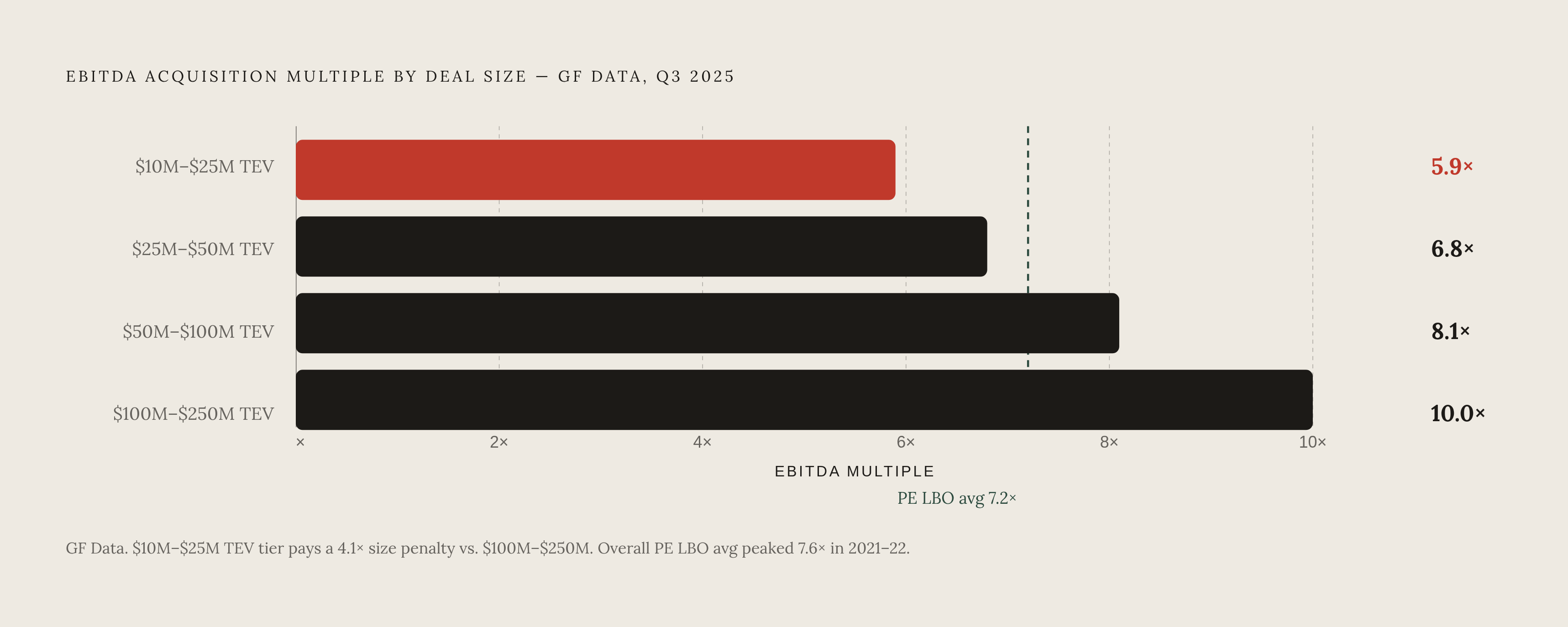
PE pricing is more predictable, which is both a comfort and a constraint. GF Data shows average EBITDA multiples for sponsored LBOs moved from 6.7x in 2016 to a peak of 7.6x in 2021–2022, then settled near 7.2x through 2023, 2024, and the first half of 2025. The floor is relatively firm; so is the ceiling. Transactions in the $10M–$25M total enterprise value range averaged 5.9x EBITDA through Q3 2025, while deals in the $100M–$250M TEV range averaged 10.0x, per GF Data. That size penalty is steepest precisely where most founders in this market sit, and it is larger than most of them realize before they begin.
PE's ceiling rises under specific conditions: the target is a strong platform candidate, the market is fragmented and ripe for roll-up, free cash flow is reliable, or rollover equity makes total founder economics comparable to a higher strategic headline price. Prairie Capital's analysis adds one useful data point: strategic buyer pricing has been more volatile than PE multiples over the past several years, shifting with synergy value cycles while PE has held closer to 7.3x. Volatility is not inherently bad for sellers, but it is difficult to underwrite with confidence when you are trying to decide whether to accept a letter of intent.
That raises an important question: is the right goal finding the buyer who pays the highest number in the abstract, or identifying which conditions make a given business worth more to each buyer type — and whether those conditions genuinely exist?
How Deal Structure Creates Winners and Losers at the Same Headline Price
Two offers with identical purchase prices can deliver materially different financial returns depending on how the deal is constructed. Founders who negotiate hard on headline multiples and treat structure as boilerplate tend to discover this somewhere between six and eighteen months post-close, when it is no longer possible to renegotiate.
Strategic deals are typically structured as all-cash at close. The financial outcome is largely determined on the day the transaction closes: cleaner, more certain, no ongoing dependency on post-close performance. That simplicity has real value, particularly for founders who have spent a decade building something and want the transaction to actually be over when it is over.
PE deals commonly include rollover equity, in which the founder reinvests a portion of sale proceeds back into the business alongside the PE firm. Rollover equity appeared in 46% of transactions in 2020 and grew to 57% by 2023; it is now the norm rather than the exception. The mechanism is often described as the "second bite of the apple": when the PE firm exits, typically three to seven years later, the founder's retained equity participates in a second, often higher-value transaction. The logic is sound. But how does this affect our original promise of a cleaner outcome? The risks deserve equal attention: illiquidity, loss of control, dilution, and waterfall economics that may not distribute value the way the founder expects when they sign.
That last point deserves particular scrutiny. If the founder receives junior common equity while the sponsor holds preferred equity with liquidation preferences, the founder's interest may not be worth what the headline rollover figure implies. Paper value and realized value can diverge significantly depending on exit scenario, exit timing, and how many subsequent financing events occur in between. I have seen founders treat rollover equity as near-cash and be genuinely surprised when the waterfall did not work the way they assumed.
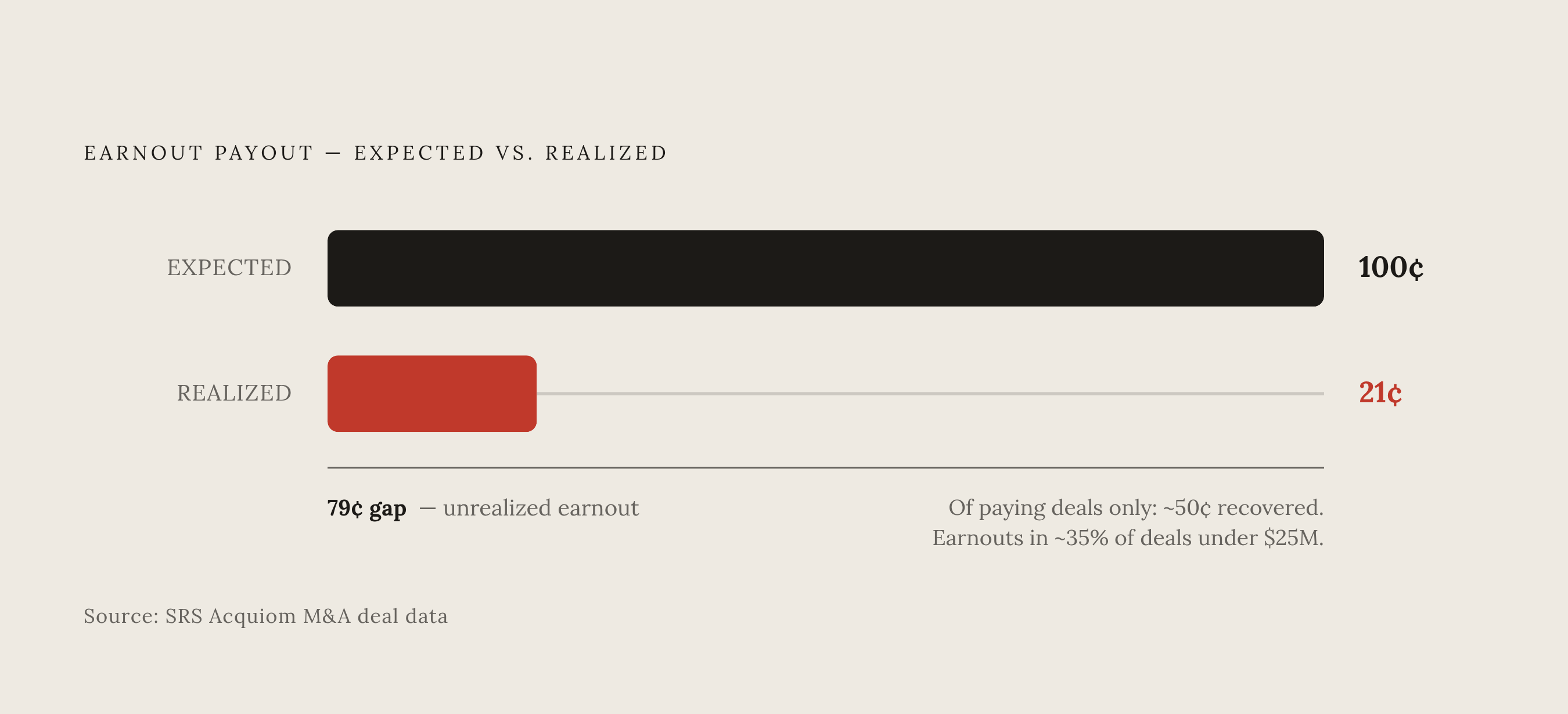
Earnouts appear in roughly 35% of deals under $25M and approximately 29% of all lower middle market deals under $50M, per SRS Acquiom. PE buyers used earnouts in 28% of platform acquisitions in 2024, generally tied to EBITDA metrics over a 24-month median period; strategic buyers used them in 18% of deals, typically tied to revenue or product milestones over longer average periods, per Bain & Company's 2025 Global Private Equity Report. SRS Acquiom's data on earnout performance is worth reading before accepting one: across all deals containing earnouts, sellers collect roughly 21 cents on the dollar on average. For the subset that pay anything at all, approximately half the maximum is ultimately paid. Most founders who accept earnouts believe they are in the subset that will outperform that average. Statistically, most of them are wrong.
Indemnification escrow adds another layer. Median indemnity escrow in non-insured deals has risen to approximately 9% of purchase price, capital the founder does not control for an extended period post-close.
The structure section of a letter of intent deserves at least as much scrutiny as the headline number. In practice, it usually deserves more.
What Post-Close Life Looks Like Under Each Buyer Type
Under a strategic acquirer, integration is the point. Systems, teams, and processes are merged with the acquirer's existing operations. The founder's role typically diminishes quickly; most strategic buyers have no structural need for the former owner once integration is complete. The business may look unrecognizable within twelve to twenty-four months. For founders who want a clean break, that trajectory can be exactly right. For founders who carry real concerns about brand, culture, or the team they spent years hiring, that same trajectory carries real risk, and the time to surface it is before signing, not six months after close.
PE buyers typically retain existing management and operations. The business runs as a going concern rather than as a division of something larger. The founder may be asked to stay on in an operating or advisory capacity, particularly in add-on acquisitions where customer and relationship continuity is central to the thesis. New governance structures follow: reporting cadences, board oversight, and financial metrics become more formal and more frequent than most founder-led businesses are accustomed to. For rollover equity holders, the work is not done at close; a second exit is still ahead, with a new set of stakeholders, a new set of expectations, and a timeline the founder does not fully control.
Employee outcomes follow a similar divergence. Strategic integrations may produce redundancies as duplicate roles are eliminated; PE add-ons typically preserve existing teams as an operational asset but introduce performance expectations and accountability structures that can feel abrupt in businesses where accountability was previously informal.
Neither buyer type guarantees that brand, team, or culture survives the transition. The mechanisms of risk differ by category; the exposure is shared. One might argue that a founder who cares about legacy has already made a values decision that should precede any conversation about price — and that asking each specific buyer about their integration plans directly, with enough follow-up to get past the prepared answer, is simply the operational expression of that decision.
How the Decision Actually Maps to What a Founder Wants
The framework should start with goals, not buyer type. That sequencing is less obvious than it sounds, and most founders invert it.
A founder seeking maximum cash at close with no ongoing obligation should look toward a strategic buyer, assuming the synergy conditions exist to support a premium. A founder seeking the highest total lifetime value, with tolerance for illiquidity and continued involvement, may find that PE with rollover equity produces a better outcome than a clean strategic exit at a lower headline. Certainty and process discipline tend to favor PE add-on buyers, who are often more organized than corporate acquirers navigating multiple internal approvals.
Business characteristics shape fit as well. Strategic buyers are drawn to unique technology, proprietary customer relationships, geographic expansion potential, and talent or IP that is difficult to replicate. PE buyers are drawn to reliable EBITDA, recurring revenue, fragmented markets with add-on potential, and businesses capable of growing under professional management without the founder in the room. A business that scores well on the strategic checklist but poorly on the PE checklist is not a bad business; it is simply one that will price differently across buyer types.
The earnout and rollover equity questions are personal as much as financial. A founder's tolerance for post-close risk, ongoing involvement, and liquidity timeline should weigh heavily in how much deference to give deferred consideration. With PE dominant at 42% of deal flow and strategic premiums more volatile than PE multiples, founders in the $10M–$25M range may see more PE interest than they anticipate and less competitive strategic interest than they hope for. What looks like a lower offer from one buyer type may outperform a higher headline from the other once structure, timing, and post-close factors are applied. Figuring that out requires running the numbers on actual offers, not assumptions.
Why Running a Competitive Process Across Both Buyer Types Produces Better Outcomes Than Choosing One in Advance
Founders who decide before going to market that they want only a strategic buyer, or only PE, often miss the buyer whose motivations align best with their actual goals. Choosing early is itself the mistake, not a strategy.
To understand why this works, we must first look at the specific mechanism behind competitive tension. When both buyer types are engaged simultaneously, the pricing logic of each can push valuations and terms in the seller's favor. A strategic buyer who knows a PE firm is bidding may be more willing to share synergy value. A PE firm that knows a strategic is at the table may price more aggressively. This is not a negotiating tactic so much as a structural feature of how buyers behave when they believe they might actually lose a deal to a buyer operating from an entirely different rationale.
The buyer identification problem compounds this. In the sub-$50M segment, knowing which strategic buyers exist, which PE platforms are actively adding in a given sector, and which family offices are currently looking is not publicly legible information. It requires reach and market intelligence that most founders do not independently possess, which is why platforms such as Succession AI, a tech-enabled exit platform for founder-led businesses with a network of 10,000-plus vetted buyers, exist to close that gap. Running a process without that intelligence means engaging a subset of the available market and optimizing within a smaller universe than actually exists.
The choice between strategic and PE is not a decision made cleanly in advance. It is a conclusion that emerges from running the right process, with enough market coverage to let the buyer universe answer the question through actual offers rather than a founder's assumptions about who might show up.