Independent Sponsor Buyers in Canadian Sub-$20M Transactions
Independent sponsors are filling Canada's $2 trillion succession gap institutional funds ignore.

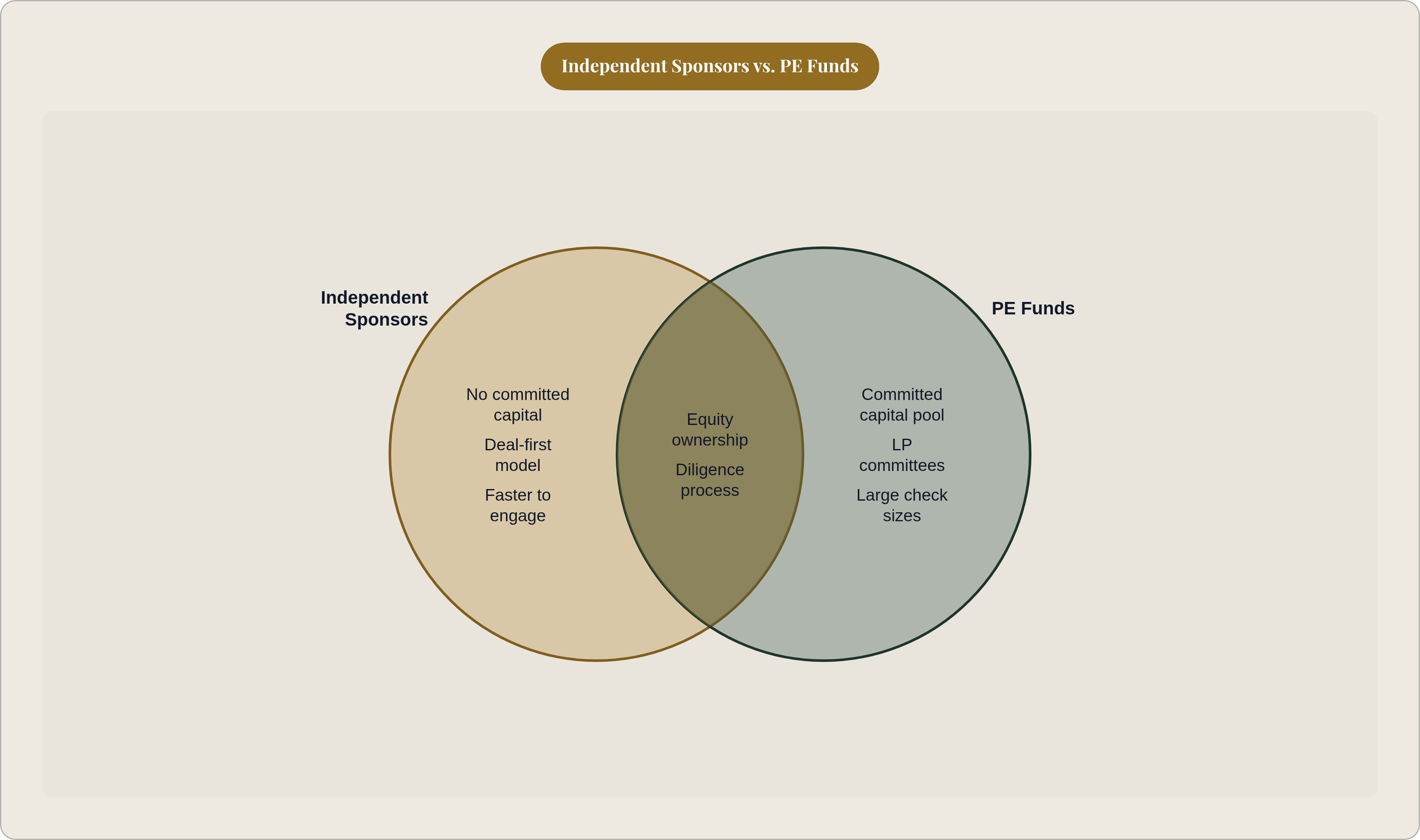
No fund sits behind an independent sponsor. There's no pool of limited partner commitments waiting around, no committee that needs convincing; what a sponsor brings to capital partners is conviction about one specific business, its numbers, its people, its place in the market. The model exists because institutional funds have a math problem they can't solve. A large institutional fund needs to write big checks just to justify its own overhead, and a business worth $20 million doesn't move the needle for a vehicle that size. So that middle stretch, roughly the smaller end of the enterprise value spectrum, has become independent sponsor territory almost by default. Fund administration stays light and LPs never enter the picture, which lets a sponsor move fast and focused. For a seller, that translates into something practical: the independent sponsor who calls you has probably already done real homework on your business before you ever pick up the phone.
How the Canadian lower middle market became structurally fertile ground for independent sponsors
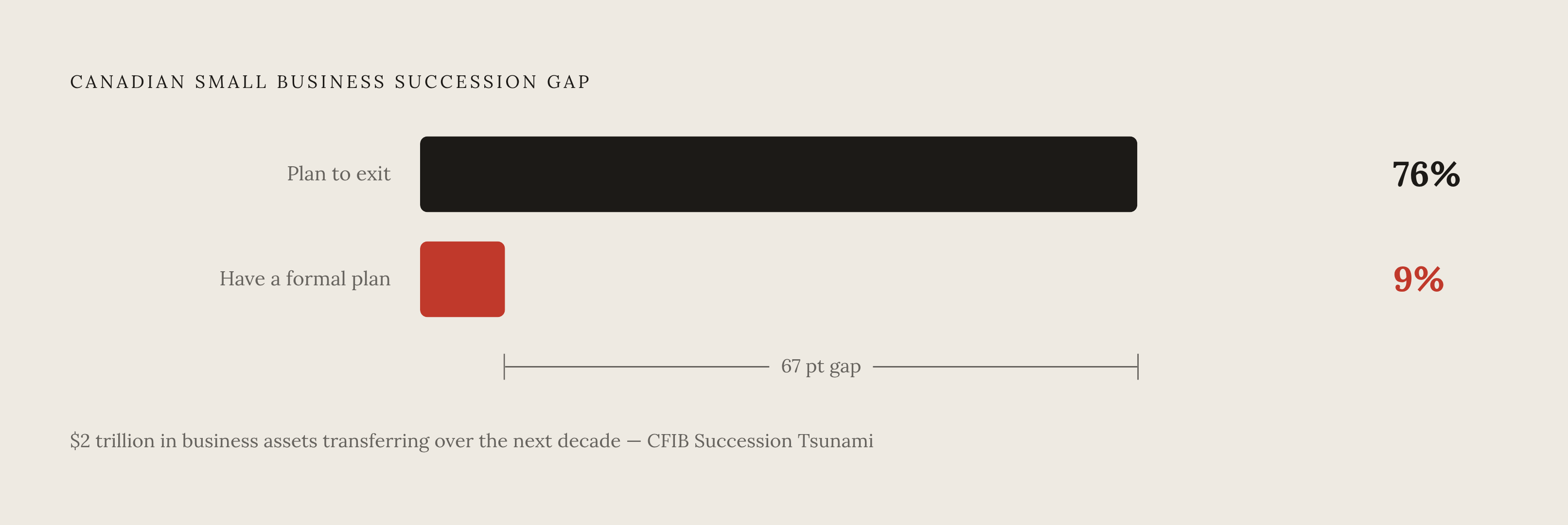
Start with supply. The Canadian Federation of Independent Business, in its Succession Tsunami report, pegs the coming handoff at more than $2 trillion in business assets over the next decade. That's the headline number, and it's a big one, but the detail underneath it does more work: 76% of small business owners plan to exit, and only 9% have a formal succession plan sitting in a drawer somewhere. Sit with that gap for a second. Three out of four owners know they're leaving, fewer than one in ten have mapped out how, and that mismatch is exactly the condition independent sponsors are built to work inside. An owner in that position usually knows they need out and hasn't figured out the mechanics, with no auction running and no investment bank shopping the deal to twenty names.
Now look at where the institutional money actually lands, because it isn't landing here. Canadian private equity deployed CAD $57.5 billion across 592 deals in 2025, more than double the CAD $27.2 billion from the year before. Sounds like a wave of buyers is coming, until you notice four take-private deals alone soaked up CAD $23.5 billion of that total, something like 42% of all PE dollars through the first three quarters. The money pools at the top. Less of it trickles into the sub-$20 million tier, which means fewer institutional competitors down there, sloppier price discovery, and owners with no obvious route to a qualified buyer. That's the terrain an independent sponsor works best in, mostly because nobody else bothers to show up and compete for it.
Then there's the friction specific to Canada right now, layered on top of all this. Economic uncertainty after the U.S. election, tariff threats, the political transition following Trudeau's resignation: all of it stalled lower-middle-market activity through 2024 and into 2025. IBBA Canada expected things to normalize around mid-2026. A stalled market doesn't mean the buyers disappeared, though; it means the sponsors who kept calling owners through the freeze, who kept building pipeline while everyone else waited for clarity, are sitting on relationships their competitors simply don't have.
Where Canadian independent sponsors are actually sourcing deals
Most sponsors don't wait for the phone to ring, but when it does ring, it's usually because of a broker. Sell-side advisors are the primary deal source for the large majority of independent sponsors, and business brokers remain the single most-used channel among them. Regional and national investment banks have picked up share as a sourcing path too, which says something about how the lower middle market keeps professionalizing even while ownership itself stays scattered across thousands of small, unadvised businesses.
Intermediary-sourced deals are only half the story. Plenty of independent sponsor firms run cold outreach, calling owners who've never listed anything and have no plans to. For a Canadian owner who spent twenty years building a company and never once formally marketed it, that call is often the first real evidence that outside buyers exist and would pay real money for what's been built. Compare that owner's headspace to one who already hired an advisor and kicked off a process. Totally different starting point, psychologically.
Then there's the corner of the market nobody talks about much: broken auctions. A deal falls apart, the winning bidder walks, whether from financing trouble, diligence surprises, or plain cold feet, and the seller is left standing there more tired and less optimistic than they were six months back. Tarrus Richardson of IMB Partners said it plainly in Citrin Cooperman's 2025 report: "If a seller has gone through a broken process, they often get fatigued and become more realistic… that is when an independent sponsor can be a very good fit." Fair point. But fatigue doesn't erase a seller's leverage, and realism has its limits. A seller in that spot is still weighing options on their own terms.
The ecosystem covers real range across the country: Toronto firms chasing EBITDA in the lower middle market range, Vancouver sponsors already stacking up acquisitions across Western Canada, Ontario-focused acquirors marketing themselves around a clean, straightforward path to owner transition. Fragmented, sure. Active, definitely.
The economics a seller will encounter: fees, multiples, and capital structure
Valuation multiples in this market have historically clustered between 4x and 6x EBITDA. Practitioners working the space now say quality assets clear above that band, and the drift matters, because what multiple you actually get depends heavily on presentation and on how competitive the process around your business turns out to be. A sponsor working off a single cold call, no other bidders anywhere near the table, negotiates from a fundamentally different position than one competing against two or three other qualified buyers. Same type of buyer, wildly different leverage.
Worth understanding how these sponsors get paid, and not because the seller foots the bill. The fee structure shapes what the sponsor is incentivized to do once the deal actually closes. There's a closing fee, typically rolled into equity instead of paid in cash, so the sponsor keeps skin in the game rather than pocketing a bonus and walking. There's an ongoing management fee, usually a slice of EBITDA, and carried interest tied to exit returns, often with hurdles attached. All of it lines the sponsor's upside up with how the business performs for years, not quarters. This buyer needs your business to keep working long after the ink dries, in a way a strategic acquirer folding your company into a larger machine might not.
Where does the money come from, then? Family offices dominate as capital partners in these deals, followed by high-net-worth individuals, according to Citrin Cooperman's 2025 data. Repeat relationships are the norm, not the exception; an established sponsor firm calls people they've already closed with before rather than scrambling for fresh capital every time out. J.P. Morgan's 2026 Global Family Office Report found roughly half of family offices plan to do direct deals through independent sponsors going forward, which tells you the capital behind this model is growing rather than drying up.
Here's what actually matters for a seller trying to size up the person across the table: they're personally and financially motivated to close, and to make the business perform afterward. But the money behind them isn't sitting in an account waiting for a signature. That gap between motivation and money is the whole subject of the next section.
The closing risk that sellers need to plan around
This is the risk built directly into the deal-first model described up top. An independent sponsor has no committed capital when the letter of intent gets signed. They raise it after terms are negotiated, which means a seller granting exclusivity is really betting on the sponsor's ability to assemble financing, not just their willingness to get the deal done.
The data backs this up plainly. Most advisors report that independent sponsor transactions take longer to close than deals with committed PE funds, and the ones that collapse are rarely bad deals on the merits. They're slow deals, ones where the capital-raising process outran the seller's patience, or outran the business's own momentum while everyone waited. A PE fund deal carries a different risk profile, since the money already sits in a committed vehicle and the real question is just what diligence turns up.
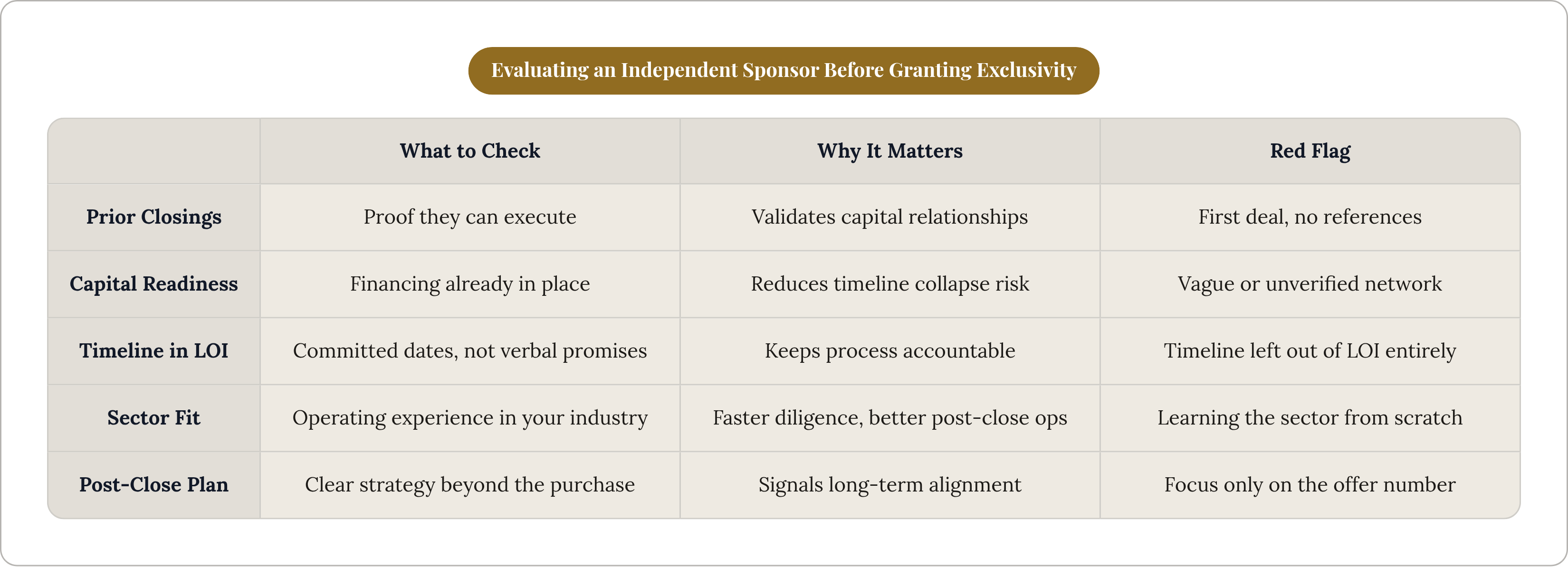
So what should a seller actually check before granting exclusivity? Whether the sponsor has real capital relationships already in place, or whether this happens to be their first deal out of the gate. Whether they've closed before, and whether they'll connect you with references from the capital partners who backed those closings. What their realistic timeline looks like to get money committed, and whether that timeline is written into the LOI itself rather than just promised on a call. These are the difference between a deal that closes in ninety days and one that limps along for eight months before falling apart, dumping the seller right back into the broken-process fatigue from the section before this one.
One more thing worth flagging, sitting slightly outside the closing-risk conversation but adjacent to it: Canada extended the window during which the Competition Bureau can retroactively review unreported transactions, from one year to three years, a change McCarthy Tétrault has been tracking closely. That touches roll-up strategies some sponsors run, where they buy multiple businesses in the same sector over time. If your business sits in a space where that kind of consolidation is already happening, it's worth asking whether your buyer's broader strategy could draw scrutiny down the road.
Independent sponsors carry a different risk profile than PE funds, not necessarily a larger one. The risk shows up in timeline and capital readiness instead of deal quality, and a seller needs a clear read on the specific person in front of them rather than a blanket assumption about the whole model.
What a seller can do to engage IS buyers from a position of strength
Go back to that 9% figure. Only 9% of Canadian small business owners have a formal succession plan, per the CFIB, which means most sellers walk into a conversation with an independent sponsor underprepared. Underpreparation is exactly what weakens a seller's hand at the table. Being process-ready, before any offer ever shows up, is the single biggest lever a seller actually controls.
What does that look like in practice? Clean financials that don't require a forensic accountant to decode. A documented management team, so the business doesn't collapse into a single point of failure the moment the owner steps back. A clear, honest account of why the business is worth buying in the first place. All of it cuts down the sponsor's diligence risk, and cutting diligence risk directly shrinks the timeline risk that, as the last section laid out, is what actually kills these deals. A sponsor who gets comfortable with your numbers fast moves faster toward locking in capital. Speed benefits the seller here just as much as it benefits the buyer.
Running some version of a process, even a modest one with two or three qualified buyers, beats a one-on-one negotiation almost every time. A sponsor who approaches a seller directly is holding more information than the seller has: what similar businesses actually sold for, what terms are genuinely reasonable. A competitive process closes that gap fast. Sponsors are entirely used to competing through intermediaries anyway, since that's their main sourcing channel to begin with, so running a process doesn't scare them off. If anything, it tells them the business is worth fighting for.
Evaluate the buyer as carefully as the offer itself. Track record of closed deals matters. Depth of capital relationships matters too, maybe more than anything else given the closing risk from the section above. Sector fit counts for something real: a sponsor with genuine operating experience in your industry moves through diligence faster and runs the business better once they own it, compared to one learning the sector cold. Cultural fit around the transition deserves real attention as well, since plenty of independent sponsors expect the seller to stick around for a stretch post-closing. Understanding their actual plan for the business, not just the number on the offer sheet, tells you whether this is someone worth being in business with for the next two or three years.
This is where advisory support and buyer-matching tools change the picture, too. An advisor or platform that surfaces multiple buyer types at once, independent sponsors alongside family offices, search funds, strategic acquirors, gives a seller the fuller view of who's actually out there, instead of letting one motivated caller define the whole conversation. For a founder-owned Canadian business in the lower middle market, that broader view is really the entire point. Independent sponsors are a strong option, often a genuinely good one given everything above. But they're one option among several, and a seller should weigh them against the rest rather than default to whoever happened to call first.