Buyer Reference Checks Sellers Should Run Before Signing an LOI
Verify your buyer's finances, track record, and approval chain before granting exclusivity.

Sellers spend months preparing data rooms, cleaning up financials, and rehearsing management presentations for buyer scrutiny. Almost none of them run the same scrutiny in reverse, on the buyer, before signing away exclusivity. That asymmetry costs sellers real money, and this piece walks through the specific checks that close the gap while the seller still has leverage to demand them.
Before signing a letter of intent, sellers should run five categories of checks while they still hold leverage: confirm proof of funds in a form that is liquid and current; identify the buyer type and understand the full fee structure and approval chain that comes with it; collect references from prior sellers and ask directly whether deals closed on the originally proposed terms; run public records checks covering litigation, regulatory exposure, and credit history; and get the buyer's post-close integration plans in writing. The moment exclusivity is granted, the seller's ability to demand candid answers and walk away shrinks considerably, which is why all of these checks belong in the window between narrowing the buyer field and finalizing LOI terms. A buyer who resists any of these requests before signing is itself a data point worth weighing.
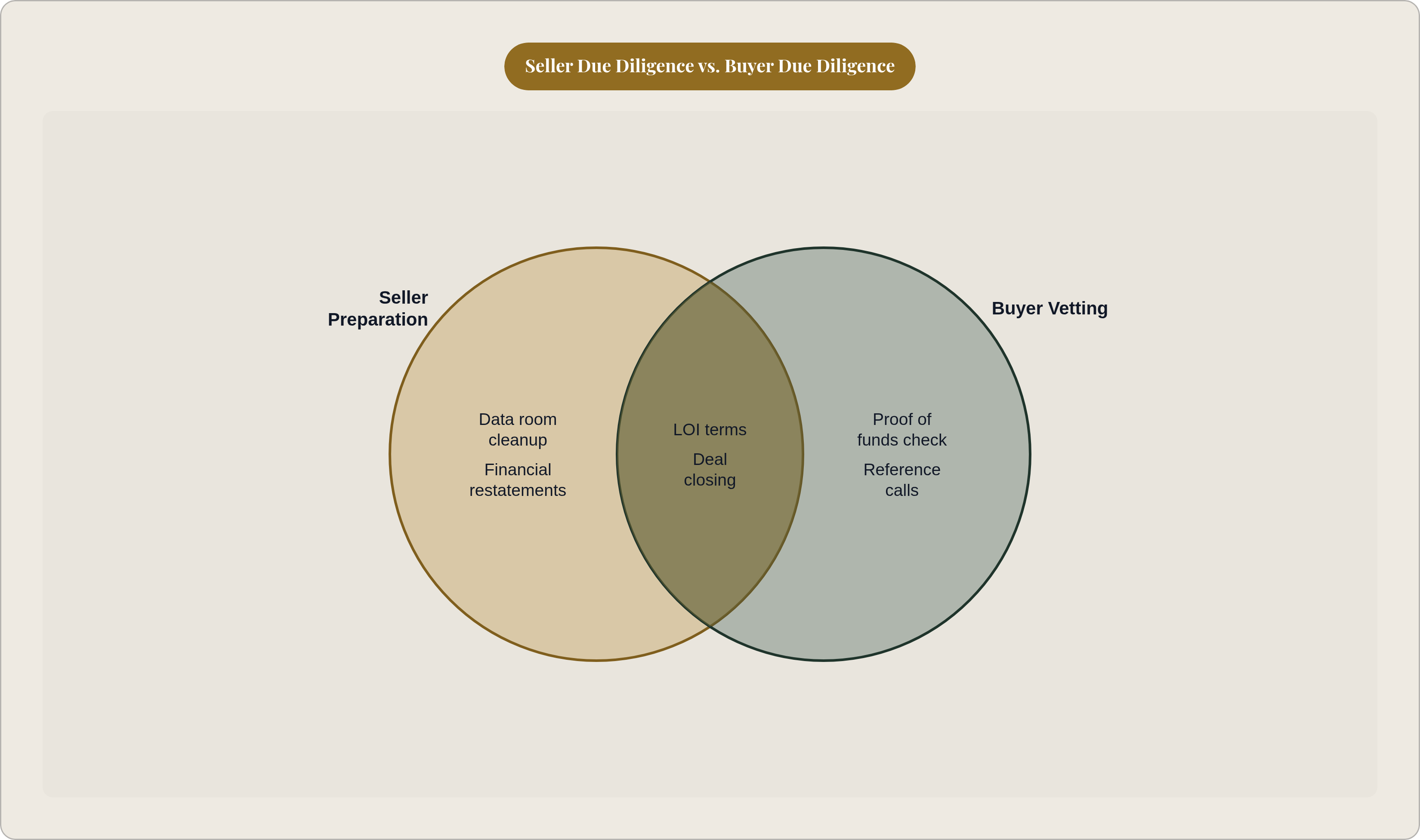
How often deals fall apart after LOI — and why the causes point back to buyer quality
A meaningful share of signed letters of intent in the lower middle market never make it to a closing table, and the failure rate runs noticeably higher in smaller, financed deals than in cash-heavy strategic transactions. That gap alone tells you something: the more a deal depends on someone else's capital stack, the more fragile it becomes once exclusivity locks the seller in.
The causes cluster in predictable places. Diligence findings, both operational and financial, show up as the leading driver of broken deals according to industry research on lower middle market transactions. Retrading, where a buyer comes back after the LOI with a lower price or harder terms, is a distinct failure mode; it doesn't always kill the deal, but it quietly transfers value from seller to buyer at the exact moment the seller has the least room to push back. Financing gaps show up too: buyers who proposed a deal they simply couldn't fund. And sometimes it's the seller who walks, after learning something about the buyer's character or intentions that should have surfaced months earlier.
Here's the uncomfortable part. Most of these outcomes were foreseeable. A buyer's financing fragility, their retrade history, the complexity of their internal approval chain, all of that is knowable before an LOI gets signed. Discovering it during diligence, or worse, after closing, means discovering it at the exact point where it costs the most in time, money, and the kind of emotional wear that doesn't show up on a balance sheet. And if the deal includes seller financing or an earnout, the exposure doesn't end at closing; the seller stays financially tied to that buyer's competence and character for years.
When to start checking buyers — and how to frame it without killing the deal
Most sellers wait too long. According to Brett Holcomb of Prospect Partners, sellers typically reach for reference checks at the final LOI stage, or after, using them to confirm a decision they've already made rather than to shape it. By then the check is a formality, not a filter.
The better moment is earlier, right as the field narrows down to a handful of serious contenders. At that stage, the seller still has multiple parties in tension, and asking pointed questions doesn't cost anything, because no one has been granted exclusivity yet.
How you frame the ask matters as much as the ask itself. Present it as mutual diligence, not suspicion. Buyers who've done this before, particularly repeat acquirers, expect it and generally respect it. Buyers who bristle at basic questions about their financing or their track record are themselves handing you information, whether they mean to or not.
At this stage, keep the requests simple: basic proof of financial capacity, names and contact information for sellers they've worked with before, and clarity on who actually makes the final call on their side. None of this should feel invasive. A buyer's willingness to answer openly previews how they'll behave later, in diligence and after the wire transfer clears.
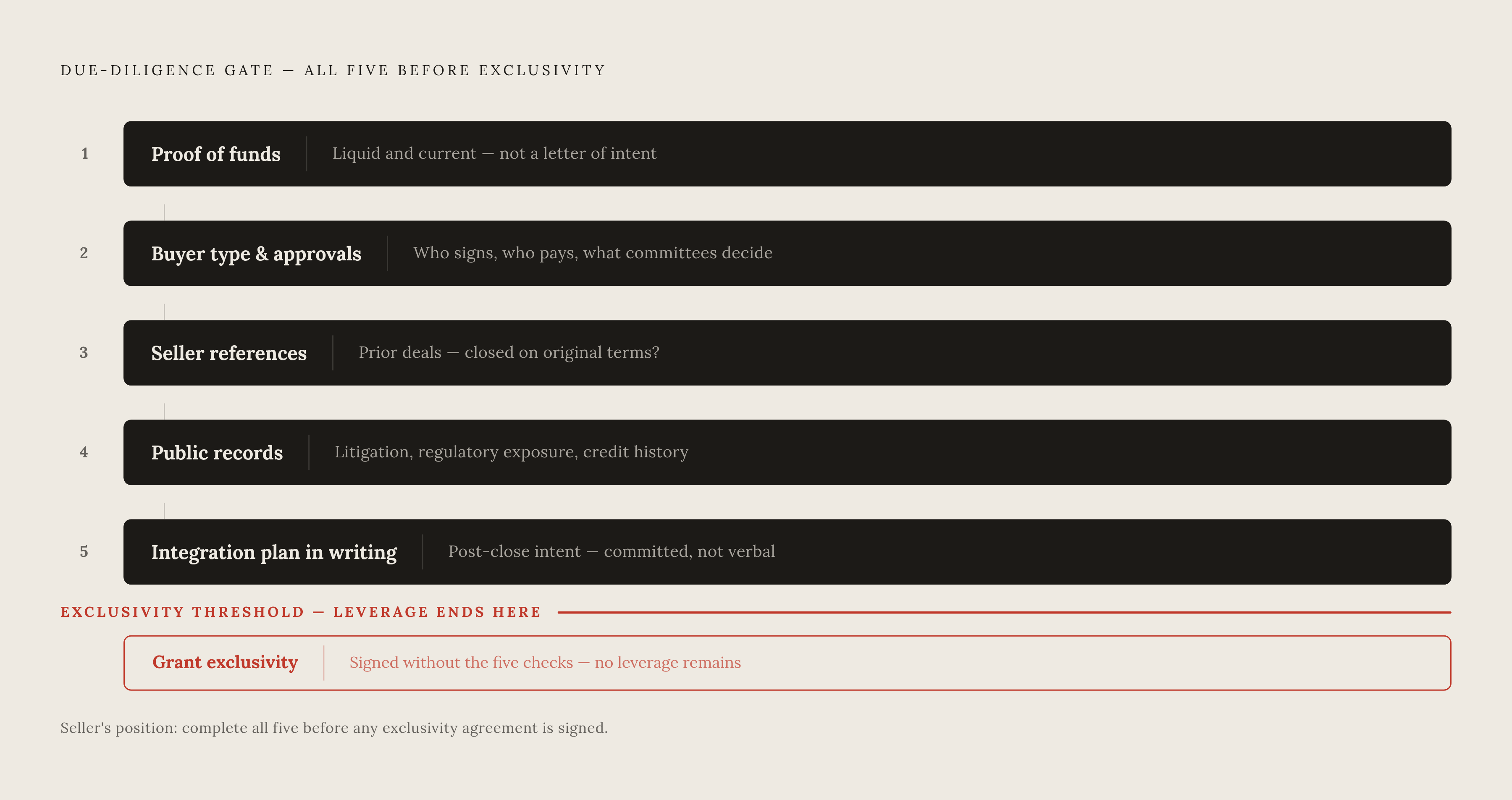
Confirming the buyer can actually fund the deal
The first question is the most basic one, and also the one sellers skip most often: where is the money coming from, and can the buyer show it?
The answer looks different depending on who's asking. Strategic buyers should be able to produce bank letters, balance sheet evidence, escrow confirmation, or a board resolution authorizing the acquisition. PE-backed buyers should provide a sponsor comfort letter confirming the fund can cover the purchase price once diligence clears, along with evidence of dry powder pulled from fund reports or LP statements. Independent sponsors deserve extra scrutiny; they identify and structure deals but often don't have the capital themselves, which means their ability to close depends on convincing an investment committee the seller has never met and has no relationship with.
Proof of funds documents go stale fast, so insist on something recent. And only liquid assets count. Retirement accounts, mutual funds, life insurance cash values, none of that typically qualifies as proof a buyer can actually fund an acquisition, no matter how large the number looks on paper.
There's a pattern worth watching for, too. Offers that sit well above market often come from buyers who still need to go find the money after the fact. That means lenders and equity partners will apply their own scrutiny down the road, layering in a risk the seller has no control over and, often, no visibility into until it's too late to negotiate around.
For SBA-financed deals specifically, the bank usually requires a signed LOI before it will issue a commitment letter. So sellers should expect that letter to show up quickly after signing, and treat a long silence as a flag worth asking about directly.
Understanding who the buyer actually is — strategic, financial, or independent sponsor
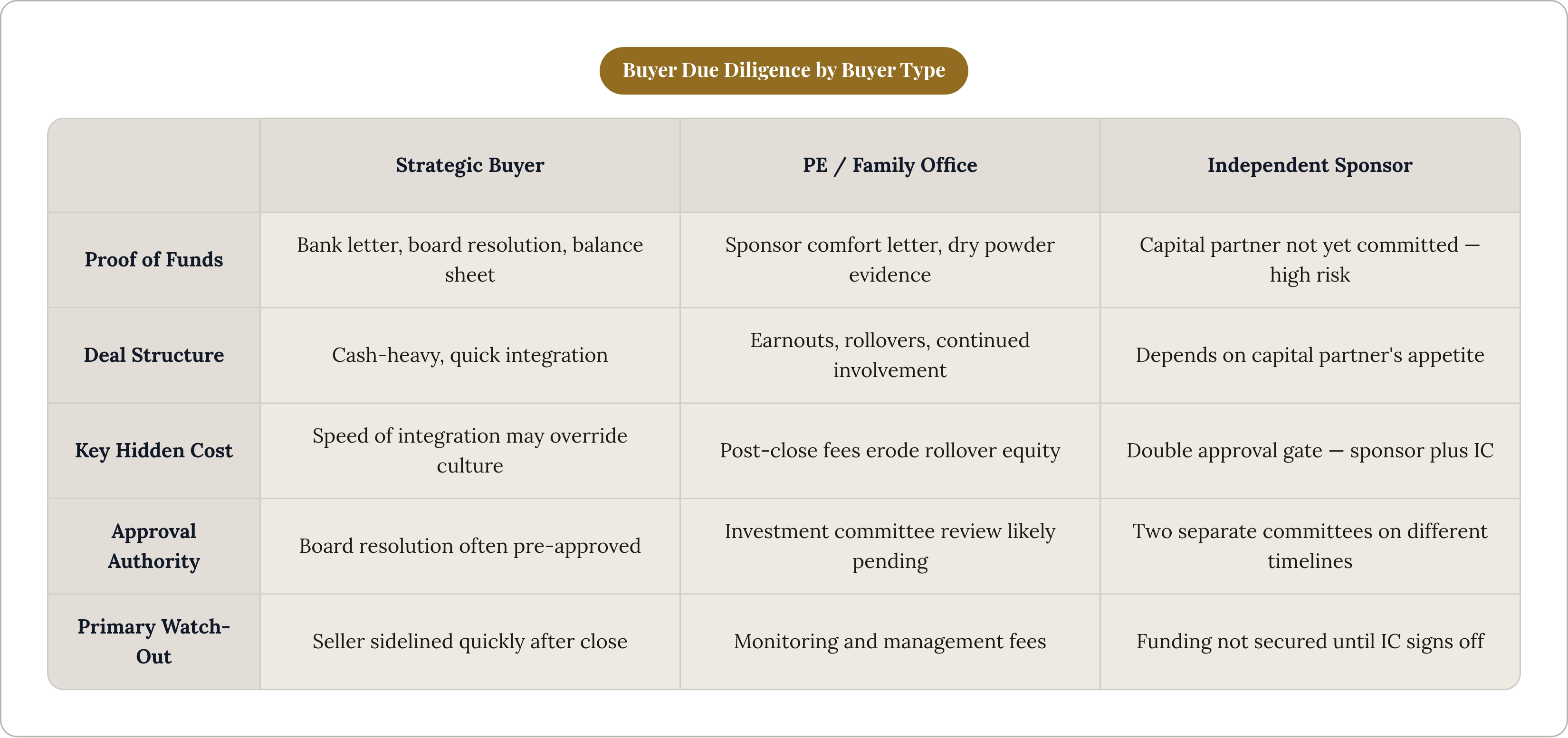
Buyer type isn't a background detail. It shapes deal structure, earnouts, equity rollovers, post-close fees, and what the buyer expects from the seller after the ink dries.
Strategic buyers tend to focus on synergies, market expansion, and competitive positioning. They're more likely to pay in cash, integrate the business quickly, and have less patience for keeping the seller involved once the deal closes.
Financial buyers, PE firms and family offices, care most about financial metrics and return on capital. They're the ones more likely to propose earnouts, equity rollovers, and continued seller involvement. If a rollover is on the table, sellers need to understand exactly what fees the buyer charges the portfolio company after close: monitoring fees, management fees, transaction fees, refinancing fees. According to Mintz (2025), these fees can materially change what that rollover equity is actually worth by the time it pays out. An equity rollover, in practice, is a second deal stacked inside the first one; it deserves its own diligence, on governance, valuation, and tax treatment, separate from the diligence on the sale itself.
Independent sponsors bring deal expertise to the table but not capital. Their funding depends on capital partners who haven't evaluated this specific deal yet, which creates what amounts to double diligence: both the sponsor and the capital partner's investment committee need to sign off, often on different timelines that the seller has no way to control.
The question worth asking isn't just who are you. It's what does this deal look like from your side of the table, and how does that shape what I walk away with.
Checking whether this buyer has a track record of closing on the terms they propose
Past behavior predicts future behavior here about as well as it does anywhere else. A buyer who has retraded before will likely retrade again, and the questions to surface that pattern are direct enough to ask without apology.
Ask what percentage of their signed LOIs actually closed. Ask whether they've ever renegotiated price or key terms after signing an LOI, and under what circumstances. Ask what pre-closing challenges they've run into on past deals, and how they handled them. Ask about their experience with indemnity claims after closing, since that's where post-sale disputes tend to surface.
Retrading, a post-LOI price cut justified by diligence findings, happens often enough in private-market M&A that sellers should treat it as a baseline risk rather than a rare exception. The gap between a buyer's LOI price and their final closing price often reflects how seriously they took their own opening number in the first place; a buyer who habitually offers high and walks it back has a pattern, and references will confirm it faster than anything else.
One more question matters here: is the deal team sitting across the table the same team empowered to make the final call, or does a committee, board, or senior partner who hasn't been in the room yet hold approval authority? That question sets up the next section, because it's rarely a simple yes.
What prior sellers will tell you that the buyer won't
Ask for contact information for previous sellers before the LOI gets signed, not after. Timing here is everything; once exclusivity is granted, the seller's incentive to keep pushing for candid answers drops off fast.
Expect the buyer to hand over a curated list. That's normal, but it's worth trying to reach sellers outside that list too, particularly if the buyer has made multiple acquisitions and those other sellers are identifiable through public deal announcements or industry contacts. The goal isn't to find only glowing reviews. Companies that grew smoothly under new ownership and companies that hit real difficulty both tell you something useful, according to Brett Holcomb of Prospect Partners.
Worth asking directly: did the deal close on the terms originally proposed? How did the buyer behave when something unexpected turned up in diligence? Were the commitments made about employees, culture, and operations actually honored? What was life like after close, for the seller, for the team, for customers? And would they do the deal again, knowing what they know now?
One detail matters more than industry overlap. According to Erik Maurer of Prospect Partners, a buyer's track record with similarly sized businesses tells you more than their track record in a similar sector, because smaller companies tend to share the same growth pains and integration headaches regardless of what they sell. A buyer who's only ever bought $50 million companies may handle a $5 million deal very differently than their pitch suggests.
If a buyer resists providing references, or keeps delaying, that hesitation is itself an answer worth sitting with.
Mapping who holds internal approval authority on the buyer's side
An LOI is a statement of intent from whoever signed it. It is not, on its own, a commitment from everyone whose sign-off the deal actually needs, and that distinction trips up more sellers than it should.
At PE groups, family offices, and larger strategics, the person sitting across the table during negotiations is often not the final decision-maker. So ask plainly: what internal approvals does this transaction still need? Have those approvals already happened, or will they play out during diligence? Is there an investment committee, a board, or an LP group that hasn't reviewed this deal yet?
Independent sponsor deals compound this risk. The capital partner's investment committee applies its own criteria on its own schedule, with its own preferred terms, and that committee is a second approval gate the seller is effectively subject to without having any relationship with the people sitting on it.
Understanding the full approval chain before granting exclusivity isn't optional caution; it's the only way to know how much time and optionality you're actually giving up. Delays that trace back to internal approvals cost the seller real time, with no offsetting benefit on their side of the table.
Checking legal standing, regulatory exposure, and any litigation history
Some of this work doesn't require the buyer's cooperation at all. Court filings, beneficial ownership records, and regulatory blacklists are accessible through public records, according to Datasite (2025), and running these checks costs a seller almost nothing in time or goodwill.
Worth checking: ongoing litigation involving the buyer entity or its principals, any regulatory investigations or sanctions on record, credit history issues (especially relevant for individual buyers or newly formed acquisition entities that don't have an operating history of their own), and whether the buyer has actually closed a comparable transaction before or whether this would be their first deal at this size or complexity.
For cross-border deals, CFIUS scrutiny has intensified around certain categories of foreign investment in recent years. Sellers should understand upfront whether their buyer's structure or nationality triggers a review process that could stretch the timeline out or, in some cases, block the deal outright.
None of this means every check turns up something disqualifying, and it shouldn't be treated that way. The point is surfacing anything that would change the seller's decision, or that would affect their obligations after close. A buyer with a clean record who volunteers this information without being asked twice is, by that behavior alone, easier to trust than one who treats the question like an accusation.
Assessing what the buyer plans to do with the business — and the people — after closing
For most founders, the business isn't just a set of financials changing hands. It carries obligations: employees who've built careers there, customers who count on service staying consistent, a culture that took years to form and can't be rebuilt once it's gone.
Research on M&A outcomes points to cultural misalignment between buyer and seller organizations as a leading driver of integration failure. That's not a soft consideration tacked onto the financial diligence; it's a factor that shows up in whether the deal actually delivers what both sides expected.
Ask about integration philosophy directly. Does this buyer impose their own systems and processes wholesale, or do they preserve what already works? What happened to the teams at businesses they've acquired before? What role, if any, do they expect the seller to play after close, and for how long? And how do they typically handle it when an acquired business underperforms against projections in year one, because that scenario comes up more often than buyers like to admit during courtship.
Cultural compatibility is worth assessing before offers even arrive, not after. By the time the LOI sits on the table, the seller has far less room to let the buyer's answers change the outcome. And here's the pattern worth watching closely: a buyer who talks exclusively in financial terms, and never once brings up people, teams, or the legacy of what's being built, is telling you something about what they actually value. For sellers holding an earnout or a rollover, this isn't just a legacy question either. Post-close culture directly shapes whether that deferred piece of the deal ever pays out at the number originally promised.
How do you run buyer due diligence checks without losing deal momentum?
None of the checks above need to run one after another, stacking weeks onto a timeline that's already tight. Most of them run in parallel, tucked into the window between narrowing the buyer field and finalizing LOI terms, which is the stage where platforms like Succession AI, an AI-driven sale platform for founder-led businesses, help owners enter that window with buyer quality already filtered.
A workable sequence looks something like this. As the field narrows, request proof of funds and get clarity on buyer type. During management presentations, ask directly about approval authority, who's actually in the room versus who holds the final vote, and the buyer's historical closing rate. Before LOI negotiations wrap up, start reference calls with prior sellers and run the public legal and regulatory checks in the background. And before signing anything, get post-close integration plans and cultural expectations confirmed in writing wherever possible, because a verbal assurance made during courtship carries a lot less weight once exclusivity has already changed hands.
None of this guarantees a clean close. But it does mean that if the deal falls apart, or gets retraded, or drags through a committee the seller never knew existed, it happens as a known risk rather than a surprise. That distinction, foreseeable versus blindsided, is worth almost as much as the price itself. A seller who takes a slightly lower offer from a buyer who reliably closes on their stated terms has, in a very real sense, gotten the better deal.