Proprietary Deal Flow vs Broad Market Listings for Small Business Sales
Choosing between broad market and proprietary channels shapes your negotiating power.

Picking a channel, broad market or proprietary, decides who shows up to the table and how much leverage they carry once they're there. Most owners treat this like a marketing question: where do I post the listing? A more useful frame treats it as a negotiating question, since the two paths produce different outcomes even on an identical business with identical numbers.
The structural backdrop: why this decision is becoming more consequential for more owners
The scale here is worth sitting with before we get into mechanics. McKinsey's Institute for Economic Mobility projected in February 2026 that something like 6 million small and mid-size businesses will change hands as baby boomers retire by 2035, representing up to $5 trillion in enterprise value. More than half of U.S. small-business owners are already past 55, and one in four have cleared 65. That same McKinsey work suggests annual exits could run 42% above 2011 levels by 2035, putting the yearly figure as high as 665,000.
Here's the part that should stop an owner mid-sentence: 92% of small business exits happen through closure, not sale. Only about 5% ever complete as an actual transaction. So the broad-market-versus-proprietary debate sits downstream of a much bigger problem, because most owners never run a sale process long enough for the channel question to matter at all.
For the ones who do sell, the buyer pool has gotten thicker and better funded. Stanford's Graduate School of Business counted 190 new international search funds launched across 2024 and 2025 alone, part of a buyer population that's more disciplined and more capitalized than it was ten years ago. More buyers chasing the same set of good businesses raises the stakes on how a seller shows up. Show up poorly, and a genuinely good business gets a mediocre result. Show up well, and an average business can beat expectations.
What broad market listings actually are and how they function
On-market listings put a business in front of any registered buyer, usually through a broker or a listing platform, with an information packet and, for bigger deals, a full data room. The largest of these platforms pull in millions of visitors a month and carry tens of thousands of active listings at once. This is the picture most people have in their head when they imagine buying or selling a small business.
But the brokers running that visibility aren't interchangeable, and the gap between them matters more than sellers expect going in. Some brokers run on volume: heavy listing counts, light-touch service, revenue that leans on listing fees rather than success fees. They make the introduction and step back. Others work the opposite way, coaching a seller through prep, running the process end to end, screening buyers before anyone gets an introduction. That second kind of broker changes the outcome more than the platform itself ever does. A seller who's been walked through preparation, with documentation actually organized and buyers who show up with reasonable expectations, tends to close faster than an equivalent off-market deal, largely because the comparison-shopping infrastructure is already built in.
Even so, the broker industry as a whole only handles about 20% of businesses sold, per Marketdata LLC's 2024 estimate, leaving roughly 80% of the market untouched by any intermediary. That doesn't mean four out of five businesses are quietly transacting through some sophisticated back channel. Most of them just never transact at all, which loops right back to the closure number above. Keep that number in your pocket; it's going to matter again before this piece is done.
What proprietary deal flow means and how buyers build it
Proprietary deal flow is a deal a buyer sources directly, through cold outreach, an existing relationship, or a buy-side advisor working on their behalf, often before the business is listed anywhere, sometimes when it would never be listed at all. From the outside it can look almost accidental, like the deal just landed in someone's lap. In reality, a buyer doing serious proprietary sourcing is running a structured campaign aimed at founders, and the funnel underneath it is brutal.
Hundreds or thousands of outreach contacts turn into a small handful of real conversations. Those conversations produce a few signed NDAs, fewer businesses that make it to reviewed financials, and usually one closed deal at the end of the whole thing. Building that machine, the outreach people, the data tools, the years of relationship-building, takes real ongoing investment, and even sponsors who are good at this close only a handful of proprietary deals a year. The math still works, because the pricing edge on one well-sourced deal can pay for years of that overhead.
Search funds are probably the best-documented practitioners of this model at the lower end of the market, and their numbers tell the story. Stanford's 2026 study puts average time-to-acquire at around 20 months, and searchers who closed a deal in 2024 or 2025 signed 2.5 letters of intent, on average, before one actually closed. The aggregate close rate for search funds, meaning the share that ever land any deal at all, has run 58% since 1996, but dropped to 48% for funds launched between 2021 and 2024. That's a real slide, and it says something about how much harder sourcing has gotten, even for buyers built specifically to do it.
What does a buyer actually get for all that grinding? Mostly, it's visibility: seeing a business before a competitor does, or seeing one that never would have surfaced publicly. That changes the shape of the whole negotiation before either side says a number out loud.
How confidentiality concerns push sellers toward off-market paths
For most owners, keeping a sale quiet is closer to a requirement than a preference. The downside of getting it wrong isn't theoretical.
Employees who catch wind of a pending sale start updating resumes, and a team that thins out mid-process makes the business less attractive to the exact buyer the owner is trying to close. Key customers, spooked by the uncertainty, delay renewals or hold off on bigger commitments until they know what new ownership might mean, and that hesitation shows up as a revenue dip at the precise moment the business needs to look its strongest. Suppliers get cautious about continuity, and some tighten terms before anything's finalized. Competitors treat a public listing as a signal of weakness and move in on customers while the seller is distracted.
A listing on a public site is visible to every one of those parties at once, with no way to control who's looking. The leading reasons owners sell in the first place — retirement, burnout, economic uncertainty — are personal enough that plenty of owners don't want the story out before they're ready to tell it.
Off-market engagement solves for this by letting an owner talk to one qualified buyer, or a short and carefully vetted list, under NDA, well before anything becomes even semi-public. Some of the strongest businesses in a given market never show up on a listing site at all, since the owner's need for discretion pulls them out of the visible market entirely. What a buyer sees on a broker site, in other words, isn't necessarily representative of what's actually worth buying.
The pricing and leverage trade-off between the two channels
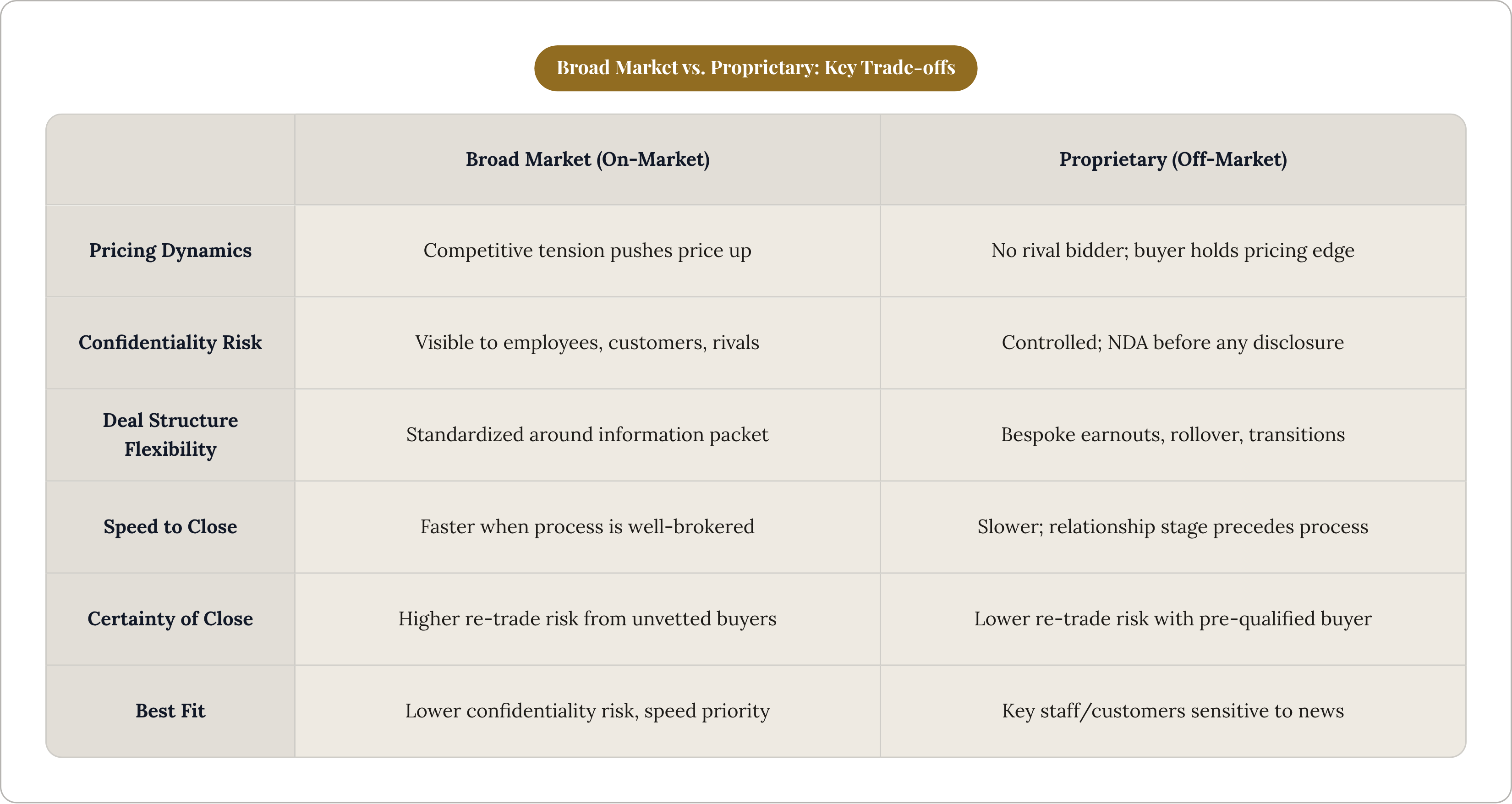
Broad market listings create competitive tension among buyers, and that tension pushes price up. Proprietary deals happen without it, which pulls price down in the buyer's favor; they have historically closed at a real EBITDA discount to auctioned deals for exactly this reason, since there's no rival bidder in the room forcing anyone's hand.
That gap moves, though, and it tracks the broader deal environment pretty closely. In the strong seller's market of 2021 and 2022, auction premiums over proprietary comparables were noticeably wider. By 2024 and 2025, in a cooler market, that gap narrowed, which makes broker-run, competitive processes look more attractive to sellers right as buyers have gotten more careful. There's a real irony in that: an auction becomes more valuable exactly when fewer buyers are willing to bid hard in one.
What a seller gives up going proprietary is that competitive pressure, the thing that forces a buyer to sharpen an offer instead of lowballing it. What they get instead is control: over timing, since there's no artificial auction clock; over who's in the room, since it's one qualified buyer instead of an unknown field; over structure, since earnouts, rollover equity, and seller financing are all easier to negotiate when nobody's worried about losing the deal to a competing bid.
The leverage question resists a simple rule that auctions always win on price. A broad listing that pulls in unqualified buyers and tire-kickers delivers no price benefit at all, while still costing the seller every bit of confidentiality described above. A proprietary process built around one highly motivated, well-capitalized buyer can beat a thin, half-hearted auction without much trouble. And by most accounts, overall listing close rates sit well below half, meaning most sellers who pay the confidentiality cost of a public listing never actually get to a closing table.
What deal quality looks like beyond the headline price
Sellers who optimize purely for the number on the letter of intent tend to underweight the stuff that decides whether a deal actually survives to closing, and whether life afterward is livable.
Start with certainty of close. A well-structured off-market deal, with a buyer who's already done informal diligence, usually carries less re-trade risk than a broad-market auction that opens hot and slowly deteriorates under scrutiny. Underwriting has tightened lately, and financial review has gotten deeper, so buyers who weren't pre-qualified before entering a process are more likely to walk, or to renegotiate terms downward late in the game.
Structure matters just as much as price. Proprietary buyers, negotiating one-on-one, have more room to build earnouts, rollover equity, and transition arrangements tailored to the founder's actual situation; those terms can add up to more total value than a slightly higher cash offer from an auction winner. On-market processes standardize around whatever's in the information packet. It's hard to negotiate something bespoke when three or four bidders are competing over the same document.
Then there's fit, harder to quantify but not harder to notice. Plenty of founders genuinely care what happens to their employees and customer relationships once they're gone, and a channel that surfaces one strategically aligned buyer can beat an auction that just surfaces the highest bidder. Search fund and independent sponsor buyers, who mostly come in through proprietary channels, tend to build operational continuity into the pitch itself, as a selling point.
The search fund performance numbers are a useful stand-in for what's happening here. Stanford's 2026 Search Fund Study found an aggregate IRR of 33.9% and an aggregate ROI of 4.75x across the funds it tracked. Buyers running the proprietary playbook are clearly creating real value, and a meaningful chunk of that value starts with paying less than an auction would have made them pay.
How seller preparation changes outcomes in both channels
None of this matters much if the seller isn't ready. The whole channel debate quietly assumes a prepared seller, and an unprepared one underperforms no matter which door they walk through.
On the on-market side, sellers who work with hands-on brokers, ones who invest in documentation, valuation, and buyer screening before a listing ever goes live, close at meaningfully higher rates than sellers who go through a volume lister. Clean financials and a well-built information packet cut down on buyer hesitation and re-trade risk no matter where the listing ends up.
Off-market work runs on a slower clock. These processes usually take longer than a well-brokered on-market sale, since there's a relationship-building stage before any formal process even starts. A seller who's actually done exit planning, with clean books, normalized earnings, and a clear explanation of customer concentration risk, becomes a much more attractive off-market target and can move from first conversation to signed LOI faster than one who hasn't bothered.
Timing compounds all of it. Owners who start thinking about channel strategy years before an eventual sale end up with more options and more leverage than owners who list reactively, out of burnout or necessity. Available survey data consistently finds that a meaningful share of employer firms with owners 55 and older have no clear long-term exit plan. The businesses that do close, through either channel, tend to share a few traits: financial clarity, a credible story about how durable the earnings really are, and a seller who understands what buyers are actually trying to underwrite before anyone sits down at the table.
How advisors and technology are reshaping access to both channels
Proprietary deal flow used to be a privilege reserved for sellers big enough to justify investment-banking attention, or connected enough to attract buyer outreach on their own. A founder running a business under $5 million in revenue basically had two options, a volume broker or a public listing, and not much of a middle path existed.
That's changing on two fronts at once. Technology-driven matching tools are beginning to give smaller sellers better access to qualified buyers outside the traditional public listing, narrowing a gap that used to require years of relationship-building to bridge. Separately, investment-banking advisory has moved down-market, with firms now focused on smaller businesses that previously had few options beyond a volume broker, bringing the same process discipline and buyer relationships once reserved for much bigger deals.
Put those two developments side by side and each one covers the other's blind spot. Pure technology matching can surface a buyer list, but it can't negotiate deal structure or walk a seller through the emotional weight of a hard process; that still takes a human with judgment. Pure relationship-based advisory has always been limited by reach and by the sheer time it takes to build those relationships one at a time. Technology extends that reach without watering down who gets introduced to whom. For a seller in that $500,000 to $50 million range, the practical question has shifted from whether to list publicly to which advisor can get the right buyers into the right channel for a business like this one.
Making the channel decision as a seller
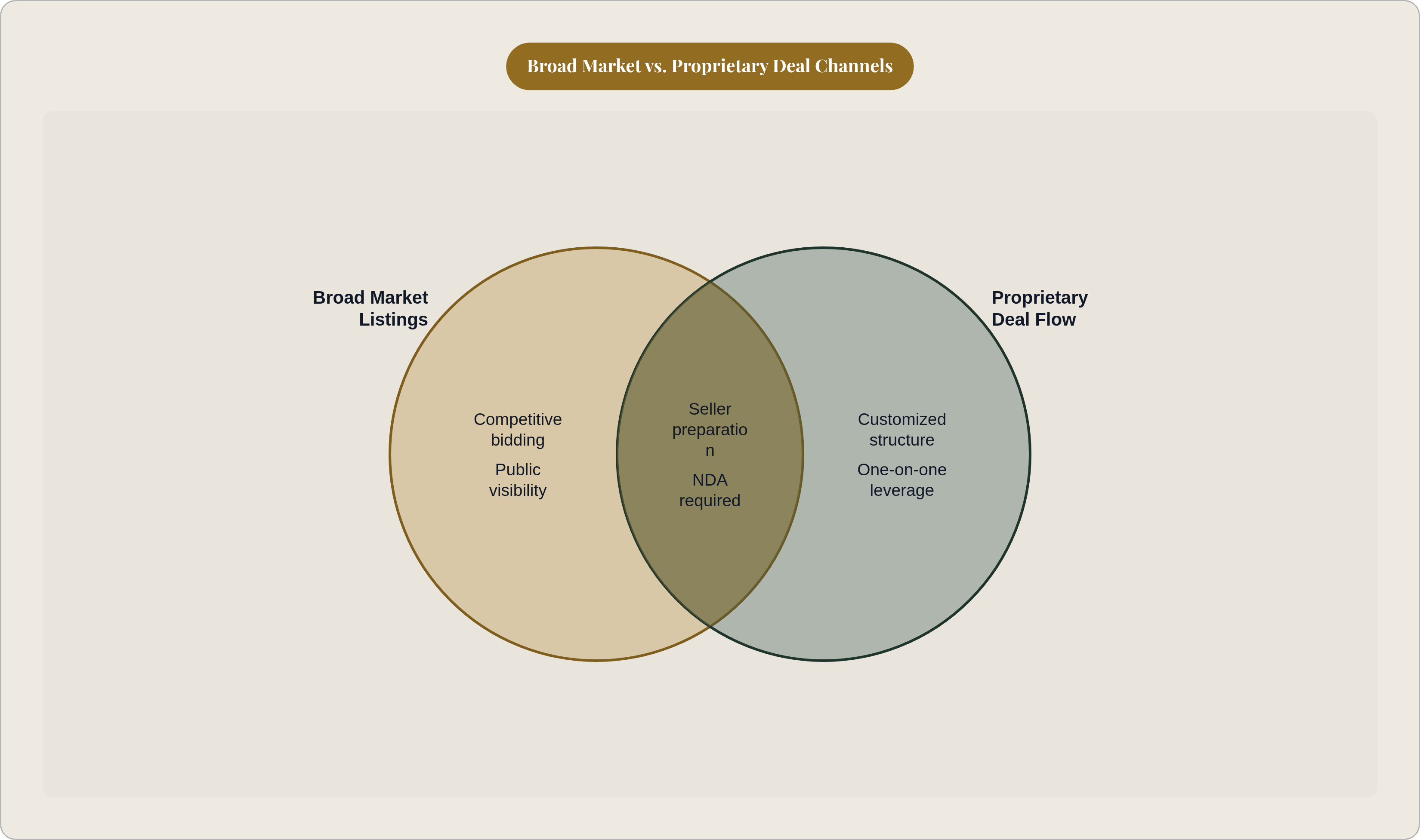
No single channel fits every seller. Which one an owner should use depends on variables that can actually be assessed before signing with anyone, not on some universal ranking of on-market versus off-market.
Some questions point toward broad-market, on-market: Does the business sit in an industry where confidentiality risk is genuinely lower, where a for-sale sign doesn't spook customers or send employees job-hunting? Is speed worth more here than squeezing out the last dollar of price, and would a shorter timeline still hit the owner's financial goals? Is the business documented well enough to survive scrutiny from several competing bidders at once, without cracking?
Other questions point toward proprietary, off-market: Could a handful of key employees or a concentrated customer base walk if word got out too soon? Does the owner care more about structure, an earnout that reflects real confidence in the business, rollover equity, a transition that feels humane, than about the single highest number on a term sheet? Is there already a buyer, or a short list of them, worth approaching quietly before anything goes wide?
Nobody hands you a formula for this. What the data does make clear, across search funds, brokered listings, and the sheer number of businesses that never sell at all, is that the channel decision carries real weight; it decides who shows up, how much pressure they're under, and whether the number on the closing statement reflects what the business was actually worth, or just whatever the process happened to produce.