How Buyer Databases Are Built and Scored for M&A Outreach
Qualified buyers need strategic fit, financial capacity, and current deal motivation all at once.

A buyer universe isn't every company in an industry with a pulse and a balance sheet. It's a set of parties that clear three bars at once: strategic fit, financial capacity, and current motivation to do a deal. Miss any one of the three and a party belongs on a watch list, not the outreach list. I've seen a company that looked like a perfect strategic fit on paper get scratched off because its balance sheet was still digesting an acquisition from eighteen months earlier. I've also seen a PE fund with plenty of dry powder sit two sectors away from where the target actually operated. Neither belongs in the active pool yet, and pretending otherwise just wastes phone calls.
Scale varies a lot depending on deal size and how the process gets run. A lower-middle-market sale run by a boutique shop might contact a few dozen parties, full stop. A broad mid-market auction can run past a hundred. Neither number is right or wrong on its own; the number follows the deal, never the other way around, and any banker who tells you there's a magic count is selling you something.
Here's the detail that gets missed constantly, even by teams who should know better: the universe isn't a document you build once and reuse. Buyer appetite shifts. Funds close and reopen. Corporate development priorities get rewritten the week after a management change, sometimes literally the week after. A universe built eighteen months ago for a different deal in the same sector is a starting point at best, not a finished product, no matter how clean the spreadsheet looks.
And there's a separate distinction that trips people up: the universe, meaning the full qualified map of buyers, is not the short list, meaning the prioritized set that gets called first. Conflating the two is where processes go sideways. Treat every qualified party as equally worth an early call, and you burn goodwill on marginal buyers while diluting the outreach that should have gone to the strongest candidates. Treat the short list as though it were the whole universe, though, and you'll miss the buyer nobody flagged on paper who turns out to be the hungriest one in the room.
The three categories of buyers, and why sourcing each one takes a different playbook
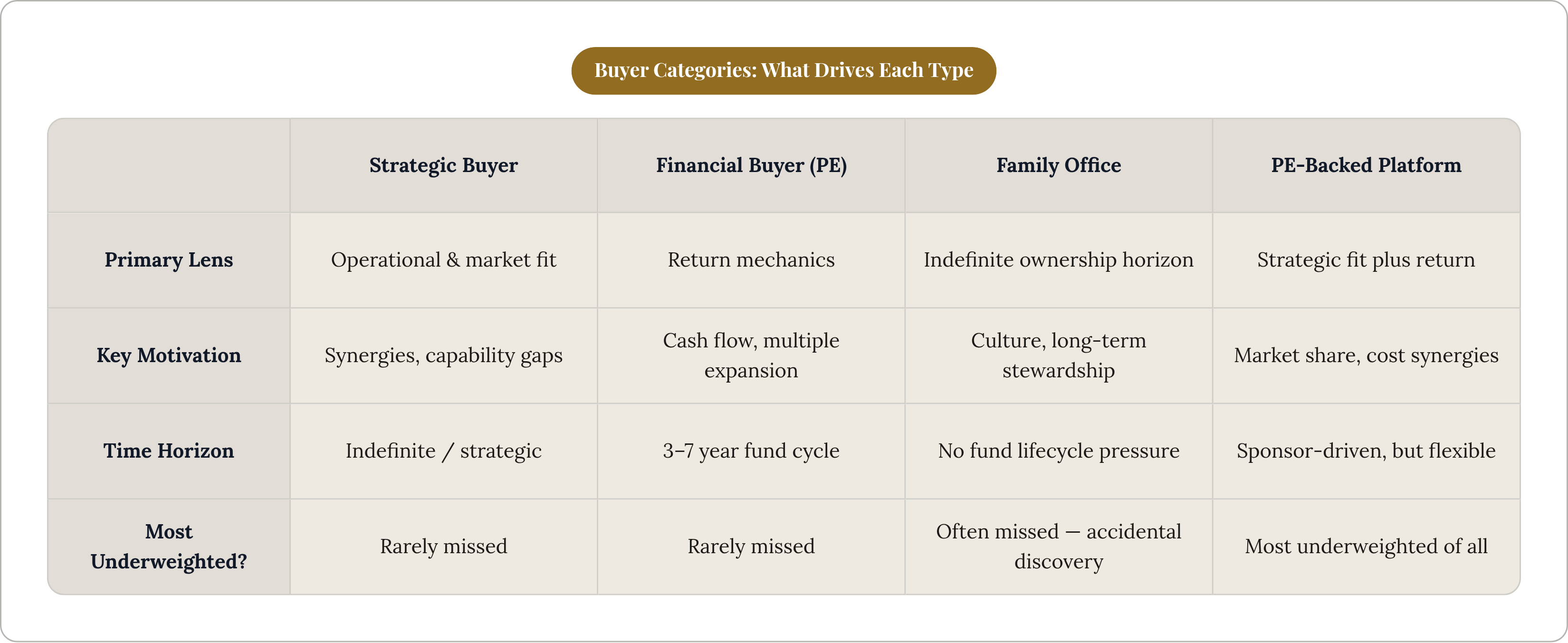
Strategic buyers are operating companies, and they show up in a few flavors: direct competitors consolidating or pushing into new geography, supply chain players integrating vertically (a customer wanting to own its supplier, a supplier wanting to reach the end customer directly), and adjacent players hunting for a capability they don't have yet. The old assumption, that strategics always outbid financial buyers because synergies let them pay more, doesn't hold up the way it used to. Whether a strategic actually pays a premium depends on how cleanly the target's numbers map onto that specific buyer's value drivers. Strong recurring revenue might be worth real money to a buyer trying to build a subscription base, and worth nothing extra to a buyer that only cares about factory capacity. Sourcing strategics well means mapping the competitive landscape and supply chain by hand, because a database search alone misses a meaningful share of the most motivated parties. Motivation just doesn't show up as a field you can filter on.
Financial buyers split into two groups that behave nothing alike. Private equity firms raise institutional capital and put it to work against a target return over a defined fund cycle, usually three to seven years, so their lens is return mechanics: cash flow, multiple expansion, a credible exit. Family offices run on a different clock entirely. They're not bound by a fund lifecycle, they can hold a business indefinitely, and they've gotten steadily more active further down-market than they used to be. For a seller who cares what happens to the culture or the employees after close, a family office can be a far better counterparty than a PE fund angling for a five-year flip. That's exactly why family offices deserve deliberate inclusion in the universe, rather than the accidental discovery that happens when someone runs into one at a conference two months into the process. They also show up in a quieter second role, as capital behind independent sponsors, which makes them worth tracking even when they're not the name signing the purchase agreement.
Then there's the hybrid category, and it's the one people underweight most, probably because it doesn't sit cleanly in either bucket. A PE-backed platform company is financially sponsored on paper but evaluates a target the way a strategic would: market share, cost synergies, real operational fit with what it already owns. These buyers have grown into a bigger factor in competitive processes, partly because they bridge the gap between what a pure financial sponsor will pay and what a pure strategic might pay. For add-on targets in a fragmented industry, missing this category often means missing some of the best-capitalized, most motivated buyers in the whole market.
Where the raw data comes from: databases, networks, and deal history
The infrastructure starts with commercial databases, and no single one covers the job alone. PitchBook is the largest private-market platform by coverage, tracking transaction comps, ownership history, and fund-level performance across millions of companies; it's priced for institutional use, so it tends to show up at larger advisory shops rather than smaller ones. Capital IQ Pro, S&P's market intelligence product, blends public and private company data pulled from multiple third-party sources and does particularly well on financial benchmarking and public-company deal comps. Grata and SourceScrub, now merged under Datasite's ownership, were built specifically for granular private-company search, which matters a great deal for lower-middle-market targets and for buyers a PE-focused database would never surface. Outbound tools like ZoomInfo and Apollo come in after the fact, once target companies are identified, mostly to fill in contact data and round out the list.
The standard setup among serious teams is a tiered stack: one tool for transaction comps, a different one for private-company search, a third for contact enrichment. No platform does all three well, and treating one database as good enough is a common, quietly expensive way processes end up thin on buyer coverage.
Relationship networks fill in what the databases structurally cannot touch. A PE firm's current fund position, how much dry powder it actually has left, where its investment thesis shifted in the last two quarters: none of that reliably shows up in a database field. Advisors who've closed deals in a sector build up a working knowledge of who's actually buying right now, and that knowledge is a genuine edge no subscription replicates. Corporate development contacts and sector operators often know a buyer is hungry before that buyer has said so publicly, sometimes months before.
Transaction history adds the third layer. A buyer who's made three acquisitions in an adjacent space over the past two years is a far higher-probability contact than one whose only relevant deal closed a decade ago. Fund lifecycle matters here too: a firm that just closed a new fund has capital that needs a home, while one nearing the end of its investment period isn't likely to chase a new platform aggressively, no matter how good the fit looks. Earnings call transcripts, conference presentations, and published acquisition criteria round this out, offering clues about where a buyer's appetite is actually pointing this quarter, not two years ago.
Where commercial databases fall short, and what fills the gap
Industry classification codes work fine at a macro level and fall apart the moment you need niche precision. PE firms don't buy industries; they buy specific business profiles within a niche, and a standard industry screen usually can't tell a target apart from its ten nearest, and largely irrelevant, competitors. A SaaS company sitting under an unexpected NAICS code. A family-owned manufacturer that's never been marketed by a bank. A division of a conglomerate that's quietly become a divestiture candidate. None of these show up on a screen built around clean industry buckets.
Coverage gets thinner the further down-market you go. A large-revenue company is well documented across every major database. A small-revenue business with three owners and no outside investors might barely register anywhere at all.
Motivation is the piece structured data almost never captures. A company can check every financial and strategic box and still have quietly shelved its acquisition strategy internally last quarter, a fact no database field records but that a relationship network often picks up within weeks. This is where AI-driven sourcing has started closing part of the gap: machine learning models can chew through transaction patterns, portfolio composition, and stated fund mandates at a scale no analyst team could match by hand, surfacing buyers who'd never have made it onto a traditional industry screen in the first place. It's a real advance. It also works best layered on top of the human network, alongside it, not instead of it.
Combine the four, database infrastructure, relationship networks, transaction history, AI screening, and the pattern is hard to miss: any one alone produces a universe with holes in it. For founder-led businesses in the lower-middle-market, where database coverage is thinnest and where relationships matter most, that infrastructure gap has historically been the single largest source of missed buyers and value left on the table.
How scoring turns a long universe into a short list worth calling
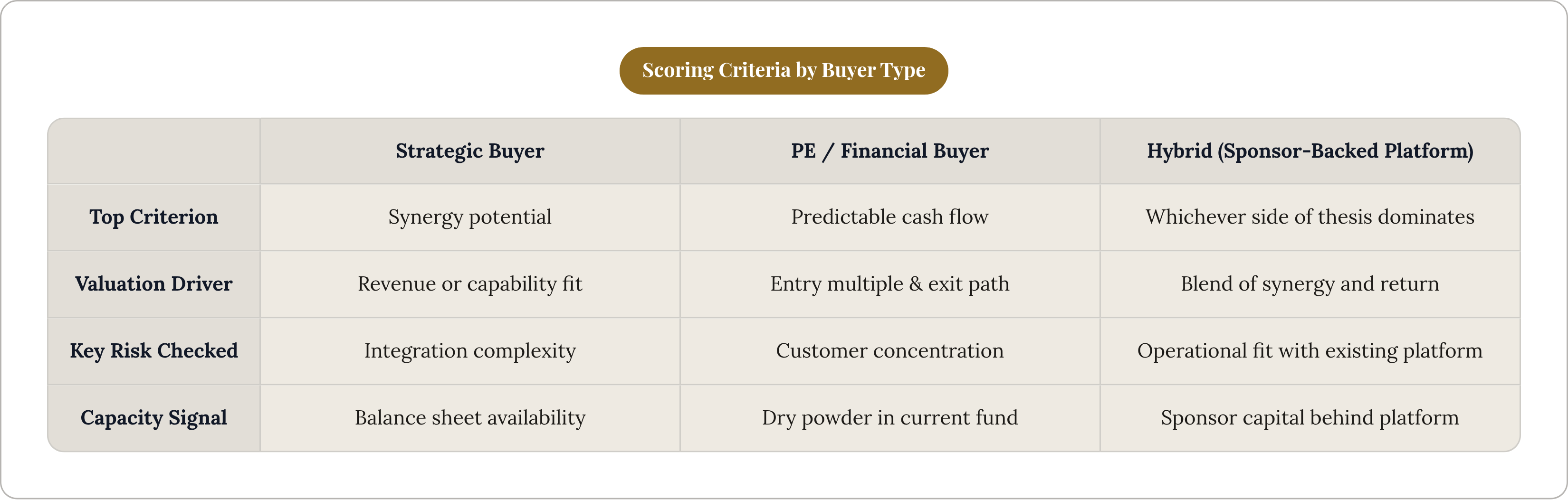
Once the universe exists, the job shifts from completeness to probability. The universe gets built so nobody qualified gets left out; the short list gets built to figure out who's actually going to bid. That runs on weighted frameworks, where different criteria carry different weights depending on what actually matters for this deal, not some generic template.
The common dimensions show up across most processes. Strategic fit measures how closely the target maps to what the buyer is actively trying to build. Financial capacity asks whether the buyer can actually fund a deal at the expected price, because a motivated buyer without capital isn't a real bidder no matter how enthusiastic the phone call sounds. Recent acquisition activity signals current appetite, not historical interest from three years back. Operational compatibility covers integration complexity, management continuity, cultural fit. Valuation alignment checks whether the buyer's typical entry multiples and deal structures land anywhere near the seller's expectations.
So why does the same target score high for one buyer and mediocre for the next? It's tempting to assume scoring measures something intrinsic to the target. It doesn't. Scoring only exists relative to a specific buyer's specific situation, which is why the criteria shift by buyer type. For a strategic, synergy potential dominates the score: cost savings, revenue upside, a capability gap filled. For a PE buyer, return mechanics take over: predictable cash flow, customer concentration, unit economics, a believable path to an exit multiple three to seven years out. For a hybrid, sponsor-backed buyer, it's a blend, weighted toward whichever side of the strategic-financial line that buyer's current thesis happens to favor this year.
Why the tiered list still gets beaten by the buyer nobody ranked first
Good teams don't treat the qualified universe as one flat list of equally likely prospects. They tier it. The top tier, usually the smallest group, holds buyers with the clearest strategic logic, confirmed capacity, and recent, demonstrated activity in the sector; these get the earliest outreach and the most personalized framing. A middle tier includes buyers who clear most of the criteria but whose connection to the target isn't obvious on the surface, strong candidates who just need a sharper story told to them. Below that sits the broader qualified universe, a reserve pool that looks, on paper, like a lower-probability group.
Except that reserve pool closes deals more often than the tiering would suggest. Practitioners describe something close to half of completed transactions in competitive processes coming from outside the top-tier list. A scoring model, however carefully built, can't see inside a buyer's own strategic calendar. A company that scores as a second-tier fit today might be one quarter away from a board mandate to expand into a new category, a mandate that simply didn't exist when the scoring model ran. The model can't know that. Often the buyer doesn't fully know it either, not until the opportunity lands on their desk and something clicks.
So keeping a wide, well-qualified universe beyond the obvious names isn't wasted effort. It's insurance against the one thing scoring frameworks are structurally unable to predict: an internal shift in a buyer's own priorities that happens to line up with the seller's timeline by coincidence rather than design.
Who gets the call matters almost as much as which company gets the call. For a financial buyer, the right first contact is usually the deal professional covering the portfolio company most similar to the seller's business, not a cold introduction to a partner with no context on the sector. For a strategic, routing outreach to corporate development rather than a generic business development inbox, or to the specific divisional leader rather than the CEO's assistant, changes response rates and deal speed in ways that surprise people, and cost them dearly when they get it wrong.
How the auction format decides the size of the room
Format isn't a decision made after the list exists; it's made alongside it, because the two shape each other constantly. A targeted or negotiated sale, one or two pre-selected buyers, trades competitive tension for confidentiality and speed. It makes sense when a seller has a strong existing relationship with a preferred buyer, or when broad market exposure carries real operational risk: employees finding out, competitors sensing weakness. A limited auction contacts a pre-screened set of likely best-fit buyers and is the most common format in the middle market, balancing multiple bids against the desire to keep exposure contained. A broad auction reaches a wide cross-section of the qualified universe, maximizing competitive tension and the odds of turning up a non-obvious buyer, but it demands tighter process management. Volume without discipline tends to erode bid quality rather than improve it.
Which format fits depends on how sensitive the seller is about confidentiality, how deep the buyer universe actually runs, the timeline, and how much bandwidth management has to spend fielding buyer calls mid-process. Here's a pattern worth flagging, because it surprises people the first time they see it: as deal size climbs, the pool of qualified buyers shrinks, so a broad auction for a large transaction ends up contacting fewer total parties than a broad auction for a smaller one. Fewer buyers simply clear the capacity bar at that size.
For most lower-middle-market transactions, wider outreach, even short of a full broad auction, tends to be the safer default. A seller has no reliable way to know in advance which buyer will turn out to be the most motivated one. The list itself is how that gets discovered, not guessed at from a conference room.
Keeping the seller safe while the list gets worked
Every name added to the outreach list is a name that now knows the business is for sale, and that fact carries real risk for as long as the process runs. Confidentiality agreements come first, signed before any identifying financial detail goes out the door. But a signature on an NDA doesn't eliminate the risk of a competitor using the process itself as market intelligence, reading who's for sale into pricing decisions, hiring plans, or customer conversations, even if that competitor never places a bid.
Sequencing matters here more than people expect. A teaser goes out blind, without naming the company, and only parties who show real interest and sign paperwork get the fuller picture in the CIM. That staged release is a control mechanism as much as a sales tool: it keeps sensitive detail limited to buyers who've cleared a basic threshold of seriousness. Tracking who has access to what, and when, isn't bureaucratic box-checking. It's the mechanism that keeps a broad list from turning into a broad leak.
There's also a quieter risk that shows up specifically in broader auctions: a buyer with no real intention of bidding uses the process to gather competitive intelligence and then walks away clean. Careful qualification before the CIM goes out, paired with close attention to who's actually engaging versus who's just collecting documents, is how experienced teams keep that risk contained. Done right, it doesn't require shrinking the list down to the point where it loses the competitive tension that made running a broader process worth it in the first place.