Customer Concentration Discount in Business Sale Valuations
Buyers apply specific revenue thresholds when discounting concentrated customer risk.
Customer concentration discount is not a vague gut feeling buyers apply when a deal makes them nervous. It's a structured, graduated adjustment tied to specific revenue thresholds, and once a founder understands the math behind it, the discount stops looking like bad luck and starts looking like something that can be measured, argued with, and in many cases, reduced before a deal ever gets to the table.
The threshold bands buyers actually use and what changes at each one
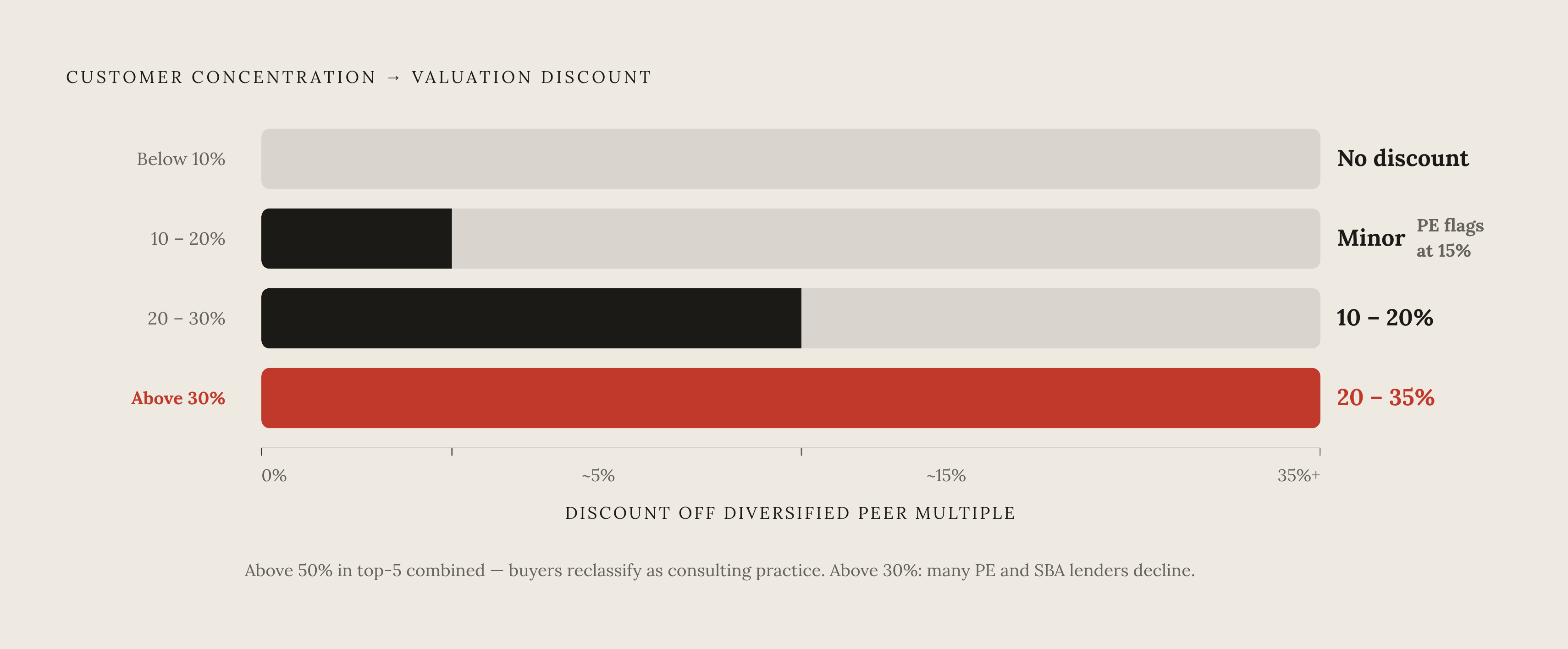
Below 10% of revenue from any single customer, a business reads as clean. Buyers compete for it, lenders extend full borrowing capacity against it, and no special diligence flags get tripped. This isn't arbitrary. U.S. GAAP requires public companies to disclose any customer above 10% of revenue in the footnotes of their financial statements, because auditors and SEC staff have long treated that line as the point where ordinary business risk becomes something investors need to see spelled out. Private M&A didn't invent this threshold. It borrowed it, because the underlying logic, a buyer is purchasing a stream of future cash flows, and one customer that large can materially disrupt those flows, doesn't care whether the company is public or private.
Between 10% and 20% concentration from the top customer, the deal enters what's best described as a caution zone. Buyers start digging into contract terms and relationship depth rather than taking the revenue at face value. Private equity firms, in particular, tend to draw a hard internal line around 15%, and crossing it can begin to affect the multiple buyers are willing to pay. Loan agreements in this band sometimes carry a concentration trigger, a covenant that activates if the customer's share climbs further.
From 20% to 30%, the risk becomes something buyers actively investigate rather than just note. Expect detailed customer interviews built into the diligence process, escrow holdbacks tied specifically to that account, and reduced advance rates if the company finances its receivables. Industry practitioners tracking deals through 2025 and into 2026 put the valuation compression in this band at roughly 10% to 20% off what a diversified peer would command.
Above 30%, the discount turns severe: 20% to 35% off a comparable diversified business, according to the same practitioner data. Many institutional PE buyers and SBA lenders simply decline to run the process at all once they see a number that high. The buyers who remain usually demand earnouts or holdbacks substantial enough to shift most of the concentration risk back onto the seller.
L40's 2025 benchmarks set the preferred ceiling for a genuinely clean exit at just 5% to 10% from any single client, a bar most lower middle market companies don't come close to clearing. Concentration in the top five customers matters independently of any single account: Industry analysis notes that once the top five customers combined exceed 50% of revenue, buyers start reading the business less as a scalable company and more as a consulting practice built around a handful of relationships, a distinction that shows up directly in the multiple offered. FOCUS's own threshold work lands on 20% as the real inflection point. Below it, a business is a strong asset carrying a known, quantifiable risk. Above it, the risk starts to define the asset itself, and buyers price it that way.
How buyers convert concentration percentage into a dollar discount
Here's the part that surprises a lot of sellers: the discount doesn't apply only to the revenue tied to the concentrated customer. It compresses the multiple across the entire business's EBITDA, because once one departure can rewrite the income statement overnight, every dollar of cash flow becomes a little less trustworthy in the buyer's model. Platforms focused on founder exits, such as Succession AI, use AI-driven valuation tools to help owners see exactly where that compression is coming from before they go to market.
According to Eagle Rock CFO, moderate concentration, a top customer between 20% and 30% of revenue, typically costs a seller 0.5 to 1.0 turns of EBITDA. Push past 40% and the reduction can run 1 to 2 turns or more. CT Acquisitions frames it in dollar terms: a discount of 1 to 2 turns of EBITDA on a business generating $5 million in EBITDA works out to $5 million to $10 million of purchase price gone, simply because one customer crossed the 20% line.
Sofer Advisors lays out comparable ranges from the other direction, as a percentage discount rather than a multiple reduction. At 20% to 35% concentration, expect roughly 10% to 20% off valuation. Above 40%, that climbs to 20% to 30% or more. Highland Global's discount guidelines follow a similar shape: 25% to 35% concentration triggers up to a 10% discount, 36% to 50% runs 15% to 20%, and anything past 50% brings a 25% to 35% discount, or a change in how the deal gets structured entirely.
Livmo's side-by-side illustration makes the point concrete. Two businesses with similar revenue and margins, otherwise comparable. One sold at 6.2x ARR. The other's best offer came in at 3.8x ARR. The entire gap traces back to how revenue breaks down by customer. That's not a rounding error, it's millions of dollars of enterprise value, and it shows up before any earnout or escrow gets layered on top.
What the SaaS comparison and the two manufacturing withdrawals reveal about how fast concentration destroys a deal
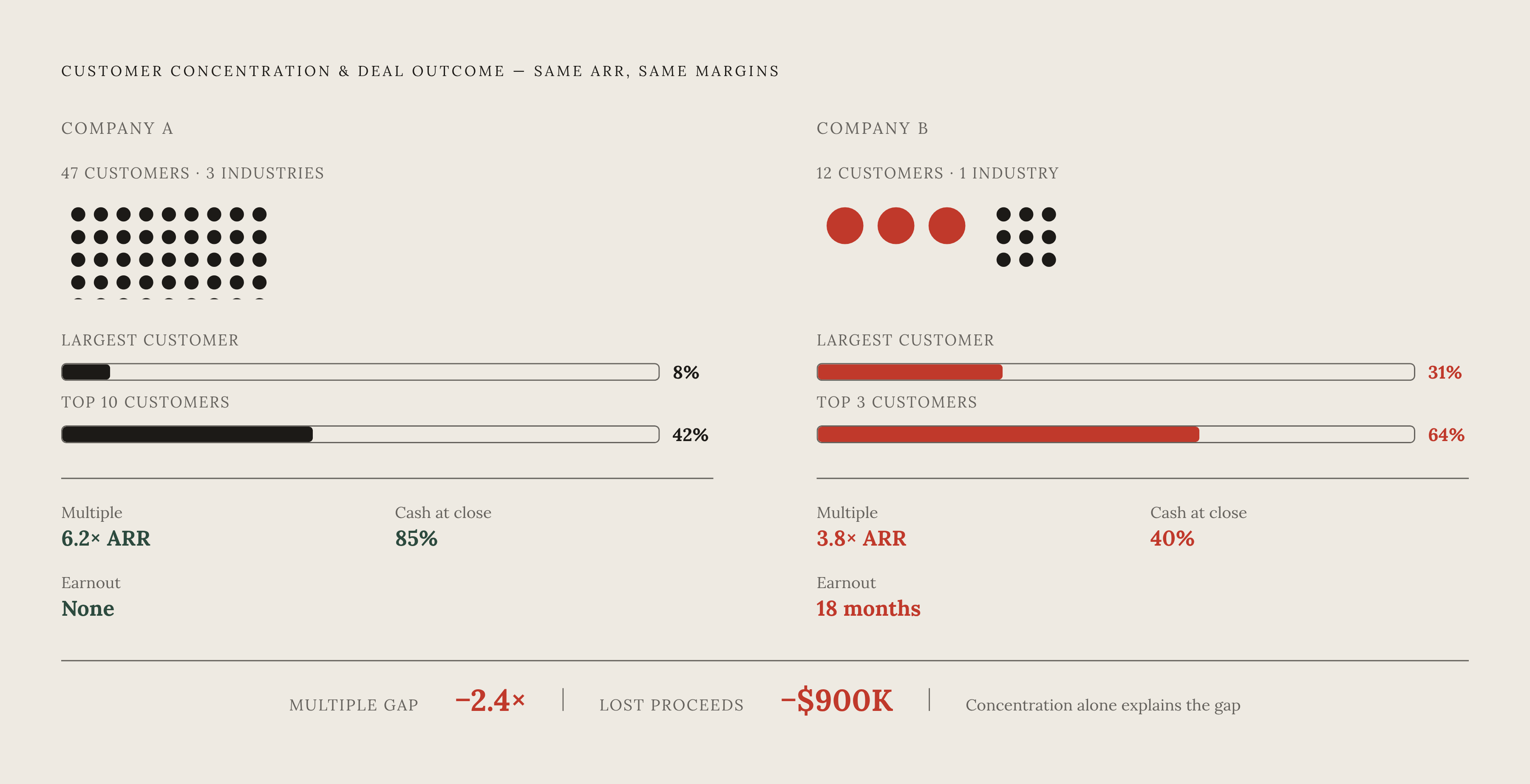
A 2025 comparison of two SaaS companies in the same vertical, both running roughly $1.5 million in ARR with similar margins, shows how quickly this plays out in practice. Company A had 47 active customers, its largest at 8% of revenue, with the top ten combined at 42% spread across three industries. It sold at 6.2x ARR with 85% cash at close. Company B had 12 customers, its largest at 31% of revenue, the top three at 64%, all concentrated in one industry. Its best offer came in at 3.8x ARR, with 40% of the deal structured as an earnout tied to customer retention over 18 months.
Same ARR. Same margins. A 2.4x multiple gap, driven almost entirely by concentration. Company B's owner left roughly $900,000 on the table compared to what a more diversified revenue base would have brought in.
Livmo documented a case that shows the risk doesn't always show up as a lower number, sometimes it kills the deal outright. A B2B SaaS company with $1.1 million ARR, growing 22% year over year, clean books, strong retention, had already signed a letter of intent at $4.2 million. Then a buyer's analyst pulled the customer revenue breakdown and found one account sitting at 38% of revenue. The deal didn't die on valuation. It died on fear, once the buyer actually saw the number in black and white.
FOCUS Investment Banking's data from the first half of 2025 makes the point even more sharply, with two separate manufacturing businesses pulled from active sale processes mid-stream, after each lost a customer that had represented more than 50% of revenue. There was little to no warning in either case, despite what had looked like strong, stable relationships. Neither loss reflected any failure on the manufacturer's part, and both customers were S&P 500 companies in solid financial health. For the sellers, the outcome was the same either way: catastrophic. These withdrawal cases show something distinct from price compression. Concentration doesn't always show up as a lower offer, it can eliminate the offer entirely, and it can do so retroactively, after a deal already looked signed.
Worth noting, though: Some buyers have completed acquisitions despite elevated concentration, when deal context, buyer type, and contract structure aligned favorably. Concentration alone didn't determine the outcome. Buyer type, context, and how the contracts were structured did. High concentration isn't automatically fatal to a deal, but the conditions that let a seller overcome it are specific, and they're demanding.
How buyer type and lender underwriting together shrink the pool of viable acquirers
Concentration doesn't just move the price a buyer offers. It changes which buyers show up at all, and that shift matters just as much as the multiple compression itself.
Private equity firms tend to flag anything above 15% of revenue from a single customer, and those relying on leveraged financing generally won't proceed once concentration climbs into elevated territory. Strategic acquirers have more room to maneuver: if the concentrated customer fits into relationships the strategic buyer already has, or if it believes it can stabilize or grow that account after close, it may tolerate a number that would scare off a financial buyer. That flexibility comes at a price worth noting in reverse, strategic buyers typically pay a meaningful premium over financial buyers, so every time concentration pushes a strategic acquirer out of the pool, that premium disappears along with it.
SBA lenders finance a large share of lower middle market acquisitions, and they get uncomfortable once a single customer passes 20% of revenue. Some won't fund a deal at all past that point. SBA guidance generally applies a firmer threshold around 25% to 30%, beyond which loan amounts get reduced or declined outright. The rules got tighter recently, too: SBA SOP 50 10 8, announced in April 2025 and effective that June, raised underwriting standards across the board and shifted more responsibility onto participating lenders. That tightening amplifies whatever effect concentration already has on a buyer's ability to finance the deal.
Conventional commercial lenders sometimes address concentration through the loan terms themselves, writing in a provision that makes the loan immediately callable, or forces accelerated repayment, if the key customer leaves after closing. That clause moves the concentration risk off the lender's books and onto the buyer's, which in turn limits how much operational flexibility that buyer has post-close. Asset-based lenders financing a company's receivables handle it more bluntly: most cap any single customer at 15% to 25% of the total borrowing base, and anything above that ceiling simply doesn't count. A company with one customer representing a large share of revenue might find it can only borrow against a fraction of what it's actually owed.
Many lenders treat revenue diversification as a central factor in credit assessment for both growth financing and acquisition loans. Put it together and the effect compounds: once PE buyers and SBA-financed buyers both step back, the seller is left negotiating with a much smaller group of strategic or all-cash buyers, and the competitive tension that normally pushes price upward thins out along with the buyer pool.
How concentration reshapes deal structure even when the buyer stays at the table
Price compression and structural changes to the deal aren't alternatives to each other, they stack. A seller can land close to the headline number they wanted on paper and still walk away from the closing table with far less cash than that number implies.
A customer-specific holdback is one of the more common tools buyers use: a portion of purchase price held in escrow for a defined period, released only if the key customer stays through it. If that customer terminates during the escrow window, the buyer can draw on those escrowed funds to offset the resulting shortfall. Earnouts work on a similar logic but with more risk transferred to the seller, often 15% to 25% of total consideration, deferred and paid out over 12 to 24 months, contingent on the concentrated customer remaining in good standing.
Livmo documented a case where a strategic acquirer, genuinely interested in the product, closed the deal, but 15% of the purchase price sat in a holdback tied entirely to one client's first-year renewal. The seller waited 14 months for that piece of the payment, and for the entire window, every risk from contract performance to that client's day-to-day satisfaction sat squarely on the seller's side of the ledger.
The combined effect of these tools can be significant: a seller might see a substantial share of total consideration tied up across a multi-year earnout and an indemnification escrow simultaneously. If the concentrated client walks after close, the seller forfeits a meaningful chunk of proceeds they'd already counted as sold. Kits West draws a useful distinction between the two structures: an escrow or holdback tends to fit concentration risk better than an earnout does, since it releases on a fixed schedule rather than requiring ongoing performance. An earnout can bridge a genuine valuation disagreement between buyer and seller, but it also transfers more of the operational risk directly onto the seller's shoulders. Reps and warranties insurance gets harder to bind in these deals too, or comes back with concentration-specific carve-outs that leave the seller exposed anyway.
The contextual factors that can reduce the discount, and what buyers are actually checking for in each one
The percentage alone never tells the full story. What buyers are actually pricing is the combination of contract length, the customer's own creditworthiness, how hard it would be for that customer to switch elsewhere, and how quickly the revenue could be replaced if it disappeared. A manufacturer with a top customer at 15% to 20%, locked into a long-term contract with real switching costs, can look perfectly acceptable to a lender, even though the raw number sits inside the caution zone.
Contract structure carries a lot of that weight. Multi-year agreements, auto-renewal clauses, and early termination penalties all reduce how buyers perceive churn risk, and Sofer Advisors points to long-term contracts with auto-renewal terms as among the most consistent ways to soften a concentration discount. During diligence, buyers dig into the specifics: how long the relationship has run, whether there have been service disputes in the past, the customer's own financial health, and whether the contract can even transfer to a new owner in the first place.
Relationship depth matters just as much, maybe more. A buyer discounts concentration far more sharply when the relationship runs through the founder personally, because that buyer is effectively purchasing a client's loyalty to someone who's about to walk out the door. Multiple points of contact inside the customer's organization, product integrations spread across several modules or user seats, and a documented service history all work against that fragility.
Even customer quality has limits. The FOCUS manufacturing cases involved S&P 500 customers in solid financial health, and even that offered no protection against the departures. Buyers still dig into the customer's own financial trajectory and watch for any sign the customer is running a supplier evaluation behind the scenes.
The trajectory of everything else matters too. A business sitting at 25% concentration with 12 months of documented growth in its smaller accounts tells a very different story than one stuck at 25% with flat revenue everywhere else, because buyers are modeling the probability of loss, not just the current snapshot, and visible momentum changes that model. Industry norms shift the baseline as well: a specialized industrial components manufacturer at 15% to 20%, backed by high switching costs, reads nothing like a SaaS company at the same percentage running month-to-month contracts.
How a seller frames concentration in diligence changes the outcome, too. Presenting it as a deep, well-documented enterprise relationship with a clear diversification plan already underway lands very differently than presenting it as a problem currently being worked on. The second framing, even when the underlying facts are identical, tends to raise buyer anxiety rather than settle it.
What a founder can do, and when to start, to move from discount territory toward a clean exit profile
Sofer Advisors puts the timeline at 18 to 36 months of active business development to meaningfully shift a concentrated revenue base, though even a sustained period of visible momentum can change how a buyer perceives the risk, well before the actual percentage moves much at all.
Growing the denominator is the most direct lever available. Adding new customers, even small ones, changes the underlying math without requiring the large account to shrink at all: ten new accounts alter the concentration percentage on their own. Upselling and cross-selling into mid-tier accounts works the same way from a different angle, since every dollar grown from a smaller customer dilutes the weight the largest one carries, and those accounts are often undervalued by founders in the run-up to a sale anyway.
Where the concentration can't be meaningfully reduced before an exit, the next best move is making that concentration look less fragile rather than trying to hide it. A multi-year, auto-renewing contract with early termination penalties does real work here, and so does any product integration that raises the customer's switching costs. Measuring and presenting the concentration by profit rather than revenue matters too: if the large customer generates a lot of revenue but thin margin, the earnings actually at risk are smaller than the revenue percentage suggests, and that's a legitimate, defensible argument to bring into diligence rather than an afterthought.
None of this works as a last-minute fix pulled together once a buyer starts asking questions. The narrative, relationship longevity, multiple points of contact inside the customer's organization, a clean renewal history, whatever contractual protections exist, needs to already be documented before the buyer asks for it. A founder who can hand over that record instead of assembling it under pressure is the one who defends the multiple. The one who waits is the one who accepts whatever discount the buyer decides to apply.
Sources
- Customer Concentration Risk: The 10% Rule That Quietly Drains Valuation, Credit, and Leverage
- Customer Concentration Risk: How Buyers Price It - Livmo
- Why Customer Concentration Kills Deals and How to Diversify Fast - Livmo
- Customer Concentration Discount Guide
- Customer Concentration: Why It Cuts Sale Price 10 to 30 Percent | Sofer Advisors
- Customer Concentration Risk in a Business Sale (2026) | CT Acquisitions
- eaglerockcfo.com
- mmcginvest.com