Asset Sale vs Share Sale Valuation Differences in Canada
Structure determines price, and owners who delay that choice leave money on the table.
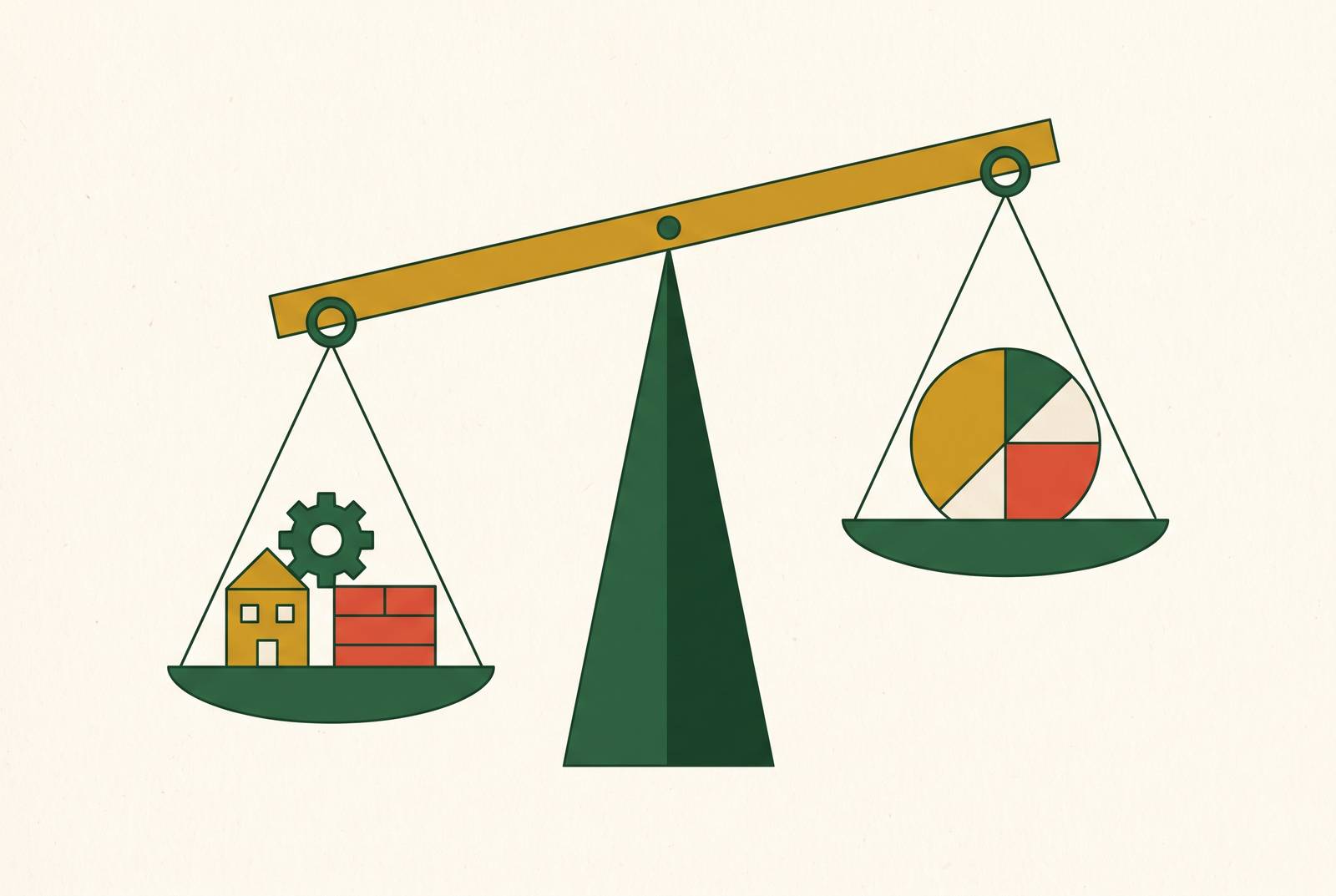
A business sale in Canada gets priced twice: once as an asset deal, once as a share deal, and those two numbers almost never match. The gap exists because the legal structure decides who pays tax, when, and on what, so structure has to be settled before a price means anything. This piece walks through why, and argues that owners who treat structure as a late-stage negotiating point, rather than the first decision, routinely leave six figures on the table.
Canadian tax law treats an asset sale and a share sale as fundamentally different events, not different wrappers around the same economics. In an asset sale, the corporation sells off individual pieces of itself. In a share sale, the shareholder sells the whole legal entity, liabilities and tax history included. Buyers and sellers show up with opposing structural preferences already baked in before anyone discusses a number, and that divergence is the actual engine behind the valuation gap this piece walks through. Most of what follows applies to incorporated private Canadian businesses, though unincorporated ones can do asset sales too. The stakes, and the tax exposure, run sharpest for owners running a corporation.
How an asset sale is valued and why the purchase price allocation creates an immediate conflict
An asset sale doesn't produce one clean enterprise number. The total purchase price gets carved into categories, inventory, equipment, goodwill, intellectual property, non-compete agreements, receivables, and each category carries a different tax character for the seller and a different depreciation schedule for the buyer. That's where the fight starts, and it starts immediately.
Sellers want value parked in land and other non-depreciable assets, since that maximizes capital gain treatment and avoids recapture. Buyers want the opposite: value loaded onto depreciable assets with fast capital cost allowance rates, because that shield reduces taxable income for years after closing. Goodwill and other intangibles with unlimited life fall into Class 14.1, depreciated at 5% on a declining balance, a regime that replaced the old Eligible Capital Property rules on January 1, 2017. Patents with a defined useful life sit in Class 14 and amortize straight-line over that life. Computer hardware in Class 50 depreciates at 55% declining balance, and assets acquired on or after April 16, 2024 and put into use before January 1, 2027 may qualify for full immediate expensing under a measure from Budget 2024, confirmed in Budget 2025.
The same dollar is worth something different to each side depending on which bucket it lands in. That's a matter tucked into a schedule somewhere, not a mere technicality. That's the negotiation.
The CRA doesn't let the parties allocate however they please, either. Section 68 of the Income Tax Act gives the agency authority to challenge an allocation it finds unreasonable, and a poorly supported split can get reassessed well after closing, unwinding the tax outcome both sides thought they'd locked in. A defensible, line-item valuation with real supporting analysis isn't optional here. It protects the price from a CRA challenge and gives both sides a documented basis to argue from instead of a number pulled from thin air.
GST/HST adds another wrinkle. Asset transfers are generally taxable unless both parties jointly file a Section 167 GST44 election under the Excise Tax Act, which requires both to be GST/HST registered and requires the sale to cover the business as a going concern. And the administrative load of an asset deal is itself a pricing factor: every asset has to be individually identified and transferred, contracts and leases often need third-party consent, and employees technically get terminated by the seller and rehired by the buyer, which can trigger severance obligations under provincial employment standards law. All of that costs something, and both sides feel it when they set their number.
How a share sale is valued and what the buyer is actually pricing when they bid on the whole corporation
Share sale valuation starts from a different place entirely. Instead of asset-by-asset math, the question becomes: what's this business worth as a going concern, liabilities, contracts, market position, growth trajectory and all? The two workhorse methods are discounted cash flow, which projects future cash flows back to a present value, and comparable company analysis, which benchmarks against market multiples for similar businesses.
Fair market value is generally defined as the highest price available in an open, unrestricted market, between willing and able parties acting at arm's length, under no compulsion, expressed in money or money's worth. That standard explicitly excludes any synergy premium a specific buyer might be willing to pay. The valuation floor is the price a disinterested market would set for the business, independent of what one particular buyer feels it is worth to them personally. It's what a generic, rational buyer would pay in the open market, full stop.
What is that buyer actually taking on when they acquire shares instead of assets? Everything. Named liabilities, sure, but also the unnamed ones: tax disputes, pending litigation, environmental exposure, warranty claims sitting dormant in old contracts. The corporation's entire tax history rides along with the shares, so any undisclosed or contingent tax liability becomes the buyer's problem the moment the deal closes.
Here's the part that catches first-time buyers off guard: there's no step-up in asset basis in a Canadian share sale. Unlike some comparable systems, Canada offers no mechanism to reallocate the share purchase price onto underlying assets to generate a fresh depreciation base. The buyer inherits the seller's undepreciated capital cost on depreciable property and the seller's adjusted cost base on everything else. If the seller already claimed CCA down to a fraction of original cost, the buyer is stuck with that same low number no matter what they actually paid for the shares.
Because of all that inherited exposure, due diligence on a share sale runs far wider than on an asset deal. The buyer isn't just checking the assets changing hands. They're auditing the target's entire tax and legal history, and that friction slows deals down and, more than occasionally, surfaces something that either discounts the price or kills the deal outright.
One more wrinkle worth flagging: fair value and fair market value are not interchangeable standards, and which one applies can swing the resulting number substantially. For minority shareholder interests, that gap is real money, not an academic curiosity.
The LCGE and the tax gap that turns a share sale into a higher effective valuation for eligible sellers
Sellers push hard for a share sale even when the headline number looks a little lower than what an asset deal might fetch. Why bother, if the top-line figure is smaller? Because of the Lifetime Capital Gains Exemption, and it only exists in the share sale universe. An asset sale generates income at the corporate level, and the LCGE cannot be claimed against corporate income no matter how the assets get characterized. This is arguably the single biggest reason sellers should default to a share sale whenever the buyer will accept one, and plenty of advisors underweight it in early conversations.
The exemption limit sits at $1,275,000 per individual for 2026, building on the $1,250,000 base introduced in 2024 and now indexed to inflation. That base rose to $1.25 million effective June 25, 2024. On a sizable sale, LCGE access can eliminate somewhere in the range of $300,000 to $500,000 in personal tax per eligible shareholder. That's often the difference between a comfortable retirement and a tight one.
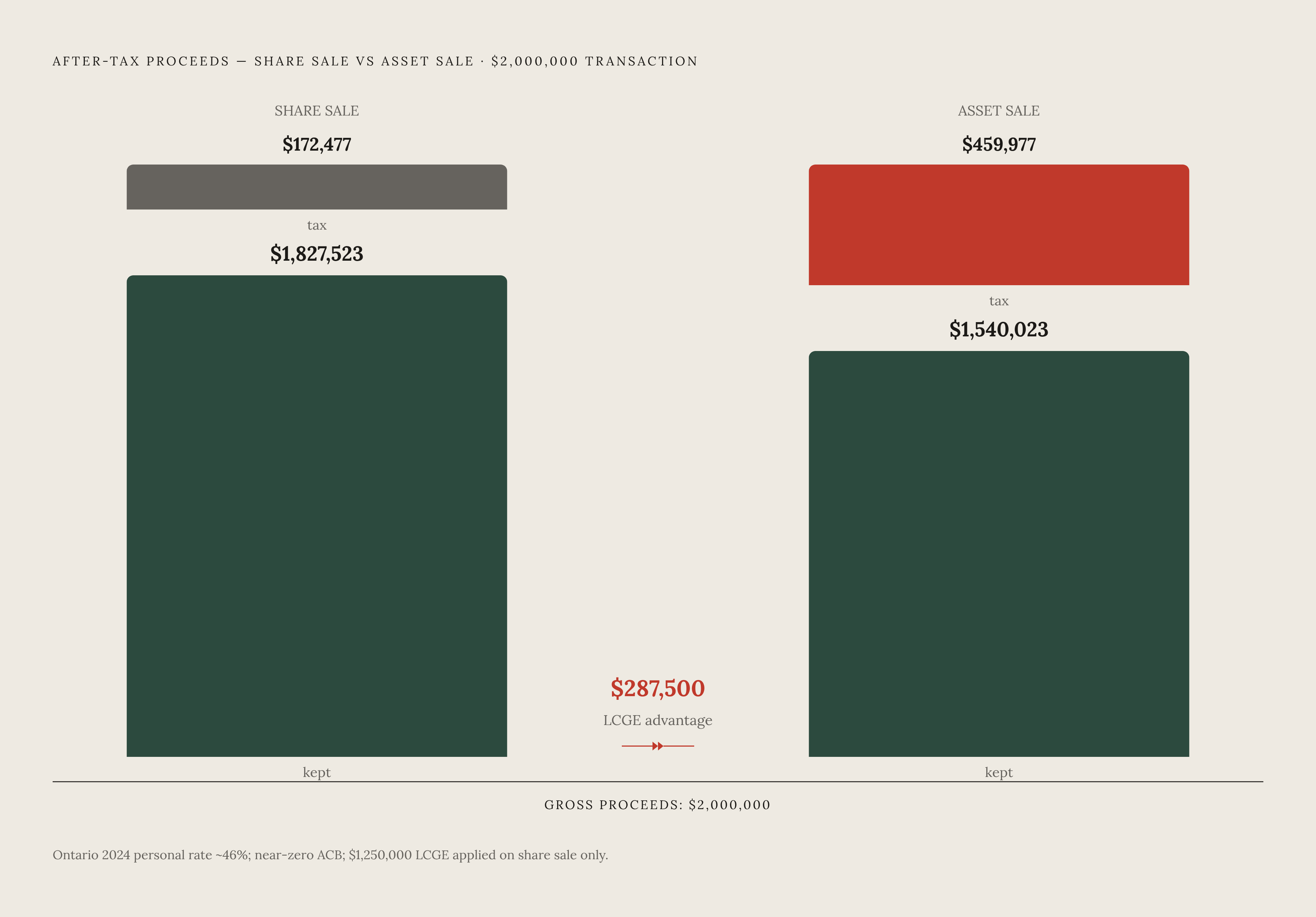
A quick illustration makes the gap concrete. Say a business sells for $2,000,000 with a nominal adjusted cost base on the shares, producing a capital gain of roughly $1,999,900. Claim the full $1,250,000 LCGE against that, and the remaining taxable capital gain, at 50% inclusion, comes to about $374,950. At an Ontario personal tax rate near 46% on that taxable amount, the bill lands around $172,477. Without the LCGE, tax on the full gain at 50% inclusion runs closer to $459,977. The exemption, in this case, is worth roughly $287,500 in the seller's pocket. That's a substantial figure on a term sheet, not a rounding error. That's the exemption doing the actual work of the deal.
Getting there means clearing three separate tests under the small business corporation exemption. At the time of sale, 90% or more of the fair market value of the corporation's assets has to be used principally in an active business carried on primarily in Canada. Looking back over the 24 months immediately before the sale, more than 50% of asset value must have been used the same way. And the shares can't have been owned by anyone other than the seller, or a related person or partnership, during that same 24-month window.
Cash sitting on the balance sheet, marketable securities, and other passive holdings can quietly push a corporation below that 90% threshold. That's why "purification" strategies, paying out passive assets as dividends or redeploying them into active use, need to start well ahead of the sale, not in the final quarter before closing. Owners who wait tend to find out the hard way that purification isn't a paperwork fix you do the week before signing.
There's a multiplication angle too. A properly structured family trust can let multiple beneficiaries, a spouse, adult children, each claim their own LCGE against the same sale. On a $2 million-plus transaction, that structure can materially change the family's total after-tax outcome. Section 84.1 of the Income Tax Act stands as a guardrail here, and it's a sharp one: it can deem a dividend and strip away LCGE access when shares get sold to a non-arm's-length corporation, say an adult child's holding company, in exchange for shares or notes from that corporation.
Budget 2024 layered in the Canadian Entrepreneurs' Incentive on top of all this, cutting the capital gains inclusion rate in half on up to $2 million in gains per individual over a lifetime, on qualifying share dispositions. It phases in at $200,000 per year starting January 1, 2025, climbing to the full $2 million by January 1, 2034, and applies to dispositions on or after January 1, 2025.
Double taxation in an asset sale and how it erodes the seller's effective proceeds
This is where the asset sale structure costs the seller real money if nobody plans for it. The corporation is the legal seller in an asset deal, not the individual shareholder, so sale proceeds land inside the corporation first. Getting that money into personal hands is a second, separate tax event, and that second event is exactly what a lot of first-time sellers don't see coming.
Two layers of tax stack up. The corporation pays tax on the gain from each asset sold, and different categories generate different treatment: recapture is fully taxable as income, a goodwill gain gets partial capital treatment, inventory proceeds count as active business income. Then, to actually get what's left into personal hands, the shareholder generally takes a dividend, or winds up the company, which triggers personal tax on the same dollars a second time.
Depending on the asset mix, corporate tax layered onto personal tax on extraction can consume the majority of each dollar of gain on certain categories. That's the double taxation problem in one sentence, and it's why sellers who understand the mechanics negotiate asset deals differently than sellers who don't.
A short worked example makes it tangible. Equipment in Class 10, bought for $150,000, with undepreciated capital cost down to $80,000, sells for $120,000. That produces $40,000 of recapture, taxed as fully includable income at the corporate level, no capital gains treatment available. Goodwill, sold separately for $400,000 with no tax cost, gets 50% capital gain treatment and flows into Class 14.1. Corporate tax hits the taxable portion first, and personal tax hits again once the shareholder pulls the money out as a dividend.
The Capital Dividend Account softens this without eliminating it. The non-taxable half of a capital gain flows into the CDA and can be paid out as a tax-free capital dividend, a real relief valve, though not a full escape hatch.
A seller who's run this math will demand a higher headline price in an asset deal, since only a higher price in that structure can net the same after-tax number a cleaner share sale would produce. Whether the buyer's benefit, avoiding inherited liabilities, justifies paying that premium is exactly the negotiation both sides end up having, whether they call it that or not.
Multiple shareholders complicate this further. In an asset sale, everyone sits under the same corporate-level tax event regardless of their individual cost basis, personal tax bracket, or liquidity needs. Nobody manages their own outcome independently. A share sale flips that: each shareholder sells their own shares and manages their own tax position, which is one more reason multi-owner businesses lean toward share deals when they can get one.
How buyers discount their offer in a share sale to compensate for what they don't get
The no-step-up rule cuts both ways, and this is the buyer's side of the ledger. Because Canada offers no mechanism to reallocate the share purchase price onto underlying assets to generate a fresh depreciation base, the buyer inherits whatever UCC the seller had left, often a fraction of what the business is actually worth today.
What does that cost in practical terms? Lower future CCA deductions, since the depreciation shield calculates against the old, depleted basis rather than the new purchase price. Any future disposal of those assets by the acquired corporation generates a gain measured against the seller's original cost, not what the buyer paid to get in. And there's latent tax exposure sitting inside assets already substantially depreciated, a liability the buyer now owns without having created it.
So buyers do the one thing available to them. They lower the offer. The discount on a share deal reflects, in large part, the future tax deductions the buyer is forgoing compared to what they'd get structuring the same deal as an asset purchase. Layer on the wider due diligence costs, auditing full tax history, chasing contingent liabilities, and the risk premium buyers attach to unknowns they can't fully price, and the opening bid on a share deal often lands below what the seller expected going in.
Indemnities and holdbacks are the standard tool buyers use to manage that residual risk. But those mechanisms cut into the seller's proceeds at the moment of sale, and stretch uncertainty out well past closing, sometimes for years, depending on the holdback term negotiated.
Put both sides together and the picture sharpens. The seller's premium demand on an asset deal and the buyer's discount on a share deal are the same force pulling from opposite directions. Structure shapes the price from the start, not something bolted on after the fact, and treating it as an afterthought is the single most common mistake owners make heading into a sale.
The capital gains inclusion rate uncertainty and how it has been affecting deal pricing since 2024
Budget 2024 proposed raising the capital gains inclusion rate from 50% to two-thirds for corporations and trusts, and to two-thirds on the portion of individual gains above $250,000 annually, effective for gains realized on or after June 25, 2024. The Parliamentary Budget Officer estimated the change would raise $17.4 billion in additional income tax revenue between 2024-25 and 2028-29.
Then implementation got pushed to January 1, 2026, and later cancelled outright, leaving owners and advisors trying to model after-tax deal values against a moving target for the better part of two years. According to CFIB, both major federal parties pledged to abandon the inclusion rate increase, but the legislative status has remained unsettled following subsequent deferrals enough that anyone modeling a deal should confirm the current rule with a tax professional rather than assume it's settled.
One thing that didn't move through all that turbulence: the 2024 LCGE increases, from $1,016,836 up to $1.25 million, stayed in effect. Sellers planning around LCGE access have had noticeably more certainty to lean on than sellers trying to model inclusion rate assumptions into a deal price. That asymmetry itself is worth noticing: the exemption held steady while the inclusion rate whipsawed, which tells you where the government's actual appetite for reversal sat.
That raises an important question for anyone negotiating right now. When inclusion rates are in flux, the relative advantage of a share sale, capital gain treatment at 50% inclusion plus LCGE access, over an asset sale, corporate-level income with no exemption, widens or narrows depending on which rate ends up applying. Sellers who closed during the uncertainty window may find, in hindsight, that they priced the deal against an assumption the eventual law didn't bear out.
For owners still working toward an exit, that whiplash serves as a lesson about the fragility of relying on tax policy as a fixed input. It argues for starting the structural conversation early, well before a term sheet is on the table, rather than trying to untangle asset-versus-share economics in the final weeks before closing.