Normalized EBITDA Add-Back Adjustments Buyers Will and Will Not Accept
Buyers reject most add-backs based on four predictable criteria sellers ignore.

Adjusted EBITDA sets the price in most lower middle market deals, and the add-back schedule (the list of expenses a seller argues shouldn't count against earnings) is what determines whether that price survives past LOI. Most sellers still treat the schedule as a negotiating document, something to be argued over and softened. That's the wrong way to think about it. It functions closer to a legal brief: every line needs a source document behind it, or a buyer's diligence team will strike it and take the enterprise value down with it.
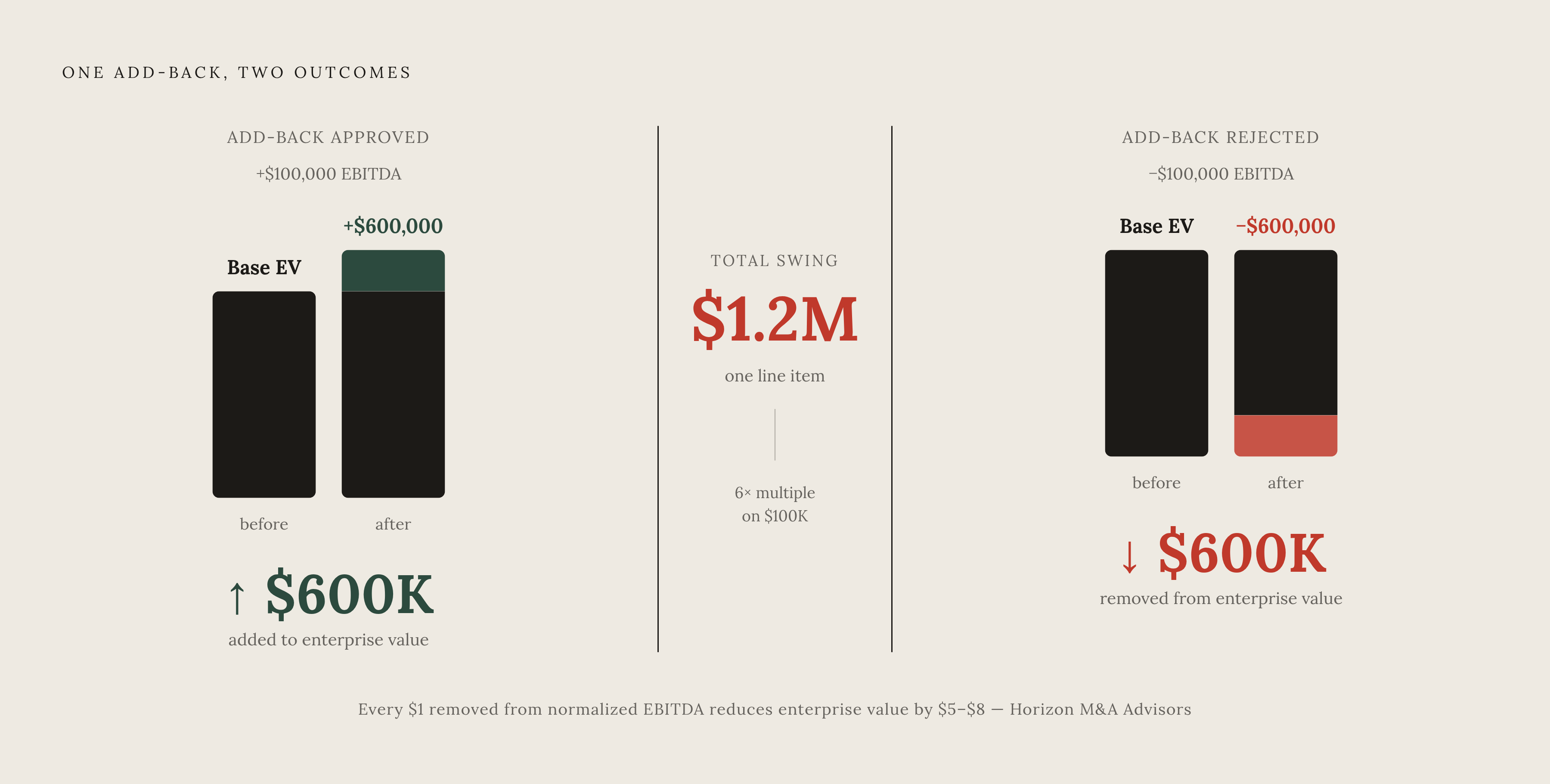
Run the math and the stakes get concrete fast. At a 6x multiple, a $100,000 add-back that survives Quality of Earnings review is worth $600,000 in enterprise value. The same add-back, rejected during that same review, costs the seller $600,000 at closing, according to Sofer Advisors. Horizon M&A Advisors puts the ratio even more starkly: in a typical lower middle market deal, every dollar knocked out of normalized EBITDA can reduce enterprise value by $5 to $8. So when a QoE-validated number lands 10 to 20% below what the seller originally claimed, that isn't a rounding error. That's where the deal's value quietly leaks out, dollar by dollar, line by line.
This dynamic is a leading reason letters of intent get re-traded after signing. Owner add-back disputes tend to surface deep in diligence, and by then the seller is negotiating from a weaker position than the one they had at LOI. Call that what it is: a preparation failure, not a negotiation failure. Buyers apply a consistent, learnable set of criteria to every add-back they see, and most sellers never bother to learn it before they need it. The rest of this piece maps which adjustments survive, which get rejected, and why the logic holds across deals of very different sizes and sectors.
How buyers categorize adjustments before they evaluate any individual line
Before a buyer's diligence team looks at a single dollar figure, they sort the entire adjustment bridge into layers. Sellers who skip this sorting step, and most of them do, are a big part of why so many add-back schedules come back contested line by line instead of accepted wholesale.
The first layer is definitional: interest, taxes, depreciation, amortization. These are mechanical, baked into the definition of EBITDA itself, and they're the least contested items on the whole schedule because no judgment call is involved. Nobody argues about whether depreciation belongs in the bridge.
The second layer is where the friction starts: quality-of-earnings adjustments. One-time items that, in theory, won't recur under new ownership. A settled lawsuit. Severance tied to a restructuring that already wrapped. Proceeds from a building sale. Buyers scrutinize these heavily, not because the concept is unfamiliar, but because "one-time" is a claim that has to be proven with documents, not asserted with confidence.
Third comes normalization: recurring items priced incorrectly relative to the market. Owner compensation set above what an independent hire would cost, related-party rent above market rate, family members drawing a paycheck without a defined role. These get benchmarked against outside data, never against what the seller believes is fair compensation for building the company.
A fourth source that sellers rarely put on their own schedule at all is adjustments the buyer's team finds independently, accounting normalizations and consistency issues the seller either missed or didn't disclose. A final category sits apart from the rest entirely: pro forma adjustments, reflecting expected future changes rather than historical fact. These are the most judgment-driven of the group, and, unsurprisingly, the most contested.
One operating principle ties all five layers together, and it's worth stating plainly because sellers routinely underestimate it: the burden of proof sits with the seller, on every single line, without exception. Buyers reconstruct the numbers from source documents, invoices, bank statements, payroll records, board minutes, rather than accepting the recast schedule as written, and they test each adjustment against four traits. Source documentation. A credible non-recurrence narrative. A market-rate benchmark where one applies. Comparability to how similar deals have handled the same issue. An adjustment can clear the "is this really one-time" test and still fail on documentation alone. Both hurdles have to clear, not just one, and sellers who only prepare for one of them are the ones who get blindsided in week three of diligence.
The adjustments that consistently clear Quality of Earnings review
Some categories pass often enough that buyers barely blink at them. Owner compensation adjustments and one-time legal fees get accepted at well above 80% in QoE reviews, a sharp contrast with pro forma and synergy adjustments, which get rejected far more often than they're approved.
Excess owner compensation is the biggest and most reliable category, but only the excess counts, never the whole figure. That distinction is where most sellers get it wrong. If an owner takes home $450,000 and an independent CEO replacement would cost $220,000, the defensible add-back is $230,000, not the full salary. Buyers pull published compensation data for the company's revenue tier and industry to set that benchmark, and the seller's own opinion of their worth doesn't enter the calculation at all. CT Acquisitions flagged, in a 2026 analysis, that adding back the entire owner salary instead of just the market-rate excess is the single most common mistake sellers make on their recast schedule. It's also an easy one for a buyer's analyst to catch coming from a mile away.
Genuine one-time costs clear review too, when they're actually one-time. Litigation settlements with documented resolution, relocation expenses, consulting fees tied to a specific completed project, severance from a restructuring that's already wrapped, transaction costs tied to the M&A process itself. The test buyers apply is simple: scan three to five prior years and see if the same expense category shows up again and again. If it does, it's a cost of doing business, not an anomaly, no matter what label the seller stamps on it.
Personal expenses run through the business are defensible too, as long as the paper trail is clean. Personal vehicle leases, family travel, home utility bills, club memberships, personal insurance premiums. These survive when they're clearly separated from operating expenses with invoices and statements behind them, and that documentation bar keeps rising every cycle. Buyers increasingly want the credit card statement and the general ledger entry side by side, not a management team's word that the expense wasn't business-related.
Non-cash charges round out the easiest category to defend: stock-based compensation, impairment write-downs, unrealized foreign exchange gains or losses, gains or losses on asset sales, inventory write-downs tied to a specific one-time event. These face the least scrutiny of any adjustment type, because every buyer's own financial model already treats them as non-cash by definition, before the seller even brings them up.
Related-party rent gets a narrower allowance. Only the portion above market rate gets added back. Rent priced at or below market stays exactly where it sits in the expense line, and this category gets contested often, mostly because sellers show up without the appraisal or comparable lease data needed to prove the market rate in the first place.
What connects every accepted category is one test: would a rational buyer, stepping into ownership tomorrow, still incur the expense at the same level? Buyers model the business as they intend to run it, and when an expense disappears cleanly under that model, the add-back holds. S&P Global data puts add-backs at roughly 29% of adjusted EBITDA in the average sale process, so buyers walk in already expecting some normalization. What they interrogate is whether each line clears the core tests described above: documented, non-recurring, benchmarked, and comparable.
The adjustments buyers reject and the specific logic behind each rejection
Rejection follows the same logic in reverse. An adjustment fails one of the four tests, and the buyer's team can point to exactly which one, on the record, without much debate.
Recurring expenses mislabeled as one-time top the list, and it isn't close. If an expense shows up in the general ledger across multiple prior years under the same category, calling it one-time in the current year won't survive an analyst's first pass through the file. Not Very Private Equity put it bluntly: if "one-time" items show up every year for four years running, they're recurring, full stop, and buyers read the GL history rather than whatever label the seller put on the line. That's exactly why diligence teams pull three to five years of general ledger detail, P&L statements, tax returns, and vendor expense records. The pattern-matching happens fast, typically early in the diligence process.
Pro forma synergies and projected cost savings get rejected almost as a rule, and sellers who lean on this category tend to be the ones most surprised at re-trade. Any adjustment that depends on what the buyer plans to do after closing doesn't belong in the seller's normalized EBITDA, because that value hasn't been created yet, and it's the buyer, not the seller, who'd have to go create it. Not Very Private Equity calls the worst offenders "fictional cost cuts," run-rate synergies dressed up as though they already happened. S&P Global data shows this category accounts for roughly 26% of add-backs across the average deal process, and it is a significant driver of re-trading after LOI. The skepticism has real data behind it: only about 8% of companies actually hit their adjusted EBITDA projections in the first year after close, per S&P Global. Buyers know that number cold, so they price speculative adjustments at zero and move on without much argument.
Ongoing restructuring costs and routine IT spending get treated as real, recurring costs of running the business, not one-time events dressed up for the schedule. IT investment in particular gets classified as capital expenditure in most buyer models, never as an EBITDA add-back, no matter how the seller frames it.
COVID-era adjustments are close to dead on arrival by 2025 and 2026. Not Very Private Equity noted that even adjustments made in 2021, close to the actual disruption, were already considered aggressive at the time. Adding back "lost COVID revenue" several years removed from the event doesn't hold up to any buyer's scrutiny today. It reads as reaching, not reconstructing.
Missed budget and hypothetical performance claims fail for a simpler reason: they aren't facts. "We would have hit $X in EBITDA if the team had executed better" is a hope, not a historical result, and buyers price the business on what actually happened. The same logic kills customer concentration adjustments. If the largest customer churned, that churn is the business reality sitting on the table, and arguing that EBITDA would have been higher had that customer stayed doesn't change what a buyer is actually pricing.
Run-rate revenue annualized without its corresponding cost base is a subtler rejection, but a consistent one. New customer revenue doesn't arrive cost-free. It requires account management, implementation staff, sales commissions, working capital, sometimes capital expenditure on top. A schedule that annualizes the revenue from a new contract without annualizing the cost of servicing it gets flagged fast, because it overstates margin on business that hasn't even matured yet.
The full owner compensation add-back deserves repeating here, not as an acceptance nuance but as the leading rejection pattern in the whole schedule. Adding back the entire salary instead of only the above-market portion remains, per CT Acquisitions' 2026 analysis, the single most common seller error on the recast. It can cut the other direction too. If an owner is actually underpaid relative to market, normalization runs backward, and buyers will subtract the market-rate replacement cost even when it exceeds what the owner currently draws. That can turn an assumed add-back into a net deduction the seller never saw coming.
Adjustments that sit in the grey zone and what determines which way they go
Not every adjustment sorts cleanly into accepted or rejected. The grey zone is real: these items aren't disputed because buyers don't understand the concept behind them. They're disputed because the amount, the timing, the documentation, or the post-closing treatment is genuinely ambiguous, and reasonable people can land on different answers about the same fact pattern.
Take marketing underinvestment. If a business has been spending well below its own historical percentage of revenue on marketing, say running at half the rate it maintained three years earlier, buyers may push for a downward adjustment reflecting what marketing should actually cost under normal operating conditions going forward. Sellers rarely see this one coming, because it's a normalization that works against them. It reduces reported EBITDA instead of inflating it, and sellers who haven't modeled for it get blindsided at the LOI stage when the buyer's team introduces it as a negative line.
Pro forma annualization for a mid-year acquisition sits right on this line too, but which side it lands on depends entirely on execution status. If a business acquired mid-year has a trailing twelve months that doesn't reflect a full year of combined earnings, annualizing that partial period to represent a full year is a legitimate, commonly accepted adjustment. Push the same logic one step further, projecting synergies or cost savings that haven't actually been implemented yet, and it slides straight into the rejected "future savings" category from the last section. The dividing line is whether the structural change already happened or is still on the roadmap. Already happened, it survives. Still planned, it gets challenged and usually loses.
Buyer type matters more here than in almost any other category on the schedule. A strategic buyer that already runs the exact cost synergy inside its own operations might accept the adjustment without much friction, because the capability already exists. A financial buyer with no comparable infrastructure won't extend the same credit, since it would have to build that capability from scratch to ever realize the saving. Sellers running a competitive process with both buyer types in the room should expect divergent conclusions on the identical line item, which is itself useful information about where the real value sits.
Not every buyer applies the same rigor, either, and that inconsistency matters more than sellers assume. Less experienced diligence teams, or lenders more focused on covenant coverage than earnings quality, sometimes accept adjustments a seasoned private equity buyer would reject outright. That's part of why running a process with multiple bidders in parallel surfaces real differences in how aggressively an add-back schedule actually gets tested.
Bad debt add-backs land in the grey zone for a related reason. A single, documented collection failure is defensible as one-time, per Sofer Advisors, as long as the documentation supports a genuine non-recurrence narrative. A pattern of recurring bad debt across multiple years is a recurring cost of doing business, and buyers will read it as a signal about underlying business quality rather than an isolated event.
How the QoE process works and where seller add-backs actually break down
The Quality of Earnings firm works for the buyer, never the seller, and that structural fact shapes everything about how the review unfolds from day one. The QoE team builds its analysis from source documents rather than the seller's recast schedule: bank statements, invoices, payroll records, board meeting minutes. Every add-back gets traced back to a primary document, and if that document doesn't exist or doesn't support the claimed amount, the adjustment doesn't survive the trace. That's the mechanism, and it's a lot less forgiving than most sellers expect going in.
Three things happen in that process that sellers often don't see coming, according to Livmo. The analysts rebuild adjusted EBITDA from scratch, independent of whatever number the seller landed on. They test every non-recurrence claim against three to five years of transaction history, and any adjustment that pattern-matches to a prior year gets reclassified as recurring on the spot. And they normalize owner compensation against published market data for the specific revenue tier and industry, not against what the seller believes their own labor is worth.
This is why adjusted EBITDA so often falls during diligence instead of holding steady at the number the seller walked in with. The usual culprits include recurring expenses buried inside the seller's own add-backs, temporary revenue that won't repeat, costs the seller's model left out entirely, under-accrued liabilities, rent priced below market without adjustment, customer concentration risk, weak financial controls, and plain discrepancies between what management reported and what the source records show. The typical gap between the seller's reported figure and the QoE-validated figure runs 20 to 30% of EBITDA. Gaps that run wider than that range signal to buyers that the schedule was built aggressively rather than defensibly, and it changes how they read everything else in the room.
That's the part that does the real damage, and it's worth sitting with. When a QoE team finds even a handful of unsupported or clearly recurring items inside the earnings bridge, the fallout doesn't stay contained to those specific lines. the credibility of every other adjustment on the schedule comes into question the moment a few weak ones get caught. Buyers don't just reverse the bad lines. They start re-examining everything, because if the seller was aggressive there, where else might they have been aggressive? The extreme version is an owner presenting a schedule where add-backs represent a substantial share of reported EBITDA. Experienced buyers know what typical adjustment ratios look like for a business of that size in that trade, and a ratio that far outside the norm reads as a red flag before a single line item gets checked in detail.
That's also why the window between LOI and closing is where value quietly disappears most often. A failed add-back schedule is among the most common causes of that erosion, according to Livmo, precisely because disputes surface late, after the seller has already anchored expectations to the higher number.
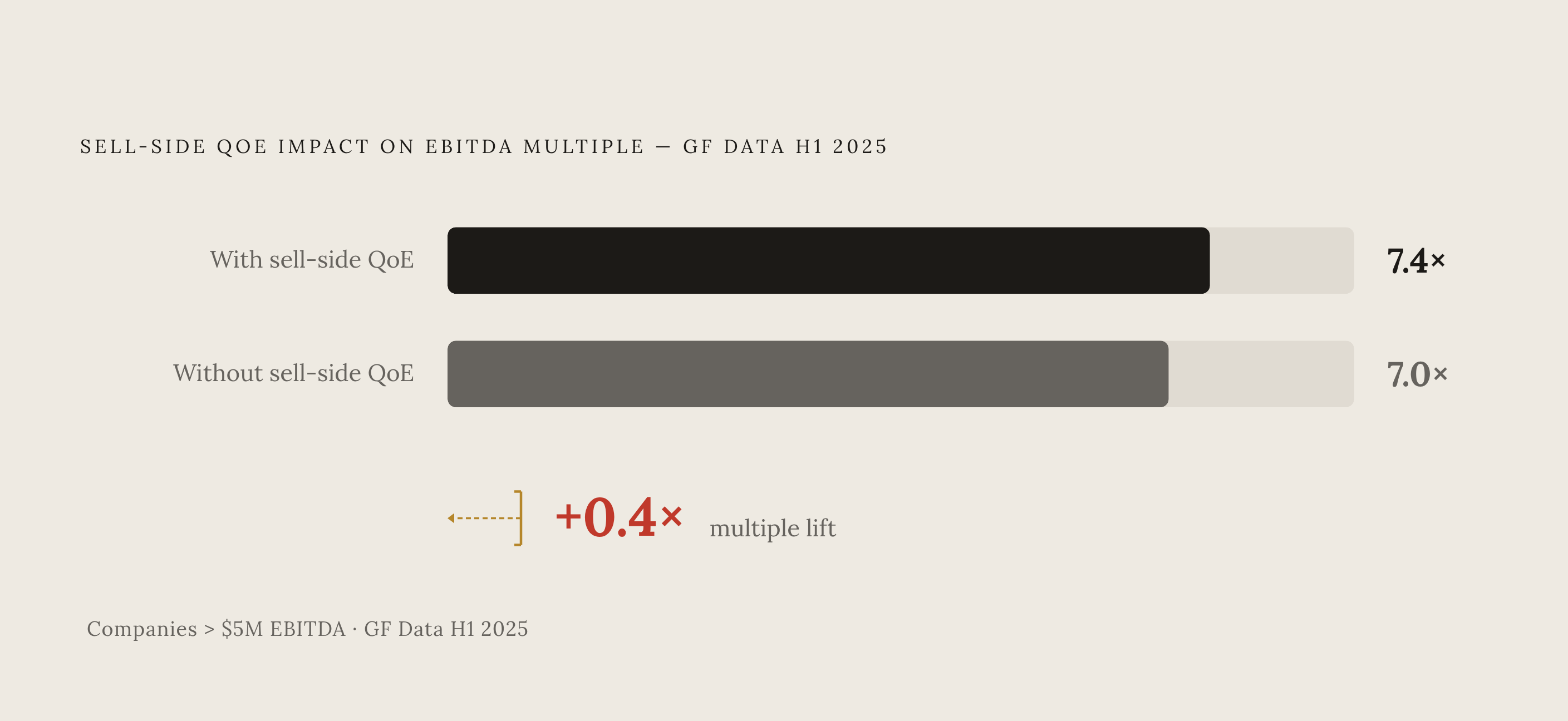
One preparation lever is worth naming directly here, because it's measurable and it's the clearest argument in this entire piece for doing the work early. GF Data's H1 2025 figures show that deals above $5 million in EBITDA that used a sell-side QoE, testing the earnings bridge before it ever reaches a buyer's desk, closed at 7.4x multiples on average, versus 7.0x for deals that skipped the step. A 0.4x lift isn't nothing on a deal of any real size, and it's attributable, at least in part, to walking into negotiation with a bridge that's already survived independent scrutiny once.
What sellers can do before going to market to build a defensible add-back schedule
Run the prior-year test on every single line before a buyer ever gets the chance to. Pull three to five years of general ledger detail and check whether each proposed add-back's expense category shows up in earlier periods. If it does, reclassify it as recurring or drop it from the schedule outright, because a buyer's analyst is going to run this exact check in the first week of diligence regardless. Finding it first costs nothing. Finding it second costs multiples, and it costs credibility on every other line right alongside it.
Document every line to the standard a buyer's QoE firm will actually demand, not the standard a seller's own bookkeeper considers good enough. Invoices, signed contracts, payroll records, litigation resolution documents, board minutes. The narrative, the story behind why an expense doesn't belong in the earnings run rate, matters far less than the paper trail sitting behind it. A well-organized set of source documents, tied line by line to the recast schedule, protects enterprise value more than any amount of persuasive argument during a live negotiation ever will.
Use published compensation benchmarks, matched to the company's actual revenue tier and industry, to set the owner compensation add-back before a buyer sets it instead. Sellers who calculate their own market-rate replacement cost ahead of time, using the same category of data a buyer's team will eventually pull anyway, walk into diligence with a number that's already been stress-tested rather than one that gets discovered and disputed later. That single step closes off the most common seller error in the entire process: claiming the full salary as an add-back instead of only the portion sitting above what an independent hire would actually cost.
None of this eliminates negotiation entirely. Grey-zone items will still get argued line by line, buyer type will still shape the outcome, and a strategic buyer will always read synergy differently than a financial one does. But the adjustments that consistently clear review share four traits, and every one of them sits within a seller's control long before a buyer ever sees the schedule. Those traits are documentation, a credible non-recurrence story, a market benchmark, and comparability to how the same issue gets treated elsewhere in the market. Build the schedule against those four traits from day one, and the number a buyer's QoE team eventually arrives at stops being a surprise. It starts looking a lot like the number the seller already had sitting in the file.
Sources
- Adjusted Ebitda Add-backs: A 2026 Deep Dive · Iconic
- EBITDA Adjustments Buyers Reject: 6 Add-Backs That Can Cost Sellers Millions
- EBITDA Add-Backs: What Buyers Accept vs. Reject - Livmo
- EBITDA Add-Backs: What Buyers Accept and What They Reject | Sofer Advisors
- Adjusted EBITDA Add-Backs in a Business Sale (2026): What Buyers Actually Accept | CT Acquisitions
- Normalized EBITDA: What It Is and Why Buyers Care
- notveryprivateequity.com