Due Diligence Checklist for Selling a Profitable Small Business
Organize your documents before the buyer asks for them to avoid price cuts and speed up the closing.

Selling a profitable small business comes down to one question buyers keep asking in different forms: can you prove what you're telling me is true? Due diligence is where that question gets answered, and sellers who control the answer, instead of scrambling to produce it on demand, close faster and keep more of their asking price. This piece walks through what that preparation actually looks like, document by document, because the sellers who build the file before anyone asks for it are the ones who don't watch their price erode in week five of a ninety-day window.
Due diligence begins once a letter of intent is signed and typically runs 30 to 90 days, with 45 to 60 days roughly average for smaller transactions. The buyer's goal during that window is to check every claim in the offering materials against the underlying records, hunting for reasons to reprice the deal or walk away. They are usually running financial verification, legal review, and an operational assessment simultaneously, often alongside an SBA lender or equity partner who brings a separate checklist. Five categories of documents cover most of the ground a seller needs to prepare: financials, corporate and legal records, contracts, operations and HR, and tax and compliance.
The market backdrop makes this worth taking seriously. BizBuySell recorded 9,586 small business transactions in 2025, up 0.4% year-over-year, with total enterprise value across those deals reaching $7.95 billion. SBA lending hit a record 77,600 loans in fiscal year 2025. Buyers are out there, and money is available to them. Yet the Exit Planning Institute's widely-cited figure holds that only about 30% of businesses that go to market actually sell, and Pepperdine's 2025 Private Capital Markets Report puts the advisor-side failure rate at 31% of engagements ending without a transaction. So what happens to the other seven in ten?
Pepperdine's data points to valuation gaps as the leading cause of dead deals. But the second-largest cause, running close behind pricing disagreements, is what diligence turns up once a buyer starts checking the seller's story against the paperwork. Put those two together and a pattern emerges: a business priced above what its own records support is going to get caught, and the catching happens during diligence. Preparation is the one move that fixes both problems at once, because a seller who has already reconciled the numbers never sets an expectation the file can't back up in the first place.
What does the due diligence process look like when selling a small business?
Due diligence, from the seller's side of the table, is a defined stretch of time (usually starting once a letter of intent is signed) during which the buyer checks every claim in the offering materials against the underlying records. Sit with that for a second, because it reframes what's actually happening. The buyer already likes the business enough to have signed an LOI. What they're doing now is hunting for reasons to reprice it, or reasons to walk.
Timelines vary by deal size, but 30 to 90 days after LOI is the typical window, with 45 to 60 days roughly average for smaller transactions. The IBBA Market Pulse survey puts the lower middle market window closer to three or four months. Zoom out further and BizBuySell's 2025 data shows the median small business took 170 days from listing to close. Add the two to three months most owners spend on pre-listing prep, and you're looking at eight or nine months from the decision to sell to money actually landing in the bank. Diligence sits in the middle third of that timeline, and it's the third most within the seller's control.
While the clock runs, the buyer isn't working alone. They're usually coordinating financial verification, legal review, and an operational assessment at the same time, often alongside an SBA lender or an equity partner who brings a completely separate checklist to the table. Every one of those parties can generate a follow-up request, and every follow-up request adds days.
Here's the lever a seller actually holds: the more organized the data room going in, the fewer follow-up requests come back, the shorter the window runs, and the less room a buyer has to manufacture a pricing objection out of a document gap. Five categories of documents cover most of the ground: financials, corporate and legal records, contracts, operations and HR, and tax and compliance. The rest of this piece works through each one.
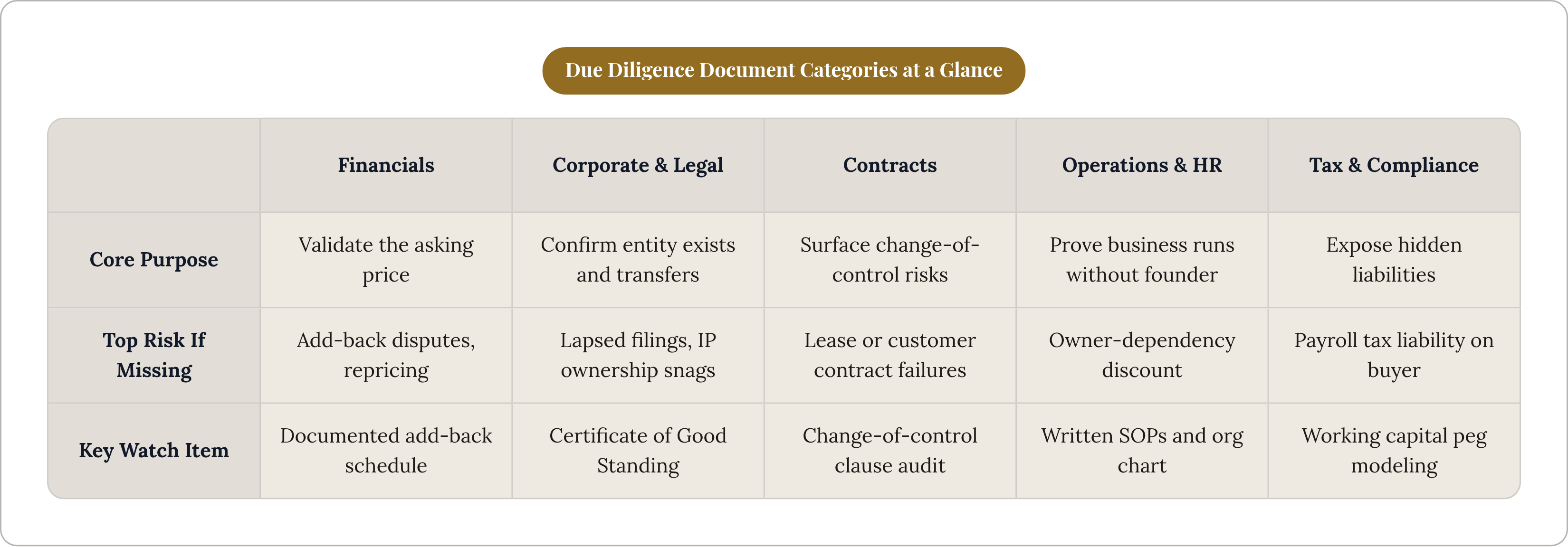
Financial documents: the records that set (or undermine) your valuation
Buyers start here because this is where the price came from. Expect requests for three to five years of tax returns, bank statements, and detailed profit and loss statements, and expect the request to specify monthly detail, not annual summaries. Annual numbers hide things. Monthly numbers expose seasonality, cash flow cycles, and the one bad quarter that didn't make it into the story the seller told in the offering memo.
Bank statements exist to verify, not to describe. A buyer's accountant matches deposits against reported revenue, and any gap between the two gets flagged right away, no matter how innocent the explanation turns out to be later. It's a mechanical check. It either passes clean or it doesn't.
Then there's customer concentration. A revenue-by-customer schedule tells a buyer how dependent the business is on any single account, and in 2026, concentration above a meaningful threshold in one customer gets treated as a named risk factor, not a footnote. If a fifth of revenue walks out the door on one contract renewal decision, that's a real vulnerability, and the buyer is pricing it in whether the seller addresses it or not.
Recast EBITDA, sometimes called adjusted EBITDA, is where most valuation arguments actually happen. Roughly 76% of advisors use it as the primary valuation method, which means the add-backs (the owner's personal car lease, a one-time legal settlement, the family member on payroll who didn't really work there) carry enormous weight. Every add-back needs a receipt and a plain explanation, because an undocumented add-back doesn't just get rejected on its own; it makes the buyer suspicious of every other number in the file. Here's what's actually riding on this: BizBuySell's 2025 average SDE multiple across its transaction base was 2.61x, while lower middle market deals in the $5 million to $50 million enterprise value range typically trade at 5.5x to 6.5x EBITDA. Multiply an unsupported add-back by that multiple and a few thousand dollars of sloppy bookkeeping turns into a five- or six-figure valuation fight.
Round out the file with current year-to-date financials and a forward projection that states its assumptions plainly. Buyers need a bridge connecting historical performance to the number on the asking price. An unsupported projection just reads as wishful thinking.
The full list for this section: three to five years of tax returns (business, and personal for sole proprietors); three to five years of P&L statements, balance sheets, and cash flow statements broken out monthly; current year-to-date financials; matching bank statements; a revenue-by-customer schedule; a documented add-back schedule with receipts; and forward earnings projections with stated assumptions.
Whether a Quality of Earnings report belongs in your preparation
A Quality of Earnings report, usually shortened to QoE, occupies narrower ground than either an audit or a valuation. It examines the composition and consistency of earnings, specifically whether the cash flow the business reports is the cash flow a new owner can actually expect to keep collecting.
A QoE tends to surface a handful of specific things. One-time items that inflated a given year's earnings. Revenue recognized on a timeline that doesn't match when the cash actually showed up. Normalized working capital needs. Whether last year's numbers were genuinely repeatable, or whether they were, in some quiet way, an outlier nobody flagged.
A seller might reasonably wonder whether a seller-commissioned QoE is worth the expense on a deal that's already getting scrutinized by the buyer's own team anyway. But it signals something the buyer's team notices immediately: a seller who walks into diligence with a QoE already in hand is telling the buyer, without saying it outright, that there's nothing left to find. That posture tends to shorten the diligence window on its own, since it removes the buyer's leverage to reprice off a surprise. The report typically costs in the tens of thousands of dollars, which sounds steep until you set it against the multiple it's protecting. On a business doing several million in revenue at a 5.5x to 6.5x multiple, the QoE fee is a rounding error next to what a single repricing conversation could cost.
It earns its cost most clearly when a business carries significant owner-related add-backs, irregular revenue patterns, or an accounting change buried somewhere in the prior three years that needs an actual human being to explain in plain language. IBBA data suggests sellers who show up without clean financials get asked more often to accept earnouts, seller notes, or drawn-out payment timelines, structures that push the risk back onto the seller. A QoE is one of the more direct ways to avoid landing there.
Not every business needs one. For sellers under roughly $1 million in SDE, a reviewed financial statement or a broker-prepared recast gets close to the same result at a fraction of the cost. Think of it as a sliding scale rather than a rule; a multimillion-dollar business and a sub-million-dollar one aren't playing by the same math here.
Corporate and legal documents: what buyers need to confirm the business is real and transferable
Before a buyer cares about a single dollar of revenue, they want to confirm the entity selling it actually exists in good standing and can legally transfer what it claims to own. That starts with the Articles of Incorporation or Organization, the bylaws or operating agreement, and every amendment made to either one over the years.
The minute book matters more than most sellers expect. It's the record of what the board or the members actually decided, as opposed to what everyone informally agreed to over lunch somewhere. Buyers read it because a business run on handshake decisions for years can bury ownership disputes or unresolved obligations that never made it onto paper anywhere else.
Ownership itself needs its own file: a cap table, stock or unit ledgers, any outstanding options or warrants, and buy-sell agreements among current owners. On top of that sits the Certificate of Good Standing, issued by the state or province of registration, confirming the entity is active and compliant. Sounds like a formality until you realize how often it isn't. Businesses that have run informally for a decade sometimes discover, at the worst possible moment, that a filing lapsed years ago and nobody noticed until now.
Intellectual property gets its own scrutiny too. Buyers want to see patents, trademarks, copyrights, and trade secrets registered to the business entity itself, not to the founder personally. That distinction sounds bureaucratic, but it's a common snag in practice; a logo or a piece of proprietary software registered under the owner's name rather than the company's can complicate a transfer in ways that eat weeks.
Licenses and permits close out the category: industry-specific licenses, municipal permits, and regulatory registrations, checked for current status and, just as important, for whether they transfer to a new owner at all or need to be reapplied for from scratch.
Full list: Articles of Incorporation or Organization and all amendments; bylaws or operating agreement; the minute book covering the last three to five years; cap table and stock or unit ledger; a current Certificate of Good Standing; IP registrations and assignment documents proving entity ownership; and every current license, permit, and registration, each noted for whether it transfers.
Contracts and agreements: finding the change-of-control risks before a buyer does
Here's the risk that catches sellers off guard most often: change-of-control clauses buried in contracts that give a customer, vendor, landlord, or lender the right to terminate or renegotiate the moment ownership changes hands. A seller who finds this six months before listing has a fixable problem on their hands. A seller who finds it during diligence, after the buyer's attorney already has, has a deal at real risk of falling apart.
The audit needs to run across several fronts at once. Customer contracts: which ones are actually written down, which exist only as a verbal understanding, which auto-renew, and which carry change-of-control language that could let a customer walk the day the deal closes. Vendor and supplier agreements: exclusivity terms, pricing that was negotiated on the strength of a personal relationship with the current owner, and any minimum purchase commitments that bind the buyer whether they want them or not.
The commercial lease deserves particular attention. Assignment rights, landlord consent requirements, remaining term, renewal options. Lease assignment failure is named as one of the top deal-killers going into 2026, and it's exactly the kind of thing that's easy to fix months in advance and expensive to fix in the final weeks before closing. Key employee agreements need the same review, specifically non-competes, non-solicits, and retention terms meant to survive a change of ownership. Loans and credit facilities carry their own landmines too: personal guarantees, change-of-control covenants, and prepayment penalties that can turn a clean payoff into an unpleasant surprise at the closing table. And if the business runs under a franchise agreement, factor in that franchisor approval of the incoming buyer often runs on its own separate timeline, entirely outside the seller's control.
The practical move is to build a contract summary schedule before anyone asks for one: one row per agreement, counterparty, term, renewal date, and a flag for whether change-of-control language exists. Where consent from a landlord, lender, or key customer will eventually be needed, start that conversation quietly before the business goes to market. Getting ahead of a consent requirement takes months of lead time; scrambling for it inside a 45-day diligence window is how deals slip their closing date, or don't close at all.
Operations and HR documents: demonstrating the business runs without you
Owner-dependency is one of the more expensive things a business can carry into a sale. Buyers, and the lenders financing them, discount heavily for a business where the relationships, the institutional knowledge, and the day-to-day decisions all live in one person's head. So here's a question worth sitting with honestly: if you disappeared tomorrow, would the business even notice?
Standard operating procedures answer that question in the buyer's favor better than almost anything else in the file. Written processes for customer onboarding, service delivery, vendor ordering, and quality control are direct evidence that the business runs on a system rather than on the founder's memory. An org chart backs this up by showing who actually does what, which roles are filled by employees versus contractors versus the owner wearing three hats at once, and where the gaps sit.
The HR file needs to be thorough: an employee roster with roles, tenure, and pay; employment and contractor agreements; the employee handbook and HR policies; any non-compete or non-solicit agreements with key staff; and a benefits summary covering health coverage, retirement contributions, and PTO obligations. None of this is exciting paperwork, but it's exactly what a buyer's team reads to figure out whether the workforce comes with the business or whether half of it walks the day ownership changes.
An equipment and asset schedule rounds out the operational picture: what's owned versus leased, condition notes, and any deferred maintenance sitting quietly in the background. Buyers and their lenders use this to confirm asset values line up with what's claimed, and deferred maintenance that surfaces late in diligence tends to get read as an overvaluation red flag rather than routine housekeeping. Current insurance policies (general liability, property, workers' comp, and errors and omissions where relevant) matter too, since buyers want continuity and sometimes require specific coverage as a condition of closing. Technology systems deserve their own line as well: software subscriptions, POS systems, CRM platforms, and any proprietary tools, each checked for whether the license and the underlying data actually transfer to a new owner or just terminate the moment the current one walks out.
Every document in this section answers the same question a buyer is really asking underneath everything else: pull the founder out on day one, and does the business keep running anyway?
Tax and compliance records: the liabilities that surface late and cost the most
Unpaid payroll taxes are named as a top deal-killer heading into 2026, and for good reason: depending on how the deal is structured, the IRS can hold a new owner responsible for a prior owner's payroll tax shortfall. That's not a negotiable point for most buyers. It gets treated as a binary pass or fail, with very little room to argue once it's found.
The request list here is predictable but unforgiving: federal and state or provincial income tax returns for three to five years, payroll tax filings with confirmation of current status, sales tax filings including a check for states or provinces where the business may have nexus but never actually filed, and any notices, audits, or correspondence from a tax authority. Add documentation of any tax elections, deferrals, or credits claimed along the way, because a buyer's accountant will want to understand exactly what those elections mean going forward.
Working capital peg disputes are their own named deal-killer, and they trip up more sellers than the phrase suggests. At signing, the buyer sets a normalized working capital target, and the actual number gets trued up at closing. Sellers who haven't modeled their own working capital needs independently, ahead of time, tend to walk into that negotiation with no leverage at all. They end up reacting to the buyer's number instead of bringing one of their own to the table.
For businesses with a physical location, equipment, or regulated materials, environmental compliance disclosure obligations vary by jurisdiction, and they're considerably easier to handle before a buyer's environmental consultant raises them unprompted. Industry-specific regulatory filings, covering things like food safety, health codes, or financial services compliance, deserve the same early attention, since gaps here connect directly back to the license transferability question from the legal section above.
Buyers find liabilities regardless of what a seller does; that's the whole point of diligence. The goal is to quantify and explain a liability before a buyer stumbles onto it cold, because the seller who raises the issue first controls how it gets framed, and the seller who gets caught by it controls nothing about what happens next.
How to organize and present documents so they work in your favor
All five categories above eventually land in the same place: a virtual data room, the structured, permissioned folder system that gives a buyer's team controlled access to everything they need without handing them everything they don't. The organizing principle is simple to state and easy to botch in practice: mirror the buyer's checklist in the seller's folder structure. Financial, legal, contracts, operations, tax, each its own clearly labeled section, so a buyer's advisor can move through the room without emailing to ask where something lives.
Document hygiene sounds like a minor detail until it isn't. Consistent file naming, date-first and descriptive, saves the buyer's team real time they'd otherwise spend hunting. Full statements belong in the room, not selectively chosen pages that happen to look good. A document log tracking what's uploaded, when, and what's still outstanding gives the seller a way to answer, instantly, any question about the state of the file.
The information memorandum, sometimes called the Confidential Business Review, gets written before buyer outreach even starts, and it needs to match the data room exactly. A contradiction between the story told in the IM and the numbers sitting in the financial folder is the kind of thing a buyer's analyst catches on day one, and it costs credibility that's hard to earn back for the rest of the process.
Sensitive items (employee names, specific customer identities) can be redacted or staged, released only after an NDA is signed or, in some cases, only after a letter of intent. That's a sequencing decision, not a transparency problem, as long as the seller stays consistent about it. Response speed matters more than sellers tend to expect, too: a slow reply to a document request reads to a buyer as either disorganization or something being hidden, and either reading erodes confidence and opens the door to a repricing conversation nobody wanted to have.
An experienced M&A attorney or advisor, brought in early rather than after the first buyer request lands, is usually the difference between a data room built calmly over months and one thrown together in a scramble during week three of diligence. Financial records that hold up under scrutiny, legal documents that confirm the entity is real and transferable, contracts free of hidden landmines, operations that don't collapse without the founder, tax records with no late surprises: none of it happens by accident. It gets built, one folder at a time, long before a buyer ever asks the first question.