Representations and Warranties Insurance in Canadian M&A
Insurance that protects buyers from seller misstatements, eliminating costly escrow holdbacks.

Every purchase agreement contains a section where the seller makes formal statements about the business being sold. The financials are accurate. There are no undisclosed liabilities. Material contracts are in good standing. Taxes are properly filed. Employees are correctly classified. Intellectual property is owned, not merely licensed. Each statement is a representation and warranty: a contractual promise that the picture of the business the buyer is purchasing matches reality.
What happens when one of those statements turns out to be wrong, not through deception, but through the ordinary incompleteness of any seller's knowledge of their own business?
The buyer has a legal claim. Indemnification clauses require the seller to compensate for losses arising from the breach. That exposure doesn't resolve at closing; it persists for whatever survival period the parties negotiated, typically 12 to 24 months for general reps, longer for fundamental ones.
This structure creates a tension that is predictable and, in my experience, reliably underestimated by first-time sellers. Buyers want broad representations, long survival periods, and meaningful recourse. Sellers, particularly founders who spent years building the business, want finality. They want their proceeds, a clean exit, not two years of fielding indemnification claims from a buyer who found something they don't like about what they chose to purchase.
The traditional mechanism for managing this was the indemnity escrow: a portion of the purchase price, historically 8% to 12% of deal value in non-insured transactions, held back after closing as a reserve against potential claims. For a seller, that escrow is deferred, at-risk capital sitting in a third-party account. The psychological weight of it tends to sour what should be a celebratory closing, and the resentment it generates before the ink dries is, in my observation, frequently underappreciated by the buyers who insisted on it.
Representations and warranties insurance emerged precisely to address this impasse, though calling it a clean solution to a messy problem may be giving it more credit than it has always deserved.
How Representations and Warranties Insurance Works as a Deal Mechanism
RWI is an insurance policy that pays financial losses when a seller's representations and warranties turn out to be inaccurate after closing. The mechanics are straightforward, even if the policy language is not.
Two structures exist. Buyer-side policies are dominant: the buyer purchases the policy and claims directly against the insurer when a breach is discovered. Seller-side policies, where the seller buys coverage to protect against indemnification claims, are less common and carry a meaningful gap: they typically exclude seller fraud. Buyer-side policies generally cover seller fraud, making them the more comprehensive instrument and the market standard in Canadian practice.
Policies operate on a claims-made basis, covering breaches that occurred pre-closing and are discovered during the policy period. This is not business interruption coverage or ongoing operational protection. The policy insures the accuracy of what the seller represented about the business as of signing and closing, nothing more.
The deal dynamic this enables is worth examining carefully, because it shifts something structural. Buyers gain broader and longer coverage than they could realistically negotiate from a seller alone; the insurer, not the seller, becomes the counterparty for most risk. Sellers can eliminate or dramatically reduce the traditional indemnity escrow. Both parties tend to reach closing faster and with less friction over survival periods, indemnity caps, and basket calculations, because the economic exposure that made those provisions contentious has moved off the table between them.
RWI also accommodates what practitioners call synthetic tax indemnity coverage: protection for tax-related representations that might otherwise require a separate, heavily negotiated tax indemnity structure in the agreement itself. For complex business structures, this alone can meaningfully simplify deal documentation.
One clarification that gets elided in enthusiastic descriptions of the product: RWI is not a substitute for diligence, a catch-all against buyer's remorse, or gap coverage for risks the parties haven't thought to address. It insures the specific representations made in the agreement, subject to exclusions, subject to underwriting, and subject to the retention the buyer has agreed to absorb. That distinction matters more than it might appear.
Where RWI Stands in the Canadian Market and Who Is Using It
RWI has become a fixture in Canadian private M&A over the last decade, though "fixture" may overstate its uniformity. More insurers have entered the market, increased capacity has improved pricing, and competition among carriers has produced more favorable terms. Fasken's 2025 market review describes a product in active growth, not stabilization.
Canadian adoption still lags the United States, where the trajectory illustrates how quickly these products can become embedded in deal practice. The 2025 ABA Private Target M&A Deal Points Study found RWI referenced in 63% of U.S. deals, up from 55% in the prior study cycle and just 29% when the metric was first tracked in 2017. A Woodruff Sawyer analysis estimated that by the end of 2024, 75% of U.S. private equity transactions and 64% of larger strategic acquirers were using the product. The ABA's 2025 Canadian Private Target M&A Deal Points Study, covering 83 transactions, notes that RWI remains less frequent in Canadian private M&A but anticipates adoption will increase as economics continue to improve.
The Canadian context where RWI is already most prevalent points to why adoption tends to cluster where it does. Transactions with widely held sellers, particularly private equity exits, are natural fits because post-closing recourse against individual shareholders is logistically unwieldy. When a PE fund exits a portfolio company, its limited partners are not sitting in escrow for two years waiting for a buyer's indemnity claims to resolve. RWI solves a structural problem that recurs in virtually every institutional exit; the surprise is not that PE adopted it early, but that it took as long as it did.
Private equity buyers have driven adoption on both sides of the table. Their discipline around standardized deal structures has normalized RWI in mid-market transactions that, five years ago, would have been considered too small for the product to be economically viable. The underwriting programs now serving transactions in the $10M to $20M enterprise value range did not exist at scale when the Canadian market began warming to RWI in earnest. Whether that lower-market expansion has been smooth is a separate question, and one the data on claims frequency is starting to answer.
The Economics of an RWI Policy: Premiums, Retentions, Limits, and Coverage Periods
The numbers governing RWI economics have shifted considerably in recent years. Figures from even three years ago are more useful as historical benchmarks than as planning inputs.
Premium rates have fallen to approximately 2.5% to 3% of policy limits, down from roughly 5% in early 2022. The driver is straightforward: more carriers competing for the same deals creates pricing pressure, and buyers and their advisors have become sophisticated enough to run competitive Non-Binding Indication Letter processes that enforce discipline on pricing. Whether rates can compress further without eventually distorting underwriting quality is a question worth sitting with, though the market hasn't shown visible signs of that strain yet.
The retention, functioning as the deductible, sits at market standard of 0.5% to 1% of enterprise value. On a $30M deal, that is $150,000 to $300,000; on a $100M deal, $500,000 to $1M; on a $500M deal, $2.5M to $5M. Many policies include a drop-down provision that reduces the retention after 12 months, reflecting empirical data that most claims arise in the first year of the policy period.
Coverage limits for general representations typically run to 10% of enterprise value. Fundamental representations covering title, corporate authority, and capitalization are treated differently: policy periods up to six years and limits that can approach the full purchase price. Non-fundamental reps are generally covered for three years, compared to the 12 to 24 months typical in uninsured deals.
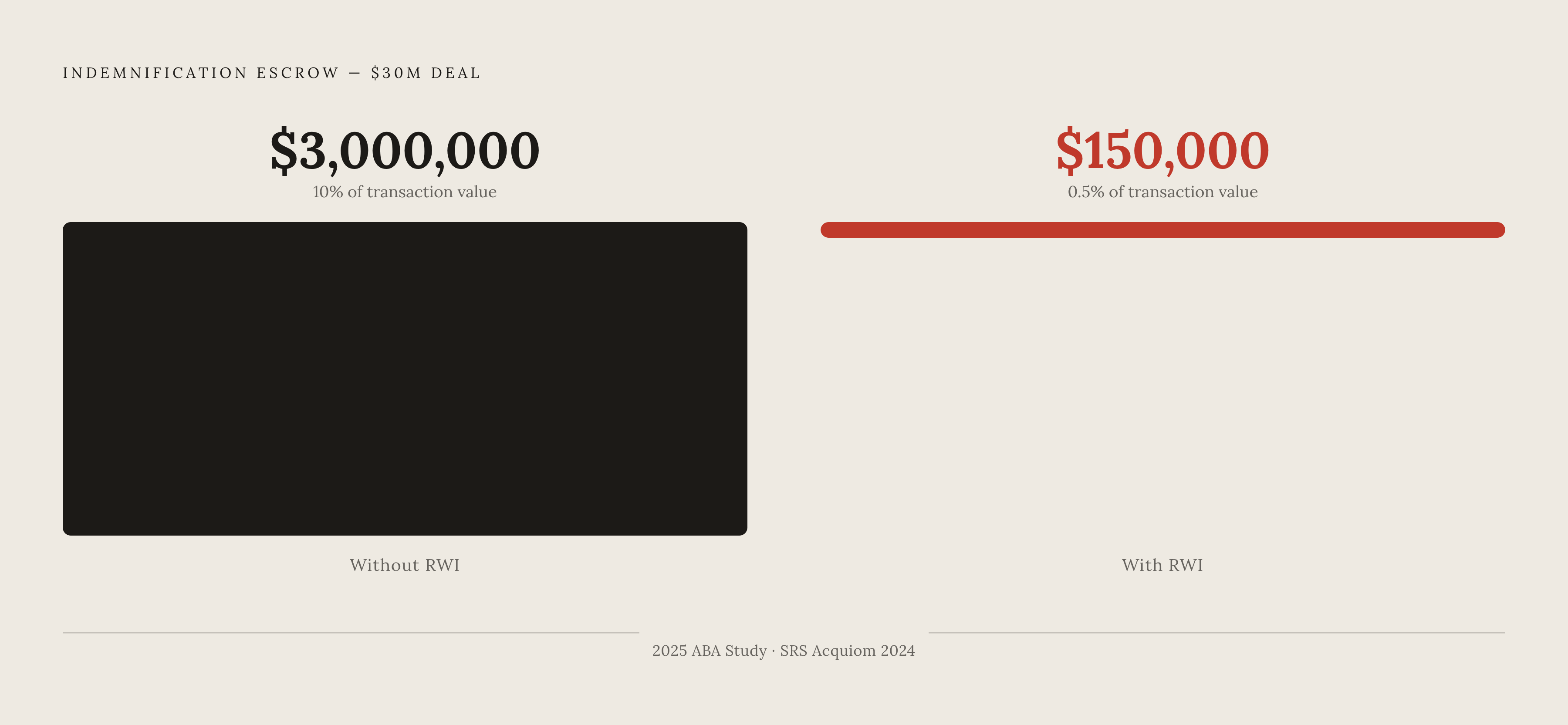
Where sellers feel the economics most directly is in the escrow. The 2025 ABA Study shows a median indemnity cap for deals with RWI of just 0.25% of transaction value. SRS Acquiom's 2024 M&A Deal data reports that general indemnification escrows in deals without RWI carry a median of 10% of transaction value; with RWI, that figure drops to 0.5%. For a founder receiving $30M in proceeds, the difference between a $3M escrow and a $150,000 escrow is not a footnote in the deal documents. It is the actual money they receive at closing.
The non-refundable underwriting fee warrants honest mention. Depending on transaction size and complexity, it typically runs $25,000 to $50,000. For deals under $20M in enterprise value, this cost enters the analysis of whether RWI makes economic sense and needs to be considered explicitly, not assumed away.
How the Underwriting Process Works and What It Requires from the Deal
The underwriting process unfolds in two stages. Understanding both helps deal participants plan the transaction timeline rather than react to it.
The first stage is Non-Binding Indication Letters from carriers. Preliminary materials are submitted and non-binding quotes typically return within two to four business days. This is a market-sounding exercise: the buyer's advisor is shopping coverage terms and pricing across multiple carriers simultaneously, establishing the competitive range before committing to formal underwriting.
The second stage is formal underwriting, typically running one to two weeks, requiring payment of the non-refundable underwriting fee before it begins. Underwriters conduct a detailed review of the data room, the purchase agreement, and the diligence reports. Any identified concern that remains unresolved at binding tends to become an exclusion rather than covered risk, which is a consequential distinction for the buyer who assumed coverage would be comprehensive.
There is a dimension of this process that practitioners sometimes underemphasize, possibly because it implicates the seller's preparation more than the buyer's: underwriting directly shapes the policy's ultimate value. A clean data room with well-organized financial records, a complete contracts schedule, properly documented employee arrangements, and clear title to intellectual property gives underwriters less to flag. Fewer flagged items means fewer deal-specific exclusions. A seller's preparation for diligence is not only about building buyer confidence; it determines the scope of coverage the buyer ultimately obtains.
For smaller transactions, several carriers now offer streamlined underwriting: simplified questionnaires and abbreviated review processes designed to keep the product accessible at deal sizes where the full formal process would be disproportionate. This is a relatively recent development, reflecting deliberate market expansion by carriers into the lower mid-market, though streamlined does not mean perfunctory.
RWI is not a product you layer onto a transaction late in the process. It requires time, a prepared data room, completed diligence reports, and a substantially finalized purchase agreement. Advisors who plan for it early run smoother processes. I have watched both scenarios play out enough times that the difference in closing experience no longer surprises me, even when it surprises the parties.
What RWI Does Not Cover and Why Exclusions Matter as Much as Coverage
Exclusions in an RWI policy are not fine print. They are the product's actual boundaries, and understanding them is as important as understanding what the policy covers. There is a version of RWI education that lingers too long on the benefits and treats exclusions as boilerplate; that framing serves neither buyers nor sellers well.
Certain exclusions are standard across virtually every policy. Known or expected breaches are excluded: if the buyer already knows about an issue at binding, that issue is not insured. Purchase price adjustments, including working capital true-ups and net debt reconciliations, are excluded because they are addressed through the deal's own adjustment mechanisms. Breaches of covenants, forward-looking statements, unfunded pension liabilities, net operating losses, transfer pricing arrangements, employee misclassification, and known cybersecurity breaches fall outside scope as well.
Environmental coverage presents a nuanced case. It is generally included in modern RWI policies, but known environmental issues with quantifiable remediation costs are excluded. Asbestos and PCBs are named exclusions in most policies, regardless of whether there is any indication of an actual issue in the target.
The exclusions that vary most significantly deal to deal are the deal-specific ones: items identified during diligence and flagged as unresolved by the underwriter. These depend on the target's industry, the maturity of the seller's records, and what the buyer's diligence team found. A manufacturing business will carry different deal-specific exclusions than a software company. A business with a pending customer dispute may find that dispute excluded entirely.
For buyers, the implication is that RWI does not eliminate the need to think carefully about deal structure. Specific known concerns require separate treatment: a seller indemnity, a price adjustment, a carved-out escrow, or a purchase price reduction. The policy covers the residual universe of unknown risks; everything already identified requires its own resolution.
For sellers, the exclusion discipline carries an uncomfortable corollary. If a known issue is carved out of the RWI policy, the buyer will not simply accept that gap without recourse. That exclusion becomes a negotiating point in its own right, and the seller may find themselves providing the very indemnity they hoped RWI would make unnecessary.
How Often RWI Claims Are Actually Made and What They Tend to Involve
Approximately 18% of RWI policies result in a claim. That figure raises an honest question: does a product paying out on roughly one in five transactions represent meaningful risk transfer, or is it largely a comfort mechanism? The data is unambiguous. This is a functioning risk market.
Claim rates dipped to approximately 15% around 2020 but have been rising since. Fasken's 2025 market review notes that claim rates for 2023 policy years could reach historically high levels by the time the three-year policy period closes. The Marsh Global Transactional Risk Insurance Claims Report 2024 recorded hundreds of millions of dollars in payments from R&W insurers in North America in 2023 alone, reflecting increases in both frequency and severity.
The categories generating the most significant claims, measured by combined frequency and severity, are financial statements representations and material contracts representations. Financial statements claims arise when errors or misstatements in reported financials affect the buyer's understanding of the business they purchased. Material contracts claims arise from undisclosed breaches, missing third-party consents, or contracts that don't reflect what was represented in the purchase agreement.
These two categories are not coincidental. They reflect areas of greatest information asymmetry between buyer and seller. The seller knows how the financials were prepared and what conventions were applied; the buyer is relying on their face. The seller knows which customer contracts have informal amendments or side letters; the buyer is relying on the contracts schedule. RWI claims arise most often at exactly that intersection.
For sellers preparing an exit, this data points directly at preparation priorities. Clean, reviewed or audited financial statements and a complete, accurate contracts schedule are not diligence courtesies. They are the primary determinants of both RWI coverage quality and claims exposure.
The rising claims environment also reflects something about market maturity that the early-adoption narrative tended to obscure. Buyers who purchase RWI are using it. The product has moved past the phase where buyers treated it as a deal-closing gesture and are now filing claims when breaches surface. Anyone who assumed that closing was also the conclusion of a transaction's risk exposure has not been watching this market closely enough.
How RWI Changes the Negotiation Dynamic Between Buyers and Sellers
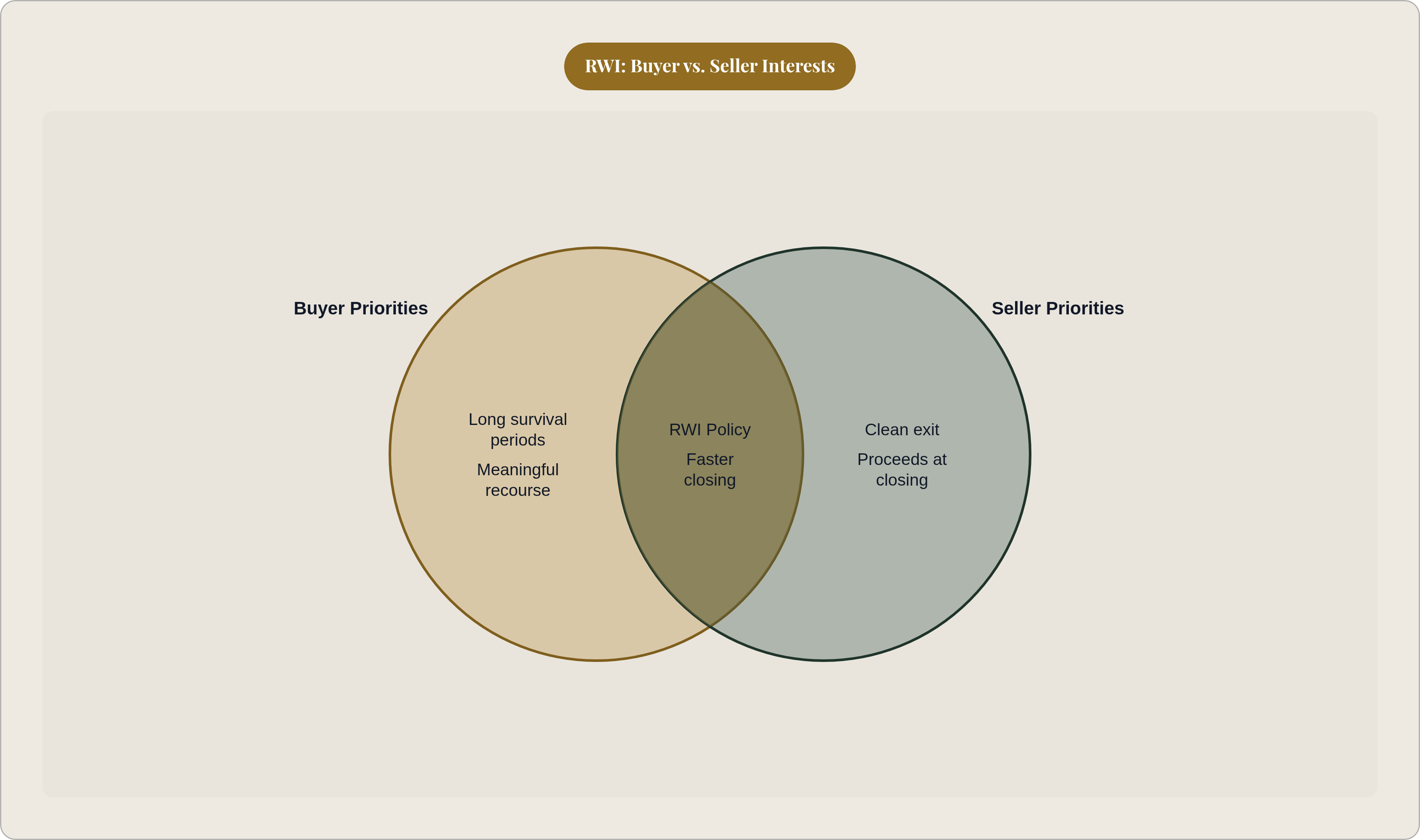
Without RWI, indemnity negotiation is genuinely zero-sum. Every dollar held in escrow is a dollar the seller does not receive at closing. Every expanded representation is additional surface area for post-closing claims. The parties are negotiating over who bears losses that may or may not materialize, and that negotiation is adversarial by design, because the structure demands it.
RWI displaces most of the economic risk that made that negotiation contentious. The insurer absorbs the exposure that was previously the subject of hard bargaining between the parties. This doesn't eliminate negotiation; it redirects it. Seller and buyer negotiate less with each other about indemnity caps and escrow sizes, and both sides engage more carefully with the insurer about policy terms, exclusions, and retention mechanics. Whether that is an improvement depends partly on your experience negotiating with insurance underwriters. Most deal practitioners find it preferable. I find it preferable, though I will admit that the underwriting process introduces its own form of friction that doesn't always get acknowledged in descriptions of how seamlessly RWI facilitates transactions.
There is a relational dimension worth noting, particularly in founder-led exits where the seller is often staying on through a transition period, maintaining an ongoing relationship with the buyer, sometimes retaining an equity interest in the combined business. The adversarial posture that traditional indemnity negotiation reliably produces is corrosive to those relationships before the transaction even closes. I have seen transactions nearly fall apart over escrow negotiations that RWI would have rendered almost irrelevant, and the residual tension from those negotiations does not simply evaporate once documents are signed.
For PE buyers, who transact repeatedly and whose fund economics depend on predictable deal structures, RWI provides consistency. The retention is known. The policy period is known. The coverage scope is established through underwriting rather than negotiated ad hoc with each seller. That standardization carries commercial value independent of any specific deal.
For first-time sellers, the presence of RWI changes the nature of what they are being asked to agree to. An indemnity cap of 0.25% of transaction value, backed by an insurance policy covering the balance, is a categorically different ask than a 10% escrow held for 24 months. Understanding that distinction before entering negotiation matters. I have watched sellers agree to terms they didn't fully understand because the language of RWI is reassuring without always being transparent about what the policy does not cover.
One question that I don't think the market has adequately reckoned with: as coverage terms improve, claim rates rise, and the product becomes more accessible to smaller transactions, does widespread adoption gradually change how carefully parties make and receive representations? Early academic literature on moral hazard in M&A insurance contexts suggests this is worth watching. If sellers know their post-closing exposure is largely absorbed by an insurance policy, does the precision of their representations drift over time, in ways that are difficult to detect in any single transaction but visible in aggregate claims data? The evidence so far suggests the product is functioning as intended, with risk being transferred and claims being paid. But that question has been sitting with me longer than the data has given me reason to dismiss it.