Sell-Side M&A Process Timeline for Sub-$50M Canadian Transactions
Most calendar time elapses before buyers commit conditionally.

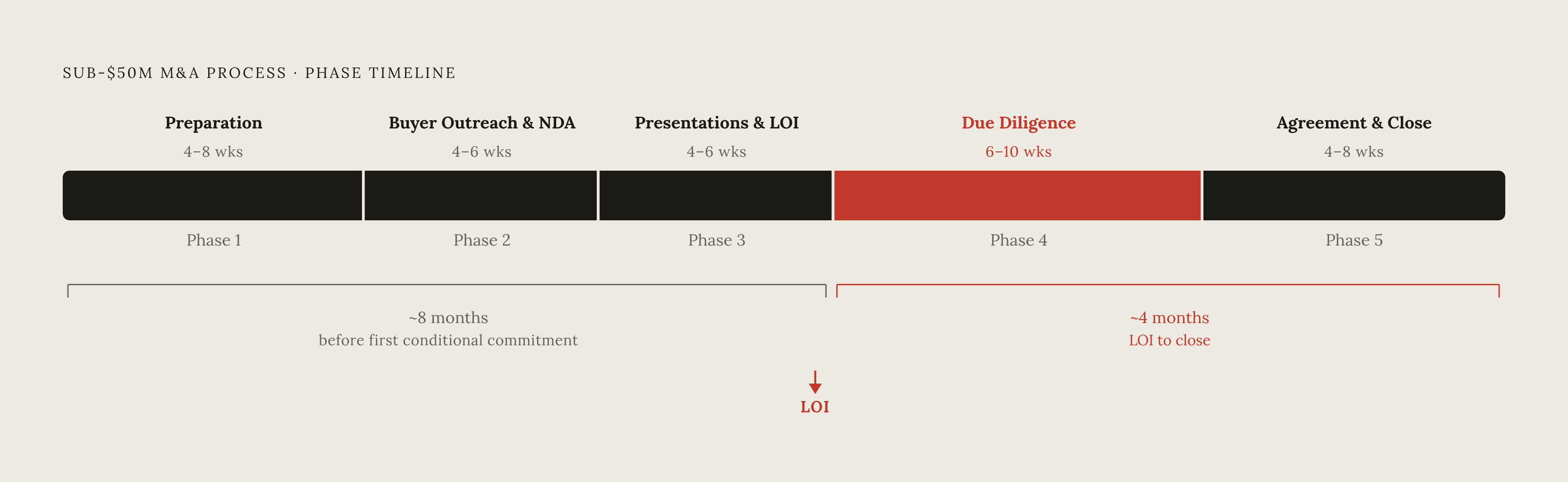
The process moves through five sequential phases: preparation, buyer outreach and NDA execution, management presentations and LOI selection, exclusivity and due diligence, and definitive agreement and close. They are not interchangeable. Each phase builds on the outputs of the prior one, and rushing any phase creates specific, predictable problems downstream.
Selling a business under $50 million in Canada moves through five sequential phases: preparation, buyer outreach and NDA execution, management presentations and LOI selection, exclusivity and due diligence, and definitive agreement and close. IBBA/M&A Source Q4 2025 Market Pulse data places total timeline at roughly six months at the smaller end of the sub-$50M range and closer to twelve months in the mid-market. Of that twelve-month process, approximately eight months elapse before a seller receives even a conditional commitment from a buyer, with LOI-to-close running roughly four months per the same IBBA data. SRS Acquiom's 2025 Deal Terms Study puts the rate of signed LOIs that never reach close at 31 percent, with diligence failures, financing gaps, and definitive agreement breakdowns accounting for nearly all of them.
IBBA/M&A Source Q4 2025 Market Pulse data shows a near-linear relationship between deal size and timeline. Transactions at the smaller end close in roughly six months; transactions in the mid-market range take approximately twelve. The relationship is intuitive when you consider what size implies: more complex financials, more sophisticated buyers with institutional diligence processes, legal documentation with more negotiating surface.
What does not scale linearly is where the time is actually consumed. On a twelve-month process, the bulk of calendar time elapses before any buyer commits. LOI-to-close for sub-$50M deals runs roughly four months per the same IBBA data. That means eight months of process elapsed before the seller has even a conditional commitment. Founders who treat the LOI as the finish line are measuring the wrong thing.
The LOI is also not a guarantee. SRS Acquiom's 2025 Deal Terms Study puts the rate of signed LOIs that never reach close at 31%. Diligence failures, financing gaps, and definitive agreement breakdowns account for nearly all of them. An LOI is a conditional expression of intent, not a transaction. If nearly one in three signed LOIs never closes, the question worth sitting with is: what actually separates the deals that complete from those that collapse? The answer, in my experience, almost always traces back to decisions made before any buyer was contacted.
What factors make a sub-$50M Canadian deal take longer or close faster? Business complexity matters: multiple operating jurisdictions, regulatory licensing requirements, and customer concentration all extend diligence. Seller preparation matters more. Organized financials and a pre-built data room compress every phase because they reduce buyer uncertainty and narrow the scope of diligence requests. Buyer type is perhaps the most underappreciated variable. Add-on acquisitions to existing private equity platforms, where the buyer has established diligence infrastructure and already knows the sector, can close in three to five months. First-time strategic buyers working through a process they have never managed move considerably slower, and no amount of seller preparation fully compensates for that.
Treat the twelve-month benchmark not as an average to aim for but as a floor to understand. The sellers who compress it are those who treat preparation as a competitive act, not an administrative one.
Phase 1: Preparation, the 4–8 Weeks That Determine Everything Downstream
Preparation typically runs four to eight weeks. Disorganized sellers extend this considerably, and that extension compounds across every phase that follows.
The work is concrete. Financial statements need to be organized and normalized. EBITDA normalization means identifying legitimate add-backs: owner compensation above market rate, one-time expenses, personal expenses run through the business. These add-backs directly affect the purchase price, and documenting them defensibly before a buyer challenges them is the seller's first real leverage point in the process.
The Confidential Information Memorandum is prepared here. In the lower-middle market, a CIM typically runs 30 to 60 pages; more complex transactions run longer. Preparation takes roughly two to four weeks. The common mistake is treating the CIM as a sales brochure rather than a diligence-preview document. Sophisticated buyers will test every claim in it. A CIM that overpromises and underdelivers creates mistrust at precisely the moment the process most requires credibility, and that mistrust is difficult to recover from.
The virtual data room is assembled in parallel: financial statements, customer contracts, key supplier agreements, IP documentation, corporate records, employee agreements. The targeted buyer list is built simultaneously. The NDA template is drafted so it is ready the moment outreach begins.
One preparation-phase decision deserves specific attention. Commissioning a Quality of Earnings report before going to market has become increasingly standard in Canadian mid-market transactions. The seller who arrives at market with a sell-side QoE already completed is signaling to buyers that the financial narrative has been stress-tested by a third party. It narrows the buyer's financial diligence because they are confirming findings rather than constructing a picture from scratch. Sellers who take this step close faster and experience fewer price re-trades during diligence. I have watched transactions where the absence of a sell-side QoE gave buyers license to spend weeks on financial diligence that a prepared seller could have compressed to days.
The division of labor matters. The owner's job is to gather documentation and define transaction goals: all-cash versus earnout structure, post-close role preferences, minimum acceptable price, target timeline. The advisor's job is to construct the marketing narrative, build the buyer universe, and draft the CIM. These are parallel workstreams, not sequential ones.
Phase 2: Buyer Outreach and NDA Execution, Running a Process, Not Waiting for Offers
This phase runs four to six weeks. The advisor distributes a teaser, a brief document communicating the business's sector, scale, and general profile without identifying the company. It is informative enough to attract serious interest while protecting employee and customer relationships from premature disclosure. A competitor who learns the business is for sale before a transaction closes has information they can exploit, and in tighter industries, word travels faster than founders expect.
The funnel works predictably. Roughly 25 to 40% of teaser recipients execute an NDA and proceed to receive the CIM. From those, a subset submits an Indication of Interest. A short list of typically four to six buyers is selected to advance to management presentations.
Middle-market businesses below a certain equity value threshold are generally well-suited to broad auctions. The logic, as Wall Street Prep and most M&A practitioners describe it, is that a wider initial field creates competitive tension that supports price. Limited auctions are better suited to larger transactions with a smaller natural buyer universe.
The owner's involvement at this stage is deliberately constrained. The advisor manages all buyer contact. The owner continues running the business, which matters more than it sounds because buyers are watching whether the business performs normally during the process, and performance dips mid-sale are discoverable.
A strong IOI specifies a valuation range with a clear rationale, describes deal structure preferences, and names financing sources. Vague IOIs that express interest without specificity rarely improve at the LOI stage. They tend to signal that the buyer has not done the analytical work to commit, and competitive pressure does not fix that.
Phase 3: Management Presentations and LOI Selection, Where the Owner Becomes the Deal
This phase runs four to six weeks, from management presentations through LOI selection and negotiation. It is where the founder's presence either creates value or introduces risk.
Management presentations are two-to-three-hour sessions, conducted in person or virtually, where the owner and key team members walk shortlisted buyers through the business. The agenda covers strategy, operations, financials, growth thesis, and culture. The numerical content matters. The owner's credibility in explaining it often matters more.
Buyers are evaluating things the CIM cannot convey. Key-person dependency is chief among them: if the business's performance is inseparable from this specific founder, the buyer is pricing in a transition risk that will show up somewhere, either in price or in structure. Management team depth addresses the corollary question of who stays and who transitions. An owner who can name capable people in each critical function, and describe how those functions would run post-close, reduces the risk premium buyers apply. This is worth considering early. By Phase 3, you cannot manufacture a management bench that does not exist.
After presentations, finalists submit Letters of Intent. The LOI specifies purchase price, deal structure, the proposed exclusivity period, and any material conditions. The advisor's role here is to manage competitive tension across multiple bidders simultaneously, because once the seller selects and signs an LOI, that leverage largely disappears.
Earnout structures deserve careful attention at this stage. In sub-$50M Canadian deals, earnouts are common when there is a valuation gap between what the seller believes the business is worth and what the buyer is willing to pay at close given performance uncertainty. The seller receives a base payment at closing plus contingent payments tied to post-close financial targets. The details of those metrics matter enormously: what is measured, over what period, and who controls the inputs. These terms should be negotiated before signing the LOI. After LOI signature, the seller has surrendered competitive leverage and negotiates from a structurally weaker position. I have seen sellers discover this the hard way.
Phase 4: Exclusivity and Due Diligence, the Phase That Kills Deals or Confirms Them
Due diligence for sub-$50M transactions typically runs 30 to 45 days. With parallel legal drafting running simultaneously, this phase often occupies six to ten weeks in total.
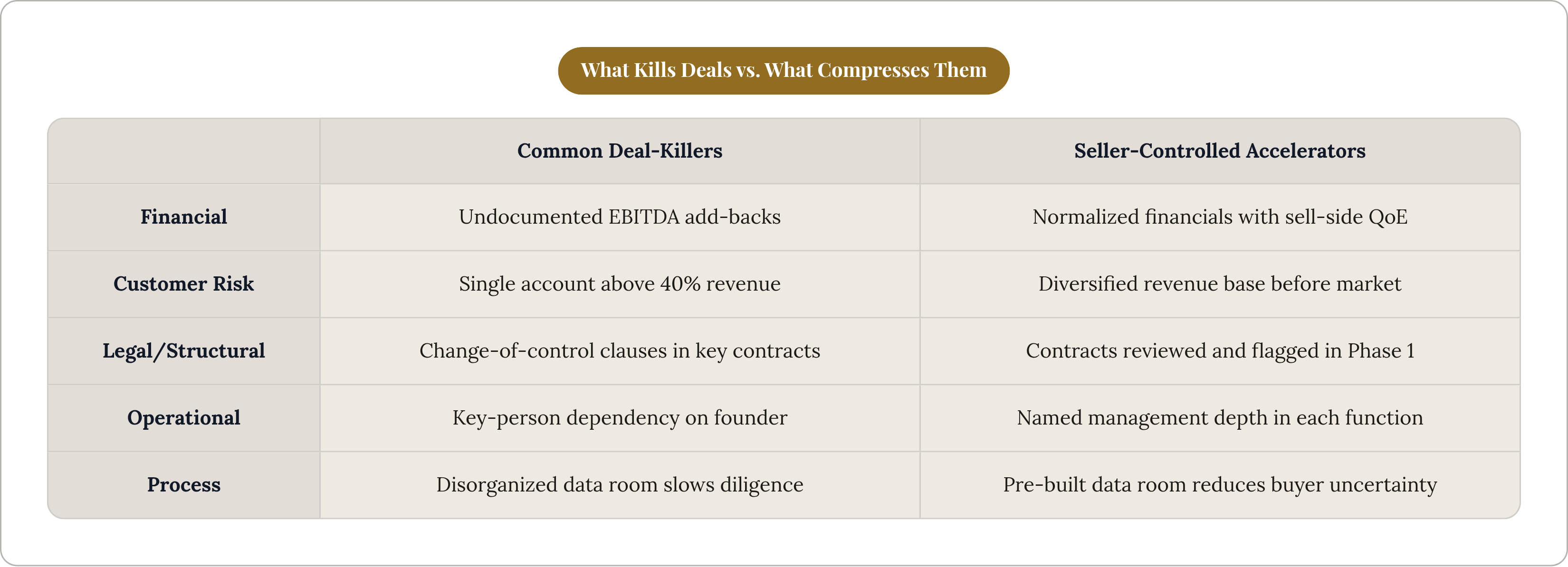
The SRS Acquiom figure bears repeating: 31% of signed LOIs never reach close. This phase is where that attrition happens. The findings that most commonly move price or kill deals outright are customer concentration above 40% in a single account, working capital shortfalls relative to the target set in the LOI, undisclosed litigation, change-of-control clauses in key contracts, and key-person dependency. These are not exotic risks. They are recurring, predictable, and largely avoidable with preparation. When I see a deal re-trade or collapse in diligence, it is almost never because of something genuinely surprising; it is because something foreseeable was not addressed before the process started.
Financial diligence examines revenue quality, customer concentration, EBITDA sustainability, and working capital adequacy. Legal diligence reviews change-of-control provisions in key contracts, IP ownership, and any undisclosed litigation. Operational diligence probes key-person dependency, supplier concentration, and employee agreements. Tax diligence examines the transaction structure itself, because the choice between an asset sale and a share sale carries significant Canadian tax consequences for the seller.
The cost of diligence is real and consistently underestimated. For a mid-market Canadian deal, total sell-side diligence costs across financial, legal, tax, and sometimes commercial workstreams represent a meaningful fraction of deal value. Budget for it explicitly.
The sell-side QoE advantage is most apparent here. A QoE commissioned in Phase 1 means the buyer's financial diligence team is confirming a narrative rather than constructing one. The seller arrives with documented answers. The buyer's questions narrow. The phase compresses.
Meanwhile, the business must keep performing. Revenue dips or customer losses discovered mid-process give buyers factual grounds to re-trade price. This is one of the clearest practical arguments for retaining an advisor to manage the data room and buyer Q&A: it protects the owner's bandwidth for running operations during the most demanding stretch of the process.
Legal teams begin drafting the definitive purchase agreement while diligence is still running. These are parallel workstreams, not sequential ones. The overlap is intentional and compresses total time.
Phase 5: Definitive Agreement and Closing, the Final 4–8 Weeks of Negotiation and Logistics
Once diligence findings are in and the definitive agreement is drafted, the final negotiation phase begins. LOI to close for a typical middle-market deal runs 60 to 120 days; the definitive agreement negotiation and closing logistics occupy the back half of that window.
The definitive purchase agreement is more detailed and more consequential than the LOI. Purchase price adjustments based on working capital peg, net debt, and diligence findings are negotiated here. Representations and warranties, the seller's formal legal assertions about the state of the business, are negotiated for scope and survival period. The indemnification cap, how much of the purchase price the seller remains on the hook for if those representations prove inaccurate, is one of the most contested terms in any deal at this size.
Representations and warranties insurance has become increasingly common in Canadian mid-market transactions. It shifts indemnification risk from the seller personally to an insurer, reducing the amount of proceeds held back in escrow and giving the seller cleaner access to closing proceeds. Buyers often favor it because it provides a professional insurer to pursue claims against rather than a former owner who may have spent the proceeds.
The asset-versus-share deal structure is a persistent negotiating point in Canadian transactions. Buyers generally prefer asset deals because they acquire only selected assets and liabilities, avoiding unknown historical liabilities. Sellers generally prefer share deals because they allow access to the Lifetime Capital Gains Exemption, which shelters a significant amount of gain on qualifying small business corporation shares from Canadian federal tax. This structural preference creates genuine negotiating tension that is often resolved through price adjustments or hybrid structures. It is worth understanding your position on this before engaging with buyers, not after.
Regulatory and third-party approvals run in parallel. For most sub-$50M Canadian deals, Competition Act review is not triggered because the transaction falls below prescribed thresholds. The Investment Canada Act applies if the buyer is a non-Canadian entity; at these values, review is typically straightforward but adds process time. The practical bottlenecks are often more mundane: landlord consents, change-of-control consents under key customer or supplier contracts, and franchisor approvals where applicable. These require lead time that founders consistently underestimate, and sometimes concessions that were not anticipated.
Closing mechanics include funds flow, any transition services agreement if the owner remains involved post-close, non-compete scope and duration, and final working capital adjustments. The announcement is a closing event, not an afterthought, and the communication plan for key employees should be executing at this point, not being drafted.
What Realistically Compresses or Extends a Canadian Sub-$50M Deal Timeline
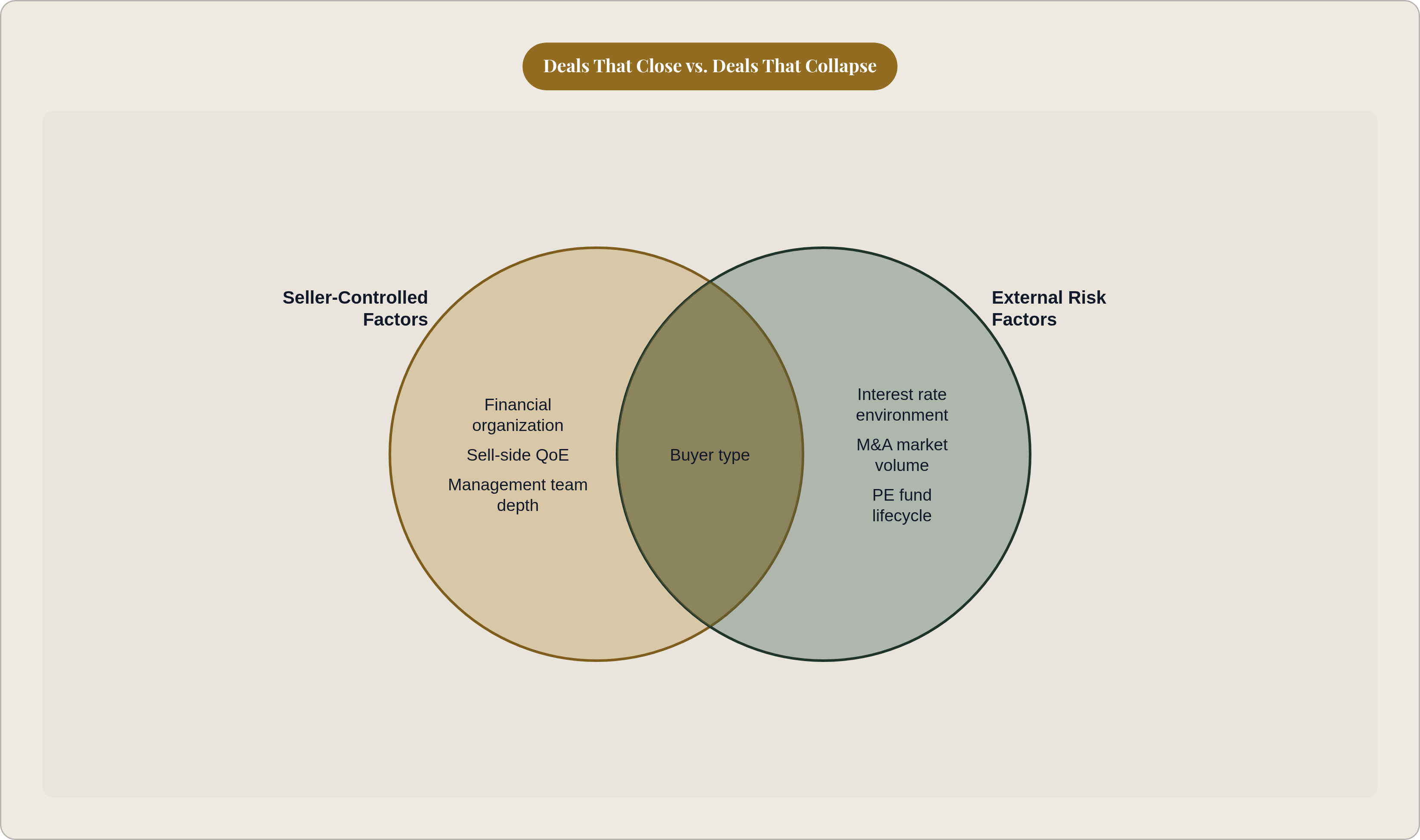
Some variables are within the seller's control. Financial organization is the most powerful. Clean books, normalized EBITDA with documented add-backs, and a pre-built data room eliminate the most common source of delay across every phase. A sell-side QoE before market launch compresses diligence and reduces re-trades. Management team depth reduces key-person dependency risk and keeps the owner available for buyer questions without the business declining. Customer concentration, the single most common deal-killer finding in diligence, can be proactively reduced by diversifying the revenue base before going to market. Advisor selection matters: a firm with an active buyer network compresses the outreach and IOI phase in ways that a cold-start process simply cannot replicate.
Other variables are not within the seller's control. Buyer financing conditions depend partly on the interest rate environment; the Bank of Canada held its rate at 2.25% through mid-2026, balancing weak growth against persistent inflation. General M&A activity declined quarter-over-quarter in Q2 2026 as trade tensions and geopolitical uncertainty weighed on deal volume. PE fund lifecycle also matters: many Canadian firms are managing overdue exits in their portfolios, creating motivated buyers who are simultaneously distracted by complex internal situations. Pretending these external conditions are irrelevant is a way of setting yourself up for frustration.
The succession wave adds a structural timing pressure that is easy to underappreciate. As 76% of Canadian small business owners prepare to exit within the decade per the Canadian Federation of Independent Business, the buyer pool does not expand proportionally. Buyers grow more selective. Preparation quality becomes the variable that separates transactions that close at full value from those that re-trade or collapse.
A twelve-month process that begins three years before the owner's target exit date creates room to correct the factors that would otherwise compress valuation or kill a deal. Customer concentration can be reduced. A second layer of management can be developed. Earnings can be normalized over several periods rather than retroactively justified. Starting earlier than feels necessary is almost always the correct decision, even when the business feels ready.
How Owners Engage Professional Advisors and What That Engagement Looks Like at the Sub-$50M Level
At the sub-$50M level, the sell-side advisor is typically an M&A advisory firm or investment bank specializing in lower-middle-market transactions. The engagement structure differs from what founders encounter in other professional service relationships: advisors in this market typically work on a retainer plus a success fee, with the success fee representing the majority of total compensation and structured as a percentage of transaction value, often on a Lehman or modified Lehman formula basis. The incentive alignment is direct. The advisor's primary economic outcome depends on the deal closing, and closing at the highest defensible value.
What the advisor actually does across a twelve-month process is broader than most founders anticipate. They build the CIM and buyer universe. They manage all buyer contact during outreach. They coordinate the data room and diligence Q&A responses during exclusivity. They manage competitive tension between bidders at the LOI stage. They advise on definitive agreement terms and work alongside the seller's legal counsel through close. In a process where the owner must simultaneously run the business, the advisor is effectively the project manager for the transaction, and that function has real value in a process where the owner's attention is a finite resource.
Selecting the right advisor requires scrutiny. The relevant questions are specific: How many transactions in this size range and this sector has the firm closed in the last three years? Who are the specific individuals who will staff the engagement, not just the partners who pitch it? What does the firm's active buyer network look like in this sector? A firm that has recently closed transactions in a relevant sector has warm relationships with buyers who have already evaluated comparable opportunities. That network compresses the outreach phase in ways that are difficult to replicate otherwise.
The sub-$50M market in Canada is also served by business brokers, who typically handle smaller transactions with less structured processes, and by accounting firms or legal practices that offer transaction advisory as an ancillary service. The distinction between a dedicated M&A advisory firm and a broker or ancillary advisory practice is meaningful. Dedicated advisors run structured auction processes, manage competitive tension, and maintain institutional buyer relationships. The process quality affects outcomes not just in timeline but in price, and the difference is not marginal.
Founders sometimes resist engaging an advisor because of the success fee, reasoning that the fee represents money they would otherwise keep. That reasoning has surface plausibility. A founder who has built a business over decades knows it better than any outside advisor ever will. But the comparison is not between a knowledgeable founder and a knowledgeable advisor. It is between a founder who has sold one company, perhaps two, and institutional buyers who have completed dozens of acquisitions and employ teams whose entire function is to understand and improve their side of the transaction. The asymmetry of experience is real, and it is the primary argument for professional representation. Advisors who run structured, competitive auction processes consistently produce higher purchase prices, faster closes, and fewer post-LOI re-trades than unadvised or lightly-advised processes. The fee is not a cost to minimize; it is the price of process quality whose return is measured against the alternative.
The twelve months between engagement and close are working time, structured and purposeful, in which the decisions made in Phase 1 reverberate through every phase that follows.