Sell-Side Investment Banking Fees for Small Business Transactions
How advisor fees for small business sales swing wildly by deal size.

Sell-side investment banking fees for small business transactions follow recognizable structures: retainers, success fees, tiered formulas that have been around since the 1970s. But the actual numbers swing widely enough by deal size and advisor type that an owner who signs an engagement letter without a working map can end up paying substantially more than a peer selling a similar business a year later. That gap (often the difference between a 3% and 8% effective rate on a multi-million-dollar transaction) translates into hundreds of thousands of dollars. This piece is meant to give owners in the small and lower middle market (roughly $1 million to $50 million in revenue) that map before they sign anything.
Who actually advises small business sales and why it changes what you pay
The advisory market isn't one market. It's a continuum, and where a business sits on it determines the fee structure an owner will face, not just the headline percentage.
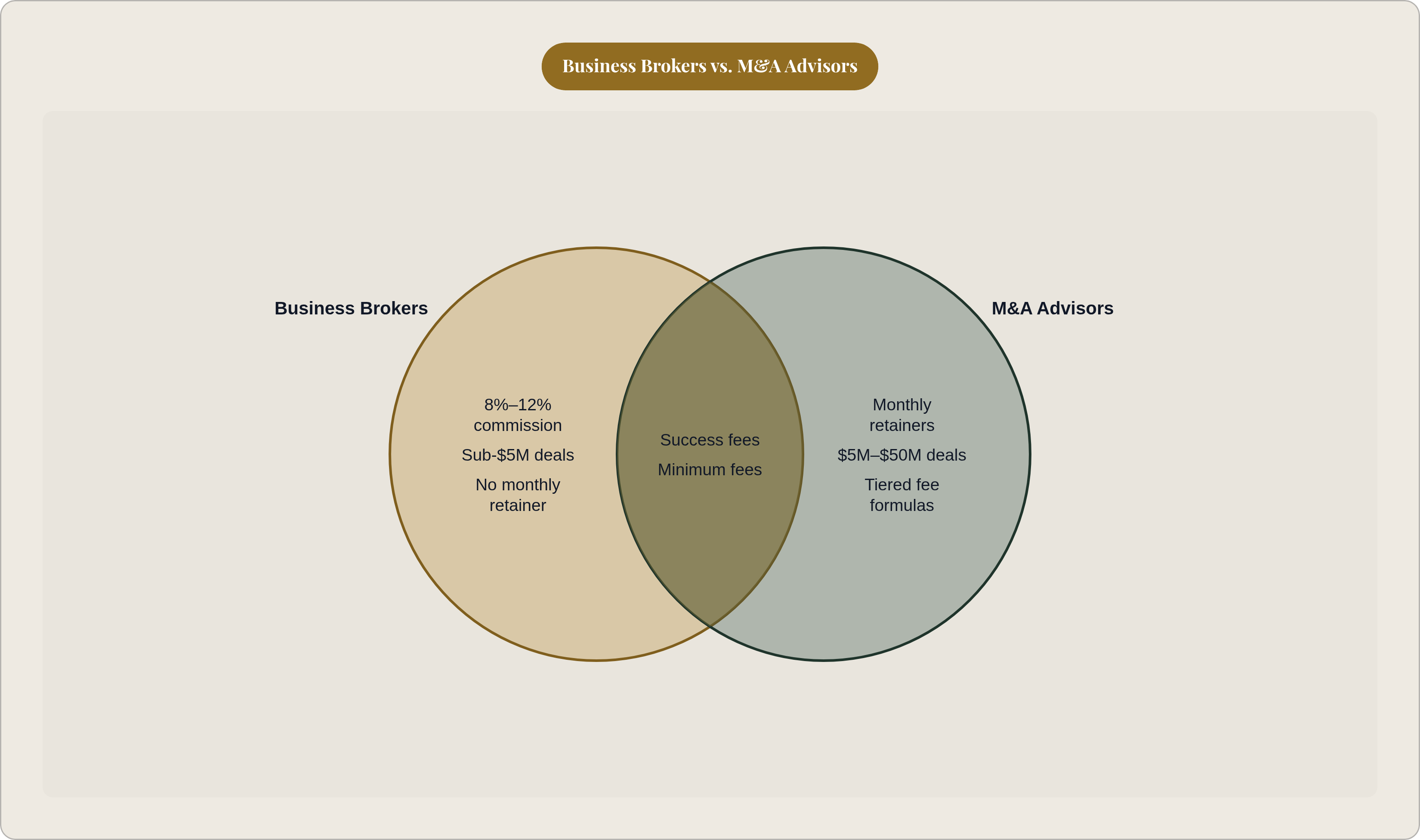
At the bottom end (sub-$5 million deals), business brokers dominate. They typically charge straight commissions of 8% to 12% of sale price, with minimum fees running $25,000 to $75,000. No monthly retainer, relatively simple terms. It's a transactional relationship: the broker gets paid when the deal closes, and the fee structure reflects that simplicity.
Move up into the $5 million to $50 million range (the lower middle market), and M&A advisors take over. Here the headline success-fee percentage actually drops, often to 5% to 8%, but the total cost picture gets more complicated. Monthly retainers, work-product fees, higher minimums; add it all up and an owner can end up paying more in total dollars than they would have under a broker's straight commission, even though the percentage looks smaller on paper. Bulge-bracket banks rarely show up below $500 million in deal value, so they're not really part of this conversation for most readers.
Why do boutiques often outperform for smaller deals? Senior bankers stay on the file. They don't hand it off to a junior associate three weeks after signing. According to Capstone Partners' 2025 industry data, roughly 400 active sell-side boutiques compete for deals in the $5 million to $50 million range, which tells you two things: the market is genuinely competitive, and terms are far more negotiable than a first-draft engagement letter would suggest.
Matching advisor type to deal size sounds obvious once stated, but it's the single most common mistake owners make. Hire a boutique with a brand name built on much larger deals to sell a small business, and you may be paying for prestige you don't need. Hire a broker to run a competitive process for a sizeable lower-middle-market company, and you'll likely leave money on the table because the process wasn't built for that scale.
The three components that make up every sell-side fee arrangement
Strip away the variation in language and paperwork, and almost every sell-side engagement is built from the same three pieces.
Retainer, or engagement fee. This covers the advisor's ongoing costs and, frankly, signals that the owner is serious about the process. It can come as a lump sum upfront or monthly installments, typically $5,000 to $15,000 a month. Across deal sizes, total retainers run from $30,000 up to over $100,000 depending on the firm's experience and how complicated the transaction is. Most engagement letters cap the retainer period at six to twelve months, which prevents the arrangement from becoming an open-ended billing relationship with no end in sight.
Here's a rule of thumb worth remembering: the upfront fee shouldn't exceed 15% of total expected compensation, meaning retainer plus success fee combined. Why does that threshold matter? Because a firm that collects most of its money before the deal ever closes has, structurally, less incentive to get it closed. Roughly 56% of advisors credit the retainer against the success fee at closing, which is a meaningful detail; it's worth confirming in writing before signing anything, because if the letter is silent on it, the safe assumption is no credit.
Success fee. Paid only when the deal actually closes, and it's the largest single component of what an advisor earns. It's usually expressed as a percentage of transaction value, frequently through a tiered formula rather than one flat number. This gets its own treatment in the next two sections, because the mechanics matter more than the headline rate.
Expense reimbursement. Out-of-pocket costs billed on top of everything else. About three-quarters of advisors bill expenses separately from their fees. What gets billed? Travel and lodging (nearly universal among advisors who bill expenses at all); virtual data room costs (roughly half of advisors include these); printing and materials (about a third). Owners should negotiate a cap ($25,000 to $50,000 is reasonable), limit reimbursement to genuine third-party costs, and require pre-approval above some stated dollar threshold.
A minimum fee provision cuts across all three components. It sets a floor beneath which the advisor won't go, no matter what the formula says, and roughly two-thirds of advisors use one. That deserves its own section, because it's where a lot of owners get surprised.
How success fee rates actually scale with deal size
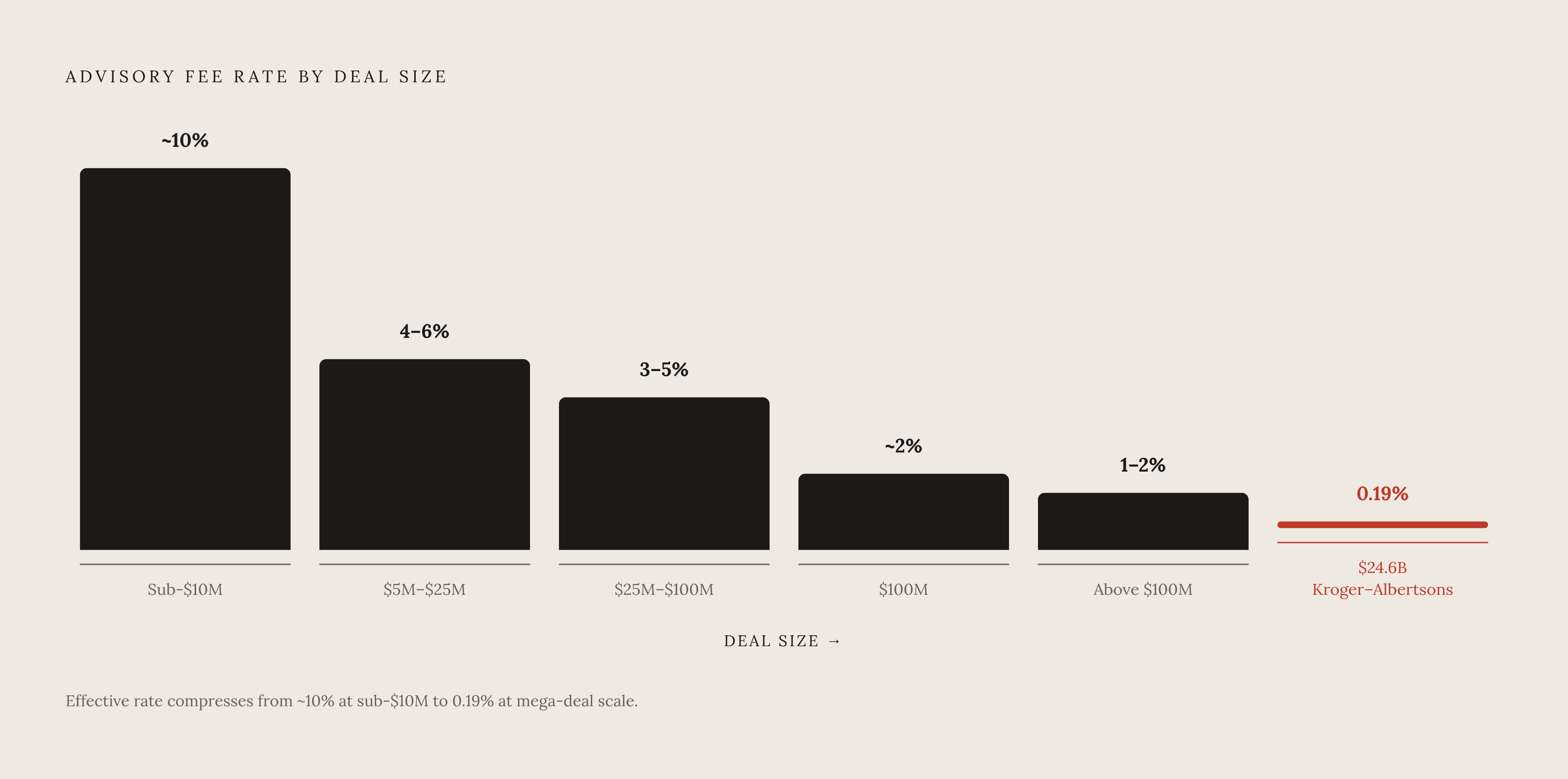
The percentage an owner pays shrinks as deal size grows. But it doesn't shrink smoothly; each band of deal size has its own norms, and the jumps between bands are worth understanding on their own terms.
Sub-$10 million deals carry the highest effective rates, and there's a simple reason: the advisor's fixed cost of running a process (building a buyer list, preparing materials, managing a data room) doesn't shrink in proportion to the deal getting smaller. Some platforms use AI-driven buyer matching to compress that list-building step for smaller deals. Industry engagement data from 2025 indicates a $150,000 minimum fee is common at this level. Lehman-style grids are the norm here: something like 10% on the first tranche of value, stepping down to roughly 5% above a threshold. On a mid-sized deal in this range, a traditional Lehman formula produces a substantially lower fee total than a Double Lehman (more common at this size), which can produce roughly twice as much. That's not a small gap.
Move into the $5 million to $25 million band (the lower middle market proper), and 3% to 6% becomes a reasonable benchmark. For deals under $25 million specifically, a 4% to 6% range paired with a minimum fee floor is typical. Available 2024-25 market data puts the effective blended rate meaningfully higher at the lower end of this band, falling to a notably lower rate by the time a deal reaches the upper end of the range. That's the scaling effect in action: same formula structure, smaller effective bite as the numbers get bigger.
At $25 million to $100 million, the standard range narrows further, to 3% to 5%. By $100 million, the effective blended rate approaches 2.0%.
Above $100 million, we're typically talking 1% to 2%, and at the mega-deal level, fees can compress to 0.1% to 0.5%. For context on just how far that compression goes: Goldman Sachs and Citigroup disclosed combined advisory fees of approximately $46 million on the $24.6 billion Kroger-Albertsons transaction, according to proxy filings, which works out to roughly 0.19% of deal value.
One more data point worth sitting with. Fee pressure showed up clearly in 2024: success fee averages edged down for smaller transactions, and only 30% of advisory firms said they'd raised at least one fee type that year, down from 38% in 2023. That's a buyer's-market signal, and it cuts in the seller's favor when negotiating terms with an advisor, not just when negotiating with a buyer.
The four fee formulas and what each one means for the seller
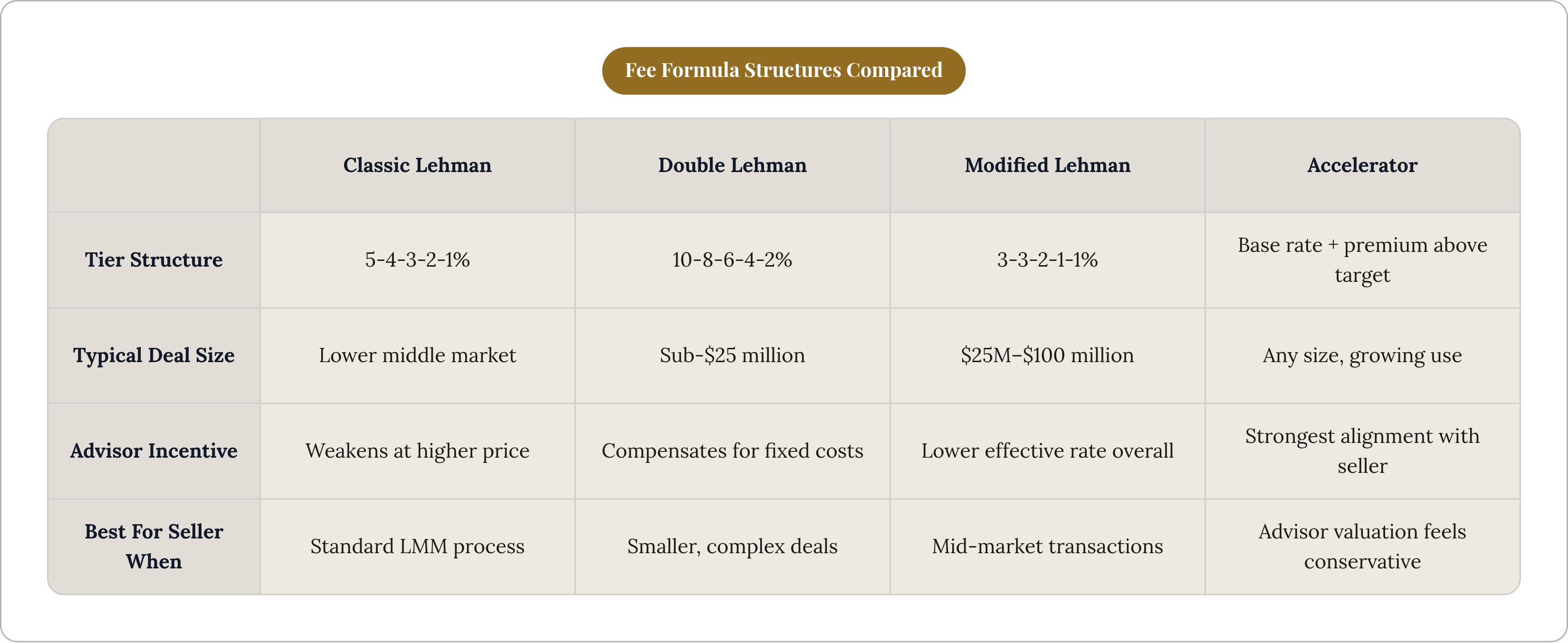
Knowing the rate isn't enough. The formula that applies that rate across the deal's value determines what actually lands in the advisor's pocket, and the four common structures produce meaningfully different outcomes on an identical deal.
Firmex's fee guide puts it this way: about 40% of advisors use a Lehman-style scale, 35% charge a flat percentage, and roughly one in five use an accelerator. Updated 2024 figures show that accelerator share climbing, which is a trend worth watching if you're negotiating right now.
Classic, or Standard, Lehman (5-4-3-2-1). This formula dates back to the early 1970s: 5% on the first tranche of transaction value, declining in steps down to 1% on anything above a defined upper threshold. It's most common today in lower middle market deals. The criticism worth understanding: the advisor earns a smaller percentage on each additional dollar of price the buyer pays, which means the incentive to push the final number higher actually diminishes as the price climbs. Not exactly the alignment a seller wants.
Double Lehman (10-8-6-4-2). This is the workhorse structure for sub-$25 million deals right now. It doubles each tier of the classic Lehman scale to compensate the advisor for the fixed cost of running a process on a smaller deal, where the work doesn't scale down with the price tag. On a deal in the upper portion of this range, Double Lehman produces a substantial six-figure success fee. It's often paired with a monthly work fee of $5,000 to $10,000 that credits against the success fee at closing. This structure makes sense when the business genuinely requires proportionally more advisor time and effort per dollar of value; a mid-sized manufacturing business with three product lines and a messy cap table takes real work regardless of its size.
Modified Lehman (3-3-2-1-1). The most common variant in the middle market. It compresses the upper tiers while keeping the progressive shape, and it produces a lower effective rate than Double Lehman on an identical deal, which makes it more appropriate for the $25 million to $100 million band where the fixed-cost argument for Double Lehman starts to lose force.
Accelerator, sometimes called the "Wall Street" formula. This one works differently and, from a seller's perspective, better. It applies a base rate up to a target valuation, then a higher rate on every dollar above that target: say, a lower rate up to an agreed floor value, then a higher rate on everything above it. That structure genuinely aligns advisor and seller, because the advisor earns more for outperforming, not less. A 2024 industry survey found roughly 20% of advisory firms had built accelerators into their fee structures, a share that's grown from prior years. If an advisor's initial valuation estimate feels conservative, this is the structure worth asking for.
Flat percentage. Simple, predictable, no tiers. One rate on the full transaction value. Some advisors prefer it for the transparency, and there's something to be said for a fee an owner can calculate on a napkin. But it's worth checking that flat rate against what a Lehman-equivalent formula would produce at the expected deal size, because "simple" doesn't always mean "competitive."
Fixed, or negotiated-sale, fee. This applies when a buyer is already identified before the advisor is even engaged. The scope of work is narrow and defined, so a flat negotiated fee reflects the actual work involved rather than a full sale process. It's the wrong structure, though, if the seller needs broad buyer outreach and real competitive tension in the process; a fixed fee removes the advisor's incentive to keep shopping the deal.
Minimum fees and tail provisions (the clauses that catch owners off guard)
Two provisions surprise owners more than anything else in an engagement letter, and both deserve a slow read before signing.
The minimum success fee sets a floor on what the advisor earns, regardless of what the tiered formula would otherwise calculate. Roughly two-thirds of advisors use one. Per 2025 industry data, $150,000 is a common minimum on sub-$10 million transactions. There's a legitimate reason for this: it establishes a shared floor expectation between advisor and client about what counts as an acceptable deal outcome, so nobody's surprised later. But on very small deals, that minimum can represent a larger share of total deal value than the formula rate would otherwise produce. An owner selling a small business against a $150,000 minimum may be effectively paying a higher rate than the stated formula would otherwise calculate. Model both numbers before signing. Don't assume the formula rate is what you'll actually pay.
The post-termination tail is the other one. If the engagement ends and the owner later closes a deal with a buyer the advisor originally introduced, the success fee is often still owed, even though the advisor didn't finish the process. Tail periods commonly run twelve to twenty-four months. Scope is everything here: a tail that covers "any party contacted during the engagement" is a far broader net than one limited to parties who actually received the confidential information memorandum. Owners should push for specificity: named buyers only, a defined time window, clear triggering events that actually happened, not just conversations that occurred in passing.
The retainer credit clause ties back to the earlier point. If 56% of advisors credit retainer payments against the success fee, and the letter in front of you doesn't say so explicitly, assume it doesn't apply and negotiate it in.
None of these clauses are standard in the sense of non-negotiable. They're negotiated language that happens to appear in most templates, and understanding them before signing is often the difference between a clean, well-understood closing and a fee dispute nobody saw coming.
What the current deal market means for owners deciding whether to engage an advisor now
Timing matters here, and the current data tells a fairly clear story. Lower middle market deal volume jumped 45.8% year over year in the first quarter of 2026, according to Capstone Partners' Q1 2026 Capital Markets Update, making it the fastest-growing segment of the middle market after a sluggish stretch in 2024 and 2025 for smaller deals.
Buyer supply is expanding at the same time. Search funds, family offices, and holding companies are all taking a larger share of closed deals than they used to, and the pool of active buyers has grown substantially. More buyers competing for the same deals is exactly the condition under which a well-run advisor process (one built to generate real competitive tension among multiple bidders) earns its fee. A direct, one-on-one negotiation with a single interested buyer rarely produces the same outcome; there's no tension pushing the price or terms in the seller's favor.
Layer that against the fee pressure noted earlier (only 30% of advisory firms raised fees in 2024 versus 38% the year before), and owners find themselves in a moment with some genuine negotiating leverage on terms, even as buyer demand for their businesses is rising.
One more demographic force worth naming: the largest cohort of business owners in North American history is approaching exit decisions at roughly the same time, which keeps adding deal supply to the market. That doesn't mean buyer attention is unlimited, even with more buyers showing up; it means the owners who move deliberately, rather than waiting for a perfect moment that may not arrive, tend to fare better. The process itself, from engagement to close, takes months under the best circumstances. Starting the conversation early isn't just advisable; it's structurally necessary given how long these processes actually run.
How AI-assisted buyer matching fits into the traditional advisory fee model
Traditional sell-side work is labor-intensive at its core. Preparing the confidential information memorandum, building a buyer list from scratch, managing outreach to dozens or hundreds of prospects, running the process end to end, all of that advisor time is precisely what retainers and success fees are compensating. It's real work, and it's the reason the fee structures above exist in the first place.
AI-assisted buyer matching changes that equation by compressing the most time-consuming part of the process: identifying and qualifying potential buyers. That doesn't eliminate the value of an advisor. But it does shift where that value concentrates.
For owners in the $500,000 to $50 million revenue range specifically, platforms that combine AI-powered buyer matching with human investment banking advisory can offer something that used to require a tradeoff: the breadth of a large-scale buyer search, paired with the senior-level attention that boutiques are known for, without carrying the overhead structure of a bulge-bracket bank. That matters directly for fees. When buyer identification and initial qualification happen algorithmically rather than through weeks of manual list-building, the advisor's billable hours concentrate on negotiation, deal structuring, and getting to close (the parts of the process where human judgment still can't be replaced by software).
That's a meaningful shift in how the traditional fee model breaks down, and it's worth watching closely over the next few years as more of the small and lower middle market adopts tools built this way. The fee structures described throughout this piece (retainers, Lehman scales, minimums, tails) aren't going away. But the cost basis behind them, the actual hours and effort an advisor puts into finding the right buyer, is starting to look different than it did even five years ago.