Working Capital Peg Disputes After a Business Sale
Sellers lose hundreds of thousands in disputes by neglecting peg methodology before closing.

Working capital peg disputes are one of the most predictable fights in M&A, and also one of the most preventable. A seller who understands how the peg gets set, where the accounting ambiguities live, and what to negotiate before signing can keep the value they already earned at closing, instead of handing a chunk of it back three months later.
Here's the problem the peg is actually solving. Without some mechanism pinning working capital to a normal operating level, a seller could stop collecting on receivables, sit on unpaid bills, and pocket the cash difference in the weeks before close, leaving the buyer to inherit a business that looks fine on paper but is starved for the liquidity it needs to run. The buyer underwrote the deal assuming a certain level of receivables, payables, and inventory sitting on the balance sheet; the peg makes that assumption concrete, a number both sides agree represents "normal." Almost every deal runs cash-free, debt-free, so cash and debt sit outside this calculation entirely, and the peg is only about operating liquidity: the receivables, payables, inventory, accrued expenses, and similar accounts that keep the business moving day to day.
The mechanics, in theory, are simple and dollar-for-dollar. Come in above the peg at closing, and the buyer pays more, and come in below it, and the seller writes a check back. On paper, this is supposed to be a neutral pass-through, a mechanism that neither party profits from and neither party loses on. In practice, it rarely settles that cleanly, and the rest of this piece is about why.
How common these disputes actually are — and why sellers underestimate the risk
Working capital adjustments show up in the vast majority of private-company M&A deals, and once a formal peg is in place, most of those deals actually produce an adjustment at closing, according to SRS Acquiom data. That's worth sitting with for a second: this isn't a rare contingency clause that occasionally gets triggered. It's closer to a routine, expected part of the deal's final act.
And when disputes happen, working capital is far and away the biggest category. Across multiple deal studies, working capital disagreements make up roughly half or more of all post-closing disputes, ahead of representations-and-warranties claims and indemnity fights combined. Lincoln International's 2026 study found that most respondents with sell-side experience had encountered a net working capital dispute at least occasionally, and a meaningful share said they'd been through multiple disputes in a single year. This isn't a tail risk; it's closer to a coin flip.
So why do sellers keep getting caught off guard? Partly it's psychological. Sellers tend to treat the peg as boilerplate, something the lawyers handle, a mechanical clause that gets resolved the moment the wire hits the account. But the real fight usually starts 60 to 90 days after closing, once the buyer's accountants sit down and prepare the final closing balance sheet. By then, the seller has moved on mentally, having closed and moved to planning the next thing. And that's exactly when the buyer's team is scrutinizing every reserve and every aging bucket for a number that favors the buyer.
There's a structural asymmetry here that's worth naming directly: the buyer controls the post-close calculation. The buyer's accountants prepare the statement, on the buyer's system, using the buyer's judgment calls, and the buyer's financial interest runs toward a lower final number. Sellers, in most true-ups, accept the buyer's calculation without objection. That means the seller's real leverage to protect the number is mostly spent before the true-up conversation even begins, back at the negotiating table, months earlier, when nobody was paying close attention.
How the peg is set and why methodology choice moves real money
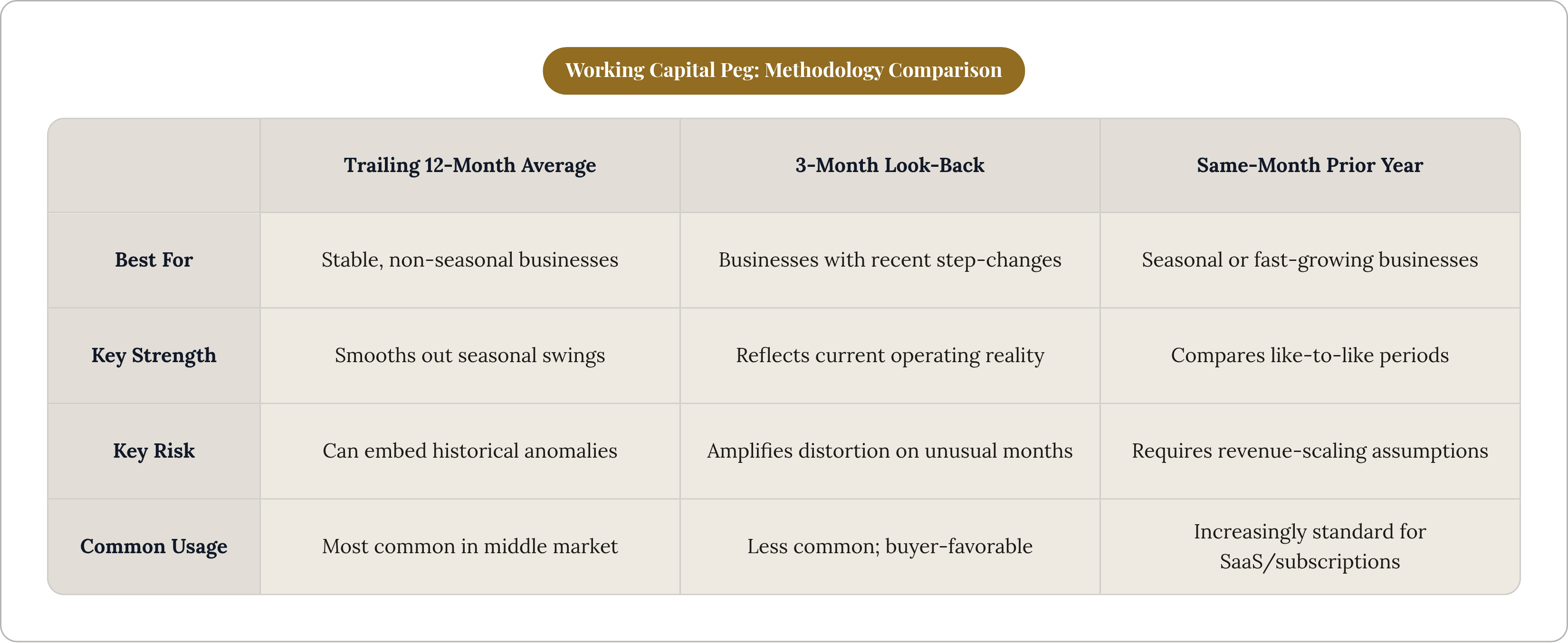
Three methodologies dominate how the peg actually gets calculated, and picking the wrong one, or letting the buyer pick it for you, can move real dollars.
The trailing twelve-month average is the most common approach in middle-market deals, according to Prairie Capital Advisors. It takes the past year of monthly working capital data and smooths out seasonal swings, which sounds sensible until you realize smoothing can also bury a mismatch between the historical average and the working capital reality on the actual closing date. A three-month look-back does the opposite: it captures a more current snapshot of the business, but if closing happens to land on an unusual month, that shorter window amplifies the distortion rather than absorbing it. A same-month-prior-year hybrid, which measures working capital at the corresponding month-end from a year earlier and scales it for revenue growth, has become increasingly standard for seasonal or fast-growing businesses, because it at least compares like to like.
This is not an academic distinction. Switching from a trailing twelve-month average to a three-month look-back can swing $200,000 to $500,000 on a $5 million deal, according to CTA Acquisitions. On a $10 million deal, poorly negotiated working capital terms versus well-negotiated ones can separate by $200,000 to $1 million. Those aren't rounding errors; they're the kind of numbers that change whether a seller walks away from the deal feeling like they won or got taken.
Consider a SaaS company with a January billing spike, a completely normal pattern for annual-subscription businesses. Its trailing twelve-month average working capital embeds that spike as deferred revenue. Now the deal closes in March, after that revenue has been recognized and the deferred liability has burned off, resulting in a working capital shortfall against the peg even though nothing about the business's actual operating health has changed. The company is performing exactly as it always has; the methodology, not the business, created the gap.
Why does this keep happening? Because the peg usually gets finalized late in the deal process, right around the time deal fatigue sets in hardest. Everyone wants to get to signing. Parties accept vague accounting language, punt on open questions, and quietly assume good faith will cover whatever gaps show up later, and it rarely does. The real lesson for sellers is that peg methodology needs to be locked at the LOI stage, not left for the definitive purchase agreement. Once exclusivity is granted, the buyer has no urgency left to compromise, and the leverage has already shifted.
The accounting ambiguities that turn into disputes most often
Certain accounts generate disputes far more often than others, and inventory sits at the top of the list, representing the single largest category of net working capital disputes according to SRS Acquiom's 2024 data.
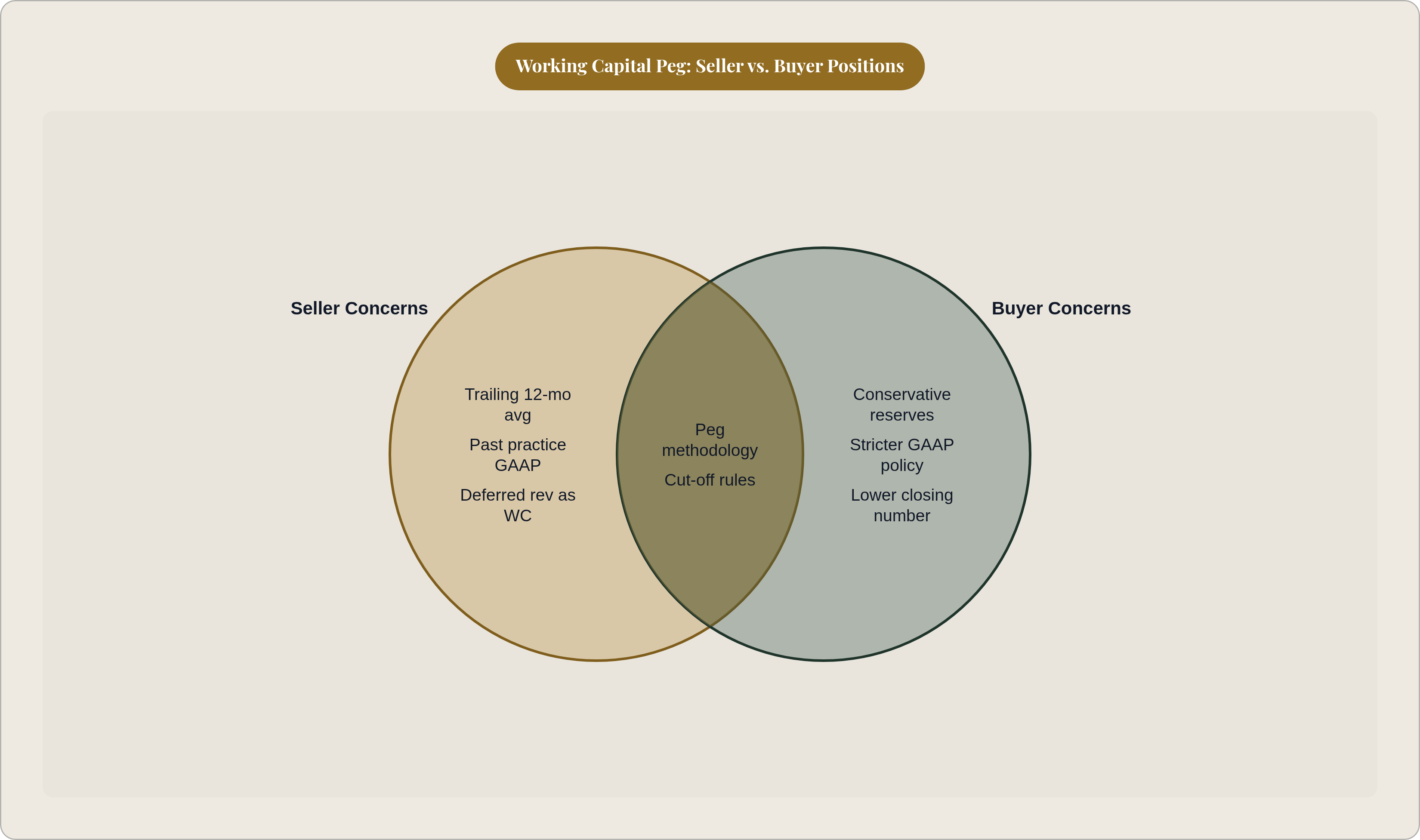
Slow-moving and obsolete inventory reserves are the usual flash point. So is costing method consistency: does the closing statement use FIFO the same way the seller always has, or has something quietly shifted to LIFO? Valuation of adjacent product families raises the same kind of question. And here's the part that should make sellers pay attention: a buyer preparing the closing statement has every incentive to apply more conservative reserve assumptions than the seller ever used historically. More conservative reserves mean lower inventory value, which means a bigger shortfall against the peg, which means money flowing back to the buyer.
Accounts receivable disputes tend to concentrate in a small number of specific accounts rather than spreading evenly across the ledger. Aging quality, unresolved customer disputes, unapplied cash sitting in suspense, and the size of the allowance for doubtful accounts all show up repeatedly. The allowance is inherently judgment-based; two reasonable accountants can look at the same aging schedule and land on materially different numbers, and that gap is exactly where disputes live.
Deferred revenue and customer deposits create a different kind of disagreement, one that's structural rather than factual. Buyers inherit the obligation to actually perform the service the cash was collected for, so they routinely want to treat deferred revenue as a debt-like liability that reduces the purchase price. Sellers, by contrast, tend to view deferred revenue as a completely normal part of working capital, something that's always been there and always will be. Neither side is being unreasonable; they're just applying different frames to the same balance. SaaS, maintenance contracts, and subscription businesses are especially exposed here, and the treatment needs to stay consistent across the peg calculation, the closing balance sheet, and any earnout metrics riding on the same numbers.
Then there's the GAAP-versus-past-practice tension, which sounds like it should be simple and almost never is. Most purchase agreements require the closing calculation to be done "in accordance with GAAP, consistently applied" or "consistent with past practice." That language sounds protective, but it often isn't, because problems surface the moment you realize the seller's monthly internal statements, the buyer's quality-of-earnings normalization, and the buyer's final closing statement can each interpret the same accounting policy differently, and all three can claim to be GAAP-compliant while disagreeing with each other. If the LOI doesn't lock the specific methodology down, the buyer can apply stricter policies after exclusivity kicks in and defend the change as perfectly consistent with GAAP.
Cut-off disputes are smaller in scope but sharper in mechanics: a payment received or made one day on either side of the closing date shifts the working capital number by the full dollar amount of that payment. The fix is almost entirely preventable through drafting, meaning explicit cut-off rules in the purchase agreement, down to the precise time of day, along with agreed procedures for handling payments that are in transit at the moment of close.
And sellers should watch their own behavior here too. Aggressively collecting receivables, stretching out payables, or drawing down inventory specifically to hit the peg can violate ordinary-course-of-business covenants, even when the resulting closing number looks perfectly clean on its face. Buyers scrutinize the operating pattern in the weeks before close, not just the final snapshot, and a pattern that looks like manipulation can invite a separate claim entirely.
What happens after closing — the true-up process and where sellers lose ground
The true-up process follows a fairly standard sequence. The seller delivers an estimated closing statement a few days before the deal closes, the buyer then prepares the final closing balance sheet, typically within 60 to 90 days, and the seller gets a limited window, often somewhere between 20 and 30 days, to file specific written objections to that statement.
Miss that window, and silence generally counts as acceptance. Sellers who don't actively engage during the review period lose their right to object, full stop. This is where a lot of value quietly disappears, not because the buyer's number was necessarily wrong, but because nobody on the seller's side was paying close enough attention to check it.
When both sides can't agree, unresolved items go to an independent accountant named in the purchase agreement, and that determination is typically binding. Most disputes get resolved before ever reaching that neutral accountant, but a meaningful share do escalate, and among sellers who've actually gone through the neutral process, most rate it as effective. Cost matters here too: fees for a complex neutral accountant determination can run substantial, so when the disputed gap is small relative to those fees, a negotiated settlement usually makes more sense than fighting it out. When the gap is large, though, the process is worth what it costs.
One blind spot deserves its own mention. Representations and warranties insurance, increasingly common in middle-market deals, does not cover working capital disputes, and sellers can't lean on an R&W policy to backstop a working capital shortfall; that protection simply doesn't extend here. Which means the escrow structure is the real, and often only, protection mechanism in play. Most deals carry a dedicated purchase price adjustment escrow, separate from the general indemnity holdback, with a median around 1% of transaction value, though smaller deals often carry a proportionally higher escrow to cover the same risk.
What sellers can negotiate before signing to limit exposure
So what can actually be done about all this, before the ink dries?
Lock methodology at the LOI stage. This is worth repeating because it's the single highest-leverage move available: once exclusivity is signed, the buyer controls the clock, and every subsequent negotiation happens on the buyer's terms. Define the accounting policies with real specificity, naming the exact reserve methodology for inventory, the aging schedule thresholds for receivables, and the treatment of deferred revenue, all spelled out in the working capital schedule attached to the purchase agreement rather than left to a general reference to "GAAP."
Negotiate a collar. A collar sets a band around the peg within which no adjustment gets triggered at all, protecting both sides from small, unpredictable swings that don't reflect anything meaningful about the business. The size of that collar should track the actual volatility of the company's working capital, not some standard template pulled from the last deal the buyer's counsel worked on.
Insist that the peg be built using the same accounting policies that will govern the closing balance sheet. This sounds obvious, and yet the gap between how the peg was originally derived and how the closing statement actually gets prepared is one of the most common sources of an ugly true-up surprise. Seasonal businesses in particular should push for a methodology that accounts for exactly when in the calendar closing lands, since a same-month-prior-year approach protects against exactly the kind of distortion the SaaS example above ran into.
Build in review rights: access to the buyer's actual workpapers behind the closing balance sheet, not just a summary page with a final number on it. And bring in a financial advisor or investment banker with real transaction experience early, well before the LOI is signed, to review or run the working capital analysis before any peg gets proposed. Waiting until after signing to get expert eyes on the number is, by then, mostly too late.
Why sellers who start planning earlier face fewer disputes
Here's the pattern worth sitting with: nearly every vulnerability described above, undocumented accounting policies, informal past practices, inconsistent reserve methodologies, developed over years, not in the weeks leading up to closing. That means the real fix starts long before a deal is even on the table.
Sellers who clean up their accounting practices, document their policies clearly, and understand their own working capital seasonality before ever going to market show up at the peg negotiation with evidence instead of assertions. That's a meaningfully different negotiating position. A quality-of-earnings review commissioned by the seller, run before the process even begins, tends to surface the same issues a buyer's own QoE team would eventually find anyway, but with the crucial difference that the seller now has time to resolve those ambiguities calmly instead of defending them under deal-fatigue pressure with a closing date looming.
Deal fatigue really is the structural problem underneath all of this. Working capital methodology tends to get finalized late in the process precisely because that's when sellers are most likely to accept vague language just to keep momentum toward closing. Sellers who understand the mechanics before the process even starts are simply less vulnerable to that late-stage pressure to concede.
Advisory and preparation solve two different halves of this problem. A properly run, competitive sale process gives the seller options and preserves leverage all the way through closing, so no single buyer ever gets to dictate terms unilaterally. Experienced deal advisory then protects the price once a buyer has actually been chosen, by making sure the peg mechanics and collar structure get negotiated with the same rigor as the headline purchase price. Founders who engage advisors years before a planned exit, not months, have the runway to normalize their financials, resolve ambiguous accounting policies while there's no clock running, and walk into the negotiating room with a working capital history that can actually defend itself.