Industry Roll-Up Acquirers and What They Offer Founder-Led Businesses
Roll-up acquirers offer back-office relief and patient capital to founder-operators.

The numbers here aren't subtle. Add-on acquisitions, the bolt-on purchases that sit at the center of every roll-up strategy, made up 75.9% of U.S. buyout activity in the second quarter of 2025. In the lower middle market, roll-ups drove more than 80% of all deals in 2024. This isn't a trend anymore. It's just how the market works now.
Industry roll-up acquirers typically offer 60 to 70% cash at close, with the remainder rolled into equity in the acquiring platform at roughly 20 to 30% of the purchase price. Beyond the check, they bring centralized back-office functions, meaning accounting, HR, IT, and procurement, that most founder-operators have personally carried for years, plus dedicated deal infrastructure that lets them execute five to fifteen add-ons a year with standardized diligence and debt facilities already in place. In the lower middle market, bolt-on add-on purchases, the individual acquisitions inside a roll-up strategy, typically price at 4 to 6 times EBITDA, while platform-level deals command 6 to 9 times; a competitive process drawing PE platforms, strategics, and holdcos simultaneously tends to produce 15 to 30% higher multiples than engaging a single buyer type alone. Add-ons drove more than 80% of all lower middle market deals in 2024, and close to half of all global add-on deals now represent at least the fourth acquisition by a single platform, which means these are patient, systematic consolidation machines rather than opportunistic one-off purchases.
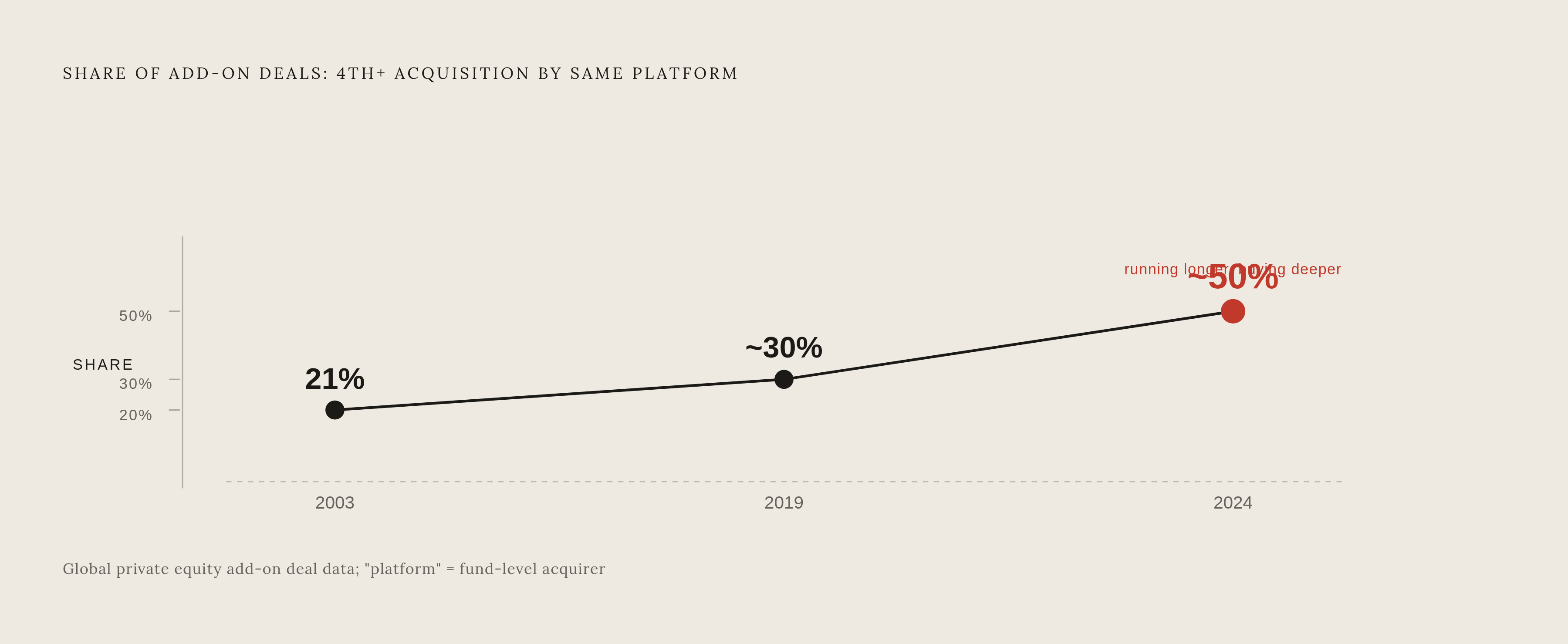
Deal volume backs it up. Lower middle market PE deal value hit $838.5 billion in 2024, up 19.3% from the year before, with deal count climbing 12.8% to 8,473 transactions. But, at least to me, the more telling number is the depth stat: close to half of all global add-on deals now represent at least the fourth acquisition by a single platform, up from roughly 30% in 2019 and just 21% back in 2003. Roll-up shops aren't just launching more often. They're running longer and buying deeper into their category before they stop, which tells you these aren't quick flips, they're patient machines built to consolidate an entire corner of an industry.
Some of this comes down to plain demographics. An estimated tens of millions of U.S. business owners sit within ten years of typical retirement age, and that population is concentrated heavily in home services, healthcare, and manufacturing. Those happen to be exactly the fragmented, owner-operated sectors roll-up buyers favor. A wave of retiring owners meeting a wave of capital that wants precisely this kind of asset; that's not a coincidence, it's a supply-demand match that private equity has been building toward for a decade.
If you run a profitable business in a fragmented industry, there's a decent chance a roll-up acquirer has already sketched your market on a whiteboard somewhere in a Chicago or Dallas office park. It is a common enough starting point that founders in these sectors are increasingly fielding unsolicited outreach. Understanding what these buyers offer, and what they don't, is preparation for a call that may already be coming.
The five types of roll-up acquirers and what distinguishes them from a founder's perspective
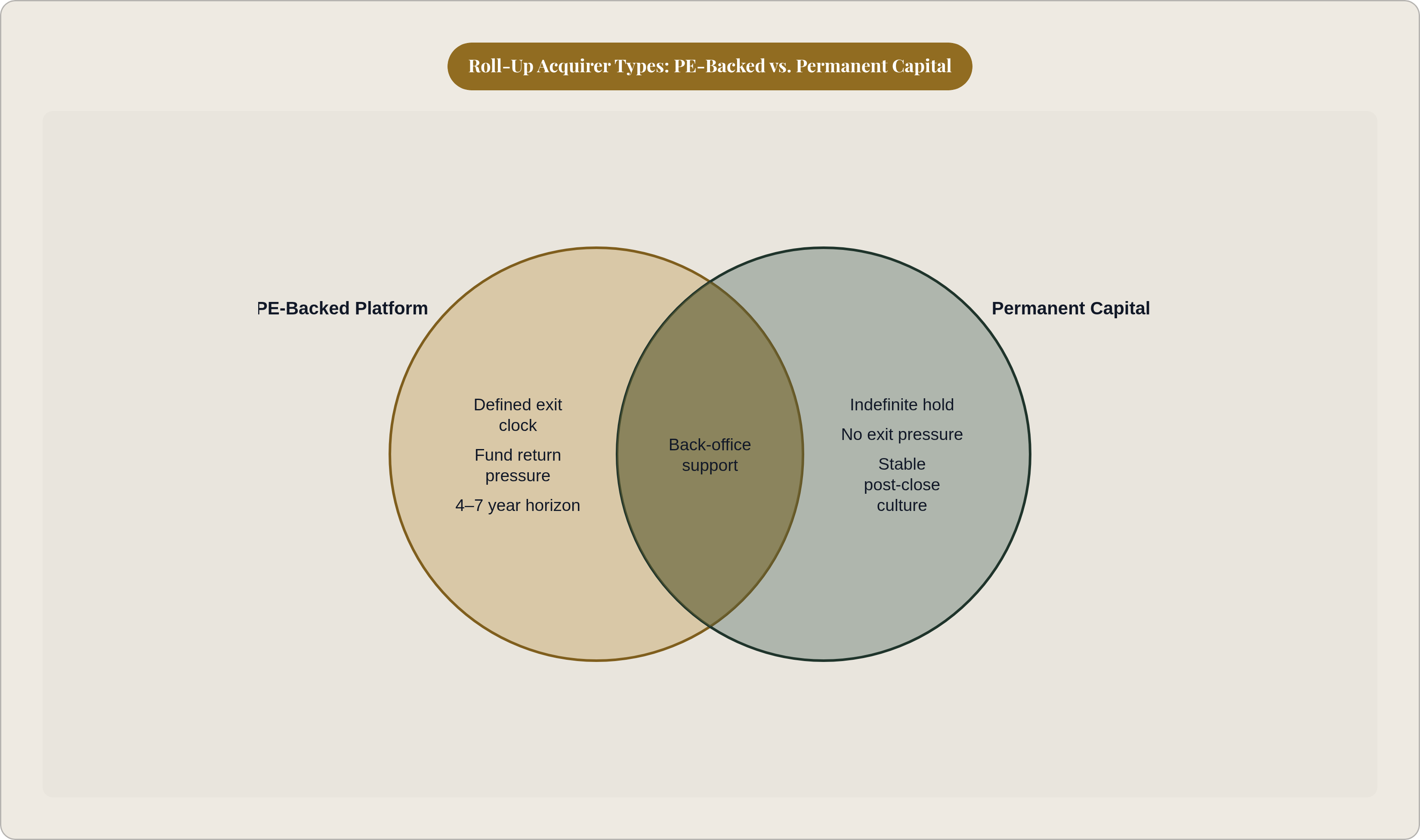
Roll-up buyers vary meaningfully even though they run similar playbooks underneath. The most common by far is the PE-backed platform: a private equity firm buys a lead company, installs or backs a management team, then funds a multi-year add-on program, typically three to five years of bolt-on purchases. This structure dominates home services, healthcare services, and business services right now. The feature founders sometimes underweight is exit pressure. The business is being built to sell again in four to seven years, and every decision downstream of close gets filtered through that eventual sale, whether anyone says so out loud in the negotiation or not.
Strategic acquirers look different. These are existing operators in your sector consolidating for competitive reasons rather than pure financial engineering. They tend to hold longer and offer less structured rollover equity, since they aren't managing a fund with a return clock ticking in the background.
Then there's the search fund or ETA operator: an individual who acquires a platform using SBA or conventional financing and runs the same add-on playbook at a much smaller scale. Less institutional infrastructure, smaller check sizes. Still, the underlying logic is basically identical to the PE version, just with one person instead of a deal team.
Independent sponsors occupy an odd middle ground. They don't have a committed fund sitting on standby waiting to deploy; they find the platform first, then raise equity deal by deal. Less capital certainty for you as a seller, in other words. Sometimes more flexibility on structure, though, since they aren't bound by some fund's pre-existing playbook.
Last is the permanent-capital holding company, which acquires and holds indefinitely, no exit clock at all. For a founder who dislikes the idea of getting sold again in five years to some buyer they've never met, this carries a fundamentally different set of incentives.
So here's a question worth asking of all five categories at once: would this business be run any differently if a sale were never on the table? For a PE-backed platform, the answer is almost certainly yes; everything from hiring to capex gets shaped by the eventual exit. A permanent-capital holdco answers no. That single distinction changes what "operational continuity" actually means after you sign, and it's worth probing well before you're anywhere near a term sheet.
Which industries roll-up acquirers are actively targeting right now
Four traits make an industry ripe for a roll-up: fragmented ownership, recurring revenue, room to professionalize management, and identifiable economies of scale once you combine multiple operators. Sectors hitting all four right now include HVAC, plumbing, electrical, roofing, pest control, dental, behavioral health, managed IT services, specialty distribution, insurance brokerage, CPA firms, wealth management, and consulting.
Home services is the flagship case. Home services roll-ups have become one of the most cited proof points that this playbook works at real scale, and the sector hasn't gone unnoticed: Goldman Sachs, Blackstone, Leonard Green, and Bain Capital are all backing competing HVAC platforms right now, which tells you something about how crowded this particular field has gotten in just a few years.
Insurance brokerage is the landmark case, though, and the numbers there are almost absurd. GTCR acquired AssuredPartners starting in 2011, completed roughly 112 acquisitions in the first four years alone, crossed $500 million in annualized revenue, then added roughly 124 more acquisitions once Apax took over ownership. The platform ultimately sold to Arthur J. Gallagher in December 2024 for $13.45 billion, one of the most significant insurance brokerage exits on record at the time. Gallagher paid something like 14 times earnings for a business assembled one local broker at a time, most of them bought at far lower multiples than that.
Accounting is the newest frontier, and it's moving fast even by this industry's standards. Annual PE deal volume in accounting climbed from roughly two dozen transactions in 2023 to more than 100 in 2025. The Hellman & Friedman investment in Baker Tilly in 2024, roughly $1 billion and the largest PE investment in U.S. accounting at the time, shows how quickly a profession that used to feel practically immune to consolidation can turn into the next hot target.
What does all this mean if you're sitting in one of these sectors? More buyers competing for your business, faster timelines to close, and, if you actually run a competitive process instead of taking the first offer that lands, meaningfully higher multiples than you'd get selling into a quiet market.
What do industry roll-up acquirers actually offer when they buy a founder-led business?
Cash at close is the headline number, and it's the only part of the offer that's actually certain. Deals typically structure this as 60 to 70% cash at close with the remainder rolled into equity. Everything past that cash figure carries either timing risk or performance risk, and founders should treat it accordingly. Not as a bonus, but as a bet.
Beyond the check, there's real operational relief on offer. Back-office consolidation, meaning centralized accounting, HR, IT, insurance, and procurement, takes functions many founders have personally carried for years off their plate entirely. Dental practices and home services businesses are probably the clearest examples; a solo dentist who's been running their own billing and insurance credentialing suddenly has a whole department handling it for them.
Speed matters too. PE-backed roll-ups execute five to fifteen add-ons a year, which means dedicated deal teams, standardized diligence checklists, and debt facilities already sitting in place before your deal even starts. Compare that to a strategic buyer doing its first acquisition ever, fumbling through diligence for the first time, and the execution risk gap becomes obvious pretty fast.
Local branding and team continuity often survive the transition too, at least in local services. The pitch founders hear, and it's usually genuine in the near term, is that nothing changes for customers or employees. There's real upside in market access as well: a formerly independent operator, once folded into a larger platform, can suddenly bid on contracts that required national scale or institutional credibility they never had on their own.
The rollover equity piece is where things get genuinely interesting, and genuinely risky. Founders typically roll 20 to 30% of the purchase price back into the acquiring entity as equity, essentially betting on the platform's future exit alongside the sponsor. The math can be compelling: a meaningful rollover stake in a well-performing platform can multiply substantially at exit, assuming the roll-up performs. That's the "second bite of the apple" everyone in this world talks about, and it's the reason so many founders take the deal in the first place.
There's a real tax benefit tucked into this structure too. Only the cash portion gets taxed at close; the rollover equity is generally taxed later, when it's actually cashed out at the platform's eventual exit. That deferral has genuine value, and good tax counsel will tell you so.
The risk cuts the other way just as hard, though. Rollover equity is worth exactly what the platform is worth at exit, no more, no less, and it isn't liquid in the meantime. Should the roll-up underperform, or should the sponsor's exit get delayed a few years (which happens more often than glossy pitch decks suggest), that second bite shrinks. It can even disappear entirely.
The valuation reality: what a roll-up acquirer will pay versus what a founder could get elsewhere
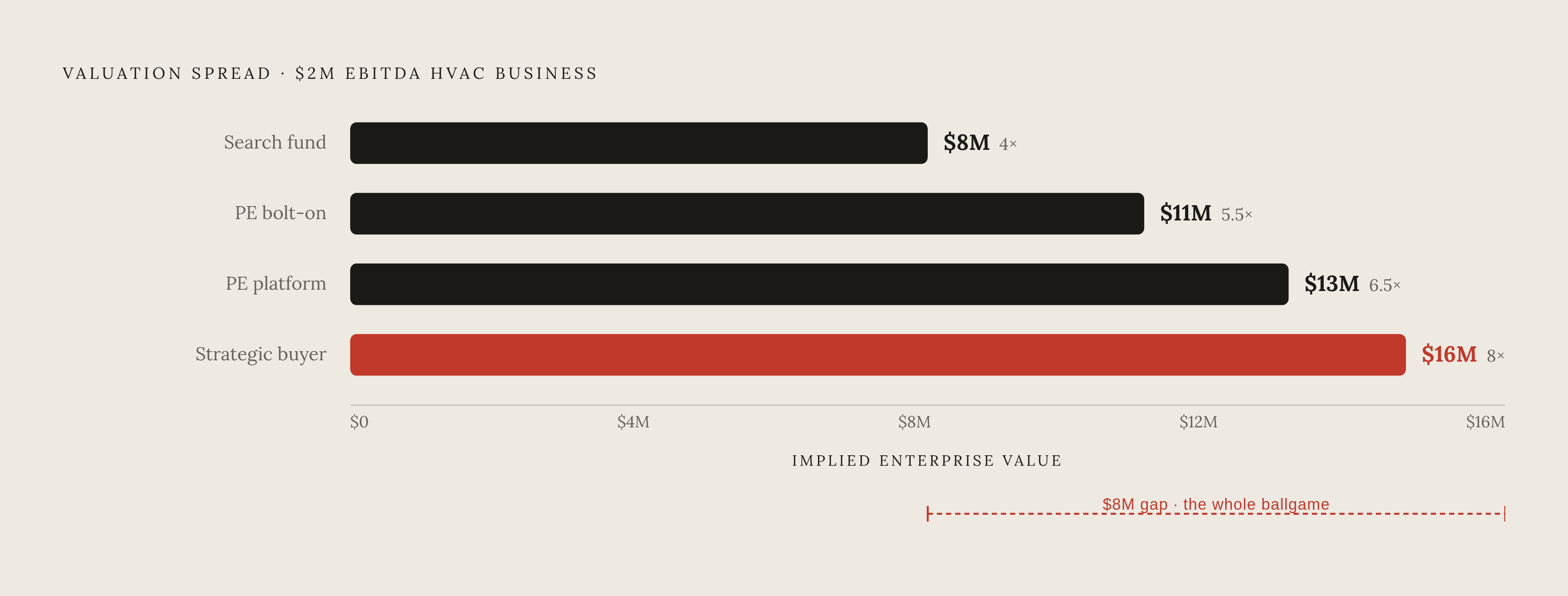
Multiples vary a lot depending on who's writing the check. Bolt-on buyers, the actual add-on purchases inside a roll-up, typically pay 4 to 6 times EBITDA. Platform-level acquisitions, where you're the anchor company rather than an add-on, command 6 to 9 times. Strategic buyers, when they show up at exit, can reach 8 to 12 times.
Put concrete numbers on it. For a $2 million EBITDA HVAC business, a search fund might offer 4x, a PE firm doing a bolt-on might offer 5.5x, a PE platform acquisition might reach 6.5x, and a strategic buyer at the top end might pay 8x. That's a two-times spread between the lowest and highest bidder for the exact same business. That gap isn't noise. It's the entire ballgame for a seller trying to maximize proceeds.
Go back to AssuredPartners for a second, because it makes this dynamic concrete instead of theoretical. Every one of those 500-plus brokers got bought at bolt-on multiples, the lower end of the range. Gallagher then paid roughly 14 times earnings for the assembled platform at exit. The distance between what individual sellers received and what the platform ultimately sold for isn't an accident or a rounding error. It's the financial engine that makes the entire roll-up model work for the sponsor. Every founder who sold into that platform financed a slice of Gallagher's eventual return, whether they realized it at the time or not.
So what does a founder actually do with this information? Run a competitive process. Data on this is fairly consistent: drawing bids from three or more buyer archetypes, meaning PE platforms, strategics, and holdcos all competing at once, typically delivers 15 to 30% higher multiples than going to a single buyer type in isolation. That's not a marginal improvement. On a $10 million EBITDA business, that's the difference between a $60 million and a $75 million outcome, and Founders regularly leave that gap on the table simply by engaging only the first buyer who reaches out.
Roll-up buyers genuinely offer speed and certainty that strategic buyers often can't match, and that's a real point in their favor, not a knock against them. That said, a founder who only talks to roll-up acquirers, without testing what a strategic buyer or a differently structured deal might pay, is very likely leaving money behind. The rollover equity can be legitimate partial compensation for a lower headline multiple, if the founder actually believes in the platform's trajectory and has done real diligence on the sponsor's track record. That's a real "if," though, not a rubber stamp, and not something to take on faith because the pitch deck looked polished.
What founders should negotiate and watch out for in a roll-up deal
Start with cash at close, since it's the only number in the deal you can actually count on. Negotiate its size hard, and resist pressure to shift more consideration into earn-outs or deferred payments when your rollover stake already carries plenty of performance risk on its own. Stacking two forms of contingent value on top of each other is how founders end up with a purchase price that looks great on paper and disappoints in practice, sometimes years later when there's no undoing the deal.
On the rollover equity itself, dig into the structure line by line. Founders often receive common equity while the PE sponsor holds preferred shares with liquidation preferences, meaning in a modest or underwhelming exit, the preferred gets paid first and common might get very little, or nothing at all. Ask directly about the platform's acquisition pace relative to its integration capacity, too; a roll-up buying faster than it can absorb and manage what it's already bought is building fragility, no matter how impressive the deal count looks on a pitch deck. Be honest with yourself about timeline as well. A "four-year horizon" gets floated in a lot of these conversations, and it sometimes stretches to seven or eight. Illiquidity has a real cost, and it compounds the longer you're stuck holding an asset you can't sell.
Get operational continuity promises in writing, with specifics attached. Which back-office functions actually get centralized, and on what timeline? What happens to your key employees, the ones who've been with you for a decade? Is local branding contractually protected, or is that just the acquirer's current preference, one that could change the moment new management walks in?
Earnout structures show up often in these deals, and founders should look closely at what they're actually tied to. If your earnout depends on EBITDA targets affected by the platform's own integration decisions rather than your operating performance, you're taking on risk you can't control. Push for metrics that are actually within your power to influence, full stop.
There's also a structural question worth asking yourself honestly: are you being bought as the platform, or as a bolt-on? Your negotiating position looks fundamentally different depending on the answer. Platform companies get more attention, more customized terms, more leverage in the room. Bolt-ons get a more standardized, take-it-or-leave-it process.
Cultural diligence runs both directions, and founders skip this step more often than they should. How many acquisitions has this platform actually completed? Can you talk to a founder who sold to them two or three years ago and ask how it really went, not how the press release described it? What does management turnover look like in the twelve months after close? The acquirer's integration track record matters just as much as the number on their term sheet, maybe more, since that track record predicts what your life actually looks like six months after signing on the dotted line.
Acquirer type still matters here too. A permanent-capital holdco and a PE-backed platform running toward a defined exit clock will treat you very differently after close, even when the initial offers look nearly identical on paper. Match the structure to what you actually want out of the next chapter of your life, not just whatever number lands on the signature page.
How to position yourself to attract — and evaluate — roll-up acquirers effectively
Roll-up acquirers aren't cold-calling randomly. They run systematic processes, with sector theses, buyer mandates, and deal teams actively mapping target markets well before they ever pick up the phone. Being findable, and having clean financial documentation ready when they do call, speeds up their process considerably. It also, frankly, makes you look like a more serious counterparty from the very first conversation.
What actually makes a business attractive to one of these platforms? Clean, recurring revenue with documented customer relationships sits at the top of the list. EBITDA that survives your departure matters just as much; owner-dependency is probably the single most common reason a buyer discounts a deal, because they're effectively worried they're buying your personal relationships rather than a durable business. Geographic density that fills a gap in the platform's existing footprint helps, and even a thin management team that can keep operating without you standing over their shoulder adds real value here.
A founder who accepts the first roll-up offer that lands in their inbox is, by definition, running a single-archetype process. That means forgoing the 15 to 30% multiple premium that genuine competitive tension tends to produce. The first offer isn't necessarily a bad one, but you have no way of actually knowing whether it's good without something to measure it against.
Running a real competitive process means identifying and approaching multiple buyer types at once, PE platforms, strategics, and holdcos simultaneously rather than one after another in sequence. It means controlling how information flows and on what timeline, so buyers are actually competing against each other instead of evaluating you in isolation with all the time in the world to think it over. It also means having independent valuation context in hand before you're anywhere near an LOI conversation, so you know what a reasonable range looks like before someone hands you a number and calls it fair.
Combining algorithmic buyer identification with actual investment banking advisory changes the equation for a founder here. Technology can surface roll-up acquirers you'd never have found through your own network or your accountant's rolodex. Human advisory expertise runs the actual competitive process and keeps you from settling for a below-market offer just because it happened to show up first. Neither one replaces the other; they're solving different halves of the same problem.
One last thing worth sitting with. Roll-up activity in any given sector can cool off just about as fast as it heats up, and the window when your business commands premium attention from multiple competing platforms at once is finite, not permanent. Founders who start preparing two or three years ahead of a planned exit, cleaning up financials, reducing owner-dependency, understanding their sector's buyer landscape, consistently land better outcomes than those who wait around for a call and react to whatever number shows up first.