How Acquirers Screen and Prioritize Acquisition Targets in the Lower Middle Market
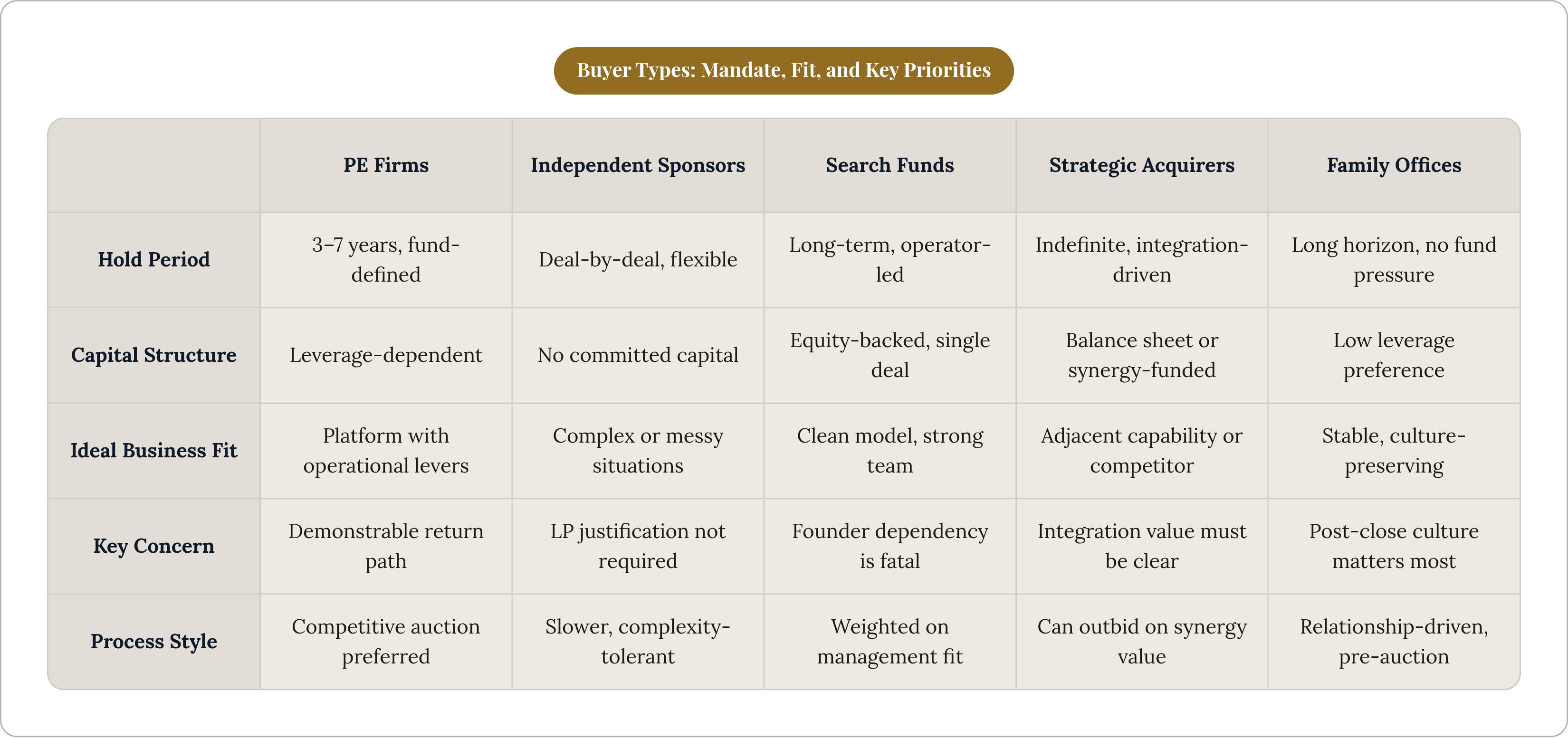
Different buyer types pursue fundamentally different operational mandates and financial structures.

The buyer universe has changed materially over the past several years, and sellers who treat it as monolithic are misreading the opportunity in front of them.
Private equity firms and independent sponsors together accounted for 61% of closed lower middle market deals in 2021. By 2025, that combined share had fallen to 45%. Search funds reached an all-time high of 14% of closed deals in 2024. Individual investors now account for 13% of transactions. Family offices and holding companies have held roughly steady throughout.
The more consequential question is not who is buying but what each type is actually trying to accomplish, because those objectives diverge sharply and a business that fails one buyer's screen is sometimes precisely what another buyer is looking for.
PE firms operate within a fund structure with defined hold periods, typically three to seven years, and return targets that require demonstrable operational improvement. They want platforms with identifiable levers: pricing power not yet captured, adjacent markets not yet entered, inefficiencies that can be systematically addressed. An add-on strategy usually follows, which means a platform acquisition is often the opening move in a consolidation thesis rather than a standalone bet.
Independent sponsors work deal by deal, without committed capital. That structure makes them more tolerant of complexity a fund manager cannot justify to its LPs: messier financials, unusual industry positions, owner-transition risk. They are often better suited to situations requiring genuine operational involvement rather than financial engineering, and they tend to move more slowly, which is not always a liability for a seller who needs time.
Strategic acquirers, including large companies buying smaller competitors and mid-sized businesses acquiring adjacent capabilities, are frequently the highest-volume buyer type in any given sector. They can outprice financial buyers when integration value is demonstrable because their ceiling is set by synergy, not leverage multiples. That distinction matters enormously for a seller trying to understand what their business is actually worth to different constituencies.
Search funds represent a structurally distinct category: a single acquisition, operator-led, with the searcher becoming CEO post-close. The weighting on management transition and business simplicity is higher here than anywhere else in the buyer universe. A business that depends on a charismatic founder-salesperson is a particular liability for this buyer; a clean operating model with a retention-ready team is close to ideal.
Family offices bring longer hold horizons and less leverage dependence. They tend to be relationship-oriented in ways institutional buyers are not, which means early-stage conversation quality matters more than in a competitive auction. A family office is rarely the highest bidder, but may be the right buyer for a founder who prioritizes post-close culture alongside price, and who finds the institutional auction process distasteful.
A business that fails one buyer type's screen may be a strong fit for another. But identifying which buyer types apply requires understanding each type's mandate, not just their name.
The First Filter: Hard Financial Thresholds That Determine Whether a Deal Gets Read at All
Before any qualitative evaluation, buyers apply financial floors. These are not preferences; they are pre-screening rules that eliminate the majority of opportunities before a buyer invests meaningful time.
For PE-focused platform acquisitions in the lower middle market, the EBITDA floor typically sits in the low single-digit millions, with the preferred range clustering in the mid-to-upper single-digit millions. Revenue expectations generally fall in the tens of millions to low hundreds of millions, varying by sector and buyer type. Buyer concentration in the lower end of the EBITDA range is particularly strong, which also means competition among buyers for those businesses is highest. For sellers operating there, that dynamic is worth understanding before pricing expectations are set.
Recurring revenue composition enters the evaluation at this stage too. A business with a high proportion of contractual or auto-renewing revenue passes the first filter more cleanly than one with equivalent EBITDA from project work. The EBITDA number may be identical; the buyer's confidence in its durability is not.
The sourcing funnel is steep by design. Typical sourcing math in the lower middle market runs from several hundred to two thousand outreach touches, down to fifty to one hundred initial conversations, ten to twenty NDAs, five to ten detailed books reviewed, two to three letters of intent, and one closed deal. The financial floor is what makes that funnel efficient for the buyer. It is ruthless precisely because it needs to be.
If the financials do not meet the threshold on paper, no narrative closes the gap. Clean, credible, normalized financials are the cost of being considered at all, not a competitive advantage over other sellers who have done the same work.
How Deal Size Translates Into Valuation and What the Multiple Spread Actually Means
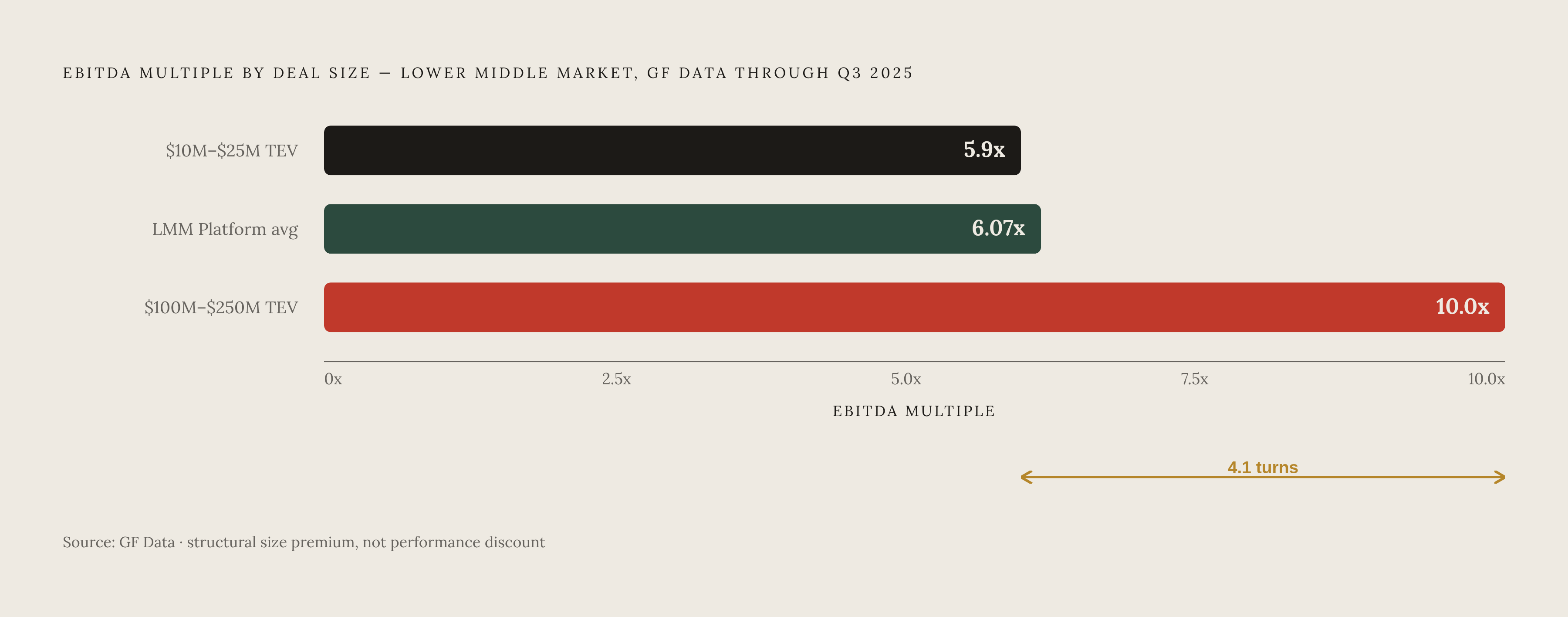
The valuation gap between smaller and larger deals in the lower middle market is persistent and measurable. GF Data's long-run tracking shows a gap of approximately 2.6 turns of EBITDA between larger sponsored platforms in the upper middle market total enterprise value range and smaller ones, widening to 2.8 turns through the third quarter of 2025.
Concrete anchors: deals in the $10 million to $25 million total enterprise value range averaged 5.9x EBITDA through Q3 2025; deals in the $100 million to $250 million range averaged 10.0x over the same period. The lower middle market platform average came in at 6.07x in 2025, above a five-year average of 5.70x.
Why does this spread exist? It reflects structural features of smaller deals: thinner buyer competition, reduced leverage availability from lenders who apply their own size floors, and lower secondary market liquidity that constrains exit optionality for PE buyers. Smaller deals are harder to finance aggressively, harder to exit predictably, and contested by fewer bidders. The multiple reflects all of that simultaneously, not any single factor in isolation.
Within any given size band, the range between a low-end and high-end transaction is often two to three turns of EBITDA. That range is not explained by size; it is explained by quality. Sellers who commissioned sell-side quality of earnings work prior to going to market averaged meaningfully higher multiples than those who did not, across tracked transaction samples. That gap is a measurable return on preparation.
Knowing which size band a business occupies tells a seller the ceiling and the floor. Everything that follows determines where within that range the deal actually closes.
The Qualitative Filters That Move a Deal From "Interesting" to "Priority"
After passing quantitative screens, sophisticated buyers apply a structured qualitative framework, consistently, across deals that cleared the same numerical thresholds but perform very differently in final prioritization.
The market question comes first: is the industry one a buyer wants exposure to? Size, growth rate, fragmentation, and secular tailwinds all factor in. A business in a structurally growing market with fragmented competition and no obvious technological disruption threat scores differently than one in a cyclically sensitive sector with a few dominant players, even at the same EBITDA.
Financial quality goes deeper than the headline number. Buyers examine revenue mix, the sustainability of normalizing adjustments made to arrive at adjusted EBITDA, working capital dynamics, and customer concentration. A business where EBITDA is heavily dependent on a single large adjustment, or where working capital requirements are volatile and poorly documented, loses priority to a cleaner business at the same multiple.
Management depth may be the single most consequential qualitative variable at this size. A non-founder team that can operate and grow the business without the founder present removes the most common deal-killer in the lower middle market. The multiple premium buyers have attributed to management depth runs from 0.5 to 1.5 turns of EBITDA across tracked transactions. On a mid-single-digit-million EBITDA business, that is not a rounding error.
Operational levers matter because financial buyers are not passive holders. They need to identify, at the time of purchase, what they are going to do with the business to generate return. Pricing discipline, technology infrastructure, distribution reach, and customer acquisition efficiency are all examined for improvement potential. A business that looks optimized leaves a buyer wondering where the return comes from.
Exit optionality is evaluated at entry. A buyer modeling a five-to-seven-year hold wants to know who buys this business at exit and at what multiple. If the exit buyer universe is thin, or if the exit multiple is likely to compress relative to entry, the investment case weakens regardless of near-term financial performance.
Customer concentration deserves specific attention because it affects both the multiple and the deal structure. A single customer above a meaningful share of revenue either compresses the valuation or pushes a portion of the purchase price into an earnout tied to that customer's retention. Buyers are not being punitive; they are pricing the probability of a relationship ending post-close when the founder, who maintained it personally, is no longer present.
Recurring revenue carries a premium because it prices in certainty. Contractually recurring, auto-renewing revenue earns a higher multiple than equivalent project-based EBITDA. The income statement may look identical in a given year. The buyer's confidence in next year's income does not.
The Automatic Disqualifiers That End Buyer Interest Before Diligence Begins
Unlike qualitative factors that move a multiple up or down within a range, these issues typically end buyer interest outright. No price adjustment resolves them in the buyer's framework, because they change the fundamental nature of what is being purchased.
Owner dependency is the most prevalent. If the business cannot function without the founder's daily involvement in sales, client relationships, technical knowledge, or operations, a buyer understands that they are not acquiring a business; they are acquiring an employment contract with the seller, and a temporary one. The business visible at close is structurally different from the business they will own six months later.
Unverifiable or inconsistent financials may be the most common early-stage eliminator. If a buyer cannot reconcile the numbers through a quality of earnings process or basic diligence, the file closes. Not a judgment about intent. A practical reality: a buyer cannot underwrite what they cannot verify, and experienced buyers have stopped trying to work around that problem because it never ends well.
An unrealistic asking price creates a different kind of problem. A seller anchored well above demonstrable market multiples does not simply invite a lower counteroffer; they create a credibility problem. Buyers who perceive a seller as uninformed about market pricing often disengage rather than negotiate, because a failed process carries real cost and the opportunity cost of time spent is real.
Financeability constrains the buyer universe directly and mechanically. A business whose cash flow cannot support a reasonable debt structure at market leverage levels limits competition to all-equity buyers. Fewer buyers means less competitive tension, which compresses price. This is not a soft risk.
Key-person risk beyond the owner surfaces during management interviews and can derail a deal late in the process. Revenue-generating employees without retention structures, or technical knowledge held by a single person who has not been mapped to a succession plan, introduce fragility that buyers price explicitly into risk-return modeling.
None of these issues can be managed at negotiation. They need to be addressed before going to market, and in most cases, years before.
How Proprietary Sourcing Changes the Dynamic for Sellers Who Get Found Versus Those Who Go Looking
The best-capitalized acquirers in the lower middle market source a majority of their closed deals through proprietary channels: direct owner outreach, intermediary referrals, accountant and attorney relationships, industry contacts who surface opportunities before they are formally for sale. A business that enters a buyer's pipeline this way arrives without competitive pressure.
That absence of competitive pressure is precisely the structural cost to the seller. Proprietary deals transact at a meaningful discount to auctioned deals because there is no competing-buyer dynamic forcing the acquirer to sharpen their price. The buyer has more time, more information, and no urgency. Experienced ones know exactly what that asymmetry is worth to them.
Technology has changed how buyers source at scale. A large and growing share of dealmakers now use data platforms to identify and screen targets systematically, supplementing traditional relationship networks, and platforms like Succession AI, a tech-enabled exit platform for founder-led businesses, have made comparable tools available on the sell side. The effect is that more businesses are on buyers' radar earlier than their owners realize, often before the owner has seriously considered an exit.
Being found is not the same as being pursued on favorable terms. A structured intermediary-run process, even a targeted one with a curated buyer list rather than a broad auction, creates the competitive tension that moves a deal toward the top of the multiple band rather than the bottom. The difference between a proprietary approach and a well-run process is often measured in multiple turns of EBITDA, which at any meaningful EBITDA figure is a material dollar amount and not a theoretical one.
What Sellers Can Do With This Logic Before They Ever Talk to a Buyer
The screening framework described in this piece is not a mystery. It is a known sequence of filters applied systematically, and sellers who understand it can address each layer before going to market rather than discovering its implications under negotiation pressure, when the options narrow.
Financial readiness is foundational: clean, normalized EBITDA; verifiable revenue; working capital that can be explained and defended. These are not presentation choices. They determine whether a deal gets read past the first filter.
Management depth is probably the highest-return pre-exit investment most lower middle market owners can make. Building a team that can operate without the founder expands the buyer universe and earns a measurably higher multiple. Both effects compound.
Customer concentration is addressable over time. Actively diversifying the revenue base changes the deal structure before negotiation begins. At minimum, understanding what a buyer will do with existing concentration, whether that means an earnout on the concentrated revenue, a price reduction, or a restructured indemnity, prepares a seller for what is otherwise a late-process surprise.
Recurring revenue is a structural upgrade where the business model permits it. Shifting from project-based to contractual revenue changes how a buyer models next year's income, and that change in confidence translates directly into multiple.
Process design is the final variable and, in some ways, the most leverageable. The difference between entering an acquisition conversation through a proprietary channel and entering through a structured process with qualified buyers competing is often 0.5 to 1.5 turns of EBITDA. On a $3 million EBITDA business, that spread is the difference between a materially lower and a materially higher outcome. Not a rounding error.
Tools now exist to help sellers enter this process more informed. Withsuccession, for instance, uses AI-driven buyer matching to identify which type of acquirer, whether PE, search fund, strategic, or family office, is most likely to see a specific business as a priority rather than a misfit. It does not replace a well-run intermediary process, but it addresses the information asymmetry that leaves many sellers unsure which segment of the buyer market is even relevant to them before they start.
The buyers already know this framework. They have spent years refining it. The sellers who close at the top of the range are, without exception, the ones who learned it before the conversation began, not during it.