How Founder-Operators Prepare Themselves Psychologically for an Exit
Founders neglect the emotional work that determines whether an exit feels like triumph or loss.

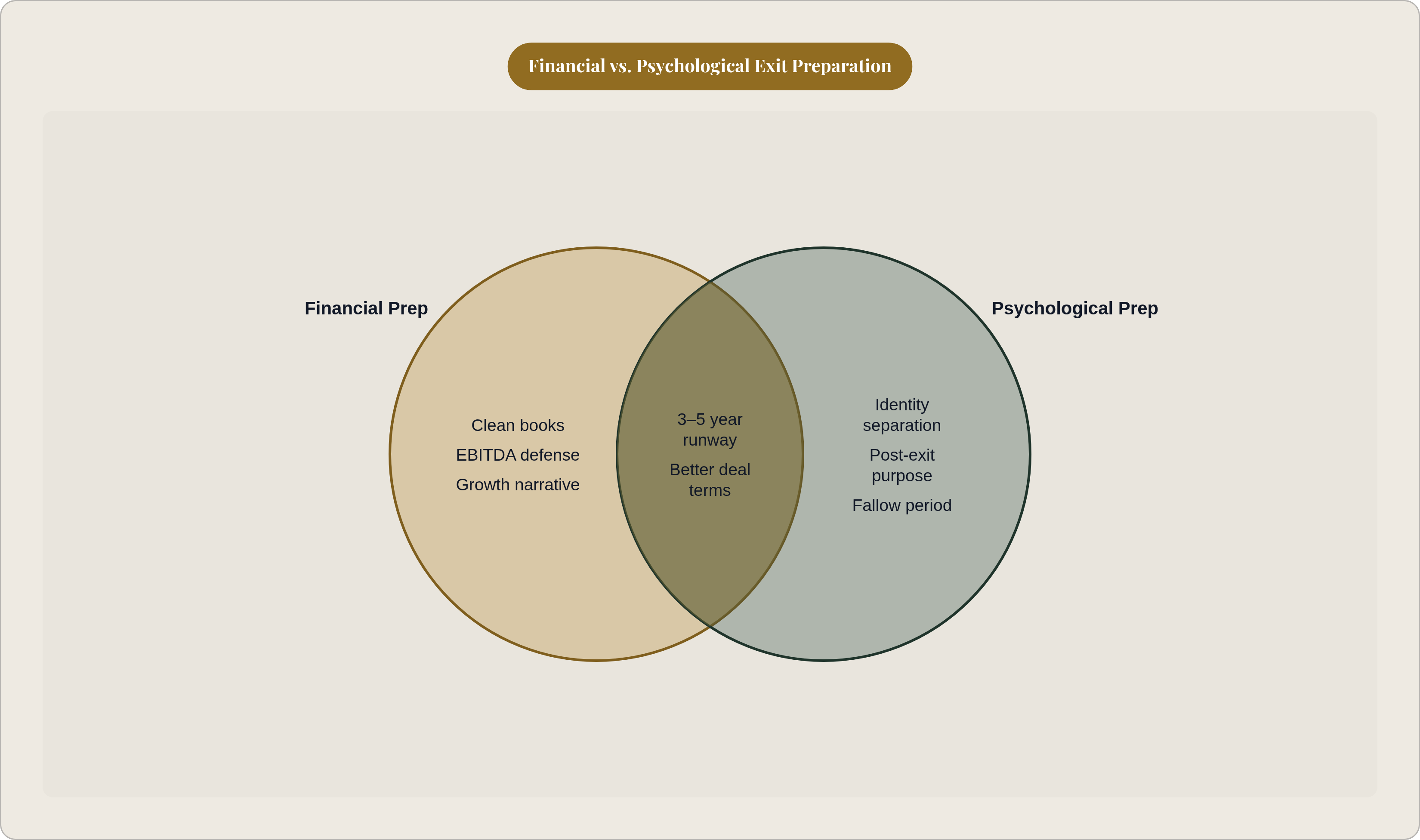
Most founders spend years preparing for an exit they spend almost no time actually preparing for. The financial mechanics, clean books, defensible EBITDA, a compelling growth narrative, get obsessive attention. The psychological dimension gets almost none. And yet research from the Exit Planning Institute and PricewaterhouseCoopers found that 75% of business owners report profound regret within a year of selling. The Exit Planning Institute's 2023 State of Owner Readiness Report found that only 44% of owners felt they had planned enough, and the shortfall they named was not financial. It was emotional.
That asymmetry is not accidental. Psychological preparation is harder to measure and easier to defer, which is precisely why most founders skip it. Scott Bushkie of Cornerstone Business Services, commenting on the IBBA Market Pulse Q1 2025 survey, put it plainly: "most owners are approaching a significant financial event unprepared, leaving money on the table and jeopardizing their hard-earned legacy." He was talking about readiness broadly, but the emotional track is where the gap is largest and the consequences linger longest.
The argument here is not that financial and operational prep matters less. It is that psychological readiness is a distinct discipline, not a byproduct of those efforts, and that it demands earlier, more deliberate attention than founders typically give it.
What Founder Identity Fusion Is, and Why It Makes Exits Psychologically Dangerous
Jerry Colonna, executive coach and author of Reboot, describes a phenomenon he calls the psychological merger of self and company: the founder doesn't just run the business; she becomes it. Every decision carries her fingerprints. The company's reputation is her reputation. Its survival is experienced as her survival.
This fusion is not a flaw. In the founding years it is often precisely what makes a founder relentless, decisive, and capable of absorbing the punishment that early-stage building requires. The problem is structural: when the container that holds all of that disappears, the founder has no secondary scaffolding to stand on.
What is actually lost at closing is not one thing. It is several losses arriving simultaneously. Daily structure and the rhythm that organized the founder's existence, gone. A clear identity anchor, the noun that answered "what do you do?", gone. Relationships that existed only within the context of the business, often the closest of the founder's working life, gone. The role of being needed, of being the person in the room whose opinion shaped outcomes, gone. The urgency and purpose that provided a reason to get up each morning with intention, also gone.
Therapist Annie Wright has named a specific experience she observes in high-achieving clients she calls "The Grief of Irrelevance": years of being the most necessary person in the room, then suddenly just a person with money. The loss registers not as relief but as a kind of ending, even when the deal was objectively excellent.
Identity fusion also suppresses planning before the exit arrives. Analysis from the Vantyr Group of family-firm succession research found that founder-led firms have materially lower levels of succession planning than firms run by descendants or professional CEOs. The psychological mechanism is avoidance: planning forces a confrontation with mortality, loss of control, and eventual irrelevance that is easier to defer indefinitely. Naming this phenomenon is not self-indulgent. It is prerequisite to addressing it.
The Emotional Stages That Typically Unfold, from Pre-Sale Delay Through the Post-Close Void
The staging begins well before the letter of intent is signed.
Pre-Sale: "One More Year" Syndrome
The tendency to defer a sale, even when the strategic case for selling is clear, is rooted in the same identity fusion. Selling means confronting who you are without the company. Deferral feels like prudence; it is often avoidance dressed as diligence. The founder convinces herself the timing isn't right, the multiple isn't full, the team isn't ready, when what is actually happening is that she is not ready to answer the question the exit will force.
During the Process: The Vulnerability of Due Diligence
Buyers examine every corner of the business. Founders frequently experience this as a personal audit, not a business one. Every question about a customer concentration or a systems gap lands as an implicit criticism of choices she made over years. Common reactions include defensiveness, frustration, and the urge to pull back from the deal at exactly the moment momentum is most important. Understanding this dynamic in advance makes the reaction manageable. Being blindsided by it mid-process is destabilizing in ways that cost founders real money.
Immediately Post-Close: The Valley of Shadows
The period immediately following a sale often begins with relief, sometimes euphoria. Then, typically within six months, affect flattens and purpose drains. Ben Chestnut, the founder of Mailchimp, described his exit after twenty years of building the company as "a psychological rollercoaster unlike anything I had experienced before, as I struggled to separate my identity from the business." Markus Persson, who sold Minecraft to Microsoft in 2014 for $2.5 billion, bought a $70 million mansion and within a year wrote publicly about feeling more isolated than ever, despite, or perhaps because of, having everything money could provide.
The void is not regret about the decision. It is the structural absence of what the business provided neurologically and socially for years.
The Guilt Trap
One of the most isolating features of post-exit experience is the rational mind's continuous case against the grief. You chose this. You have money. Others have real problems. Most founders perform gratitude publicly while grieving privately. The internal logic becomes: if I mourn the sale, I'm invalidating my own decision, so the grief goes underground. Unacknowledged grief does not resolve; it surfaces as restlessness, impulsive decision-making, or the compulsive need to immediately start something new, before the previous chapter has actually closed.
The exit also provides no mourning ritual by default. No wake, no eulogy, no collective acknowledgment that something significant has ended. The grief is real, but has no external container to hold it.
What Neuroscience Adds to the Picture: Why the Post-Exit Flatness Is Not the Same as Depression
The build years are characterized by chronic stimulation. Decisions at speed, problems with real consequences, constant novelty. The brain's reward system runs hot for years, calibrating its baseline around that level of activation.
Anna Lembke, professor of psychiatry at Stanford and author of Dopamine Nation, has documented the mechanism: the brain's reward system, chronically stimulated over an extended period, requires time to recalibrate to a lower baseline after the stimulus is removed. The post-exit founder is not, in most cases, clinically depressed. She is neurobiologically recalibrating.
The practical implication of this framing is significant. The instinctive response, immediately launching the next thing, filling the calendar, replicating the stimulus, is the wrong prescription. It delays the recalibration rather than completing it. Patience here is not passivity; it is the correct clinical analogue to what Lembke's work implies.
The reframe also removes shame from the flatness. It is not weakness. It is physiology adjusting to a fundamentally different operating environment. Founders who understand this mechanism before the close are better positioned to sit with the discomfort rather than flee it into the next deal.
Why Athletes Going Through Career Retirement Offer the Most Useful Mirror for This Experience
The people who most acutely understand post-exit grief are not other founders. They are elite athletes at the end of their competitive careers. The structural parallel is almost exact: years of elite-level intensity and identity built around a single pursuit; a defined ending event that society treats as an achievement but the individual experiences as an amputation; public expectation of gratitude and celebration that leaves no room for grief; and the sudden absence of the structure, purpose, and identity the pursuit provided.
Michael Phelps, the most decorated Olympian in history, has spoken openly about post-Olympic depression hitting him after each Games. He has estimated that more than 80% of Olympians experience some version of it. The IOC's own data finds that roughly one-third of elite athletes experience anxiety and depression during their careers, and over one-quarter face serious mental health challenges when the career ends. Researchers studying athlete retirement describe "identity confusion," "loss and turmoil," and participants characterizing disengagement from elite sport as profoundly traumatic.
The analogy is instructive for another reason. Sports organizations have built post-career transition support because the data forced them to. The M&A industry has not. Founders navigating this terrain largely do so without the institutional scaffolding that athletes, for all their other vulnerabilities, now have access to. Phelps speaking publicly about this is also a permission structure: if one of the most celebrated athletes in history could not escape the psychological aftermath of a defining ending, the founder experiencing the same thing is not being weak or ungrateful.
The Mental Health Baseline Founders Carry into an Exit, and Why It Amplifies the Stakes
Founders do not arrive at an exit psychologically neutral. A study spanning entrepreneurs across 46 countries found that a large majority report struggling with one or more mental health issues during their entrepreneurial journey. Entrepreneurs are affected by mental health challenges at meaningfully higher rates than the general population, and more founders reported concern about their mental health than their physical health, a signal that awareness is growing even if the tools and resources haven't caught up with it.
Only a small fraction of founders were even aware that mental health resources tailored specifically to entrepreneurs existed.
The exit does not create the psychological vulnerability. It concentrates and amplifies a pre-existing load that the work itself had been metabolizing. The business was, among other things, a coping structure: a container for anxiety, ambition, and the need to feel useful. When it's gone, the coping structure goes with it, and what's underneath it surfaces. That is not an argument against selling. It is an argument for knowing what you're walking into.
What Psychological Preparation Actually Looks Like in Practice, Starting Years Before the Sale
The same three-to-five year lead time that financial and operational advisors recommend for exit readiness applies equally to the psychological track. Emotions do not compress on deal timelines.
Separating Identity from Ownership, Deliberately, Before It's Forced
The foundational question is: who are you outside the company? This is not a philosophical exercise. It is a practical audit. What relationships, pursuits, and roles exist independent of the business? If the answer is very few, that is the first thing to build. Founders who have already cultivated identity outside the company before a sale begins experience the transition as a shift. Those who have not experience it as a void.
Articulating a Post-Exit Purpose Before the Process Begins
Not a bucket list. A genuine answer to "what am I moving toward?" rather than only "what am I moving away from?" Founders who can name a next chapter, advisory work, philanthropy, a new venture, deeper family investment, navigate the post-close period with more stability than those who expect the answer to arrive after the wire clears. The answer doesn't have to be certain. It has to be live and considered.
Rehearsing Loss of Control Before It Happens
Due diligence will feel like a personal examination. Delegating meaningfully before the sale, not merely for operational readiness but as psychological practice, builds tolerance for not being the final decision-maker. Founders who have never delegated consequential decisions experience the loss of control during and after a sale as acute. Those who have practiced it experience the transition as a continuation of something already underway.
Working with a Coach, Therapist, or Peer Group Who Understands the Founder Context
General therapy is useful. Coaching or therapy with practitioners who understand identity fusion and founder psychology specifically is more efficient. Peer communities of founders who have already sold, not just current founders, provide a form of mentorship the broader entrepreneurial community cannot replicate. The goal is not to eliminate the emotional response. It is to have a container for it, the mourning ritual the exit process does not provide by default.
Building in a Deliberate Fallow Period After Close
The instinct to immediately launch the next thing is strong and, given Lembke's neurological framing, understandable. It is also the wrong move. Planning for six to twelve months of reduced external stimulus as a design choice, rather than experiencing it as failure, gives the reward system time to recalibrate. Founders who do this intentionally report cleaner decision-making in what comes next. Those who skip it often find themselves inside a new venture that was selected for the wrong reasons, using the same avoidance mechanisms in a new container.
Why Starting the Exit Process Earlier Creates Room for Both Financial and Psychological Preparation Simultaneously
The 2023 EPI State of Owner Readiness Report documents a decade of meaningful progress in owner awareness. Formal exit planning education completed by owners rose from 35% in 2013 to 68% in 2023. Formal business valuations rose from 18% to 60%. Exit strategy as a stated priority rose from 6% to nearly 70%.
But awareness has not translated into action at the same rate. Only 32% of owners have a documented exit plan. Only 22% have aligned business goals with personal and financial planning. More than 7 in 10 closely held business owners hope to exit in the next decade, yet only about one-fifth have a formal transition team in place.
The gap between knowing and doing is itself a psychological phenomenon. The same identity fusion that makes planning feel threatening keeps owners from converting stated intent into structured preparation. The business owner who says she plans to exit in five years but has not begun the process is engaging in a version of the same deferral as "one more year" syndrome, just with a longer runway.
Starting earlier does more than extend the planning horizon. It changes the nature of the preparation. Withsuccession, an AI-powered M&A platform that matches founder-led businesses with qualified buyers while pairing them with investment banking advisory, is built specifically for owners who want to begin that process years before a deal is live. A founder who begins three to five years out has time to build genuine outside identity, articulate a real post-exit purpose, practice delegation as a habit rather than a concession, and develop a relationship with a coach or peer group before the pressure of a live process forecloses that space. She also has time to work through the grief before it lands all at once.
The financial and psychological tracks are not in competition. They reinforce each other. A founder who is psychologically clearer about what she wants from an exit, and what she is walking toward, tends to make better decisions on valuation thresholds, deal structure, and buyer selection. She is less likely to torpedo a deal in due diligence because she hasn't processed the identity implications. She is less likely to accept terms she resents because she was in a hurry to be done with a process she found destabilizing.
The research on regret, the neuroscience of stimulation withdrawal, the athlete literature, the mental health baseline, all of it points in the same direction. The exit is not the finish line. It is the beginning of a different kind of work, and that work goes better when the founder has started it before the wire clears.