Family Business Succession vs Third-Party Sale Decisions
Most owners underestimate how much family transfers cost compared to selling to an outsider.
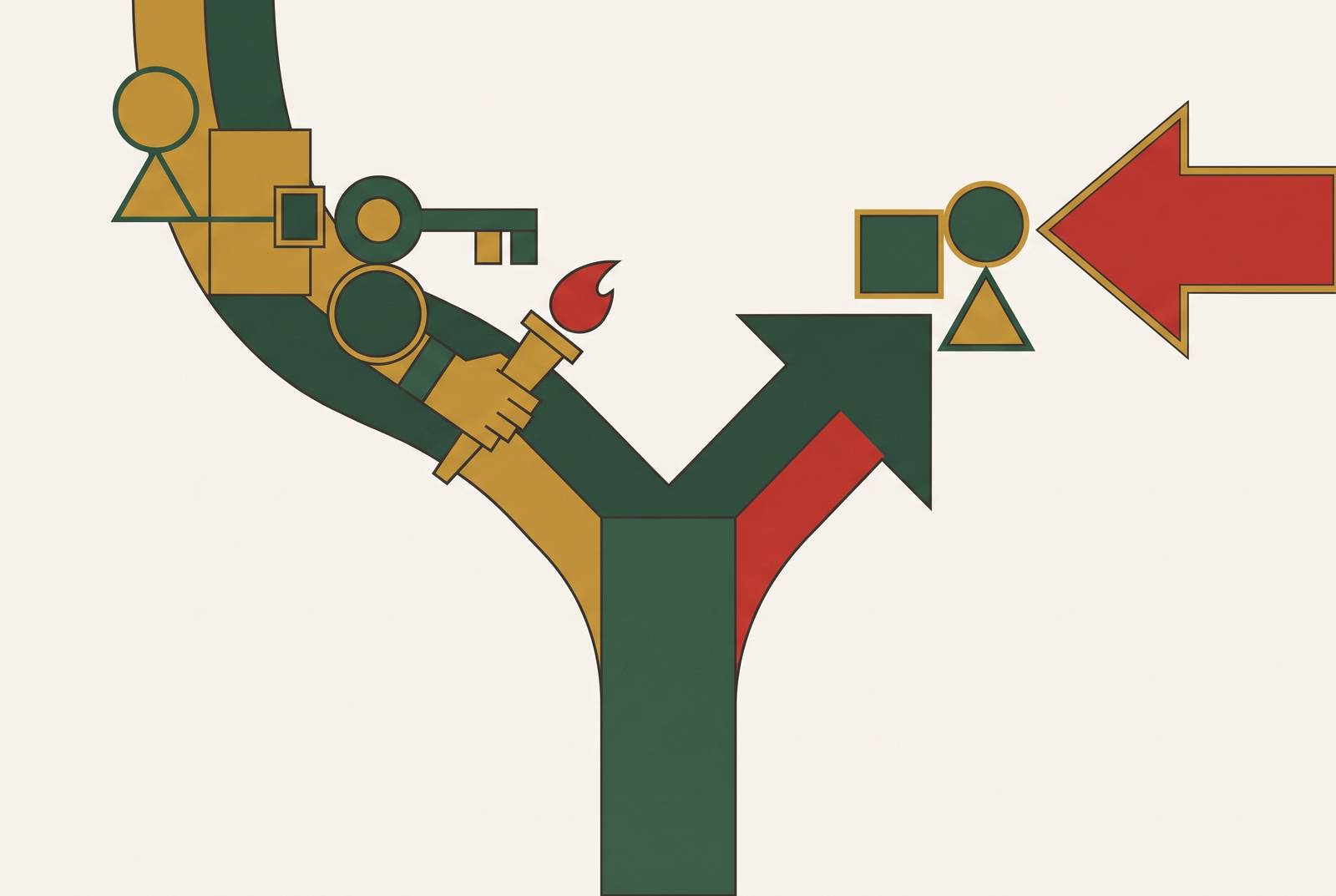
Family succession means transferring ownership, operational control, or both, to a family member. A third-party sale means selling full or majority ownership to an outside buyer. Everything else in this piece is really about that fork, and about the fact that most owners walk up to it having thought hard about only one branch.
The mechanics of succession vary: an outright gift, a below-market sale, a gradual transfer of equity over several years, or an employee stock ownership plan bent to fit family use. What ties these structures together is that ownership stays inside the family line, even when the price paid falls well short of fair market value. That gap between price and value is not an accident of poor negotiating; it is baked into how family transfers get structured, and it shows up again in the next section with real numbers attached.
A third-party sale changes shape depending on who is buying, more than most owners expect going in. A strategic acquirer wants synergies it cannot build on its own. A private equity firm wants a platform to scale. A search fund operator or independent sponsor is raising capital deal by deal and needs the numbers to work on a tighter timeline. Each of these buyers wants something different, and that difference moves valuation, deal terms, and what happens to the founder's role after closing.
State the trade-off plainly: succession keeps ownership in the family, but the founder usually ends up financing their own exit, through seller notes, gifted equity, or a discounted price. A sale produces real cash at closing, but it dilutes or ends the family's involvement, often for good. Hybrid structures sit between these two poles and get their own section later. For now, know that they exist, and that most owners never hear about them until it's nearly too late to use them.
Most owners frame this as "keep it in the family" against "sell out." That framing is the first mistake worth correcting, because it smuggles a moral judgment into what should be a financial and operational comparison. Nothing below treats either path as the sentimental favorite. The goal is to work through the actual variables, one at a time, and let the sentiment earn its place against a real number rather than assume it deserves one.
What family succession actually delivers, and what it costs
The case for succession is real, and it shouldn't get waved off as sentiment. It offers legacy continuity, a phased handoff where the founder stays engaged during the transition, and a shot at preserving culture and employee relationships an outside owner might not honor the same way. Gifting strategies also open tax planning flexibility a straight sale doesn't offer.
But the valuation gap is concrete, and it runs large. BizBuySell's 2023 transaction data shows third-party sales returning a multiple 1.5 to 2 times higher than internal transfers. That is not a rounding error; it is the difference between a comfortable retirement and a constrained one. Appraisers apply discounts for lack of control and lack of marketability on minority or intra-family transfers, and these two discounts commonly stack, cutting further into what the seller actually walks away with.
Financing makes the problem worse before it makes anything better. Family transfers get structured through seller-financed notes, deferred payments, or below-market pricing far more often than not, so liquidity shows up slower and carries more risk than an arm's-length sale, where the buyer wires funds at closing and the transaction is simply done.
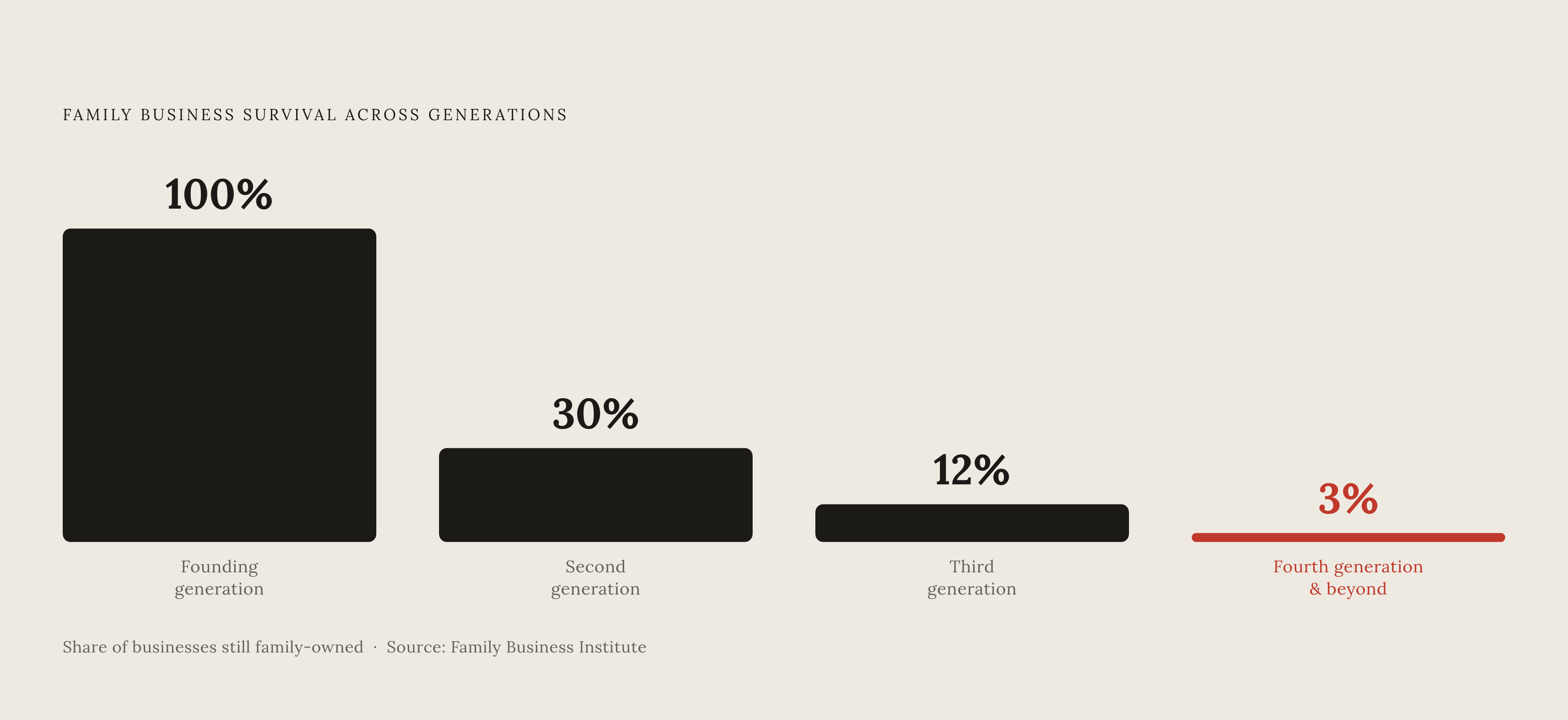
Then there's the survival question, and it should temper any assumption that succession automatically preserves what the founder built. SBA data is blunt about it: only 30% of family businesses survive to the second generation, 12% make it to the third, and just 3% survive to the fourth generation and beyond. Every founder says legacy preservation is the goal. Statistically, it's rarely the outcome that follows, and that mismatch between stated intent and actual result runs through nearly every part of this decision.
The human barriers matter as much as the financial ones. Deloitte Private's research on family businesses found the three biggest global obstacles to succession are next-generation readiness (35%), difficulty identifying a suitable successor (33%), and current leadership's reluctance to step aside (32%). That last one deserves a pause. Amy Wirtz, the Exit Planning Institute's 2024 Exit Planner of the Year, calls it the "Cha-Cha of Succession": founders re-engage the moment the process starts to feel uncomfortable, stepping back in just as they were supposed to step out. It shows up across enough families to count as a pattern, not a one-off story about one stubborn founder.
What a third-party sale actually delivers, and what it costs
The liquidity case is direct. A well-run competitive process tends to produce the highest achievable price, because strategic buyers pay for synergies they cannot build on their own, and private equity buyers pay for platform value they intend to scale. GF Data's M&A Report puts high-performing buyout companies at an average of 6.5x EBITDA in Q1 2025, up from 5.9x recorded between 2003 and 2020. The median across all private transactions runs lower, between 3.5x and 3.8x. Averages among top performers describe the best deals, not the typical one, and confusing the two is how owners walk into a sale process with expectations no buyer in the room intends to meet.
Private equity now dominates a large share of this market. IBBA's Market Pulse Report found PE buyers accounted for 59% of all transactions in the $5 million to $50 million range, and most of those are add-on acquisitions bought specifically to create synergy inside an existing platform. A PE add-on buyer has different incentives than a standalone strategic acquirer, and conflating the two leads to bad assumptions about what happens after signing.
What does the seller give up? Control, first, and often culture continuity, too. A strategic buyer may fully integrate the company and retire the brand within a year. A PE buyer may keep existing management in place, but only for a defined hold period, typically measured in years, before another sale or recapitalization follows.
The process itself is riskier than it looks from the outside, and this is the part sellers underestimate most. A meaningful share of small businesses that go to market never actually close a sale. BizBuySell's data on businesses listed between 2018 and 2022 puts the close rate at roughly 6.46%, a number that should sober anyone who assumes a "For Sale" sign guarantees a buyer shows up. Preparation quality and access to genuinely qualified buyers explain most of that gap between listing and closing, not bad luck.
One misconception deserves to be knocked down directly: the idea that selling to an outsider automatically means employees suffer or culture gets dismantled. Financial buyers, in particular, frequently keep existing management in place and offer an equity rollover, letting the seller retain a stake and ride a future upside. What actually pushes owners toward a sale, even when family succession was the first preference, usually comes down to one of three things. No successor is both willing and capable. An industry is consolidating fast enough to punish anyone who waits. Or an unsolicited offer shows up and reframes the whole decision overnight.
The five variables that should actually drive the decision
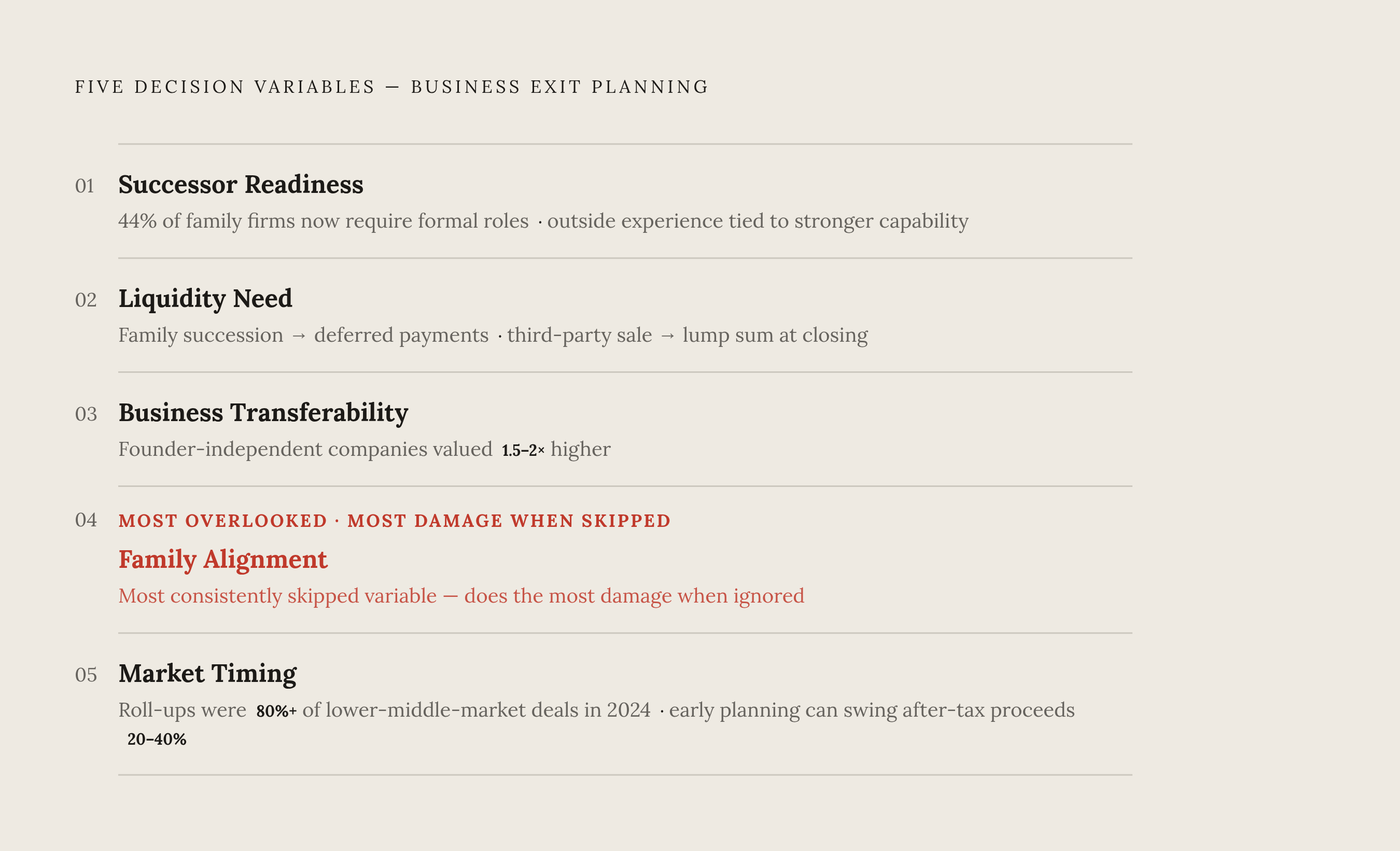
Successor readiness. Is there a family member who's not just willing, but capable and financially positioned, to run the business day to day? Readiness gets built, not assumed. Research finds successors who spend at least three years working outside the family firm come back with measurably stronger leadership capability than those who never left. Deloitte Private's 2025 data shows the market catching up to that finding: 44% of family businesses now require formal roles with real accountability for next-gen candidates, and 40% mandate outside work experience before anyone touches the top job. If the honest answer is "not yet," the real question is whether there's enough runway left to close that gap before a transition gets forced by something else entirely.
Liquidity need. Does the owner need full, near-term cash for retirement or estate planning, or can proceeds arrive deferred and in pieces? Family succession almost always means slower, structured payments stretched over years, while a third-party sale delivers a lump sum at closing. Owners planning to fund retirement directly from the transaction face a much higher bar for internal succession to clear.
Business transferability. How dependent is the business on the founder's personal relationships, institutional knowledge, or standing in the industry? A company that keeps running smoothly without the founder in the room is worth 1.5 to 2 times more than an identical business that can't function without them. That premium matters under either path, but it bites harder in a third-party sale, where buyers price that independence directly into the offer. Installing a non-family CEO or COO three to five years ahead of an exit, and building a board with outside members, are concrete moves that raise value no matter which door the owner eventually walks through.
Family alignment. Is there genuine agreement, not assumed agreement, among family members, including the ones with no plans to ever enter the business, about who gets what and why? Once multiple family members hold a stake in the outcome, managing expectations around ownership and compensation becomes one of the harder operational problems a founder will face. Perceived favoritism is a well-documented source of conflict that outlasts the transaction itself. Alignment is a precondition for succession to work, and it rarely shows up on its own once the paperwork is signed; owners who assume it'll sort itself out mid-process tend to hit the hardest version of this problem at the worst possible time.
Market timing. Is the current environment favorable for a sale, and is the industry consolidating in a way that's pulling unusually strong interest from private equity or strategics right now? In the lower middle market, roll-ups accounted for over 80% of all deals in 2024, which means owners sitting in a consolidating industry who never seriously test the market may be leaving real money on the table without knowing it. Choosing the right path 24 to 36 months ahead of a transition can swing after-tax proceeds by 20 to 40 percent, while owners who wait until a health event forces the decision tend to give up 15 to 30 percent of value they could otherwise have captured.
Of the five, family alignment is the one owners most consistently skip, and it does the most damage when skipped. Valuation and readiness show up in spreadsheets. Alignment shows up at Thanksgiving, three years after the deal closes, when someone finally says what they've been thinking the whole time.
When neither pure path fits: what hybrid structures look like in practice
Pure succession and a pure outside sale are the two poles. Plenty of owners land somewhere in between, and that middle ground has real structures behind it, not just improvisation.
A partial recapitalization lets the owner sell a majority stake to a private equity firm while keeping a minority position and staying involved operationally. That gets cash now, while leaving room for a second, larger payout when the PE firm eventually exits. A minority PE investment runs the opposite direction: the family keeps control, but brings in outside capital and operational expertise the family alone can't supply, useful when growth demands more than the balance sheet or the bench currently allows.
There's also the phased family transfer with outside management running the middle stretch: a non-family CEO handles day-to-day operations while family members grow into ownership roles over a period of years. This addresses a readiness gap head-on, instead of forcing the succession window shut before anyone's actually prepared to walk through it.
One more pattern worth naming, because it's newer and worth watching, is the skip-generation transfer, where an owner bypasses the immediate next generation in favor of the one after it. Advisors increasingly flag this as an emerging response to readiness gaps. It is not yet common, but it is a sign that owners are getting creative when the obvious successor isn't ready and might never be.
None of this means every owner needs a hybrid structure. It means business, financial, and family variables rarely line up neatly behind one clean path, and owners who know these structures exist walk into the decision with a wider set of options than "keep it" or "sell it."
How to sequence the evaluation: a practical approach for owners doing this for the first time
Start with an independent valuation, before any other conversation happens. Owners consistently misjudge what the business is actually worth, in both directions, and that gap between perceived and actual value distorts every decision downstream if nobody corrects it first.
Next comes the family alignment conversation, and it has to happen before the succession conversation, not during it. Surfacing disagreements about ownership, compensation, and who expects which role, while there's still time to work through them, beats discovering those disagreements mid-transition, when reversing course costs real money and real relationships.
Then assess successor readiness honestly, ideally with someone outside the family in the room. Internal optimism about a next-gen candidate's readiness is a well-documented bias. An objective read on capability and a realistic timeline is worth more than a generous one, even when the generous read feels kinder in the moment.
After that, test the market before committing to either path. Understanding what qualified buyers would actually pay, and at what multiple, gives an owner the information needed to make a real comparison, without obligating anyone to sell. It just means the succession option gets measured against an actual number instead of a hopeful guess.
Finally, model the after-tax outcome of each path, not the headline multiple. Pre-tax numbers rarely reflect what owners actually retire on. Deal structure, the timing of when proceeds land, and the estate planning vehicles wrapped around the transaction all move the real number, sometimes by a lot.
The ideal planning horizon runs 5 to 10 years ahead of an anticipated transition. Owners only three to five years out can still meaningfully improve their outcome with structured preparation started now instead of later. Real market exposure earns its keep here: understanding what a competitive sale process would actually yield sets the benchmark any internal succession plan needs to beat. That kind of exposure, paired with genuine access to qualified buyers rather than a rough estimate from a broker, is what turns this evaluation from a set of assumptions into a decision made on real data.
What the research consistently shows separates owners who get good outcomes from those who don't
Timing is the single biggest predictor of a poor outcome. Owners who wait until a health event or some other external pressure forces the decision lose a documented 15 to 30 percent of value they could have captured with earlier planning. A decision made under duress is, with striking consistency, worse than the same decision made deliberately, years ahead of the deadline.
Preference alone rarely produces a plan, and the gap between wanting and preparing is where most families lose the outcome they said they wanted. Seventy-two percent of family businesses want to stay in the family; nearly two-thirds have no documented plan for making that happen. Wanting a specific outcome and preparing for it are two separate projects, and only one of them shows up in the eventual result.
The owners who land the best outcomes, regardless of which path they eventually choose, are consistently the ones who took both options seriously before deciding anything. A family succession chosen after real market exploration tends to be a stronger decision than the identical succession chosen because it was never seriously tested against an alternative. That distinction sounds subtle on paper, but it's the line between a genuine decision and a default one nobody actually examined.
There's a demographic wrinkle worth noting, too. Gusto's study of 400,000 payrolls found a 13% increase in young adults under 30 working in family businesses as of January 2025, which suggests the succession path may be gaining ground in ways it wasn't a decade back. Renewed interest from the next generation doesn't, on its own, settle the readiness, alignment, or valuation questions this piece has walked through. Interest is a starting point, and preparation still has to follow, even though preparation is the part almost nobody wants to do first.
State the position outright: succession chosen for sentimental reasons, without a market test and without honest alignment among the people who'll live with the outcome, is usually the worse decision, even when it's the one that feels right at the kitchen table. The five variables, readiness, liquidity, transferability, alignment, and timing, are not a formula that spits out an answer. They are a structure for thinking that forces the sentimental case to earn its place against a real number. Owners who model both paths honestly, with real access to buyer markets to establish an actual benchmark instead of a guess, consistently land on more clarity and better outcomes than those who study either path alone.