NDA Management and Buyer Confidentiality in Competitive Sale Processes
Strategic NDAs require sellers to limit buyer access and negotiate unilateral protections carefully.
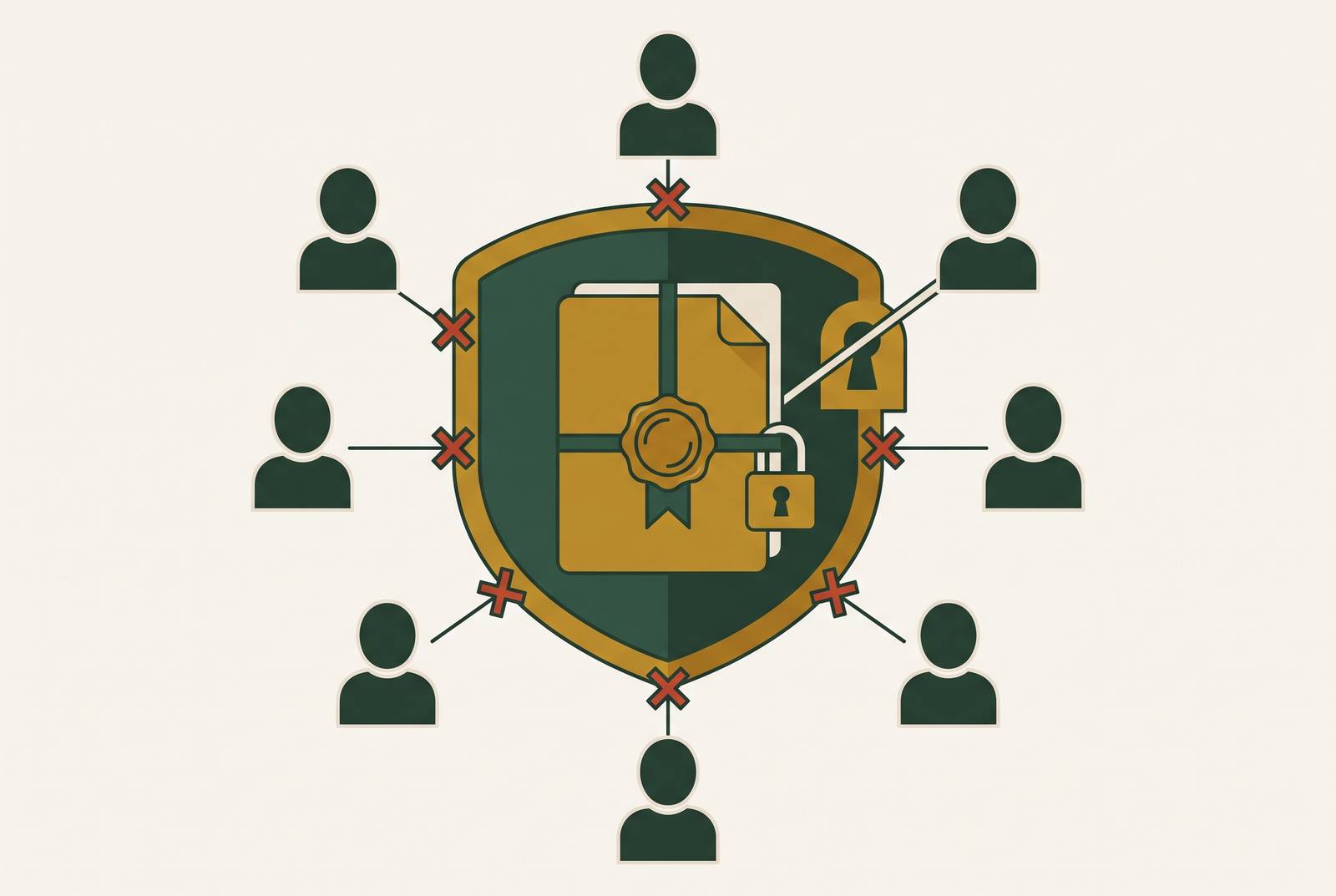
An NDA in a sale process shapes how much control a seller keeps once information about the business starts moving through other people's hands, and in a competitive process, information moves fast, through more hands, than most owners expect.
Per an SS&C Intralinks/Bayes Business School study analyzing more than 15,000 public acquisitions, 9.5% of global M&A deals leaked in 2024, the highest rate recorded in the study's 16-year history. That figure is worth sitting with for a second. Nearly one in ten deals had word get out before the seller wanted it to, whether to a competitor, a journalist, or the seller's own workforce. Extended negotiations, cross-border structures, and the involvement of multiple advisors and financing parties all expand the circle of people holding sensitive information; and ordinary digital habits, messaging apps, social platforms, group chats, leave a footprint that's easier to trace back to a source than a hallway conversation ever was. Every one of those additional touchpoints is a place where confidentiality can fail.
The founder's instinct, understandably, is to grab a standard NDA template, sign it fast, and get back to running the business. That instinct undersells what's actually at stake. Once employees, customers, or competitors learn a business is for sale, the seller doesn't just lose privacy, they often lose leverage, tempo, and sometimes the deal itself. The rest of this piece walks through what an NDA actually does, where sellers under-negotiate it, and how the document needs to be managed, not just signed, across an entire buyer pool.
What an NDA actually governs in a sale — beyond the obvious
Ask most founders what an NDA protects and the answer comes back fast: financials. Don't share the numbers. That's true, but it's a fraction of what a well-drafted M&A confidentiality agreement actually covers.
A properly scoped NDA protects the existence of the sale process itself, meaning the fact that discussions are happening at all, before it protects any specific number inside the data room. It covers the identity of the parties at the table, the terms being floated, and yes, financial statements, customer lists, pricing structures, employee compensation, trade secrets, pending litigation, and strategic plans. Even something as seemingly harmless as the company's name in connection with a sale, or its market niche, or a single top-line KPI, can be competitively sensitive information. If a competitor learns that a company is being shopped, that alone can shift customer conversations and pricing dynamics before a single financial statement changes hands.
The NDA is typically the first legally binding contract signed between a buyer and seller. That timing matters: it governs the exchange of information from the earliest teaser through the final closing, which means everything that happens in between, management presentations, site visits, data room access, rides on the strength of this one document. Sellers who treat it as boilerplate often overlook its secondary functions entirely: restrictions on soliciting the seller's employees, standstill limits on the buyer acquiring stock or making an unsolicited offer, and requirements to return or destroy information if the deal falls apart. Skip any one of those, and the exposure doesn't show up on day one. It shows up later, usually at the worst possible moment.
There's also a signaling function that's easy to miss. A thin NDA, or worse, no NDA before real information changes hands, tells a sophisticated buyer something about the seller. It suggests the business may not be run with much discipline, that proprietary information isn't taken seriously, and that the seller hasn't thought carefully about what they're protecting. That perception alone can chip away at the seller's negotiating position before terms are even discussed.
Before any of these specific provisions get negotiated, though, sellers face a more basic structural decision, and it's one that shapes everything downstream.
The unilateral vs. mutual NDA choice and why it matters in a seller-run process
NDAs come in two basic shapes: unilateral, where only one party's disclosures are protected, and mutual, where both sides owe confidentiality obligations to each other.
In most M&A transactions, the seller is the one doing nearly all the disclosing, financials, customer relationships, operational detail, so a unilateral NDA binding the buyer as the receiving party is the natural fit. The asymmetry in the document reflects the asymmetry in the actual risk. Mutual NDAs make sense in narrower circumstances: when a strategic buyer is also sharing sensitive integration plans or proprietary technology roadmaps, or when the seller genuinely stands to receive competitively meaningful information from the buyer during diligence.
The mistake sellers make is defaulting to mutual because it feels more balanced, more fair. Fairness, though, isn't really the goal here; proportionality to actual risk is. A mutual NDA can create the appearance of equivalent protection when the underlying exposure is nowhere near equal, and that false symmetry can end up diluting the specific protections a seller needs. In a competitive auction with multiple buyers signing paper, unilateral should be the starting position, and the seller, not any single buyer, should control the form everyone signs. That's a small point of leverage, but it's one worth holding onto, because it sets the tone for every negotiation that follows.
Once the structural question is settled, the next fight is buried in the definitions section, and it's arguably more consequential than the headline structure of the agreement itself.
How the "representatives" definition controls how far information travels
Every NDA defines who the buyer is allowed to share confidential information with. That group is usually labeled "representatives," and it typically includes lawyers, financial advisors, lenders, potential co-investors, and sometimes management teams at the buyer's other portfolio companies.
Buyers push for this definition to be broad, and their reasons aren't unreasonable on their face: they need financing sources engaged, integration planners looped in, and co-investors briefed before they can commit to a deal. But look at it from the seller's side. Each name added to that list is another person who now holds sensitive information about the business, and not all of them have interests aligned with keeping that information quiet. A lender evaluating three competing deals in the same sector is a different risk profile than outside counsel bound by professional ethics rules.
The seller's counter should be a "need to know" standard written directly into the agreement, not assumed as a courtesy. Information should flow only to representatives who actually require it to do their piece of the diligence work, and that standard needs to be explicit rather than implied. Financing sources deserve particular attention here. Lenders and debt arrangers routinely receive full confidential information memoranda and complete financial models, yet founder-negotiated NDAs frequently forget to require that those financing sources be bound by confidentiality terms at least as strict as the NDA itself. Leave that gap open, and a buyer's lender can end up holding the seller's financial model with no direct contractual obligation to the seller at all.
A tightly written representatives clause often does more real protective work than an extra year or two tacked onto the confidentiality term. Limiting exposure at the point of disclosure beats trying to claw information back after it's already circulated. That said, term length still matters, and it comes with its own set of tradeoffs.
Confidentiality term, trade secret carve-outs, and the return-of-information problem
How long does the NDA actually bind the buyer? Most confidentiality periods in commercial M&A run two to five years, with three years functioning as the de facto market standard.
Buyers lean toward the shorter end, two to three years, because it limits how long they carry ongoing compliance obligations on their books. Sellers sometimes push back, arguing that trade secrets and customer data don't lose their value on a fixed schedule and should carry perpetual protection instead. Neither side is wrong exactly; they're just weighing different risks. A useful real-world data point: in the LAVA Therapeutics NDA filed with the SEC in June 2025, the buyer's confidentiality obligations were set to expire three years after signing, which lines up with where market practice generally lands even in a sector, biotech, where the underlying IP can remain valuable well past that window.
Then there's the question of what happens if the deal doesn't close. Most NDAs obligate the buyer to return or destroy confidential information at that point, and on paper, that sounds like a clean resolution. In practice, it's messier than it looks. Information shared through a virtual data room, over email, or across messaging platforms is genuinely hard to fully destroy, and harder still to verify as destroyed. Buyers often push for the right to retain limited copies for legal or regulatory compliance purposes, which is a reasonable ask but one that chips away at the seller's sense of closure.
What should a seller actually insist on? A written certification of destruction, not just a contractual promise to destroy, and a clear-eyed understanding that even a certification has practical limits once information has been copied, forwarded, or downloaded across a dozen devices. The obligation is worth having. It just shouldn't be mistaken for a guarantee.
Term length and return provisions describe what happens after diligence winds down. Standstill provisions describe what a buyer can and can't do while the process is still live, and this is where negotiations tend to get genuinely contentious.
Standstill provisions and why they are the most heavily negotiated NDA clause in competitive processes
A standstill provision stops a buyer from acquiring stock, launching an unsolicited public offer, or soliciting proxies for a set window, typically six months to two years, after signing the NDA.
For a seller running a competitive process, the standstill does three things at once. It keeps a buyer from using confidential information gained through diligence to mount a hostile approach if talks stall. It protects the seller's ability to run a controlled, orderly auction without a disgruntled buyer disrupting it from the outside. And where the target has public debt or equity outstanding, it reduces the insider trading exposure that comes with multiple parties holding material nonpublic information at once.
The single most contested clause inside a standstill is the fall-away provision, the term that determines when the standstill stops applying. Buyers want fall-aways triggered broadly, often by the mere fact that the seller has started talking to other parties. Sellers should resist that framing, because a fall-away triggered by early-stage discussions, rather than a signed definitive agreement, exposes the process at precisely the moment it's most fragile: when a leak or a hostile move could unravel months of work before there's anything binding to show for it. Best practice for sellers willing to accept a fall-away at all is to tie it to the public announcement of a competing definitive agreement, not to reports or rumors of discussions.
The Guess Inc. sale process, per a 2025 SEC filing, offers a concrete look at how hard this single clause gets fought, with counsel on each side negotiating hard over the fall-away language. That's not an unusual outcome; it's closer to the norm in any deal where the stakes are real. There's a Delaware law dimension here too: standstills can help a public company's board extract more value in service of its Revlon duties, but the same provision, if it locks the board in too tightly pre-closing, can also constrain its ability to weigh a better competing offer. That tension doesn't fully resolve in a private, founder-led sale, since there's no board acting under Revlon, but the underlying logic still applies. A standstill keeps a buyer who's walked away from turning around and approaching the seller's own employees, customers, or rival bidders using what they learned in diligence.
A buyer blocked from an unsolicited bid can still cause damage in a quieter way, by simply hiring away the people who make the business work.
Non-solicitation of employees and the antitrust constraint sellers rarely anticipate
Non-solicitation provisions matter most in businesses where the people are the product: professional services firms, technology companies, any operation where a handful of employees carry a disproportionate share of institutional knowledge and client relationships.
The basic protection is straightforward. It stops the buyer, and the buyer's representatives, from directly recruiting the seller's employees using information gathered during the diligence process. Without it, a buyer who walks away from the deal has still walked away with something valuable: a clear picture of exactly who the seller's top performers are, plus the relationship built during management presentations to go recruit them directly.
Here's where it gets genuinely complicated, though, and it's a wrinkle most founders never see coming. When a buyer and seller compete for the same pool of talent, a broad no-hire agreement or sweeping non-solicitation clause can raise real antitrust concerns. Regulators and courts have scrutinized broad no-poaching agreements on the theory that outright prohibitions against hiring another company's employees suppress wages and mobility in a way that's more anticompetitive than a narrower restriction would be. That's not a hypothetical risk confined to giant tech companies; it's a live consideration for mid-market deals too, wherever the buyer and seller draw from an overlapping labor market.
So how does a seller draft around it? The workable approach narrows the provision to employees whose identities the buyer specifically learned through the M&A process, rather than people the buyer already knew about or had prior relationships with, and it targets solicitation rather than hiring outright. A candidate who independently applies for a job at the buyer's company, without having been actively recruited, generally shouldn't fall under the restriction. Get the scope wrong in one direction and the clause becomes unenforceable; get it wrong in the other and key employees sit exposed. This is a provision that rewards careful, deal-specific drafting over a copy-pasted template, more than almost any other clause in the agreement.
Individual clauses like this one matter enormously in isolation. But in a competitive process with several buyers circling at once, the real test of an NDA program lies in whether the seller can actually manage the whole stack of them at once, not just how any single agreement reads.
Managing NDAs across a buyer pool — the operational discipline most sellers skip
In a competitive sale, the seller isn't managing one NDA. They're managing a stack of them, signed at different moments, sometimes carrying different negotiated terms, each one governing a different buyer's access to a different slice of information.
That creates real operational demands. Someone needs to track which buyers have signed and on what terms, and it can't be done from memory once the buyer pool grows past a handful of names. Not every buyer who signs should receive the same information at the same time; disclosure should be tiered by how far along a given buyer is in the process. Whoever is running the process needs to cross-check what's actually been shared with each buyer against what that specific buyer's NDA covers, because if disclosure ever outpaces the NDA's scope, the seller has no contractual protection for that gap. And there needs to be a running log, what was shared, when, and with whom, because that log is often the only thing standing between the seller and an unenforceable breach claim later.
The information typically moves in a sequence. A teaser or blind summary goes out first, with no NDA required and no identifying details disclosed. The confidential information memorandum follows only after an NDA is signed and the buyer has been confirmed as legitimate. Management presentations and site visits come next, deeper into diligence, with the NDA already in place but often warranting extra controls over exactly who from the buyer's side is allowed to attend. Full data room access is reserved for buyers who've reached the final stages, and the data room itself should be permissioned by stage and audited, not opened wide to everyone who's signed something at some point.
Virtual data room platforms make some of this discipline easier to enforce than it would have been a decade ago. Access rights should be tied to where a buyer actually sits in the process, not just to the fact that they signed an NDA at some earlier point. Audit trails, records of who accessed which document and when, become essential if a breach claim ever needs to be proven. Watermarking sensitive documents gives the seller a way to trace unauthorized distribution back to its source if a document ever surfaces somewhere it shouldn't.
Why does this level of operational discipline matter so much? A 2023 SRS Acquiom study found that 28% of failed transactions cited confidentiality concerns as a contributing factor. That's not a marginal number. It suggests confidentiality failures don't just cause embarrassment; they're a meaningful contributor to deals actually falling apart. Founders running a sale without professional advisors typically have none of this infrastructure in place: no tracking system, no tiered disclosure, no audit trail, just a single NDA template applied uniformly to every buyer regardless of what stage they've reached.
But leaks don't only originate from buyers and their representatives. Just as often, they start closer to home.
Controlling disclosure inside the seller's own organization
The most underappreciated source of leaks in a sale process comes from the seller's own employees, advisors, and board members, people who learn about the process and share what they know, sometimes deliberately, more often without quite meaning to.
This risk is especially acute in founder-led businesses. Smaller teams mean fewer degrees of separation between the owner and the people who'll eventually notice something is different. Founders, understandably, often confide in a trusted manager or two well before the process formally begins, wanting a sounding board or simply needing help pulling together financial records. And employees who sense a sale is coming, even without being told directly, sometimes start quietly job hunting, which itself can tip off the market before the seller has said a word to anyone outside the company.
The same "need to know" principle that governs what buyers can access should govern the seller's own organization. Information should go only to the people who genuinely need it to move the deal forward, not to anyone the founder simply trusts personally. In a well-run process, the internal circle is usually just the owner, a CFO or senior financial lead, legal counsel, and the M&A advisor, full stop, with no one else brought in until the deal has advanced considerably further.
Timing the broader employee announcement is its own delicate calculation. Tell people too early and retention risk climbs immediately, along with morale problems that can show up in customer-facing work long before the deal closes. Per a 2024 ABA survey, NDA-related disputes featured in roughly 15% of failed M&A processes, and premature leaks to employees ranked among the most common triggers behind those disputes. That statistic closes the loop on everything this piece has covered: the NDA itself can be airtight, the representatives clause narrow, the standstill well drafted, and none of it matters if the leak comes from inside the seller's own walls. Confidentiality in a sale process is a discipline that has to hold at every point where information could move, including the points closest to home.