Virtual Data Room Setup for Small Business M&A Transactions
Organizing your data room right can make or break the deal.
What buyers look for when they open your data room
A virtual data room setup decides whether a signed letter of intent turns into a closed deal or dies quietly in diligence. This piece covers the operational calls that matter most: folder structure, document staging, access controls, platform choice, and security. For a lower middle market seller, the room itself is part of the negotiation. It is not a filing cabinet with a login screen.
Start with what a VDR actually is. It's a secure online repository built specifically for storing, sharing, and controlling confidential documents during a transaction, and it is not a general-purpose cloud drive with a password bolted on. That distinction matters because a small business sale means sharing financial statements, contracts, IP records, and employee data with multiple outside parties at once, often on different timelines, while keeping tight control over who sees what and when. Email threads, Dropbox links, and physical binders cannot do any of that. None of them leave an audit trail, none support real version control, and none let a seller cut off access the moment a buyer walks from the table.
That last point is not hypothetical. Capstone Partners' LMM Survey puts the failure rate for signed LOIs in the lower middle market somewhere between 12% and 18%. A signed LOI feels like the finish line, but it actually marks the start of the phase where buyers stress-test everything a seller has claimed, and how that material gets presented has a direct bearing on whether the deal survives. Layer on the security angle: one industry breach study for 2025 found that breaches involving a third party accounted for 30% of all breaches that year. During diligence, a small business hands sensitive data to accountants, attorneys, and specialists it has never worked with before. Document security in that window is an operational concern, and treating it otherwise is how sellers end up explaining a leak instead of closing a deal. It is an operational one, and treating it otherwise is how sellers end up explaining a leak instead of closing a deal.
So the real question under a VDR setup was never which platform looks the most impressive on a call. It is whether the seller can control the pace and shape of diligence well enough that the process works for them instead of against them.
Picture the diligence team on the other side of a typical lower middle market deal. Capstone's survey puts the average at 4 to 6 third-party diligence providers involved in a typical mid-market deal. These include a Quality of Earnings accountant from a Big Four or regional firm, an M&A attorney, and specialists covering tax, IT, insurance, and benefits. Each has a narrow mandate. The QoE accountant is not reading employment agreements. The attorney is not parsing the AR aging report. But every one of them forms an opinion about the seller's credibility from how organized the room looks the moment they walk in.
Advisors trained to find problems assume a gap in the documentation is something being hidden, not a filing oversight, and that assumption shapes how they treat the rest of the room. A disorganized or incomplete room does not just cost time. It generates suspicion that compounds with every follow-up request. A well-structured room reads as evidence of a professionally run business, which builds buyer confidence and cuts the volume of back-and-forth that slowly bleeds a deal of its momentum.
A quality VDR also gives the seller something buyers rarely think about: real-time visibility into their own behavior. Which documents are being opened, how often, by which user. That is genuinely useful intelligence in a multi-party process or a competitive auction, because it shows who is actually engaged and who is just keeping a seat warm.
Which sets up the idea running through everything below. The setup decisions that move the needle are folder structure, document completeness, and access control, not platform sophistication. A $150,000-a-year enterprise system with a chaotic folder tree will lose to an inexpensive monthly platform organized with discipline, every time.
The folder structure that lets buyers navigate without asking questions
A useful test: can a buyer's QoE accountant find three years of financials without sending a single email? Can the M&A attorney locate every material contract in under two minutes? If the answer is no, the folder structure is not doing its job, no matter how much the platform cost.
A workable top-level structure for a small business VDR generally runs through: corporate records (incorporation documents, bylaws, cap table, ownership history, prior transactions), financial statements (three to five years of P&Ls, balance sheets, and tax returns, plus a separate folder for interim or trailing-twelve-month figures), revenue and customer data (top customer lists, concentration analysis, a breakdown of recurring versus one-time revenue), contracts and agreements (customer contracts, supplier agreements, leases, any exclusivity or non-compete terms), legal and compliance records, employee and HR documentation, intellectual property, operations, and management or deal materials such as the CIM or financial model.
Naming conventions sound like a small detail until a buyer's team is staring at three files called "Final_v2," "Final_v3," and "REVISED_Final." A file named "2024_Annual_PL_Audited.pdf" tells a reader what it is before they open it, and that is not just tidiness. It is a signal about how the business is run. Version control follows the same logic: when a document gets updated, the old version needs to be replaced or clearly marked superseded. Buyers should never hit two different P&Ls for the same fiscal year and have to guess which one is current.
The most common mistake is dumping everything into two or three flat folders and calling it done. That is not a shortcut, it is a signal to the buyer's team that the seller has not thought carefully about their own business, and it is a rough thing to have communicated before diligence has even started. Build the folder skeleton before a single document goes into it. Then run a dry test: pretend to be a buyer hunting five specific documents and time how long it takes to find them.
Which documents belong in the room, and what to hold back until later
Sellers tend to go one of two directions here, and both create friction. Some dump everything into the room on day one. Others wait to be asked for each item individually, treating every request like a negotiation. Neither serves the deal, and the right posture sits somewhere more deliberate than either instinct.
Certain documents need to be in the room before any serious buyer starts diligence: several years of annual financial statements, typically three to five (audited or reviewed is preferred, compiled is acceptable if explained), the most recent twelve months of management accounts, business tax returns that match the financial statements (discrepancies between book and tax figures are a common red flag), accounts receivable and payable aging reports, and any existing debt schedules. On the legal side, that means material customer contracts, especially any with change-of-control clauses, supplier and vendor agreements above a reasonable materiality threshold, lease agreements, key employment and non-compete agreements, and disclosure of any pending or threatened litigation. Buyers will find litigation history through their own searches regardless of what a seller does, so disclosing it upfront reads as honesty. An unresolved issue that appears mid-diligence reads as concealment, even when it was not.
Some material is better staged than loaded all at once. Employee-level compensation detail can wait for buyers who have made it past a signed LOI, not initial bidders still forming a view. Customer-specific pricing or margin data can be anonymized at the indication-of-interest stage and named later, once intent is confirmed. Genuinely sensitive competitive information should go only to parties who have signed an NDA and shown real intent, not to every early-stage tire-kicker working three deals at once. Staging does two things at once: it protects sensitive material if a buyer walks early, and it builds a cadence that tracks the deal's actual progress instead of handing over everything before there is any commitment on the other side.
What spooks buyers is rarely the content of a document. It is its absence. A missing tax return for a year inside the review period, an unexplained margin anomaly, a business that leases its premises but has no lease agreement anywhere in the room: these gaps generate more suspicion than most sellers expect, because buyers assume completeness on the categories they know to ask for. Break that assumption, and the reaction is almost never "must be an oversight."
Setting up access controls so the right people see the right things at the right time
Access control on a modern VDR is not a single on/off switch. It works at the folder level, the document level, and sometimes down to the individual user. A seller decides not just who sees a file but what they can do with it once they see it: view only, download, print, or save.
A workable group structure for a small business deal tends to run along these lines. The sell-side team, meaning the owner, advisor, accountant, and lawyer, gets full access across every folder. Stage 1 buyers, anyone who has signed an NDA but has not gone past an initial indication of interest, get access to financial summaries, the CIM, and general business materials, with employee-level data and sensitive contracts walled off. Stage 2 buyers, the ones past a signed LOI with confirmed intent, get expanded access: customer contracts (possibly still anonymized), employee agreements, detailed operational data. Specialists brought in by the buyer, a QoE accountant or an environmental consultant, get narrow access limited strictly to what their mandate covers, and nothing more.
Two features do quiet but real work here. Dynamic watermarking stamps every document with the identity of the specific user who opened it rather than a generic company name, which makes a leaked file traceable back to whoever pulled it. Download restrictions, keeping the most sensitive material view-only in early stages, let a buyer read something without ever creating a copy that leaves the seller's control. Paired with an audit log that records every view, download, and print, the room becomes a management tool in its own right: if a buyer has not opened the key financials a week before their IOI deadline, that is a signal they may not be serious, or that they are already planning to walk.
Set access groups before any buyer gets invited in. Tightening permissions after the fact is a harder correction to make, and a far more visible one to the buyer sitting on the other side of it.
Choosing a platform that fits your deal size without overpaying or under-building
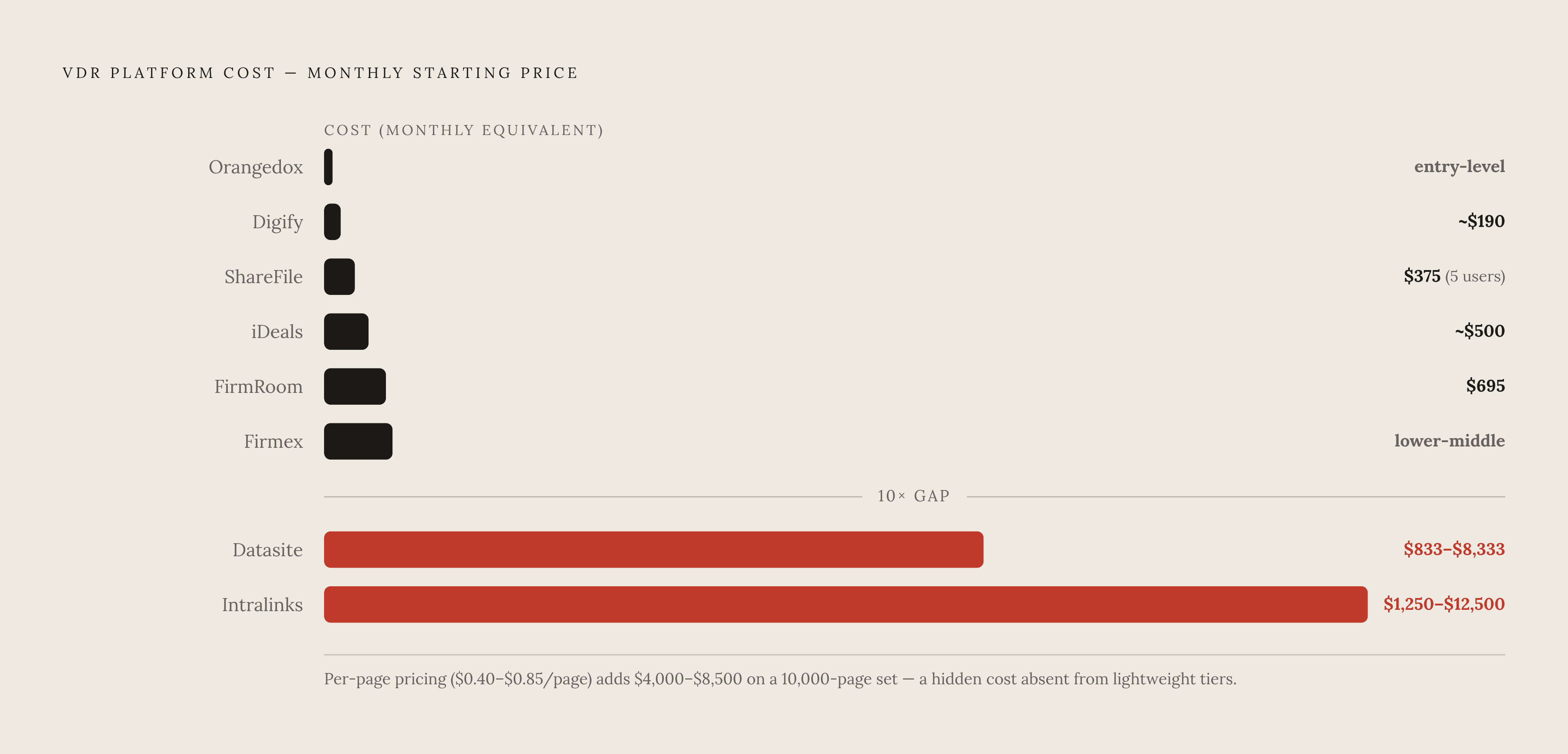
The VDR market by 2026 has settled into roughly ten leading providers, and the right pick comes down to deal size and counterparty expectations, not brand recognition. Enterprise platforms built for bulge-bracket banks and institutional buyers, Intralinks at $15,000 to $150,000 a year, Datasite at $10,000 to $100,000, are built for a different kind of transaction. Most small business sales do not need that scale, and paying for it does not make the deal look more serious. It just adds cost the deal did not ask for.
For transactions well under the range where deals in the tens of millions sit, lightweight platforms tend to fit better. FirmRoom starts at $695 a month with unlimited users, and it carries SOC 2 certification with watermarking, granular permissions, and built-in Q&A tools. Digify runs around $190 a month for its Pro tier. Firmex has become something close to the workhorse of the lower-middle-market segment, running a modest cost for a full deal with strong watermarking, download tracking, and Q&A functionality, and it shows up constantly among search funders, independent sponsors, family offices, and smaller private equity firms. iDeals, at roughly $500 or more a month, suits sellers who want live human support around the clock.
Teams already living inside Google Drive or Dropbox have another option. Orangedox, at an entry-level monthly price point, converts existing cloud folders into trackable data rooms without a full re-upload of every file, adding NDA gating, dynamic watermarking, and page-level analytics on top of what is already there. For businesses in healthcare, financial services, or another compliance-heavy sector, ShareFile offers HIPAA and financial-industry regulatory compliance starting at $75 per user monthly with a five-user minimum.
The quote on the pricing page rarely matches the final invoice, and that gap is where sellers get burned. Actual costs commonly run two to ten times the initial quote once overage fees, extra users, and post-close archiving get added in. Per-page pricing, often $0.40 to $0.85 per page hosted, looks negligible until the math gets done at scale: a 10,000-page diligence set can run $4,000 to $8,500 in hosting fees alone, before a single buyer has logged in to look at anything.
Onboarding speed varies just as widely, from about 15 minutes for platforms like iDeals or FirmRoom to 3 to 5 days for Intralinks. On a deal running against a tight timeline, that gap is not trivial. And on the compliance side, a market audit found that only a small minority of vendors publicly state both a SOC 2 Type II attestation and a corporate ISO 27001 certificate under their own name. Marketing language about "bank-grade security" should get checked against the actual attestation documents, not taken at face value. Many platforms offer a free trial period, and that window is the moment to test onboarding speed and interface friction before signing a 12-month contract. If an M&A advisor is running the process, they usually have a default platform already (lower-middle-market advisors lean toward Firmex more often than not, while bulge-bracket banks lean toward Intralinks), and that preference should be surfaced early in the engagement rather than discovered after a room has already been built on the wrong system.
The security features that matter for a small business transaction
When the marketing copy is stripped away, only a small number of features actually make a data room secure. Encryption in transit (TLS) and encryption at rest (AES-256), with encryption keys managed separately from the stored data, means that even if the underlying infrastructure got compromised, the files themselves would stay unreadable. Multi-factor authentication is close to non-negotiable at this point: a password alone is not enough protection for a room holding a company's tax returns and customer contracts. Granular permissions, set at the folder and document level rather than all-or-nothing, are what make staged information release possible. Dynamic watermarking tied to a specific user, not a generic stamp, and immutable audit logs recording every view, download, and print with a timestamp, round out the baseline.
Beyond features, independent certifications tell a seller what has actually been verified rather than claimed. SOC 2 Type II means auditors examined a platform's security controls over an extended period and found them effective, a determination made over time rather than a one-time snapshot pulled together for a sales deck. ISO 27001 is the international standard for information security management, independently verified rather than self-declared. GDPR readiness matters if any counterparty or data subject sits in the EU, and HIPAA safeguards matter for any business touching protected health information.
The skepticism here is earned. A market audit found only 2 of 14 vendors publicly state both SOC 2 Type II and ISO 27001 under their own name. A compliance claim on a pricing page is not the same thing as an attestation document sitting behind it. Ask a vendor directly for that documentation before committing to a contract. In a transaction where third-party breach risk has doubled in a single year, the room holding the deal together is not the place to take a claim on faith.