Post-Closing Integration Obligations Sellers Agree to at Signing
Sellers commit to obligations that shape their lives for years after the money clears.

Why covenants survive closing
Closing day feels like the finish line. Closing day does not mark the finish line: the purchase agreement a seller signs that morning binds them to obligations that outlast the transaction itself. The purchase agreement a seller signs that morning binds them to obligations that outlast the transaction itself, often by years, and those obligations end up shaping post-sale life more than the headline sale price does.
A covenant is a promise written into a contract. Some are affirmative (do this), some are negative (don't do that), and purchase agreements are loaded with both kinds. Which ones survive closing isn't automatic: it comes down to specific drafting choices, often buried in language a tired seller skims for the third time at 11pm the night before signing.
Deal structure changes how this plays out. In a simultaneous sign-and-close deal, there's no gap between agreement and ownership transfer, so the post-closing covenants carry the entire weight of what happens next. In a sign-then-close deal, common when regulators or third parties need to approve the transaction first, pre-closing covenants govern the waiting period and post-closing covenants take over the moment the deal closes. Osler's analysis notes this deferred structure appears regularly in deals that need outside sign-off before anything can transfer.
Either way, the seller agrees to restrict their own conduct for a defined stretch after the money changes hands. None of this is boilerplate, whatever the term sheet implies going in. Sellers who bring in advisors who actually know deal norms tend to walk away with narrower, more reasonable terms than sellers who negotiate alone, and the gap between those two outcomes is where most post-closing regret gets manufactured.
What follows isn't a rundown of legal categories for their own sake. Each one costs something real: time, money, restricted freedom, or exposure that doesn't disappear just because the wire transfer cleared.
Transition services obligations: what it means to keep running someone else's business
A Transition Services Agreement, or TSA, requires the seller to keep providing operational support, payroll, IT, accounting, supply chain, whatever the business actually needs, while the buyer builds its own systems underneath. These arrangements typically run anywhere from a few months to roughly two years. Some functions take considerably longer to untangle than others, depending on how deeply embedded they are in the seller's systems.
What causes the obligation to exist? In a carve-out or subsidiary sale, the target company's employees might still sit on the seller's benefits plans, its data might live on the seller's servers, its invoices might route through the seller's accounts payable team. Untangling those threads doesn't happen on closing day. It happens over months, sometimes longer, and someone has to keep the lights on while it does.
The real friction occurs in how the services get defined. Buyers want delivery at the same level, same quality, same priority as before the sale, no degradation allowed. Sellers push back with "reasonable efforts" language, which sounds fair until a dispute breaks out over what "reasonable" actually meant in practice. The catch-all clause requires the seller to keep providing any service historically provided to the target, even one that never made it onto the written schedules. A clean, bounded handoff and an open-ended commitment nobody budgeted for hinge on that single clause.
Get specific in the schedules or pay for it later. Vague "assist as needed" language is where scope creep breeds: a defined transition can turn into months of unpaid firefighting if hours aren't capped, reporting lines aren't locked down, and the scope isn't nailed to paper before signing. This obligation doesn't sit off in its own corner, either. A transition that eats a seller's time and attention lands during the exact window when earn-out targets need to be hit, and these two obligations don't just coexist. They compound.
Earn-out obligations: the portion of the purchase price that depends on what happens after you leave
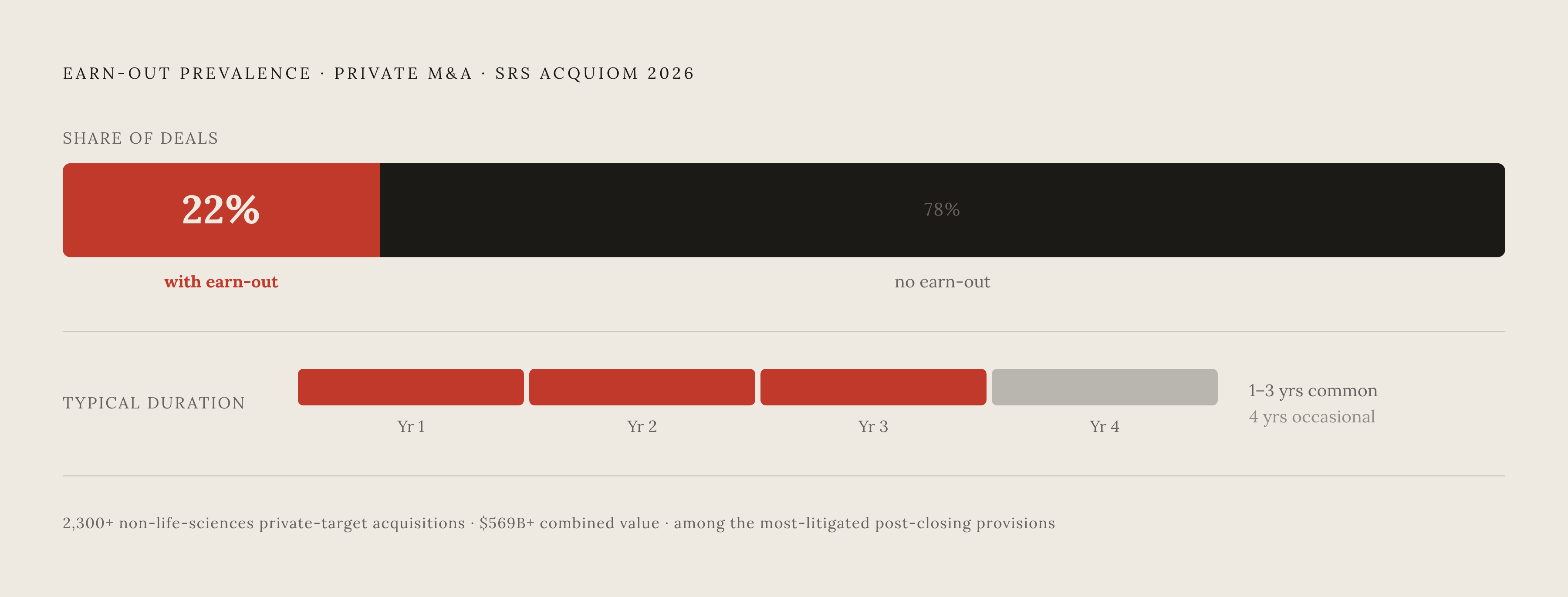
An earn-out is contingent purchase price. Part of what the seller gets paid is deferred and tied to how the business performs afterward, over a period that commonly runs one to three years, sometimes four. The logic is straightforward: buyer and seller disagree on what the business is worth going forward, so the earn-out splits the difference. The seller bets on future performance. The buyer limits what it risks upfront.
These provisions aren't rare, and they aren't fringe. SRS Acquiom's 2026 M&A Deal Terms Study, which looked at more than 2,300 private-target acquisitions worth over $569 billion combined, found earn-out provisions in 22% of non-life-sciences transactions. The metric chosen, general revenue, gross income, or net operating income, shapes how much control the seller actually keeps over whether they get paid.
Earn-outs are among the most heavily litigated post-closing provisions in M&A, and the reason is rarely exotic. It almost always traces back to sloppy measurement language. A change in accounting method, a shift in business strategy, a cost allocation that quietly drags down earnings, a change in market conditions, or a fight over how involved the seller is still allowed to be, any of these triggers a dispute. The deeper cause is structural: buyer and seller incentives split apart the moment the deal closes. The buyer runs the business. The seller just watches, hoping the buyer's decisions line up with the seller's payout.
So what should a seller actually push for before signing? Skip the boilerplate reassurances and negotiate specific control rights over the decisions that move the metric: budgeting, staffing, integration pace, working capital minimums, debt limits, pricing, marketing spend, and limits on the buyer making another acquisition mid-earn-out. Information rights matter just as much, including periodic reporting, audit access, a defined arbitration path, and a real window to challenge the buyer's math. If a seller skips those, the seller is flying blind on their own payout.
One clause gets overlooked constantly and regretted just as often, and it deserves more attention than it usually gets: acceleration. This is the provision that deems earn-out targets automatically met if the buyer sells the business, if the buyer itself goes through a change of control, or if key seller personnel get terminated without cause. If a seller skips it, the seller can do everything right and still watch the earn-out evaporate through events entirely outside their control.
Representations, warranties, and indemnification: the financial exposure that outlasts closing
Reps and warranties are factual statements the seller makes about the business: its financials, its contracts, its employees, pending litigation, tax posture, intellectual property ownership. If any of those statements turns out false, the buyer has grounds to claim indemnification, which is simply how the agreement allocates who pays for what goes wrong after closing, whether that's a breach of a rep, a broken covenant, or an old liability that surfaces later.
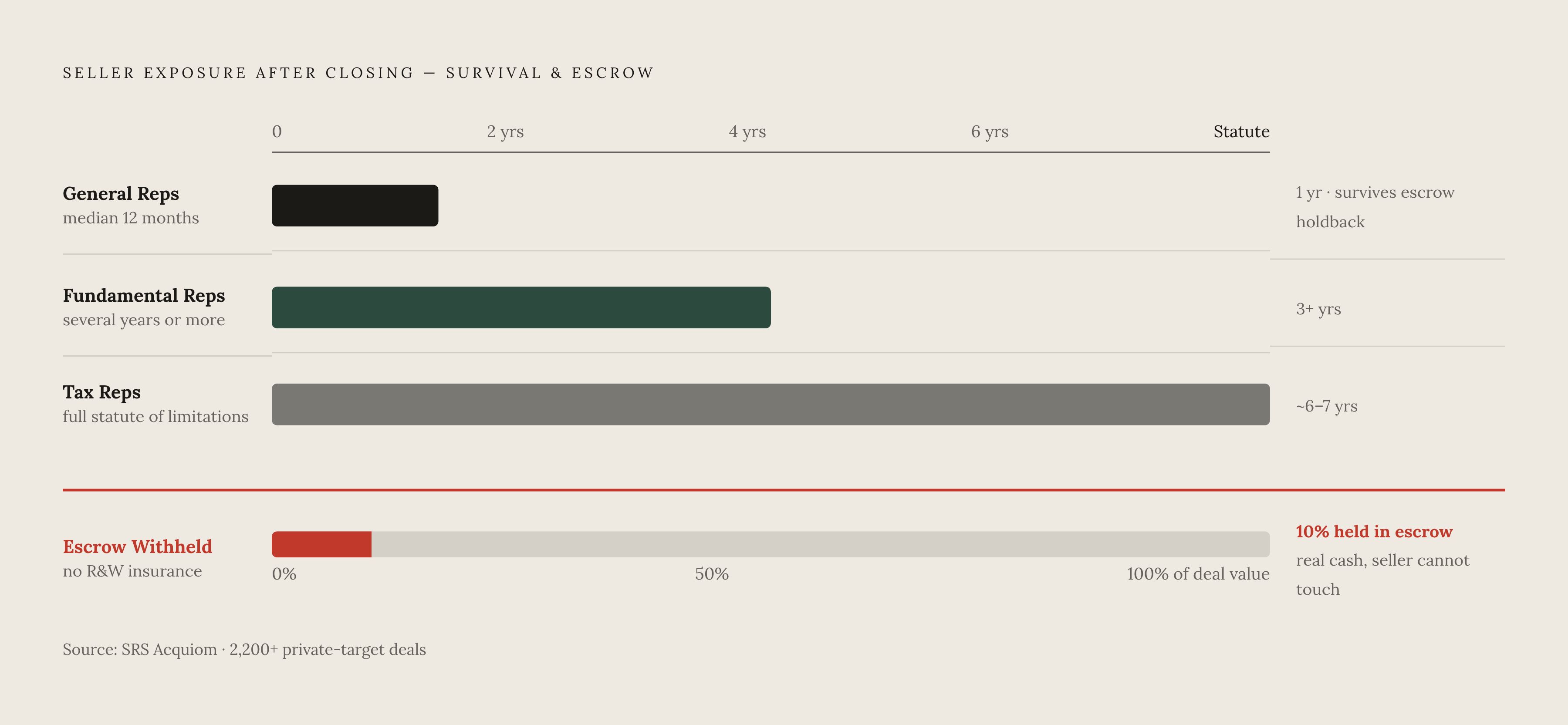
The seller's exposure runs for a defined stretch called the survival period, and how long depends on what's being represented. SRS Acquiom's Deal Terms Study puts the median survival period for general representations at 12 months. Fundamental representations, the ones covering ownership, authority, and capitalization, typically survive far longer, often several years or more. Tax representations run as long as the relevant statute of limitations allows. Indemnification obligations overall can usually get negotiated down to a one-to-three-year post-closing window, but "usually" isn't "always," and the actual number lives in the fine print, not in market convention.
Then there's escrow, and this is where the exposure stops being theoretical. The same SRS Acquiom study, covering more than 2,200 private-target deals, found the median indemnification escrow at 10% of transaction value on deals without representations and warranties insurance. On a sizable exit, that's real money held back in an account the seller can't touch for the length of the survival period. R&W insurance shifts that risk onto an insurer and can shrink or eliminate the escrow requirement, and buyers increasingly want it in place before they'll finalize terms. Sellers should understand it going into negotiations, not discover it halfway through.
Signing the purchase agreement doesn't close out a seller's financial exposure. It opens a defined but potentially multi-year tail, and the escrow sits as real money out of reach until that tail runs its course.
Non-competition covenants: what you agree not to do with your own expertise
A non-compete tied to selling a business isn't the same animal as one buried in an employment contract, and courts don't treat them the same way. In a sale, the buyer is paying for goodwill, for customer relationships, for confidential know-how, and the non-compete is part of what got purchased. Courts recognize that, and enforce accordingly, with far less of the skepticism they apply to employment non-competes.
Typical terms run two to five years, scoped to the actual territory the business operates in. Enforceability right now is in a strange spot: the FTC's 2024 rule that would have banned most non-competes nationwide got struck down by the Northern District of Texas in Ryan LLC v. FTC in August 2024, and the rule has not been revived. As of 2026 there's no federal ban, so enforceability reverts to a patchwork of state law. Sale-of-business non-competes are broadly enforceable across states, though scope and conditions vary, Oklahoma, for example, limits geographic reach to the business's home county and neighboring counties. Heightened judicial scrutiny still targets employment non-competes almost exclusively, not sellers who took real money in exchange for their equity.
State law adds texture that matters before anything gets signed. Delaware enforces sale-of-business non-competes under a reasonableness standard, and its Chancery courts have shown a willingness to "blue pencil," narrowing an overly broad clause down to something enforceable rather than tossing the whole thing out. That favors drafting with stepped-down fallback language rather than swinging for maximum scope and hoping it holds up whole. Florida broadly enforces sale-related non-competes under its restrictive covenant statute, and the 2025 CHOICE Act left that framework untouched, since it only applies to employment-context non-competes for certain high earners. That makes Florida one of the more seller-restrictive states on the map. California's treatment of sale-of-business non-competes differs meaningfully from most other states and warrants close review with counsel before signing.
Buyers and sellers often have competing interests when it comes to how the purchase price gets allocated across the non-compete and other deal components, and those differences have real tax consequences for both sides. Whatever allocation gets agreed upon should be reasonable and economically defensible. And in horizontal deals, where buyer and seller competed before the acquisition, no-poach arrangements between former competitors can raise criminal or civil antitrust concerns that deserve careful attention. How non-solicitation language gets structured post-closing needs real care.
Non-solicitation of employees and customers: the narrower but more enforceable restriction
Non-solicitation covenants target specific relationships instead of general competitive activity. The seller can't recruit the company's employees, can't directly approach its customers, and this restriction can reach beyond the geographic boundary where the non-compete itself applies.
Courts tend to treat these as narrower and more defensible than non-competes. They hold up even in jurisdictions where a broad non-compete might get struck down or trimmed back. A seller who successfully challenges a non-compete in a tough state may still find themselves bound tight by the non-solicitation clause sitting right next to it, and that's the part sellers underestimate most.
Duration commonly runs three to five years, and it isn't unusual for this term to outlast the non-compete itself. A founder whose non-compete expires after two years might discover they're still barred, for several more years, from calling the same customers they spent decades building relationships with. These covenants usually travel alongside confidentiality obligations covering the same people and the same information, and together they form a durable perimeter around whatever the buyer just paid to acquire.
Confidentiality and non-disparagement obligations that run after closing
Post-closing confidentiality means the seller keeps protecting the target company's trade secrets, customer lists, financial data, and proprietary processes, even after walking away from any operational role. The obligation doesn't expire just because the seller no longer works there.
Non-disparagement runs alongside it, with the seller agreeing not to badmouth the buyer, the business, or its leadership, and this clause frequently runs indefinitely or for a long specified stretch. What does that mean in practice? A founder who vents online about the buyer running the business into the ground, particularly when the earn-out is going sideways, can trigger a breach claim, and it doesn't take much. One frustrated post can be enough.
These clauses are increasingly used as a workaround where non-compete enforceability is shaky. If a non-compete might not survive a legal challenge, buyers lean harder on confidentiality and IP assignment terms instead, since those hold up almost everywhere. Before signing, a seller should look hard at how "confidential information" gets defined (an actual boundary, or something open-ended?), how long the non-disparagement runs, whether it's mutual (does the buyer owe the same restraint back, or is this one-directional?), and whether a carve-out protects truthful testimony in legal proceedings.
Post-closing purchase price adjustments: the money that can move after closing
The purchase price isn't necessarily final at closing. Purchase price adjustment mechanisms let the number get recalculated afterward, based on the business's actual condition at closing measured against targets both sides agreed to earlier. The most common is the working capital adjustment, alongside net debt and cash-on-hand adjustments, and these typically resolve within 60 to 90 days after closing through a process built into the agreement itself.
Working capital pegs work like this: buyer and seller set a target level ahead of time. Actual working capital at closing lands below that peg, the seller owes the buyer the difference. It lands above, the buyer owes the seller more. Mechanically it reads like a technical accounting exercise, and it is one, but the number moving through that formula is real cash, and it moves after the deal has closed, after the seller has already mentally filed the transaction as finished.
That's the pattern running through everything covered here. Closing ends ownership. It doesn't end exposure. The purchase agreement keeps working long after the seller stops.