Quality of Earnings Reports in Sub-$20M Business Sales
A closer look at how earnings adjustments can shrink a business's sale price by a third or more.

A Quality of Earnings report exists to answer one question a tax return was never designed to answer: what does this business actually earn, once you strip out everything that only makes sense on a tax filing? In business sales in the lower end of the market, where owner-operated books blend personal expenses, deferred income, and family payroll into a single number labeled that translation job determines the price. Because deal value gets calculated as a multiple of earnings, whatever the QoE adjusts becomes, almost mechanically, whatever the buyer pays.
What a Quality of Earnings report is, and what it is not
Start with what it's not, because the confusion here costs sellers real money. A QoE is not an audit. An audit checks whether the numbers on a financial statement are accurate according to an accounting standard, full stop. A QoE assumes the numbers are roughly what they say and asks a different question: are these earnings sustainable, and do they come from the core operations of the business, or from something that won't be there next year?
It's also not a valuation. A QoE doesn't set a price. It validates (or corrects) the earnings figure that a multiple then gets applied to, which means it sits upstream of valuation rather than inside it. Confusing the two is common among first-time sellers, and it's an easy mistake, since both processes involve poring over the same financial statements.
Typically, an independent third party conducts the analysis after a letter of intent gets signed, though sellers can commission one earlier (more on why that's increasingly the smarter move in the sections ahead). Analysts work month by month across the trailing twelve months, plus usually two to three prior fiscal years. Why monthly, instead of just comparing annual totals? Because annual figures smooth out seasonality, one-time spikes, and revenue timing games that appear only when you look at the twelve individual months that produced them.
The specific ratio here is net cash from operating activities divided by net income. This is the Quality of Earnings ratio, and it quantifies, in a single number, what the full report investigates in narrative form: whether reported profit is actually backed by cash. A ratio at or above 1.0 suggests earnings that convert to cash reliably, which lenders and buyers read as high quality. A ratio well below 1.0 is a flag. It means the business is reporting profit on paper that does not appear in the bank, which raises the question of where, exactly, that profit went, or whether it exists at all in a form a buyer can rely on.
High-quality earnings are recurring, tied to core operations, and consistent from period to period. Low-quality earnings come from one-time events, asset sales, or accounting choices that inflate the picture without reflecting how the business actually performs. The distinction isn't academic. A buyer financing an acquisition has to service debt from earnings that will actually be there after closing, not earnings that existed once, in one good quarter, for reasons that won't repeat.
What the report examines, section by section
The centerpiece of any QoE is the adjusted EBITDA build. The analyst takes the reported EBITDA figure and recasts it, removing non-recurring items, owner discretionary expenses, and accounting anomalies that wouldn't continue under new ownership. What's left is the number a buyer can actually underwrite against, and it's this adjusted figure, not the one on the tax return, that becomes the basis for the valuation multiple.
Revenue quality gets its own scrutiny. Are the sales real, recurring, and recognized in the right period? Analysts look for aggressive recognition practices, customer concentration risk, and whether contracts are likely to survive a change in ownership. A common issue in smaller companies: one-time project revenue gets booked as if it were recurring, which overstates the durability of the revenue base. For businesses on cash-basis or inconsistent reporting, which describes a large share of the smaller end of the market, the QoE normalizes revenue to what standard accrual accounting would show. That adjusted number often looks meaningfully different from what the seller originally presented, not because anyone lied, but because cash-basis books were never built to answer this question.
Proof of cash is one of the more direct tools in the analyst's kit: a reconciliation between reported revenue and the cash that actually landed in the company's bank accounts. It's blunt, it's hard to argue with, and it's becoming a formal requirement rather than a best practice, and it resurfaces later in the discussion of the new SBA rule.
Working capital trends matter too. How much working capital does the business actually need to run day to day, how has that figure moved over time, and has the seller quietly manipulated it before the sale, accelerating collections, delaying payables, building up inventory to make the balance sheet look better than it normally does?
Then there's the contested territory: add-backs. A legitimate add-back increases EBITDA because the associated expense won't continue once the business changes hands. Owner compensation above market rate is the textbook case. If an owner pays themselves far more than it would cost to hire a replacement manager, the gap between the two gets added back to earnings. Other familiar examples include personal vehicles folded into fleet expenses, family members on payroll who don't actually work in the business, personal travel booked as a business expense, and legal fees from a dispute that's already resolved and won't recur.
None of these add-backs are inherently a problem. The trouble starts when they're undocumented, inconsistent from year to year, or stretched to cover expenses that don't really qualify as non-recurring. A buyer's QoE provider will push back on anything that looks like a stretch, and that pushback, if it happens during diligence rather than before it, tends to happen at the worst possible moment for the seller's leverage.
Related-party transactions round out the picture: payments to entities or individuals connected to the owner that might not reflect arm's-length pricing. Combined with an assessment of customer concentration, the report ultimately asks whether the revenue would survive a change in ownership at all, or whether it's tied so tightly to the seller's personal relationships that a new owner inherits a much smaller business than the numbers suggest.
A concrete case: what the gap looks like in a real sub-$20M deal
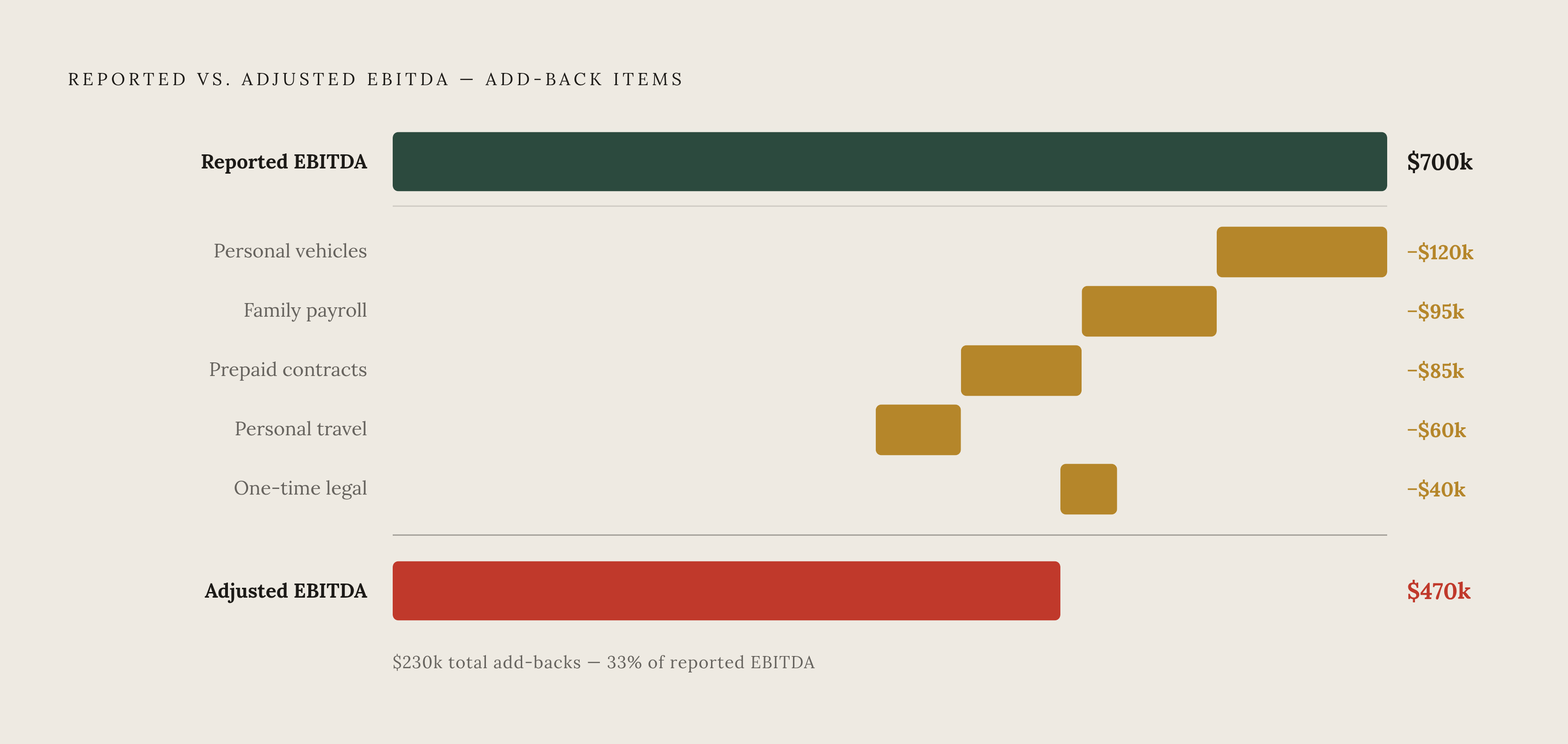
Consider an HVAC company doing roughly $3 million in revenue, under a signed letter of intent. The seller's tax returns showed $700,000 in EBITDA. After the QoE, the adjusted figure came in at $470,000, a gap that ate up roughly a third of the originally reported number.
Where did the gap come from? Personal vehicles mixed into fleet costs accounted for $120,000. Prepaid service contracts recognized too early added another $85,000 to the original figure. Family payroll paid above market rates contributed $95,000. Personal travel added $60,000, and one-time legal expenses made up the remaining $40,000.
Every one of those items, on its own, was a legitimate deduction under tax law. The seller wasn't hiding anything or cooking the books. The QoE simply did the job it exists to do: separate what's valid for tax purposes from what a buyer is actually purchasing when they buy the business, which is a stream of earnings that will keep occurring after the current owner is gone.
The report itself, for a business this size, likely cost somewhere in the $10,000 to $20,000 range. Compare that against what it revealed. Price a deal off the original $700,000 figure and a buyer overpays substantially at any reasonable multiple. Price it off the corrected $470,000, and the negotiation starts from a number that will actually hold up under a lender's scrutiny. That's the asymmetry that makes the report's cost almost beside the point.
This raises the obvious follow-up question. If a buyer's diligence team is going to find this gap anyway, why does it matter who commissions the report first?
Why sellers commissioning their own QoE before going to market is now the stronger position
Two models exist for commissioning a QoE. Buy-side QoE is the traditional approach: the buyer orders it, and it gets completed during diligence, after the LOI is signed. Sell-side QoE flips the sequence. The seller commissions the analysis, ideally well before going to market, with enough lead time for anything useful to come out of it.
The asymmetry problem with relying solely on a buy-side QoE is structural. The buyer's diligence team has no reason to go looking for add-backs that would increase EBITDA and cause their own client to pay more. Their job is to find the problems, not to build the seller's case. That's not a criticism of buy-side analysts, it's simply what the incentive structure produces.
A credible sell-side QoE changes the sequence of who finds what, and when. It pre-tests, in effect, what a buyer's team is likely to uncover, while the seller still has full negotiating leverage to address it. It documents the add-backs with enough support that they survive scrutiny instead of getting stripped out during diligence. It establishes the seller's preferred working capital peg before a buyer proposes one that favors them instead. And because so many of the diligence questions get answered up front, it tends to shorten the whole process. Sellers who've gone through a well-prepared sell-side QoE are better positioned at closing because the buyer isn't discovering surprises that justify holding money back.
Yet adoption remains uneven. Sell-side QoE adoption among lower middle-market, founder-led businesses remains far below the near-universal adoption, at least 90%, seen among private equity-backed deals. Why the gap? A lot of founder-led owners assume that because their books are audited, or because they use a competent bookkeeper, a QoE is redundant. But that assumption is wrong. An audit and a QoE ask entirely different questions of the same numbers, and one doesn't substitute for the other. Still, the trend line is moving: sell-side QoE use has grown over the past several years, as a practice that once lived exclusively in larger deals has moved down into the lower middle market.
What the new SBA rule changes for deals at $3 million and above
On August 14, 2026, the SBA issued SOP 50 10 8.1, and the new QoE requirement inside it takes effect October 1, 2026, applying to loan applications that receive a loan number on or after that date. For initial business acquisitions and business expansions with a purchase price of $3 million or more, before factoring in buyer equity, seller debt, or other financing sources, an independent QoE report becomes mandatory for SBA 7(a)-financed transactions.
There are carve-outs. Owner Buyout and ESOP or Cooperative transactions aren't subject to the requirement. And when owner-occupied commercial real estate is part of the deal, its appraised value gets removed from the purchase price before determining whether the transaction crosses the $3 million threshold, which matters for deals that would otherwise trip the requirement on the strength of the real estate alone.
The rule is specific about who the QoE is for. It has to be performed for the benefit of the lender, not prepared by or for the borrower or the seller, which is a meaningful distinction from the sell-side QoE model discussed above. It must reconcile financial statements, tax returns, internal records, and IRS transcript data into a single normalized earnings figure. It has to include a cash proof analysis covering the trailing twelve months plus the prior two fiscal years. And it has to evaluate nonrecurring items, owner compensation adjustments, related-party transactions, and customer concentration, essentially formalizing everything described earlier in this piece as standard QoE practice.
The most consequential operational change sits in underwriting. Lenders must use the QoE-adjusted earnings figure, not the seller's originally reported number, in their debt service coverage calculations. Add-backs that might have quietly passed through underwriting before now face a level of scrutiny that could sink a deal structure if the adjusted number doesn't support it. Which raises a real possibility for sellers and brokers to plan around: a transaction can be marketed and even agreed to based on one earnings figure, only to run into a lender whose underwriting relies on a materially different, and lower, normalized figure. If the debt service coverage doesn't hold up under that adjusted number, the financing may need to be renegotiated, late in the process, after both sides thought they had a deal.
It's not hard to see where this leads. As sellers and brokers absorb what the new rule means for deals north of $3 million, commissioning a lender-ready sell-side QoE ahead of time looks less like an optional expense and more like table stakes for keeping a transaction on schedule.
What QoE reports cost in the sub-$20M market and how to size the engagement correctly
Pricing splits into two broad categories. A limited-scope QoE runs $10,000 to $20,000 and focuses on specific risk areas rather than a full rebuild. It suits deals with EBITDA under roughly $750,000 and books that are already reasonably clean. A full QoE runs $20,000 to $40,000 and involves a complete financial rebuild with a professional opinion covering every revenue stream, every expense category, and a full balance sheet analysis. SBA financing requires the full version, and it's the right call anyway for businesses with EBITDA well into seven figures, or wherever add-backs are extensive or family involvement complicates the picture.
Looking at 2026 pricing by size, businesses with sub-$3 million EBITDA typically fall into the $15,000 to $25,000 range, while $3 million to $10 million EBITDA businesses run $25,000 to $50,000. Separately, For companies under $10 million in revenue with relatively simple operations, a local accounting firm can often produce the report for $10,000 to $20,000, and more complex engagements can reach $20,000 to $80,000 or more.
Complexity adds cost in predictable ways. Multi-entity structures typically add 30% to 50% on top of a baseline engagement. Regulated industries, healthcare and financial services being the obvious examples, typically carry a 20% to 40% premium, since the analyst has to account for industry-specific compliance and revenue recognition rules. Multi-state operations bring their own layer of state tax complexity that adds time to the engagement regardless of the business's size.
Timeline runs 4 to 6 weeks from engagement to draft report, though it can stretch to 30 or 45 days depending on how quickly the seller can produce the underlying financial records. Slow document turnaround is, in practice, one of the more common reasons a QoE timeline slips.
A simple decision framework helps here. Under $750,000 in EBITDA, with clean books and no family involvement, a limited-scope engagement is probably sufficient. Once EBITDA climbs well into seven figures, with family on payroll or SBA financing in the mix, go with the full QoE. Multiple entities or a regulated industry push toward a full QoE regardless of EBITDA size, since the complexity itself demands the deeper review.
Set against the deal math from earlier in this piece, the cost barely registers. At a five times multiple, even an $80,000 QoE engagement is immaterial next to what a $200,000 earnings adjustment does to purchase price. The report's value is asymmetric by design: a modest, fixed cost against a variable that moves the sale price by a multiple of itself.
What the valuation data shows, and what it leaves unresolved, for small deals
GF Data analyzed 360 transactions completed since the third quarter of 2024 and found that sellers who used a sell-side QoE saw average TEV/EBITDA multiples of 7.4x, compared with 7.0x for sellers who didn't. On its face, that supports everything argued in this piece: doing the work up front pays for itself in the multiple a seller ultimately captures.
But the data gets more complicated once you isolate the smaller end of the market, and that complication shouldn't be smoothed over. The premium wasn't evenly distributed across deal sizes, it concentrated in larger transactions. In the upper mid-market range of total enterprise value specifically, sellers who ran a sell-side QoE averaged 5.9x, while sellers who didn't averaged 6.6x, the opposite direction from the overall trend.
What explains that reversal? GF Data's own analysis shows that a majority of the smaller transactions in the sample, 63%, involved some other variable that likely confounds the simple comparison between QoE use and multiple outcome. That detail cuts off mid-thought in the available reporting, which is itself instructive. It means the honest answer, for sellers at the smaller end of the market looking at this data, is that a sell-side QoE clearly reduces risk, clearly speeds up diligence, and clearly protects against the kind of surprise renegotiation the new SBA rule makes more likely. Whether it reliably buys a higher multiple at this specific deal size, though, remains an open question the current data doesn't settle. That's not a reason to skip the report. It's a reason to value it for what it demonstrably does, protect the deal from collapsing under diligence, rather than for a multiple premium the smaller end of the market hasn't yet proven out.