Minority Discount and Control Premium in Partial Business Sales
How control premiums and marketability discounts reshape the price of partial stakes.

Selling 30% of a company does not mean pocketing 30% of what the whole business is worth. The price per point moves depending on whether that slice carries control, and the two mechanics governing that shift, minority discount and control premium, are the same phenomenon viewed from opposite sides of the table. Add discount for lack of marketability into the mix, and a founder negotiating a partial sale is suddenly juggling three adjustments that get misapplied, stacked wrong, or lifted from a benchmark that was never built for the deal sitting in front of them. Most of the damage in this area comes from one habit: treating a median discount pulled off a table as an answer, instead of as the opening line of a negotiation.
Start with what a minority owner actually cannot do, no matter the size of the check they wrote. They cannot elect or remove directors alone, cannot force a dividend, cannot approve a sale of the company, cannot set executive pay, cannot amend the governing documents, and cannot pivot strategy without buy-in from whoever holds control. That bundle of things a minority holder cannot do has a price, and appraisers call the downward adjustment for it the Discount for Lack of Control, or DLOC, better known as the minority discount. Flip the transaction around and look at it from the buyer's side, and the same gap becomes a control premium, the extra amount paid specifically to acquire the rights a minority holder lacks. One number, two names, depending on which side of the table someone sits.
DLOM gets confused with DLOC constantly, and that confusion is where a lot of valuation reports quietly go wrong. DLOM addresses illiquidity, the plain fact that a private stake, even a controlling one, cannot be sold in an afternoon the way a public stock can. It has nothing to do with voting rights or board seats, and treating it as a stand-in for DLOC is the fastest way to misprice a stake. This piece works through each mechanic in turn: where a stake sits on the valuation ladder, the math connecting discount to premium, what benchmark data says and how wide that data spreads, the deal-specific factors that move the number, the risk of stacking DLOC and DLOM wrong, how deal structure decides which adjustment even applies, and the legal standard that determines whether a discount is allowed at all.
The levels-of-value framework: where any partial stake sits on the valuation ladder
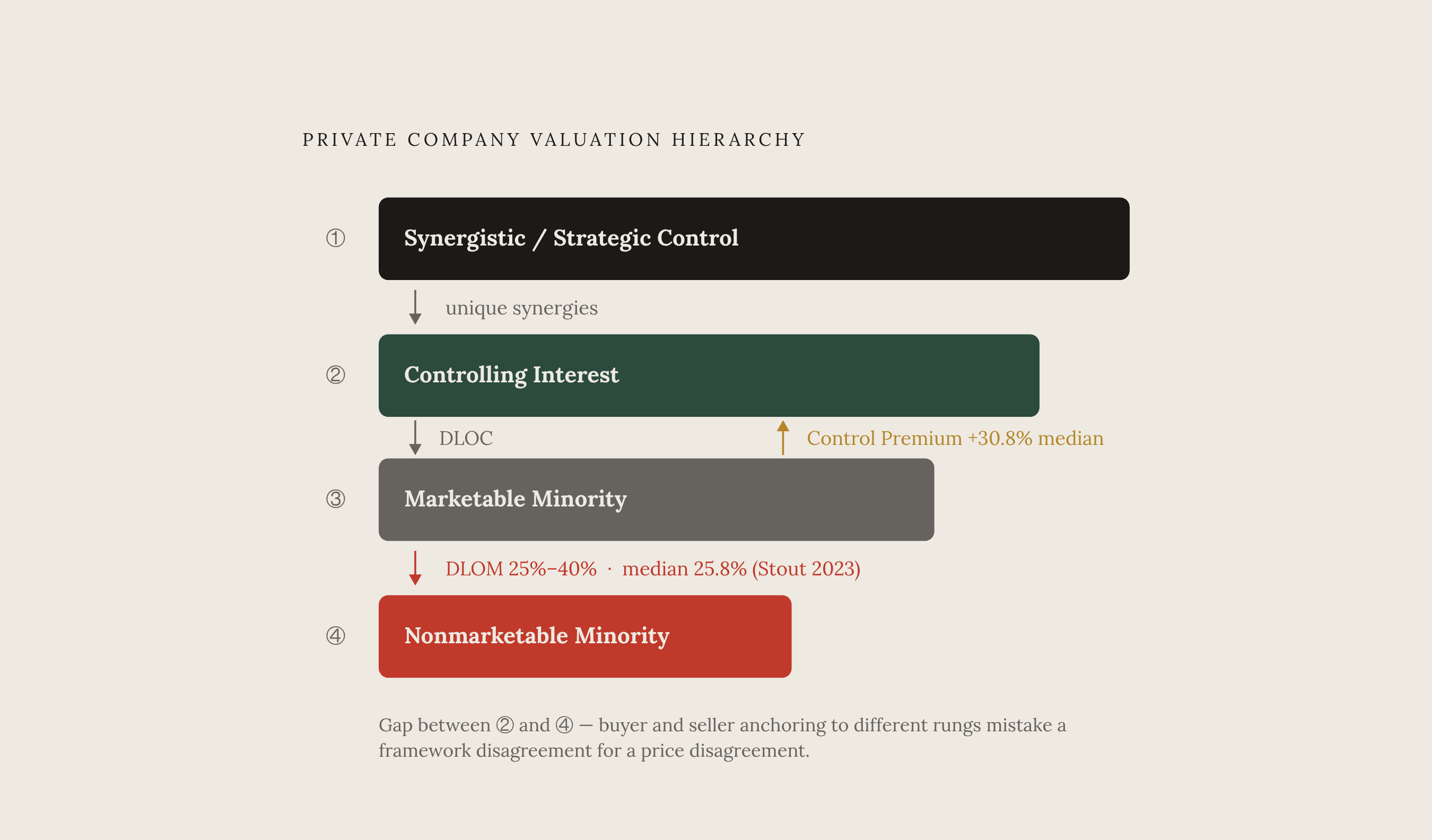
The traditional levels-of-value framework, formalized in published valuation literature in 1990, stacks three tiers. At the top sits the controlling interest level, the value of the whole enterprise if someone can direct it. Below that is the marketable minority level, sometimes called the "as-if freely traded" level, which approximates what a share would fetch on a public exchange despite the company being private. At the bottom sits the nonmarketable minority level, which accounts for both the lack of control and the lack of a ready market to sell into.
A more current version extends the ladder to four levels by adding synergistic, or strategic, control above ordinary control. That top tier exists because a specific buyer, one with a unique strategic fit, can extract value from an acquisition that no generic controlling owner could. A competitor absorbing a target into an existing distribution network is the standard example of why synergistic value sits above plain control value.
Most appraisals start at the marketable minority level and move in one of two directions. Moving up means adding a control premium. Moving down means applying DLOC first, then DLOM separately, since each adjustment addresses a different limitation, not the same one twice.
Here is the part of the framework that actually misleads people: the "marketable minority" level is mislabeled. It behaves, mathematically, like an enterprise-level value rather than a genuine minority concept, since it assumes public-market liquidity that a private nonmarketable minority stake simply does not have. The traditional chart papers over that gap, and it remains one of the more persistent sources of confusion in the field. Anyone building a valuation off this ladder without naming that flaw out loud is standing on a rung that was never quite solid.
Why does this matter to a founder about to sell 40% of a company built over a decade? A buyer and a seller can anchor to different rungs on that ladder without either one realizing it. The buyer may price from the nonmarketable minority level, discounting for both lack of control and lack of a market. The seller may think in enterprise terms, as though 40% simply means 40% of what a full sale would fetch. That gap looks like a disagreement about price. It is actually a disagreement about which level of value the conversation is happening at, and no amount of back-and-forth on multiples fixes that until both sides name the starting rung out loud.
The inverse mathematical relationship between control premium and minority discount
Once the level-of-value question is settled, the arithmetic connecting premium and discount is fixed and mechanical. Minority Discount = 1 minus [1 divided by (1 plus Control Premium)].
FactSet put the median US control premium for Q2 2025 at 30.8%. Run that through the formula and it implies a minority discount of roughly 23.6%, close to the rough shortcut of dividing 0.30 by 1.30.
Why does the discount come out smaller in percentage terms than the premium that produced it? The two percentages are measured against different bases. The premium marks up the smaller, minority-level value. The discount marks down from the larger, control-level value. The same dollar gap, expressed as a fraction of a bigger number, looks smaller. That asymmetry is exactly what gets exploited at the negotiating table: a buyer who wants to look generous quotes the discount figure, and a seller who wants to sound reasonable quotes the smaller-looking one right back.
Here is the part that should unsettle anyone leaning too hard on a cited discount: no direct market evidence for minority discounts exists. Nobody observes a "minority discount transaction" the way analysts observe a control premium in an announced M&A deal. Minority discounts are derived, always, backward from observed control premiums, using the formula above as the bridge. Every minority discount cited anywhere is only as reliable as the control premium data feeding it. Quoting one without naming the source behind it is quoting a number nobody actually measured.
The trap that catches even experienced negotiators: this math compounds, it does not add. Stacking a control premium and a minority discount is not a matter of adding percentages or netting them against each other in a single line. Apply them multiplicatively, on the correct base value at each step, and the numbers reconcile back to the same starting point. Treat it like simple algebra instead, and the final valuation drifts, sometimes by a meaningful amount, from what the underlying data actually supports.
What the benchmark data actually shows, and how wide the real range is
The headline number is the FactSet Q2 2025 figure: a median US control premium of 30.8%, implying a minority discount around 23.6%. That number gets quoted often enough to feel like gospel. It should not. It is a median, and the spread around it is wide enough to make the median nearly decorative.
Look back further and the picture gets murkier, not clearer. FactSet data spanning 1980 to 2022 puts the average control premium closer to 25%. None of the historical averages agree precisely, and none should, since they draw from different transaction samples across different years and different economic conditions. Averaging them into one number would be a mistake. The range itself is the finding, not the midpoint.
Industry-level control premiums run anywhere from 10% to 70% depending on sector and market conditions at the time of the deal. Deloitte data on the US technology, media, and entertainment sector makes the point vividly: premiums climbed from 27% in 2014 to as high as 57% in 2017, with the 2014 to 2016 average near 38% and the 2017 to 2019 average jumping to roughly 55%. That is not a rounding difference. That is a sector where the going rate for control nearly doubled inside a five-year window, which should make anyone quoting a flat industry-wide number pause before they use it.
Minority discounts show a comparably wide spread. Empirical studies and court decisions between 2010 and 2025 place US small-to-middle-market private companies most commonly in a 15% to 45% inter-quartile range, with notional valuation contexts often running between 10% and 40%. Ownership size matters too: a 25% stake might draw a discount somewhere in the 20% to 30% band, while a 5% stake, carrying almost no influence at all, can push toward 30% to 40%.
A 2024 panel hosted by CAANZ, with commentary from FTI Consulting, made the point directly: a flat, "standard" 30% discount applied without regard to a deal's specific circumstances does not hold up in front of a court or a serious counterparty. The direction of travel in the valuation community is away from mechanical defaults and toward case-by-case, stake-by-stake analysis, and a founder who quotes a flat percentage without that analysis behind it is going to lose the argument.
So what should a founder actually take from a median like 30.8%? Treat it as an opening line, not a verdict. Anyone who quotes it as the final answer is skipping the entire next section, which is where the real number gets built.
The factors that push a discount up or a premium down in any specific deal
Some conditions push a minority stake below the benchmark discount. A lower ownership percentage means less influence and a steeper discount. Non-voting shares, or a total absence of voting rights, do the same. A documented history of withheld or irregular dividends raises perceived risk and shrinks the realistic return a minority holder can expect. Weak statutory protection against minority oppression in the relevant jurisdiction removes a legal backstop that would otherwise soften the discount, and an absence of information rights in the shareholder agreement, leaving the holder unable to even see reliable financials, compounds all of it.
Other conditions narrow the discount. Liquidity provisions, like a right to sell the stake back to the company or to other shareholders at a pre-agreed formula price, matter enormously. Veto rights over major decisions (acquisitions, new debt, dilutive share issuances) give a minority holder real leverage even without majority control. A track record of consistent, well-documented distributions signals both return and lower risk. A board seat, or even just observer rights, keeps a holder informed and somewhat influential. And in a company where no single shareholder holds a majority, a meaningful minority stake can carry outsized "swing vote" value, since whoever holds it can tip decisions one way or another, a dynamic that can shrink or, in rarer cases, eliminate the discount.
On the premium side, synergy is the largest single driver, and it is not close. A strategic acquirer who can quantify meaningful annual cost savings or revenue lift from combining operations will routinely pay meaningfully more than a financial buyer chasing the same target, because the financial buyer has no equivalent synergy story to justify a higher number. An underperforming stock price on the target side can inflate the apparent premium too, since a depressed baseline makes any offer look larger in percentage terms even when the absolute dollar gap is unremarkable. A competitive bidding process, with multiple strategic buyers actively bidding against each other, pushes premiums upward through plain auction dynamics.
Put those two lists side by side and the practical point is this: a founder who negotiates governance rights, veto provisions, information rights, and a liquidity mechanism into a shareholder agreement before selling a partial stake is not just protecting the business. They are measurably shifting where their own stake lands within the discount range, often before a buyer has made an offer at all. Skip that work, and the discount a buyer proposes gets built entirely on the buyer's assumptions, not the actual rights attached to the stake, and that is the version most founders end up signing.
How DLOM interacts with DLOC, and why stacking them incorrectly destroys value
DLOM prices something entirely separate from control: the time, cost, and uncertainty involved in converting a private ownership interest into cash, plus the reality of a limited pool of buyers for that interest. A controlling stake in a private company can carry a significant DLOM even though it carries no DLOC at all, because control does not make the stake any easier to sell quickly. That distinction is the one most often lost when a buyer bundles both discounts into a single round number, and it is worth insisting on, every time.
Benchmark data on DLOM clusters in a few well-studied ranges. Restricted stock studies, looking at discounted shares that cannot be freely traded for a set period, show average discounts between 20% and 35%. Pre-IPO studies, comparing private transaction prices to the eventual public offering price, show a steeper 40% to 50% range. The Stout Restricted Stock Study, 2023 edition, drawing on more than 775 transactions between 1980 and December 2022, found a median DLOM of 25.8%, with an inter-quartile range from 16.7% at the 25th percentile to 35.9% at the 75th. Controlling interests typically see DLOM in the 10% to 25% range; minority interests, facing illiquidity and lack of control at once, typically see 25% to 40%.
That gap is not academic. A genuinely attractive private business, with clean books and a defensible market position, can still take six to eighteen months to find a qualified buyer and close a sale. That stretch of time, and the uncertainty riding along with it, is exactly what DLOM prices.
Combining DLOC and DLOM is legitimate when a stake genuinely lacks both control and a ready market, which describes most minority interests in private companies. The mistake is in how the two get combined. They compound multiplicatively, they do not add. A 25% DLOC and a 30% DLOM do not sum to a 55% discount. Applied correctly, in sequence, the combined effect lands below the naive sum, though still substantial, generally somewhere between 25% and 45% in fair market value work. Courts have grown noticeably more skeptical of combined discounts pushing past 50% without a strong factual basis behind them, and that skepticism is earned: a number that big usually means someone stacked the same limitation twice.
That is the second trap, subtler than the addition-versus-multiplication error: if the capitalization rate or market multiple used to build the base valuation already reflects limited distribution control, layering a full DLOC on top prices the same limitation twice. A defensible valuation report has to show, explicitly, that each discount addresses a distinct economic limitation rather than the same one wearing two names. For a founder facing a buyer who wants to apply both a steep DLOC and a steep DLOM to the same stake, the right move is not to accept the bundle. Ask the appraiser to justify each discount independently, on its own terms, and watch for the moment the justification for one starts sounding suspiciously like the justification for the other.
How deal structure determines which adjustment applies, and to what base
Everything above assumes someone has already answered a threshold question: does the stake actually carry control? A 51% sale with full voting rights sits, without much argument, at the control level. A 30% sale with no veto rights and no path to influence sits, just as clearly, at the nonmarketable minority level. Those are not close calls, and the pricing logic for each is entirely different.
Percentage alone tells only part of the story, though, and treating it as the whole story is the second most common mistake in this entire framework, right behind confusing DLOC with DLOM. Rights attached to the stake frequently matter more than the raw number. A 49% interest with veto power over major decisions (a sale of the company, a new debt raise) commands a meaningfully smaller discount than a 49% interest with no protective provisions at all, even though both are, on paper, "minority" stakes below the 50% line. A 30% interest in an LLC with strong information rights and a mandatory distribution policy written into the operating agreement is worth more, dollar for dollar, than an identical 30% interest sitting in an agreement silent on both points.
Drag-along and tag-along provisions bend the numbers further. Tag-along rights, letting a minority holder exit on the same terms the majority negotiates, reduce DLOC by giving that holder a real liquidity path tied to any future sale. Drag-along rights cut the other way. They let the majority force a sale, and if the minority holder has no consent right built in, that provision strips away leverage rather than adding it.
Buy-sell agreements matter here too. A formula-price redemption right, or a shotgun clause letting either side force a buyout at a defined mechanism, can reduce both DLOC and DLOM at once, since it creates a known, contractually guaranteed exit rather than leaving the holder dependent on finding a willing buyer someday.
The identity of the buyer changes the math as well. A financial buyer pricing a minority stake has no synergy story to lean on, so the control premium component shrinks accordingly, if it applies at all. A strategic buyer with clearly quantifiable synergies may justify paying well above the plain control level, which is exactly the dynamic behind the wide sector-level premium ranges from the previous section.
Staged partial sales add one more wrinkle. Selling a first tranche of, say, 20% at a minority discount, while retaining a contractual right (or granting the buyer an option) to transfer a controlling tranche later, means that first tranche is not purely a minority stake in the simple sense. It carries embedded option value tied to the future control transfer, and standard discount analysis, built for a single static transaction, tends to miss that value. A founder structuring a sale in stages should insist their advisors price that option explicitly, rather than let it vanish into a generic minority discount that was never built to hold it.
The standard-of-value question: when discounts apply and when they are legally excluded
Everything discussed so far assumes discounts apply at all, and that assumption depends entirely on which legal standard governs the transaction. Fair Market Value, the standard set out in Revenue Ruling 59-60 and used throughout US tax valuation, defines the price at which property would change hands between a willing buyer and a willing seller, neither under compulsion, both reasonably informed. Under FMV, DLOC and DLOM are generally permitted, often expected, whenever the interest genuinely lacks control or a ready market.
Fair Value is a different standard, used in shareholder disputes and statutory appraisal proceedings, and it typically excludes both discounts. It asks a narrower question: what is this interest's pro-rata share of the enterprise's total value, full stop, without penalizing the holder for lacking control or facing an illiquid market. The consequence is stark. The exact same 30% stake in the exact same company can be worth materially more under a Fair Value proceeding than under a Fair Market Value analysis, purely because of which standard governs, and that determination happens before the discount debate even starts.
Revenue Ruling 93-12 addressed a related point specific to family and closely held businesses, and it corrected an error worth understanding. Before that ruling, some valuations denied a minority discount to a family member's stake on the theory that the family, collectively, held control even if no single member did. The ruling rejected that logic. Each interest gets valued on the rights actually attached to it, not by attributing the family's aggregate control back onto one member's individual slice.
Courts have grown more openly skeptical of aggressive discount claims generally. Discounts for lack of control exceeding 35% draw heightened scrutiny absent strong factual justification, and combined discounts of that kind together with another discount type north of 50% face the same treatment. Courts have consistently indicated that they weigh the specific facts, the quality of expert support behind the number, the governing documents, and the controlling statute in each case. Reported case outcomes are examples of how that reasoning has played out before, not a fixed table of discounts to reuse going forward. A flat 30% discount, offered without deal-specific analysis behind it, tends not to survive a serious challenge. It should not, and any founder handed one ought to ask why not.
What founders negotiating a partial sale should do with all of this
Locate the level of value before price ever comes up. Confirm, in plain terms, whether a buyer's offer is anchored at the control level, the marketable minority level, or the nonmarketable minority level. A gap here can masquerade as a disagreement over valuation multiples when it is really a disagreement over definitions, and no amount of back-and-forth on the number fixes a mismatch in the underlying framework.
Audit every right attached to the stake on the table. Veto rights, information rights, mandatory distribution provisions, tag-along protections, and buy-sell mechanisms each move the applicable discount, sometimes substantially. Negotiating those governance terms before locking in a price, rather than treating them as an afterthought once the number is set, changes the outcome in ways that price negotiation alone cannot.
Push for independent justification of every discount a buyer proposes. DLOC and DLOM each address a distinct economic limitation, and if either one overlaps with an assumption already baked into the base valuation methodology, that is double-counting, plain and simple. A founder does not need to be a valuation expert to ask an appraiser to show their work on this specific point, and if the appraiser can't separate the two, that is the answer right there.
Use the conversion formula as a sanity check whenever a buyer proposes a minority discount. Run it backward to find the implied control premium, then check whether that implied premium lines up with what is actually observed in comparable transactions in the relevant sector. Given that sector-level premiums run anywhere from 10% to 70%, "reasonable" only means something in context. It means nothing in the abstract, and a discount defended only by its own reasonableness deserves to be rejected on sight.
Remember that synergy drives premium size more than any other single factor. A strategic buyer bringing genuine, quantifiable synergies to the table should be paying a higher implied control premium than a financial buyer would, which means the minority discount applied to any non-controlling stake in that same deal should be benchmarked against a higher starting point, not a generic median pulled from an unrelated transaction sample.
Treat deal structure as a design decision made before the stake is ever offered, not a reaction negotiated under pressure once a buyer is already at the table. Partial sales built around real governance rights, dependable distribution commitments, and a defined exit mechanism consistently command smaller discounts than stakes offered without any of that scaffolding. For a founder running a business in the $500,000 to $50 million revenue range and weighing a partial sale, the number that matters is not the one pulled off a benchmark table. It is the one built from the actual rights, structure, and standard of value governing the specific deal. That number gets earned through negotiation. It does not get assumed from a median, and a founder who lets it be assumed has already given away more than the discount itself.