Strategic Acquirer Synergy Valuations and How Sellers Can Capture Them
Sellers who understand synergy math can negotiate for a larger share of the value they create.

Strategic buyers pay more than financial buyers for one reason: synergies. This piece walks through how those synergies get calculated, why buyers keep most of that value by default, and what a seller actually has to do to walk away with a bigger share of it. None of this is theoretical. It's the math playing out in every competitive process I've watched, whether the seller understood it or not.
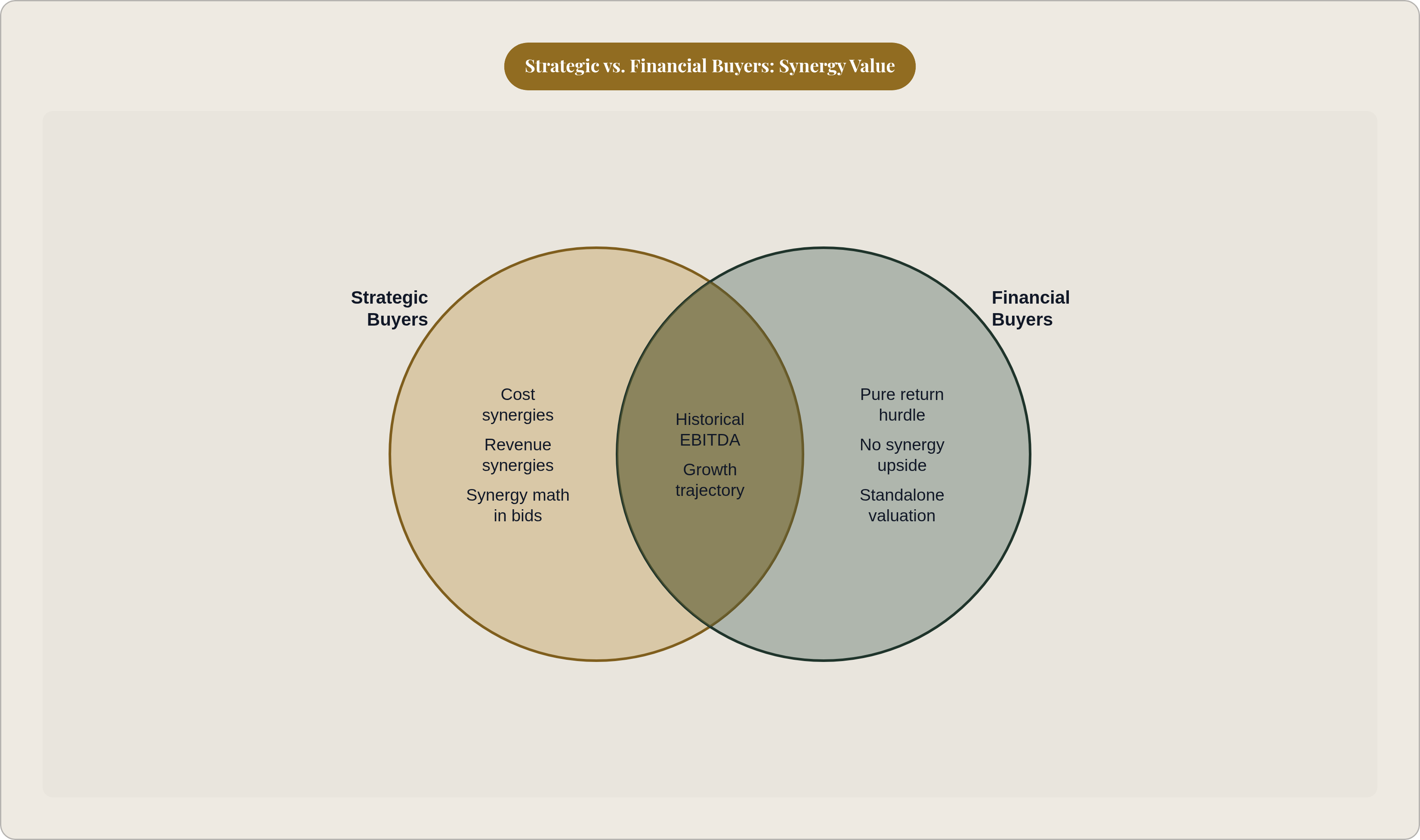
Start with the math a strategic buyer runs before picking up the phone. They begin exactly where a private equity firm would: a standalone valuation built off historical earnings, growth trajectory, market comps. Then they add something a financial sponsor usually can't touch, the present value of what happens after close once this target gets bolted onto their existing operation. Cost savings, new revenue channels, freed-up capacity. Those expected gains raise the ceiling on what a strategic can pay while still clearing its own return hurdle.
A lot of first-time sellers miss this part. The ability to create synergy value has nothing to do with the willingness to pay for it in advance. A buyer can see, clearly, that combining your customer list with their sales force generates real upside and still not offer a dollar of it unprompted. Every rational buyer defaults to keeping what it can capture. Why hand it over if nobody's asking?
That's also why two buyers staring at identical financials land on wildly different numbers. They're not arguing about your trailing twelve months' EBITDA. One has an overlapping distribution network or idle plant capacity the other doesn't, and that asymmetry shows up straight in the bid. It's the structural reason strategics have outbid financial sponsors across market cycles going back decades; the spread isn't sentiment, it's synergy math getting priced in quietly, before anyone says the word out loud.
Moving some of that value off the buyer's side of the ledger and onto the seller's, before the ink dries, is what the rest of this piece is about.
The three categories of synergies and how buyers price each one differently
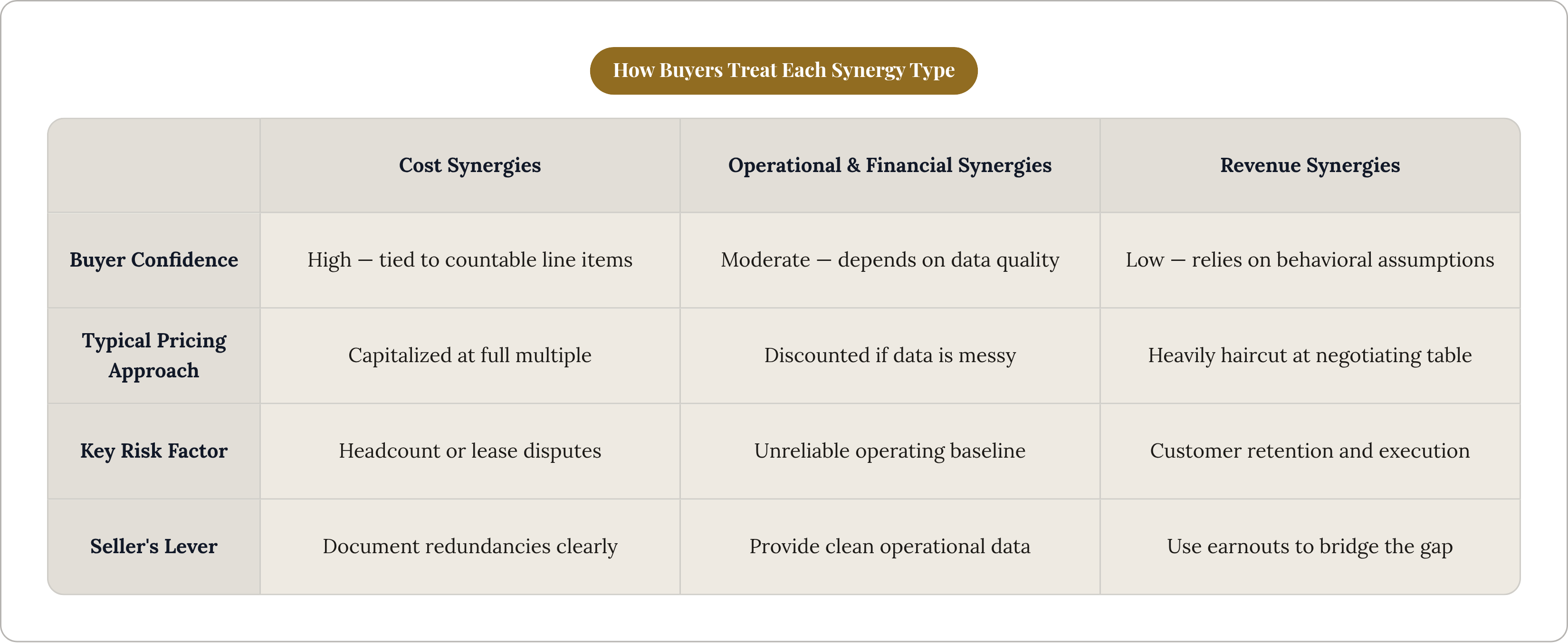
Buyers don't treat all synergies the same. Knowing the hierarchy tells you where to spend your energy during a sale, and where you're wasting it.
Cost synergies sit at the top of the confidence ladder. They tie to line items you can count: redundant headcount, duplicate leases, overlapping ERP systems, procurement volume that unlocks better vendor pricing. A corporate development analyst builds a spreadsheet around these with real precision, because the inputs already sit somewhere in an org chart or a lease file. That confidence flows straight into price. Waste Management's acquisition of Stericycle makes the point well: the company announced a large annualized cost synergy target to be hit by 2027, and once you capitalize that number at a standard EBITDA multiple, you're looking at a substantial slice of value stacked on top of the standalone business case. That's a buyer telling the market, in writing, how much of the price is synergy and how much is guesswork.
Revenue synergies work the opposite way. They depend on customers behaving the way the model assumes, sales teams executing cross-sell motions competently, retention holding up through an integration that inevitably distracts everyone. All of that takes time, and time is where optimistic projections tend to die. Buyers know this, which is why they lowball revenue synergies at the negotiating table, not because they doubt the upside is real, but because saying the number out loud means paying for it. When revenue synergies do land, though, they can reshape a deal's entire return profile. FIS raised its post-close revenue synergy target for Worldpay after the deal had already closed. Chart Industries beat its original top-line guidance on the Howden acquisition by more than half. And Facebook's purchase of Instagram is still the reference case for the whole category: a price that looked absurd against Instagram's standalone revenue made total sense once you accounted for what shared user data and integrated ad targeting would do across both platforms.
Then there's the grey zone in between: operational and financial synergies. Route density gains for a logistics business, better capacity utilization at a plant, working capital efficiencies from combined purchasing. Measurable in theory, but only if the seller's operating data is clean enough for a buyer to trust the baseline. Sloppy data pushes this whole category toward revenue-synergy treatment, discounted hard, even when the underlying logic holds up fine.
Why does this taxonomy matter to you as a seller? It tells you exactly where to aim your information package. Show up to a cost-consolidation buyer with a beautifully modeled cross-sell story and you've wasted everyone's afternoon. Match the pitch to the buyer's actual thesis, not the one you wish they had.
The haircut buyers apply before synergies reach the bid price
Buyers don't take synergy projections at face value. They run a probability-weighted discount on every number before it ever touches the bid.
Post-merger research from BCG, McKinsey, and Bain, looking across recent cohorts of completed deals, shows a consistent pattern: cost synergies realize at meaningfully higher rates than revenue synergies, which tend to land at a fraction of the original target. A buyer announcing an ambitious revenue synergy figure at signing may be underwriting only a fraction of it internally. The public narrative and the actual valuation math are two separate documents, and they don't always agree with each other.
That gap is something a seller can use. If you know roughly how much of a stated synergy case a buyer typically discounts before it reaches their offer, you can tell whether a given bid already bakes in generous assumptions or sits anchored conservatively, with room left to push. This is where a good advisor earns the fee: reading a bid not for the headline number, but for what it implies about the buyer's actual confidence level underneath.
Integration risk stacks on top of the realization haircut. A target with messy financials, no bench strength below the owner, or a culture that looks likely to clash with the acquirer gets hit with an additional discount, independent of how good the synergy story looks on paper. This part, at least, is controllable. Clean, well-documented operations don't just speed up diligence. They shrink the risk discount before the buyer even gets to the synergy conversation, and that flows straight through to a higher number at the end.
How synergy value is split between buyer and seller — and what actually moves the needle
Nothing about the split is fixed going in. It gets negotiated, sometimes explicitly through deal terms and sometimes implicitly through how the process runs, and the outcome varies more than most sellers expect.
An analysis by MARKABLES covering 605 public takeovers between 2010 and 2022 found buyers retain somewhere between 56% and 58% of total synergy value, meaning sellers as a group capture roughly the rest. The historical baseline used to run closer to two-thirds for buyers, one-third for sellers, so the gap has narrowed toward something closer to even in recent years. The driving force is competition for quality targets: more buyers chasing the same assets leaves less room for any single acquirer to keep the lion's share.
Buyers keep the larger portion regardless, because they carry the execution risk. The seller collects consideration at close and walks away from any responsibility for whether integration actually works. The buyer inherits that uncertainty, and what they keep is, in part, compensation for carrying it.
So what actually shifts a seller's share up or down? Negotiating strength matters, though it's more fragile than people assume. A seller who signals urgency, whether through language, timeline pressure, or visible eagerness, weakens their position before a single bid even lands. Buyer competition is the biggest lever in the whole framework. When multiple strategics chase the same target, the winning price gets pushed toward the value implied by the second-highest synergy case, not the highest. Bidder uniqueness plays a role too: research published in 2024 finds that more unique bidders earn higher acquisition returns and receive a larger share of synergies. Flip that from the seller's chair and it means a buyer convinced no rival can replicate its specific synergies has less reason to bid aggressively, since it isn't worried about losing the asset to anyone.
Industry and deal structure move the needle as well, though not in the direction most people expect. The seller's share varies meaningfully by sector and by how a deal gets structured, but it doesn't track with company size or the seller's own profitability. Here's the one that catches people off guard: overall M&A cycle intensity doesn't systematically change the seller's share. A hot market doesn't automatically mean sellers do better on synergy capture, and a cold one doesn't mean they do worse. What matters is competition around your specific asset, not the macro backdrop everyone reads about in the news.
Running a competitive process to shift synergy value toward the seller
If buyer competition is the biggest lever in the whole framework, running an actual competitive process is what pulls it.
A structured auction forces every bidder to price against each other's synergy assumptions instead of against your reservation price. That's a different negotiation entirely. One-on-one, the buyer is figuring out the least it needs to offer to get a yes. With multiple strategics competing, each one is trying to guess what the others might bid, and the final number converges toward the value implied by the second-highest synergy case in the room. The seller captures that spread between bidders, instead of leaving it sitting inside the winning bidder's model, unclaimed.
Disney's acquisition of Fox's entertainment assets is the large-scale version of this. Comcast's counterbid forced Disney to raise its offer substantially, a textbook case of competitive tension translating directly into value moving toward the seller. You don't even need an actual rival bid to show up for the effect to work, either. Research on competitive deal dynamics supports the view that the credible presence of potential competition raises offers before any competing bid formally materializes. The threat alone does the work.
A well-run process forces something else too: bidders showing their work. Ask each buyer to explain not just their headline number but their underlying synergy assumptions, integration timeline, and diligence conditions, and your advisors get a real window into that buyer's internal logic. That's ammunition. If one buyer's synergy case looks conservative next to what a competing bidder is assuming, that's a specific, defensible point to push, rather than a vague appeal to come up on price.
None of this comes free, though. Sharing detailed operational and financial data with multiple bidders to build synergy conviction creates real exposure, especially when some of those bidders also compete with you in the market. There's a genuine tension between giving buyers enough to bid confidently and protecting product roadmaps, customer lists, or R&D details from people who might not win the deal at all. Sellers and their advisors have to manage that tradeoff on purpose, not by accident.
The research is consistent on one more point: the more eager a seller looks, the lower the premium they end up getting. Holding a credible walk-away position, and not broadcasting a hard deadline to the room, is part of what keeps the tension alive all the way through.
Preparing an information package that makes synergy capture easier for buyers to justify
A buyer's synergy model is only as good as the data underneath it. Any fuzziness in your financials shows up as a bigger discount on the synergy side of their math, not just the base valuation.
The earnings base is where credibility gets won or lost. That means a clean bridge from reported to normalized EBITDA, with add-backs a buyer's diligence team can actually defend to their own investment committee, not a list of adjustments that raises more questions than it answers. It means monthly, customer-level revenue detail granular enough for a buyer to stress-test their own revenue synergy assumptions against your actual sales patterns. And it means a clear history of working capital swings and capex, because both feed directly into how a buyer models cash conversion and the real cost of integration.
Beyond the financial statements, the operational data that matters depends entirely on which synergy category a given buyer is chasing. A logistics acquirer wants route-level data to check density assumptions. A revenue-synergy buyer wants customer concentration figures and retention history. A cost-synergy buyer wants procurement spend broken down by category and vendor. Generic packages skip this level of detail, and generic packages get generic, conservative bids in return.
There's a research step here too, one a lot of sellers skip entirely. Look at what your prospective buyers have said publicly about their own growth priorities: geographic expansion, filling a product gap, acquiring a capability they don't have in-house yet. Frame your business specifically against those stated objectives instead of running the same pitch deck past everyone. A buyer's internal team that builds conviction on synergies quickly moves faster and bids with more confidence, because they've spent less time arguing with their own risk committee. Sellers who shorten that internal conviction cycle are, in effect, shrinking the risk discount before the buyer even applies it.
It's worth remembering who's actually reading this material, too. Strategic synergy valuations get built by cross-functional teams that often include senior leadership, not one deal analyst working alone at a desk. Sellers who can speak to synergy specifics with real credibility, not just enthusiasm, are the ones who reach the people actually shaping the number.
Protecting negotiating leverage through the LOI and exclusivity stage
Here's a hard truth about deal dynamics: competitive tension starts eroding the moment you sign exclusivity with one buyer. Every other buyer in the process quietly stands down, and your alternatives, real as they might have been a week earlier, stop being credible overnight.
The practical discipline is straightforward, even if it's hard to hold to. Negotiate the strongest possible letter of intent, on price, on structure, on the conditions that matter most to you, while multiple buyers are still actively engaged. Once exclusivity is granted, your ability to push back on unfavorable terms drops sharply, because the buyer knows you no longer have a credible fallback sitting in the room.
Competition doesn't just push up the headline price. It improves everything around that price. A buyer who knows a credible rival is still in play might reduce earnout contingencies, offer better working capital mechanics, put more cash at close instead of deferred consideration, or strengthen certainty-of-close language. None of that shows up once a buyer senses it's the only game left in town.
This is where urgency signals do real damage. A seller who communicates a hard deadline, or who telegraphs willingness to take the first reasonable offer, removes the buyer's incentive to stretch on any of these terms. Why improve anything if you believe the seller will say yes regardless?
The LOI isn't the finish line either, even though it feels that way after months of work. The stretch between signing and actually closing, when the buyer runs confirmatory diligence, is where price re-trades happen most often. Having protected a credible fallback earlier in the process makes it a lot easier to push back if a buyer tries to chip away at the number during that final stretch.
Using earnouts to bridge the gap on synergies buyers won't fully pay for at close
So what happens when a seller genuinely believes in a synergy case, revenue upside especially, that a buyer just won't underwrite at close? Earnouts exist for exactly this gap.
An earnout puts contingent, additional consideration on the table tied to post-close performance. It lets a buyer skip paying upfront for outcomes that haven't happened yet, while giving the seller a real shot at capturing value if those outcomes do show up. This structure comes up most often when the seller's synergy story rests on revenue growth or operational milestones the buyer has heavily discounted at the table, the same category covered earlier that buyers realize at lower rates and price conservatively as a result.
Earnouts have become standard across a meaningful share of middle-market transactions precisely because they let two sides bridge a valuation gap without either one fully capitulating on its own numbers.
Metric selection is where the real negotiation lives, and it determines who benefits when the earnout period actually ends. Revenue-based earnouts tend to favor sellers, since revenue is harder for a buyer to manipulate after close through cost allocation or accounting choices buried inside a larger combined entity. EBITDA-based earnouts hand the buyer more levers, because integration decisions, overhead allocation, and cost loading all flow through EBITDA and sit largely under the buyer's control post-close. Data from SRS Acquiom covering 2024 shows revenue was the most common earnout metric outside of life sciences deals, which tells you something about where seller-friendly structuring has actually landed in practice, not just where it lives in theory.
Earnout size relative to total deal value swings widely by sector. Life sciences deals lean hard on post-close milestones, since so much value depends on regulatory and clinical outcomes that haven't happened yet at signing. In most other industries, earnouts work more as a supplementary bridge than the core of consideration.
Treat the earnout negotiation as a direct continuation of the synergy conversation running through the whole process. What performance threshold triggers payment, over what time period, under whose day-to-day operational control, with what reporting obligations attached: these are the four things that determine whether an earnout actually pays out in three years or quietly expires, unmet and forgotten.
What sellers in the Canadian lower middle market need to apply this framework
Everything above applies at any deal size. The barriers to actually executing it look very different, though, for a founder running a small-revenue business than for a public company with a corporate development team and outside advisors already on retainer.
Most founder-led businesses have never run a structured sale process before, and that inexperience shows up in a predictable place: a bilateral conversation with a single interested buyer, which is, by definition, the lowest-leverage position in this entire framework. No competing bid to push price toward a second-highest synergy case, because there's no second bid to begin with.
The earnings base problem hits harder here too. Normalizing EBITDA for a founder-led company often means unwinding years of owner compensation decisions, related-party transactions, and one-off expenses nobody tracked with a future buyer in mind. A financial package that's never faced outside scrutiny gets a bigger haircut, no matter how strong the underlying business actually is.
Then there's the buyer identification problem, probably the hardest one to solve without real infrastructure behind you. A genuinely competitive process means reaching the right strategic acquirers, not just the handful of obvious names that pop up first in an industry search. The buyer with the strongest synergy case for your specific business is often not the most visible player in your sector; it might be a company one layer removed, in an adjacent vertical, whose fit only becomes obvious once someone maps the overlap carefully.
Fraca works this exact gap. It uses AI-driven buyer matching to surface acquirers whose strategic logic actually lines up with a given seller's profile, instead of relying on a manually assembled list of usual suspects. Pair that reach with investment banking advisory work, normalized financials, a synergy-aware information package tailored to each buyer type, and disciplined process management through LOI and beyond, and founders in the $500,000 to $50 million revenue range start getting access to the same structural leverage large public sellers have taken for granted for decades.
Timing matters here too, and it's worth being straight about it. Sellers three or more years out from a transaction have real runway to build the operational documentation, the management bench below themselves, and the financial clarity that shrinks the integration-risk haircut before a buyer ever sees the numbers. Sellers closer to an actual transition don't have that runway, which makes getting the right process and advisory support in place quickly less of a nice-to-have and more of a determinant of what they actually walk away with at the end.