Earnout Structures in Lower Middle Market M&A Deals
Why earnouts matter for founders selling small businesses for the first time.

An earnout is the part of a business sale where some of the purchase price doesn't show up at closing. Instead, it arrives later, contingent on the business hitting targets the buyer and seller agreed to before the ink dried. In lower middle market M&A, this structure is not a rare contingency clause buried on page forty of a purchase agreement; it's a default feature of a huge share of deals, and understanding how it works separates founders who negotiate from strength from founders who find out, eighteen months post-closing, exactly how much leverage they gave away.
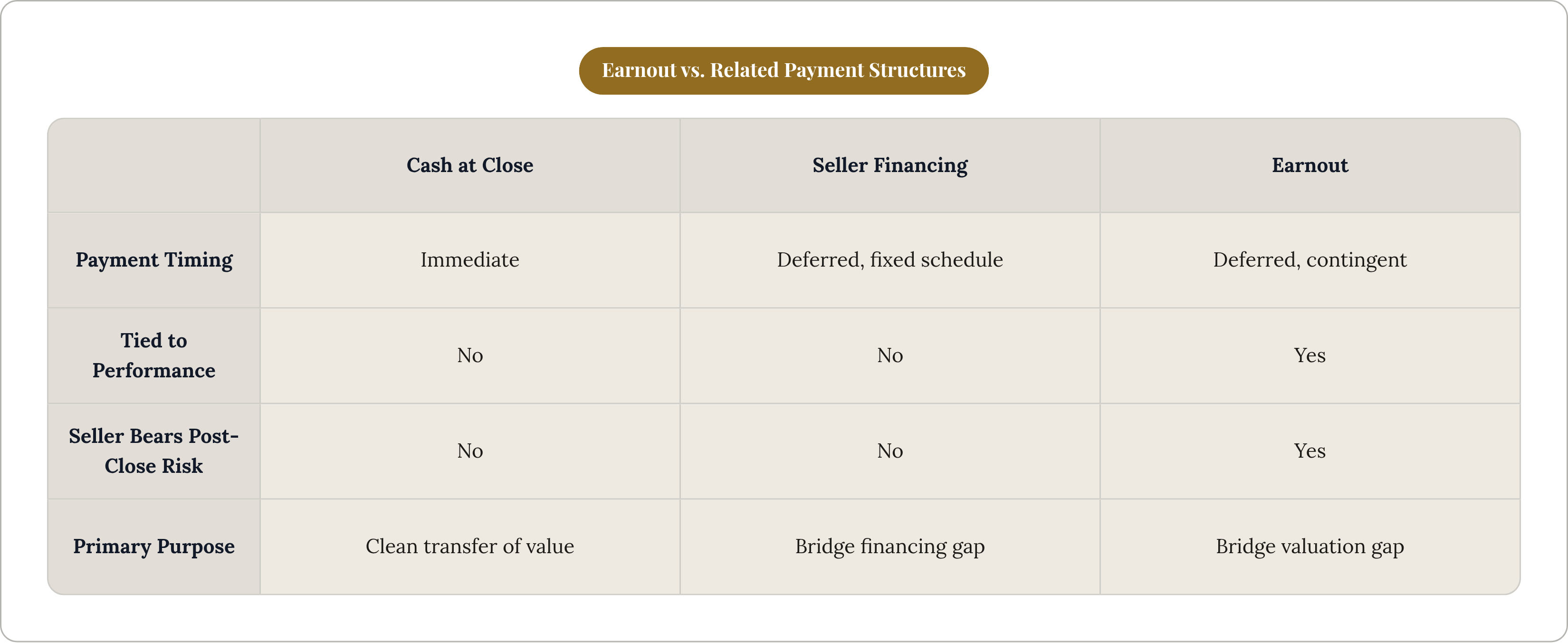
Before going further, it's worth separating an earnout from other deferred payment tools it gets lumped in with. Seller financing, where the buyer pays part of the price over time regardless of how the business performs, is not an earnout: it's a loan. Cash at close carries no contingency at all. An earnout is different from both because the payment is tied directly to what happens to the business after the seller no longer controls it. That's the whole tension the structure is trying to solve. The seller believes the business deserves credit for growth that's already in motion; the buyer isn't willing to pay full price today for results that haven't happened yet.
There's also a distinction inside "earnout" that most founders don't learn until they're already negotiating one. A risk-mitigation earnout bridges a genuine disagreement on value, the buyer and seller can't agree on a number, so they defer part of it to let the business prove itself. An incentive earnout is a completely different animal: the parties agree on price, but the seller is staying on to run the business, and the earnout exists to keep their incentives aligned with the buyer's upside. One is a pricing tool. The other is a compensation tool disguised as a pricing tool. Confusing the two during negotiation is how sellers end up accepting terms designed for a problem they don't actually have.
How often earnouts appear in lower middle market deals — and why the rate is higher than in larger transactions
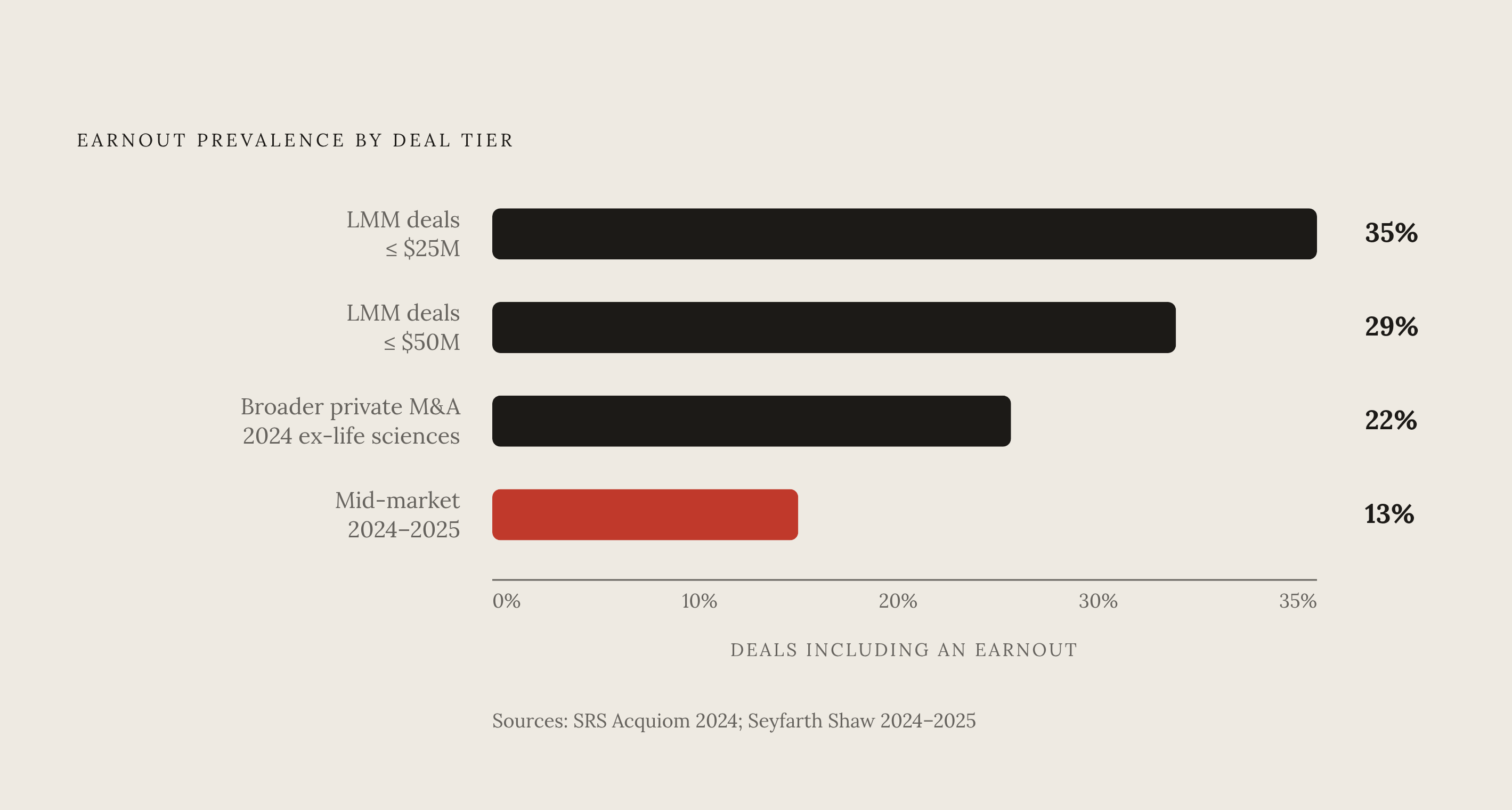
Start with the anchor number. Per the 2026 SRS Acquiom Lower Middle-Market M&A Deals Report, which draws on more than 4,400 private-target transactions, 35% of the smallest LMM deals, those valued up to $25 million, included an earnout. Across all LMM deals up to $50 million, the figure was 29%.
Now compare that to the broader private M&A market. SRS Acquiom's 2025 M&A Deal Terms Study found earnouts in 22% of all M&A deals in 2024, excluding life sciences, where earnouts are almost a separate universe of their own. Seyfarth Shaw's 2025 Middle Market M&A SurveyBook, covering more than 150 mid-market agreements from 2024 and the first half of 2025, put the figure even lower: 13% of deals. That means an LMM seller is running into an earnout roughly three times as often as a seller one or two tiers up the market.
Why does size correlate so strongly with earnout frequency? Information asymmetry is the biggest driver. A buyer acquiring a large business usually has years of audited financials, a seasoned management bench, and enough operating history to underwrite the deal with confidence. A buyer acquiring a small business often has none of that. Per the IBBA's Q4 2024 Market Pulse, roughly 90% of LMM sellers are selling a business for the first time, and the vast majority don't have a written exit plan going in. Buyers respond to that uncertainty the only way they can: by pushing risk back onto the seller through structure.
Credit constraints play a role too. Traditional bank financing gets harder to secure the smaller the deal, so earnouts sit alongside seller notes and SBA-backed loans as one of the tools filling the gap between what a buyer can borrow and what the deal actually costs. And founder-dependent revenue, the kind of business where half the client relationships live in one person's head, is far more common at this scale. An earnout keeps that person financially tied to the outcome for a while longer, which is exactly what a buyer wants when the thing they're buying might walk out the door with its founder.
Worth noting, without leaning on it too hard: earnout usage across the broader market peaked around 2023 and cooled off some in 2024. The LMM segment didn't cool nearly as much. The valuation gap that earnouts exist to bridge doesn't disappear just because deal volume shifts; it's structural to this part of the market, not a byproduct of any particular year's financing conditions. And certain sectors run hotter than others here. Healthcare services, business services, and technology-enabled services all see earnout rates well above the LMM average, because in each of those categories, forward growth is genuinely hard for an outside buyer to underwrite with confidence. A founder in one of those sectors should expect an earnout proposal, not treat it as a surprise to be negotiated away entirely.
How much of a deal's value ends up in the earnout — and for how long
Frequency is one question. Size is the more consequential one. Per SRS Acquiom's 2025 data, the median earnout across all deal types equaled 31% of the total closing payment. That's not a footnote; that's nearly a third of a deal's value sitting in a bucket the seller hasn't actually earned yet.
The trend line makes the point sharper. Median earnout potential, as a percentage of the closing payment, moved from 32% in 2023 to 43% across the first three quarters of 2024. Fewer deals overall carried earnouts during that stretch, but the ones that did carried bigger ones. That's an important distinction: it's not that earnouts became more popular, it's that where they showed up, they showed up heavier.
Seyfarth's 2025 data adds a detail that deserves attention on its own. Among the 13% of mid-market deals with earnouts, nearly half structured the earnout at 50% or more of the total purchase price. Half. That means a meaningful slice of sellers in that dataset were staring at deals where losing the earnout meant losing half the headline number they'd shaken hands on.
LMM deals track this same pattern, often more so. Smaller deals tend to carry proportionally larger earnout components relative to total consideration, because the less certain a buyer is about what they're buying, the more of the price they push into the "prove it" column. And the clock on proving it isn't long. The median earnout period, per SRS Acquiom's 2024 data, is 24 months, with a clear trend toward shorter windows and very few deals stretching past four years.
Put the two numbers together and the math gets concrete fast. If a third of the deal's value sits in the earnout, and the seller has roughly two years to hit the targets, under a new owner with new priorities and, quite possibly, new management sitting between the founder and the decisions that used to be theirs to make. That combination, size and duration together, is what actually defines an earnout's risk profile. The metric matters too, which is the next section, but size and duration set the stakes before the metric ever enters the conversation.
How the performance metric is chosen and why it shapes everything downstream
In 2024, 62% of earnouts used revenue as the primary metric, per SRS Acquiom's 2025 data, with a smaller share built around EBITDA. And the structures themselves are getting more layered: 68% of 2024 earnouts blended multiple metrics in some way, and 42% used two or more metrics outright, up from 28% back in 2019.
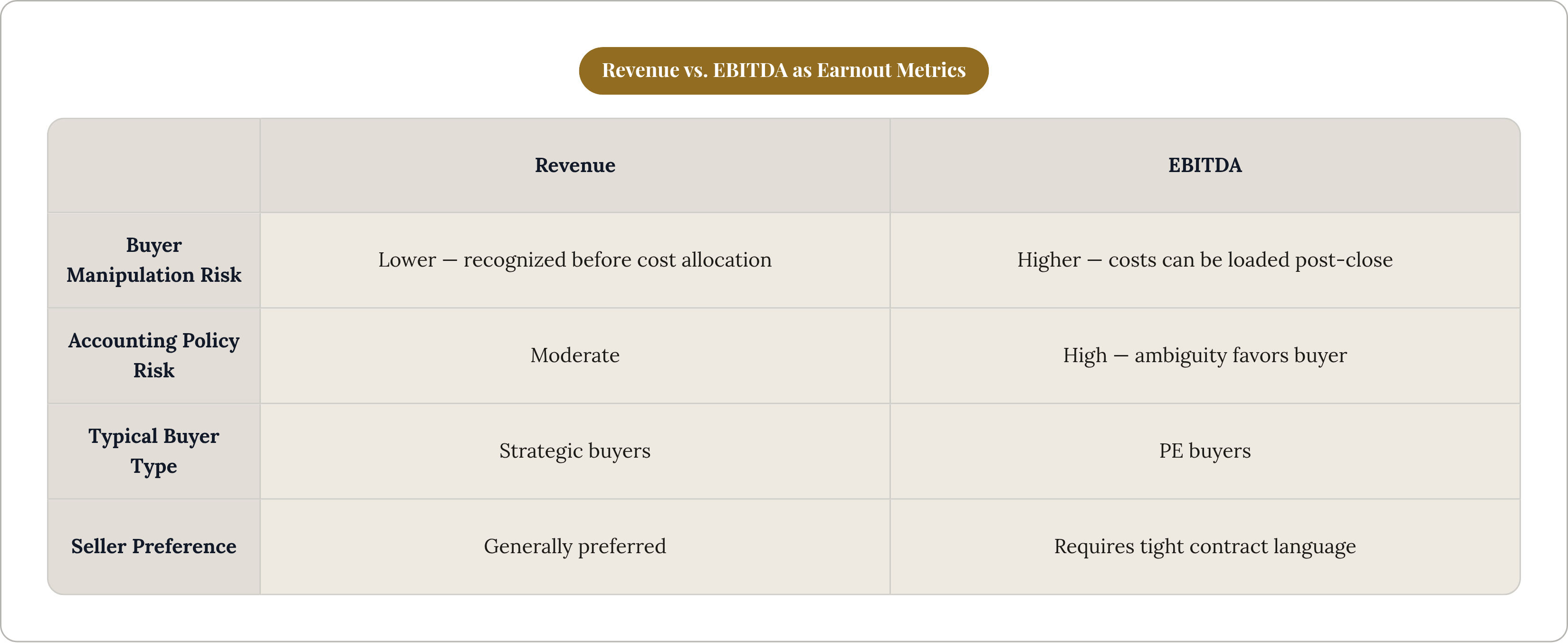
Why has revenue become the default? Because it's harder for a buyer to manipulate. Revenue gets recognized before costs get allocated, so a buyer who wants to depress the number after closing has fewer levers to pull. Sellers, understandably, gravitate toward it for exactly this reason.
EBITDA is a different story, and sellers should treat it with more suspicion. Once the deal closes, the buyer controls cost allocation. Management fees, IT overhead, shared services, integration costs, all of it can get charged against the acquired entity in ways that push EBITDA below the earnout threshold without anyone doing anything that looks like bad faith on paper. This is worth sitting with for a second: it's not a risk that the buyer might cheat. It's a structural feature of how EBITDA gets calculated once a business stops standing on its own books. That's why, when EBITDA is the metric, the accounting policy language in the agreement stops being boilerplate and becomes the single most important paragraph in the contract, a point picked up again in the next section.
Buyer type shapes this too. Per Bain & Company's 2025 Global Private Equity Report, PE buyers underwrite deals on EBITDA, so their earnouts skew toward EBITDA metrics almost by default; it's the language they think in. Strategic buyers lean more toward revenue or product milestones and tend to run longer earnout periods, since they're often integrating the business into something bigger rather than optimizing it for a future resale.
Sector shapes the menu of what's even negotiable. Milestone-based earnouts, tied to things like regulatory approval or a product launch, show up more in healthcare and SaaS, where a single event can swing the business's value overnight. Financial metrics dominate in services and industrials, where growth is more incremental. None of this is administrative detail a lawyer sorts out later. The metric is the mechanism. Get it wrong and the rest of the negotiation is decorating a structure that was never going to pay out.
The structural mechanics that determine whether an earnout is fair or a trap
If the metric is the mechanism, the payout curve is the engine room. The single most consequential design choice in any earnout is whether it's a cliff or a graduated structure. A cliff earnout pays the seller nothing if performance misses the threshold, even by a rounding error. Miss revenue by 2% and the entire contingent payment can evaporate. A graduated, or tiered, structure pays out partial credit across bands of performance, so a near-miss still means something. This single distinction is worth fighting harder for than almost anything else on the term sheet.
Accounting language is the second trap, and it's a quieter one. "GAAP" sounds precise; it isn't, not precisely enough for an earnout. GAAP tolerates a range of reasonable estimates, and "consistent with past practice" is a moving target once systems, personnel, and scale change after the deal closes, which they always do. The agreement needs to say, specifically, which accounting basis governs: audited GAAP financials, management accounts, or a purpose-built earnout schedule, and it needs to say how conflicts between those get resolved. Ambiguity here isn't neutral. The buyer controls the books after closing, so any gap in the language resolves in the buyer's favor by default, not by design.
Then there are operating covenants: what the buyer actually promises to do, or not do, while the earnout clock runs. A "no detrimental actions" covenant, where the buyer agrees not to take actions whose primary purpose is blocking the earnout, showed up in 90% of earnouts alongside reporting requirements, per SRS Acquiom's 2024 data. Enforcement is another matter entirely, and that gap between "included" and "enforceable" is where a lot of sellers get burned. Roughly a third of LMM buyers agree to a commercially reasonable efforts standard, operating the business in good faith consistent with industry norms; PE buyers are less likely to accept even that. Per the 2025 ABA Study, very few buyers will commit to running the business consistent with past practice, and fewer still will commit to actively maximizing the earnout. The covenant sellers assume they're getting is usually stronger than the covenant actually on the page.
Information rights round this out. The seller needs contractual access to the specific financials and operational data the earnout calculation depends on, otherwise there's no way to check the buyer's math. In LMM deals, sellers typically have less leverage to demand comprehensive access than they would in a larger transaction, which makes it even more important to push for what's available. Caps, floors, and collars deserve a place at the table too: a floor protects the seller's downside, and a collar can adjust the metric if the buyer's own conduct is what depressed it.
Add it up and the conclusion is uncomfortable but necessary: a poorly drafted earnout can be structurally uncollectable even when the underlying business performs well. The gap between a fair earnout and a trap doesn't live in the headline percentage. It lives in these mechanics.
What earnouts actually pay out — and why the gap between headline and reality is so wide
Here's the number that should anchor every earnout conversation a seller has. Per SRS Acquiom's 2024 M&A Claims Insights Report, earnouts pay out roughly 21 cents on the dollar across all deals with earnouts, excluding life sciences. Among the subset of earnouts that pay out anything at all, sellers collect about half the maximum possible dollars.
Sit with that for a moment. Twenty-one cents on the dollar means the majority of contingent value promised at closing simply never arrives. And this isn't primarily a story about businesses failing to perform; it's a story about the structural mechanics from the previous section working exactly as buyers designed them to. Cliff payouts, EBITDA metrics loaded with allocated costs, weak covenants, thin information rights, these aren't edge cases. They're common enough to drag the average payout down to roughly a fifth of what was promised.
The dispute pipeline backs this up. Per Freshfields' analysis of earnout litigation trends, the number of U.S. lawsuits involving earnouts nearly doubled between early 2022 and early 2023. That's not a market where disputes are the rare exception; that's a market where disagreement over earnout payouts has become common enough to show up clearly in litigation data.
Why does this concentrate so heavily in the lower middle market? First-time sellers, and remember, that's roughly 90% of this segment, are less likely to have negotiated the protective covenants that make an earnout enforceable in the first place. They also have fewer resources to pursue a dispute once one arises; litigation is expensive, and a founder who just took a big chunk of their net worth in the form of a contingent payment often can't afford to spend years fighting for it. And the buyer-favorable market conditions of 2022 and 2023 produced a wave of agreements with weaker seller protections, many of which are only now resolving as their earnout periods close out.
None of this is an argument that earnouts are bad deals to be avoided at all costs. Sometimes an earnout is the only bridge that gets a deal closed at all, and refusing one outright can mean refusing the deal. But the 21-cent figure is a very good argument for how a seller should think about the number on the page. Treat the earnout as a best-case bonus, not as part of the floor price you're counting on to make the sale work financially. As a rule of thumb worth repeating to yourself during negotiation: every dollar you move from the earnout column into the closing payment is a dollar you don't have to earn twice, under conditions you no longer control.
When a seller has genuine leverage to reduce or resist the earnout
None of the mechanics above are fixed. They're negotiated, and negotiating leverage comes from a few identifiable places, not from wishing the buyer would be more generous.
Competition is the strongest lever available. When more than one qualified buyer wants the business, sellers can push for more cash at closing and a smaller contingent tail, because a buyer worried about losing the deal to a competitor has less room to insist on protective structure. This is worth internalizing: earnout size is not just a function of the business's risk profile, it's a function of how many people are bidding for it.
Certain business characteristics also reduce the pressure a buyer feels to demand an earnout in the first place. Recurring, contracted revenue lowers a buyer's uncertainty about what happens after closing. Clean financial statements, ideally audited or at least reviewed, close the information gap that drives so much buyer caution in this segment. Growth that clearly doesn't depend on the founder personally, documented management depth, a written exit plan, all of these signal to a buyer that the business will survive the transition without the seller's continued involvement, which directly undercuts the case for a large earnout.
Seller financing is worth considering as an alternative, not just a fallback. Per the IBBA's Q4 2025 data, at the boundary between Main Street and the lower end of the LMM segment, seller notes remain more common than earnouts. A fixed note, repaid regardless of performance, can sometimes serve a seller better than a contingent earnout tied to results they no longer control. It's a different risk trade entirely, and it's worth putting on the table as an option rather than assuming earnout or nothing.
Timing matters more than most founders expect. A seller who starts the process early, before the business hits some obvious inflection point a buyer could later claim credit for, negotiates from a stronger position. A seller who waits until they have to sell, health issues, burnout, partner disputes, gives the buyer exactly the leverage needed to push more of the price into contingent territory. And working with an advisor capable of running a real process, one with multiple competing bidders rather than a single buyer at the table, changes the entire dynamic. A first-time founder negotiating alone against an experienced buyer is fighting an information asymmetry that compounds every risk this piece has covered. A structured process with real competition is often the single most effective counterweight available.
How to evaluate an earnout proposal once it's on the table
Once a proposal actually lands on the table, evaluate it on four dimensions, roughly in this order.
Size first: how much of total consideration is contingent. A small earnout riding on top of a strong close payment is a fundamentally different risk than a large earnout propping up a weak one. Metric second: is it something the seller can actually influence, and is it hard for the buyer to manipulate after closing. Revenue versus EBITDA is the starting question, not the whole analysis, but it's where the analysis should begin. Structure third: graduated payout curve or a cliff, a floor or no floor, and accounting definitions specific enough to actually be enforced rather than argued about later. Covenants and information rights fourth: what has the buyer actually agreed to do during the earnout period, in writing, and what real access does the seller have to check the numbers as they come in.
A handful of red flags deserve to end a negotiation, or at least stall it until fixed. An EBITDA metric paired with shared cost allocations and no specific accounting policy is one. A binary cliff payout with no floor and no graduated bands is another. The absence of a "no detrimental actions" covenant, or one with no real enforcement mechanism attached, is a third. And an earnout period that runs longer than the seller actually plans to stay involved in the business is a fourth, because at that point the seller isn't managing a risk, they're managing someone else's business on faith.
None of this is a reason to walk away from every earnout on principle. The frequency data at the start of this piece makes clear that in the lower middle market, an earnout is often simply the price of getting a deal done at all. But the 21-cent payout figure is the fact that should sit in the back of every founder's mind while the term sheet gets drafted: an earnout is a bonus you might collect, not a number you should be counting on to make the deal work.