Founders Who Sold and Stayed as Operators Post-Close
Founders staying post-close face earnouts, limited control, and metrics they can't fully influence.
Most founders who sell their companies and stay on as operators carry the same mental model into the deal: the business continues, capital arrives behind it, and they remain at the helm with resources they didn't previously have. It is an intuitive assumption. It is frequently wrong.
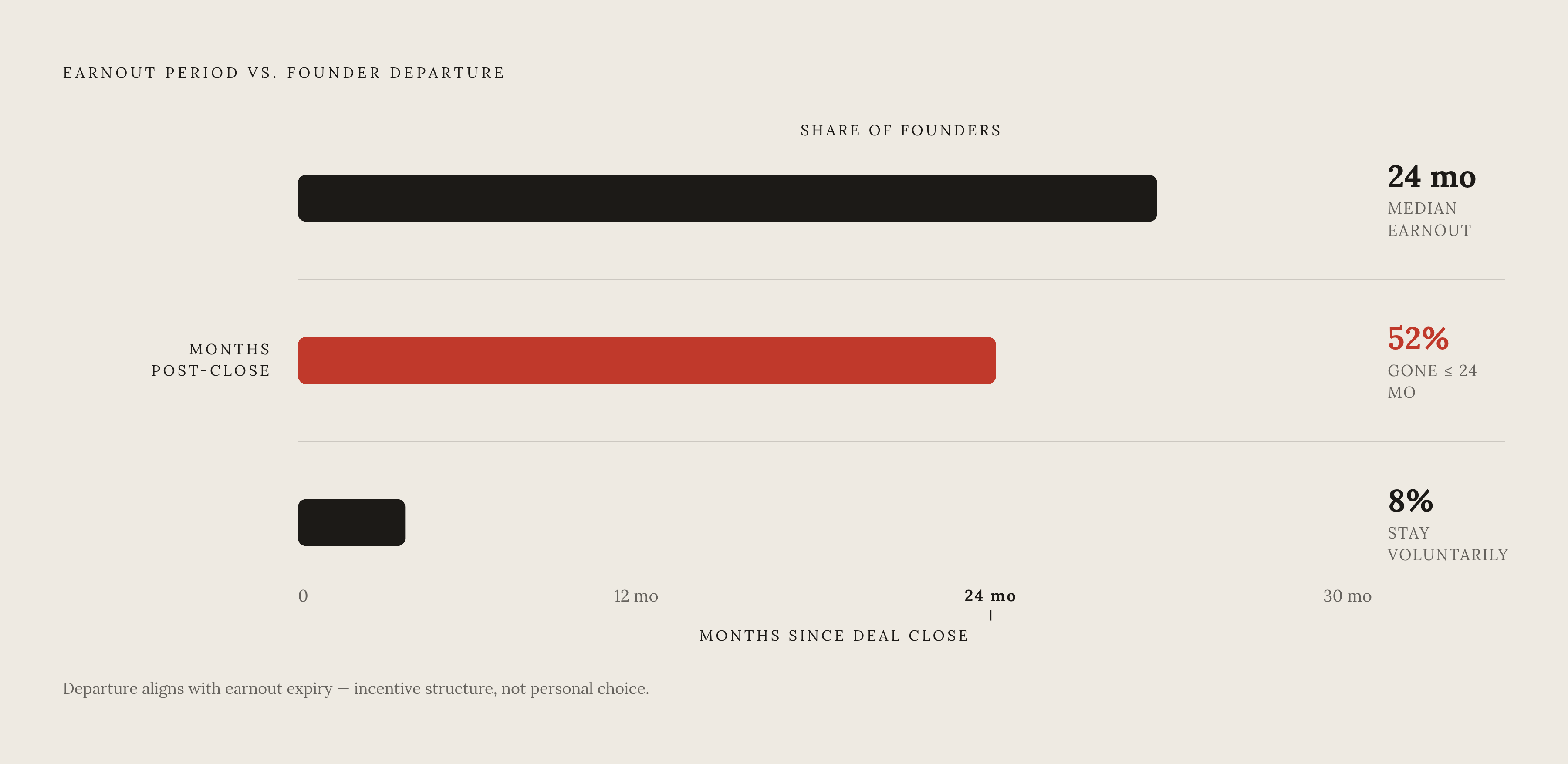
The statistics point toward departure, not continuity. Around 52 percent of founders are gone within two years of deal close, according to founder retention data cited by Qubit Capital. More revealing: only about 8 percent stay on voluntarily without any contractual lock-in. That gap is not incidental. Most post-close tenure is engineered, not chosen.
Earnouts are the primary instrument. Their prevalence varies by deal type: the ABA's 2025 Deal Points Study found earnouts in approximately 18 percent of private-target deals; SRS Acquiom's 2025 Deal Terms Study put the figure closer to 22 percent in non-life-sciences transactions; Seyfarth Shaw's 2025 SurveyBook placed middle-market prevalence at roughly 13 percent. Any founder entering the market should expect to encounter one.
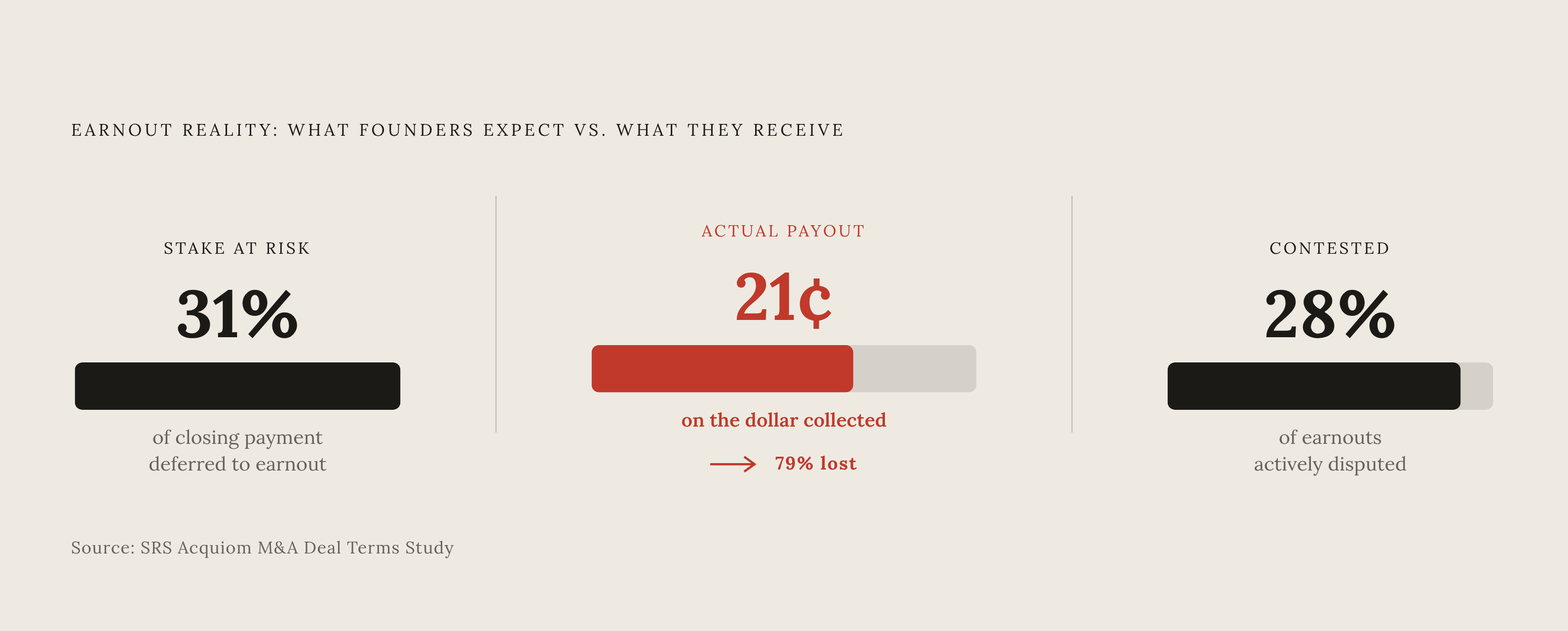
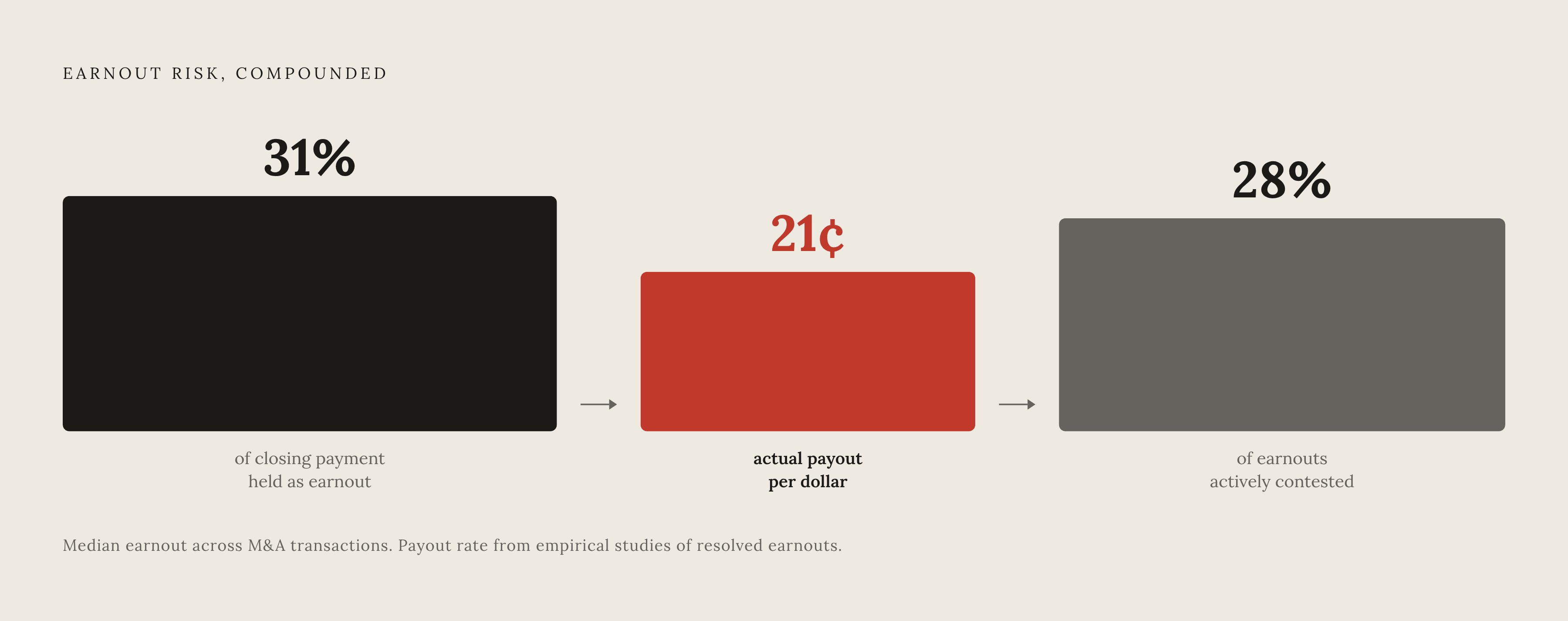
What makes earnouts consequential is not their frequency but their magnitude. In 2024, the median earnout equaled 31 percent of closing payments, per SRS Acquiom. Nearly a third of what a founder expects to collect is contingent on future performance they will not fully control. Hold that figure alongside this one: across all M&A deals, earnouts pay approximately 21 cents on the dollar, and 28 percent are actively contested. The gap between expected and received is not a rounding error. It shapes the entire post-close dynamic.
The median earnout period outside life sciences runs approximately 24 months, which sits directly alongside that 52 percent departure rate within two years. The timelines are connected because the incentives are connected.
Metric selection matters as much as duration. In 2024, 62 percent of earnouts used revenue as the primary measurement; only 22 percent used EBITDA. Revenue targets can sound founder-friendly, since founders tend to believe they know how to grow a top line. But when the acquirer controls pricing strategy, channel partnerships, or marketing budgets, the founder is accountable to outcomes they can influence only partially. EBITDA targets carry a different exposure: the acquirer's cost allocation decisions can compress margins regardless of what the founder does operationally. Neither metric is neutral, and both require the founder to understand, before signing, exactly which inputs they will and will not control. That clarity is rarely volunteered.
Beyond earnouts, a "stick and carrot" retention architecture is common, where 30 to 40 percent of total consideration sits at risk if the founder exits early, and team-linked incentives make departure costly not just financially but socially. Founders who have spent years building a team feel that obligation acutely, often more acutely than they feel the financial pressure. In some deals, that social weight is the more binding constraint. It is also the least legible one in a term sheet.
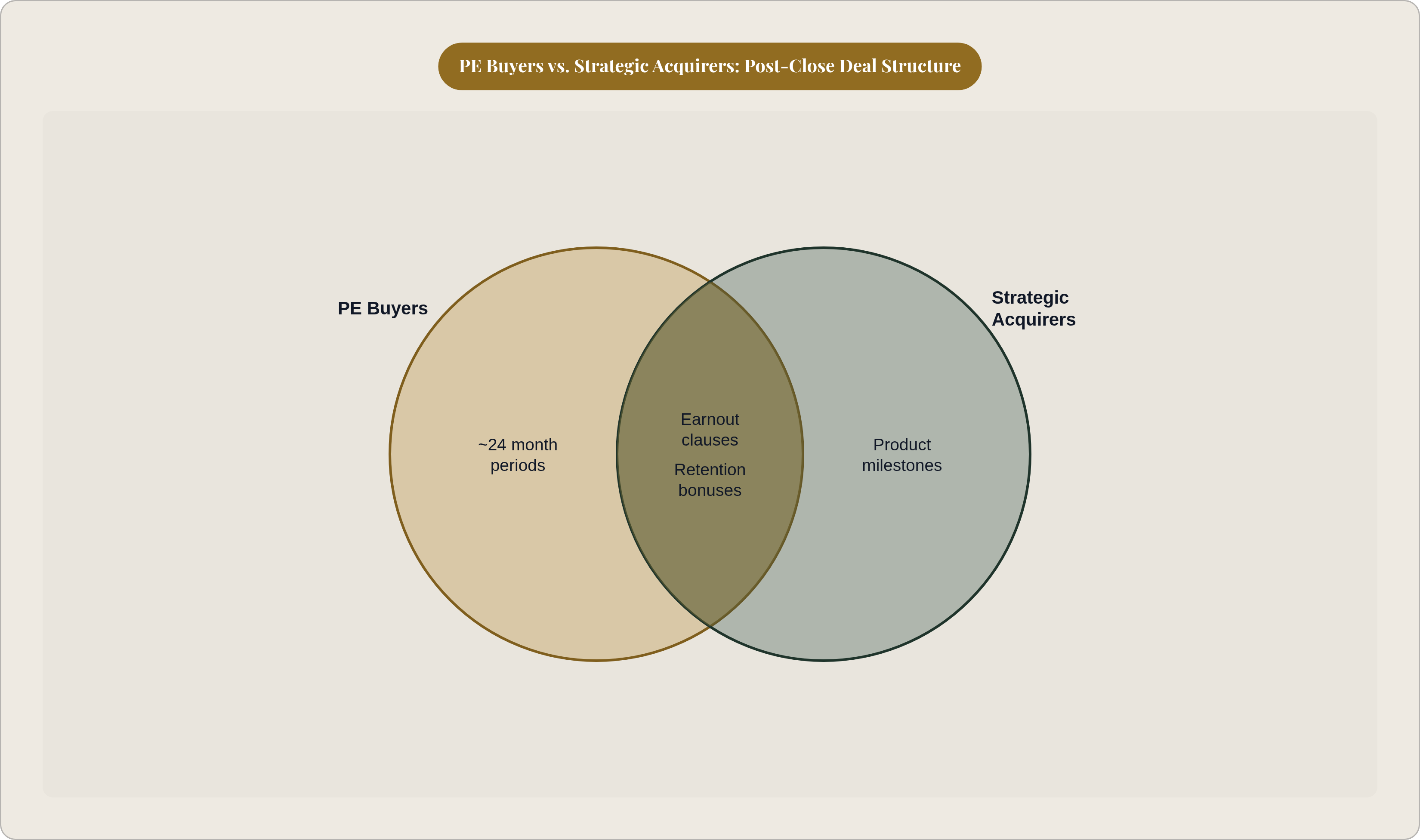
PE buyers and strategic acquirers structure these instruments differently in ways that matter downstream. PE buyers include earnouts in roughly 28 percent of platform acquisitions, weight them toward EBITDA, and work with median periods around 24 months, per Bain's 2025 Global Private Equity Report. Strategics include earnouts in approximately 18 percent of deals, weight them toward revenue and product milestones, and average periods closer to 36 months. Longer strategic earnouts often feel less urgent in year one. By year three, the texture has changed considerably.
What the Typical Post-Close Operating Role Actually Looks Like Day to Day
The title frequently stays the same. The authority does not.
A founder who spent a decade as the final word on every meaningful decision now answers to a board, a corporate parent, or a PE operating team. Approval chains that previously didn't exist now govern capital expenditures, hiring above a certain salary band, vendor contracts, and occasionally product roadmap. Decisions that previously happened in an afternoon now carry institutional latency.
The actual mandate of the post-close role, stripped of the diplomatic language used during negotiations, is generally this: stabilize the business, retain key customers and staff through the integration period, hit the earnout metrics. Building something new is rarely the assignment. For founders whose identity is tied to creation and forward momentum, this is a significant recalibration, and one the diligence process rarely surfaces directly.
The first 90 to 180 days are the most structured. Integration teams arrive, systems migrations begin, HR policies from the parent organization start to apply. There is enough activity to feel like meaningful work, and enough novelty that the narrowing of the role isn't yet obvious. That changes.
Between months four and twelve, many founders are still nominally in the CEO seat but have begun to sense the contraction. The role hasn't been formally redefined. The scope has quietly reduced, and the founder is often the last to receive a memo confirming it.
Tony Hsieh at Zappos represents the outer boundary of what post-close tenure can look like under ideal conditions. He stayed approximately 11 years after Amazon's 2009 acquisition, at his pre-existing salary of $36,000 per year, in an environment where Amazon committed explicitly to independent operation. I'd resist using Zappos as a benchmark, though. It was a convergence of three conditions that rarely appear simultaneously: genuine operational independence maintained over years, a founder whose motivation was mission-driven rather than financial, and an acquirer disciplined enough to honor its own commitments under competitive pressure. That combination is unusual. Its unusualness is the point.
Ryan Cohen's post-acquisition tenure at Chewy, following the $3.35 billion PetSmart transaction, offers a different reference point. He fulfilled his contractual obligations through the transition period and departed. No drama, no prolonged disengagement. The structure served its purpose and concluded. It is probably the more representative template, even if it generates fewer business-school case studies.
Where Post-Close Arrangements Break Down Most Often
Several failure modes appear with enough consistency to be treated as structural, not idiosyncratic.
The first is identity loss. Founders underestimate the psychological disruption of moving from final decision-maker to someone who requires approval. This transition doesn't surface at signing; it surfaces around day 90, when the novelty of the integration has faded and the new chain of command has become routine. By then, the deal is closed and the leverage is gone.
The second is misaligned expectations baked in during diligence. Diligence is optimistic by design. Buyers are acquiring something they believe in; sellers want to believe the business they built will be treated with care. The hard conversation about what governance actually looks like six months after close, who controls the product roadmap, and what "autonomy" means in practice rarely receives the same rigor as the financial terms. Everyone is too motivated to close.
Instagram is the canonical illustration, though it's messier than it usually gets treated. Kevin Systrom and Mike Krieger stayed with Facebook from 2012 through September 2018, six years, during which the platform grew from roughly 30 million registered users to 1 billion monthly active users. Their departure was attributed to reported disagreements about strategic direction under Facebook's ownership. The financial incentives had long since been satisfied; what remained was a directional tension that had accumulated over time. You could read that as a success story, six years and a billion users, or as evidence that even exceptional outcomes don't resolve the underlying friction. Both readings are defensible.
WhatsApp is a parallel case with an explicit promise attached. Jan Koum and Brian Acton were reportedly offered a five-year window before any data integration with Facebook and a commitment to preserved autonomy. Acton left in late 2017; Koum followed in 2018. The pressure to monetize the platform had, by multiple accounts, contradicted the original terms of the relationship. The takeaway is not that Facebook acted in bad faith, exactly. Large companies evolve their priorities, often legitimately. The takeaway is that verbal assurances made during diligence are not governance documents, and the distance between those two things becomes most visible when strategic priorities shift.
A third failure mode is financial disalignment once retention periods end. Earnouts and retention bonuses are finite instruments. When the period closes, the financial architecture holding the arrangement together disappears, often abruptly. The founder who was adequately motivated at month 18 has a fundamentally different calculus at month 25. The 52 percent departure rate within two years aligns almost precisely with the 24-month median earnout period, and I don't think that's coincidental.
A fourth failure mode is particularly pronounced in PE-backed deals. Founders accustomed to moving quickly and tolerating experimental failure encounter the compliance cadence, capital-allocation processes, and board reporting rhythms of institutional ownership. When forecasts are missed, confidence erodes. Departure often follows before the earnout period has run its course, costing the founder money while disrupting the acquirer's integration plan. Forbes Business Council has reported that 71 percent of PE-acquired companies ultimately hired new CEOs under PE ownership. If that figure holds broadly, founder-led continuity is the minority outcome in PE transactions, not the baseline expectation.
The About.me case occupies its own category. Tony Conrad sold to AOL, stayed as CEO, watched the integration deteriorate, and ultimately purchased the business back at a fraction of the original price: not departure, not continuation, but reversal. Most deal structures make that reversal financially impossible. Its rarity is the point, and it belongs in this analysis not as a playbook but as a reminder that the range of outcomes is wider than founders typically model before they sign.
What Makes a Post-Close Operating Arrangement Actually Work
The acquirer's posture is the single largest determinant of whether the arrangement succeeds. It outweighs the founder's attitude, the earnout size, and the quality of the legal documentation, because none of those factors compensate for a buyer who says one thing during diligence and does another after close.
The Zappos model demonstrates what genuine alignment looks like. Operational independence wasn't a verbal commitment; it was structurally maintained over years. Tony Hsieh's motivation was genuinely mission-driven. Amazon exercised restraint with a discipline that most strategic acquirers find difficult to sustain under competitive pressure. Remove any one of those elements and the 11-year tenure collapses. The case is instructive not because it is replicable but because it isolates the variables that actually matter, which is more useful than treating it as an aspirational template.
Neil Mody's post-acquisition tenure at nRelate, following its sale to Ask.com, offers a smaller-scale illustration. He stayed because the acquiring platform genuinely expanded what was operationally possible. The staying was a real choice, not a residual obligation. Voluntary engagement produces different outcomes than contractually compelled presence; that distinction shows up in product quality, team retention, and the texture of the integration itself, even when the financial terms look identical on paper.
For a post-close operating arrangement to hold, several conditions need to be negotiated explicitly before close. Decision rights require written definition: what the founder approves unilaterally, what requires parent-company sign-off. Earnout metrics need to be tied to variables the founder can actually influence. A transition timeline should be agreed in advance. The meaning of "independence" should appear in the operating agreement, rather than in someone's memory of a promising conversation during due diligence. None of this is exotic. Most of it just requires someone to insist on it before the pressure to close makes insistence uncomfortable.
Financial consideration at risk is necessary but not sufficient. Team-linked incentives, where the founder's departure carries real consequences for the people who built the business alongside them, tend to be more durable motivators. A founder who cares about their team's economic outcomes will stay engaged in ways that earnout pressure alone cannot produce. I've seen deals where the earnout was enormous and the founder was checked out by month six, and others where the financial terms were modest and the founder worked hard through the entire period because they couldn't stomach leaving their team exposed. The latter is hard to engineer contractually. It's worth understanding before you assume the financial structure will do all the work.
Voluntarily long post-close stays are rare. They require exceptional acquirer restraint, or exceptional founder alignment with the acquiring organization's mission, or both. They are not a reasonable planning assumption.
How Founders Should Think About the Post-Close Period Before They Sign
The post-close operating period is not a formality appended to the main transaction. It is a structured professional engagement with its own terms, its own failure modes, and its own negotiating leverage, and it responds to the same rigor that founders apply to deal mechanics, when they choose to apply any.
Before close, certain questions require explicit resolution. What specific decisions will require parent-company approval that currently require none? How is the earnout metric calculated, who controls the inputs, and what happens if the acquirer changes commercial strategy mid-period in ways that affect performance? What does the founder's exit from the operating role actually look like, and is there an agreed transition plan, or does departure default to disruption?
Most founders enter these negotiations thinking about the sale. The operating period is where the money is actually made or lost, and it deserves proportionate attention.
The framing that seems to help: the post-close role is a finite professional engagement with a defined purpose, rather than a continuation of being the owner. The ownership has transferred. What remains is an operational mandate with a probable shelf life of under 24 months, structured by contractual incentives that diminish on a schedule. Treating it as open-ended continuity is how founders arrive at month 18 surprised by what the job has become, and surprised is an expensive place to be with earnout metrics still outstanding.
Whether the buyer is PE or strategic changes the practical preparation required. PE deals tend to be shorter, EBITDA-weighted, and governance-intensive. A founder entering a PE transaction who hasn't internalized budget cycle discipline and board reporting cadence before close will learn it under conditions that are not forgiving. Strategic deals tend to run longer, carry revenue and product milestone targets, and involve cultural integration challenges that compound over time; founders entering strategic transactions should pressure-test autonomy promises against the acquirer's track record with prior acquisitions, not against intentions described in a letter of intent. There is usually a track record available. Most founders don't look at it carefully enough.
The exit from the exit deserves its own planning attention. Founders who treat the post-close period as a defined chapter, with a negotiated timeline, written governance terms, and a clear picture of what comes next personally, tend to navigate it with less friction. That preparation is not pessimism about the arrangement. It is the same operational discipline that made the business worth acquiring.
For founders earlier in their process, before a buyer is at the table: the structure of the post-close arrangement is shaped significantly by how the deal itself is structured. The buyer pool attracted, the terms established at the outset, and the advisory support engaged before the process begins all determine what is negotiable by the time post-close governance becomes the conversation, platforms such as Withsuccession, an AI-powered M&A advisory service that matches founder-led businesses with qualified buyers while providing investment banking guidance through the sale process, exist precisely to shape those upstream conditions. The time to build that leverage is before the letter of intent. After it, you're negotiating from inside someone else's momentum.