What Founders Regret Most After Selling Their Business
Most sellers regret losing identity and purpose, not the price they accepted.

Roughly half to three-quarters of business owners report profound regret within a year of selling their company, according to the Exit Planning Institute. Even the conservative end of that range describes a majority of founders wishing, in some way, that they hadn't sold. Here's what most people get wrong about that number: they assume it's a pricing problem, something a better banker or a sharper negotiator could have fixed. That diagnosis costs founders the chance to prepare for what's actually coming.
The timing makes this worse. An estimated 73% of privately held U.S. businesses are expected to change hands over the next decade, representing something like $14 trillion in transferring wealth, and roughly half of current owners say they want out within five years. A historic transfer of ownership is about to meet a well-documented pattern of post-sale grief, and almost nobody selling right now is pricing that collision into the plan.
Why founders assume regret is about money — and why that assumption is almost always wrong
Ask a founder why they regret a sale, and the first answer is almost always financial. Should have pushed harder on the multiple. Should have fired that advisor. Should have waited eighteen months for the market to turn. It's the explanation that arrives fastest because it comes with numbers attached, and numbers feel auditable after the fact. Everything else feels too soft to name, so it doesn't get named.
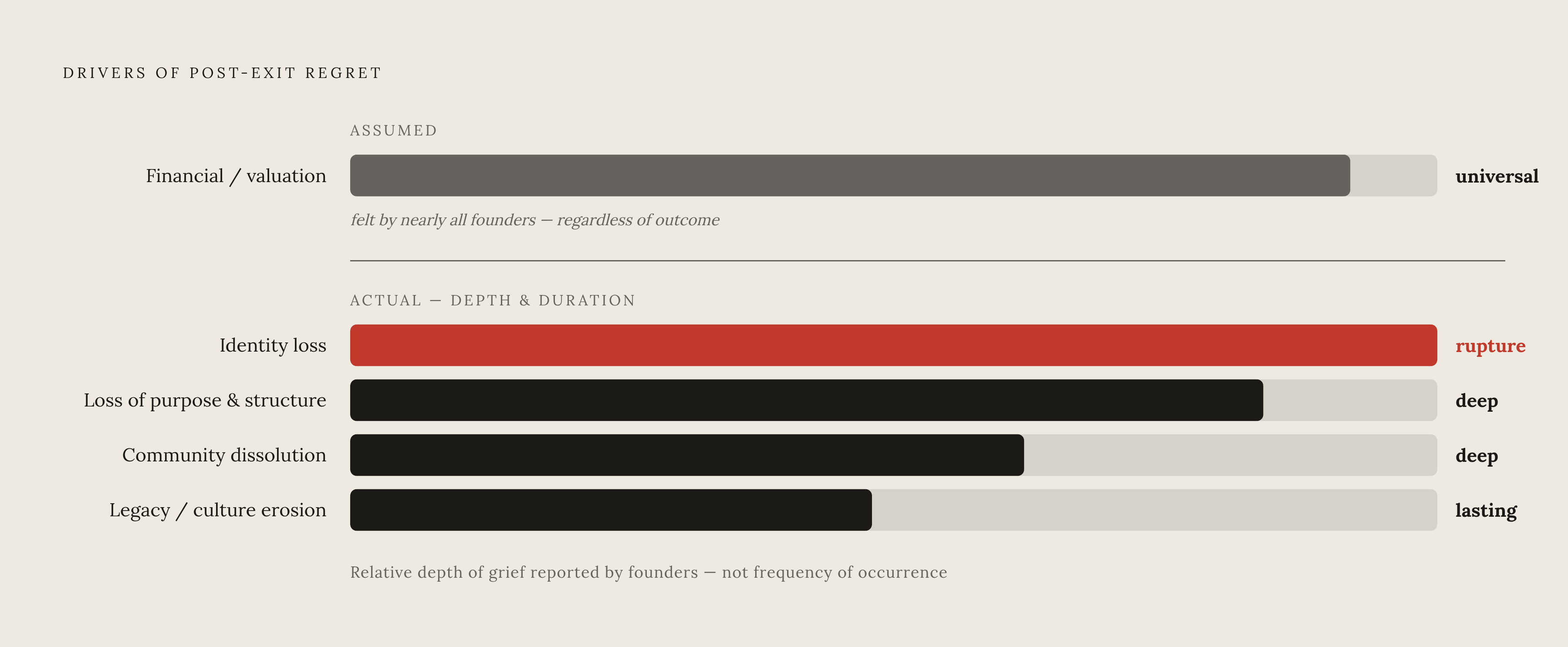
Financial regret shows up consistently, but usually as a secondary complaint, and it doesn't explain the depth or duration of what founders describe in the year after closing. Across founder accounts and exit interviews, nearly everyone wonders, at some point, whether they could have gotten more. That's close to universal, which is exactly why it can't be the full explanation: if everyone feels it regardless of outcome, it isn't tracking the outcome. Wondering whether you left money on the table is an intellectual itch. Losing the thing that organized your identity for a decade is a rupture of a different order. Founders conflate the two mostly because the financial question is the easier one to say out loud at a dinner party.
The Exit Planning Institute's 2023 State of Owner Readiness Report found that only 44% of owners felt they'd planned enough emotionally for the transition, a strikingly low number given how much attention founders pay to tax structuring and legal review before signing anything. The regret that defines the post-exit experience traces back to identity, purpose, community, and structure, far more than to the spreadsheet. Everything that follows maps where that regret actually originates, so a founder can see it coming rather than live through it unprepared.
What founders are actually losing when they sell — the psychology of identity fusion
Call it identity fusion: the process by which a founder's sense of self becomes fused with the company, to the point where the two are hard to separate even in casual conversation. This isn't a character flaw or a warning sign of unhealthy attachment. It's closer to a byproduct of what building actually requires. The refusal to draw a hard line between "me" and "the company" is precisely what generates the obsessive hours, the risk tolerance, the willingness to eat losses that would send a more detached operator toward the exits years earlier.
That's the irony worth sitting with: the trait that makes someone a good founder is the same trait that makes the exit so destabilizing. The more completely identity gets organized around the business, the more total the disruption when the business is no longer theirs to organize around. Researchers who study this transition note that the emotional stages founders go through after a sale track closely with those associated with significant personal loss, applied strangely to what is, on paper, a voluntary and financially successful event.
A pattern repeats across founder accounts: someone makes more money at closing than projected, and within days can barely get out of bed. What vanished wasn't the money. What vanished wasn't abstract. The structure of the week, the anchor of identity, the daily sense of purpose, the community built around the office, a future oriented toward for over a decade: all of it gone in the same afternoon.
The grief goes unnamed precisely because it follows something everyone else is calling a win. Friends offer congratulations; the founder can't figure out what he's supposed to be mourning, so he assumes something is wrong with him instead of recognizing the loss as real but diffuse. Researchers who study loss describe a process in which people move between confronting what's gone and slowly rebuilding an identity in its absence. Selling, under that model, unfolds as a process that starts well before the signature and continues long after the wire transfer clears, no matter how the paperwork frames it.
The daily void: purpose, structure, and community that disappear with the business
Separate from the identity question is something more mechanical: the sheer scaffolding of a working life that a business provides, independent of whatever meaning a founder attaches to it. A paper from Yale School of Management studied post-exit entrepreneurs and found the same pattern again and again. Gone are the days packed wall-to-wall with meetings, board calls, banker check-ins. It stops mattering whether the day starts at 6 a.m. or 10 a.m., because nothing is waiting either way.
Structure goes first: the calendar that once dictated every hour of a weekday simply stops existing. Community goes next, and it goes faster than most founders expect, because relationships with employees, clients, vendors, and industry peers were built inside the context of running the business, and a surprising number don't survive outside that context. The role of decision-maker disappears too. Founders spend years being the person everyone comes to when something breaks, and after the sale, there's nothing left to fix. The daily proof that the work matters, the small evidence of contribution that used to arrive constantly, simply stops arriving.
There's a guilt layer under all of this that rarely gets discussed openly. Many founders report feeling like they abandoned the people who depended on them: employees whose jobs now answer to someone else, customers whose relationship was really with the founder and not the brand. That sense of responsibility doesn't transfer with the sale. It just sits there, unresolved, for months, and the arc makes it worse. The first few weeks post-close often feel genuinely euphoric, a well-earned vacation after years of grinding. The emptiness that follows lands harder precisely because it arrives after the party's over, when everyone else has stopped checking in.
The legacy and culture regret that money cannot retroactively fix
Ask founders what bothers them most about a sale gone sideways, and loss of control over culture tends to outrank deal-term regret by a wide margin. What gets built over years isn't just a product line or a revenue number. It's a set of values, informal norms, and relationships that defined how the company actually operated day to day, and that texture rarely survives a change of ownership intact. Founders notice immediately, usually within the first quarter under new ownership.
Employees absorb a version of this loss too, and founders tend to feel responsible for it even when there was nothing they could have done differently. The founder gets liquidity; the team may lose the security, the informal influence, and the culture they helped build, sometimes within months of new management taking over.
Here is where the mistake actually happens, and founders get this backwards more often than any other part of the process. Legacy goals, what happens to the team, the brand, the mission, get defined late, if they get defined at all. Treating them as soft concerns, subordinate to valuation, something to think about after the number is locked in, costs founders the leverage they need later. By the time a founder realizes an acquirer never intended to preserve what felt non-negotiable, that leverage is already gone. A rushed exit, or one where legacy assumptions were never made explicit, can dissolve the very thing that made the company worth acquiring in the first place. The financial outcome can be excellent and the legacy outcome can still feel like a loss; those two verdicts don't cancel each other out.
The fix isn't subtle, even if it's frequently ignored. Founders who actually care about legacy need to negotiate for it structurally: employment protections for key staff, cultural covenants written into the agreement, naming rights, whatever the specific concern happens to be. Assuming an acquirer will honor legacy out of goodwill amounts to a hope, and hope has no enforcement mechanism once the deal closes.
The earnout trap: how a deal structure designed to reward you can become the thing you regret most
An earnout defers part of the purchase price, tying it to performance targets the business has to hit after the sale closes. In theory, it rewards continued growth. In practice, it transfers risk back onto the person who just tried to exit that risk in the first place, close to the opposite of what an earnout is sold as. This is the deal term that deserves the most suspicion of any line in the agreement: it looks like upside, and it behaves like a leash.
Founders accept earnout structures because there's more money on the table, and more money is hard to say no to. What often goes unexamined is what it actually means to report to someone again after years, sometimes decades, of being the final word on every decision. Many exit early anyway, forfeiting the deferred payment entirely rather than sit through the arrangement. The structural problems tend to repeat: targets get set without clarity on who actually controls the levers that drive them, decision rights get stripped away mid-agreement, and the operational support promised during negotiation quietly fails to show up once the deal has closed.
The pattern is consistent: a founder accepts an earnout because the number is too good to pass up, and ends up working just as hard as before, with far less autonomy, building someone else's version of the business on someone else's schedule. The deferred money keeps them there while the loss of control compounds every quarter.
That's the golden handcuff dynamic in practice, and it's why earnout terms deserve the same scrutiny as the headline valuation, arguably more. Stress-testing an earnout against actual post-exit goals, what a founder wants year two to look like and not just year one, has to happen before signing. Afterward, there's no renegotiating the terms of a boss nobody expected to have.
What happens when founders undervalue the business before they ever reach the table
That nagging voice, the one wondering if a better number was possible, shows up regardless of deal size or multiple. But there's a deeper issue underneath it: plenty of founders arrive at the negotiating table without a clear read on what their business is actually worth, or what would have made it worth more.
Call it the illusion of readiness. A profitable business and a valuable one aren't automatically the same thing, and founders routinely confuse a business that's good to run day-to-day with one that's structured to be sold. Per BizBuySell's 2024 Insight Report, the median small business sold for around $350,000 at a 2.57x multiple of seller's discretionary earnings. That segment, the smaller end of the market, is exactly where undervaluation shows up most often, because it's also where expert guidance is thinnest on the ground.
There's a concentration risk problem layered on top of the valuation problem. Most entrepreneurs treat the business itself as the retirement plan, and every dollar reinvested feels like the smarter move compared to diversifying elsewhere. That's a rational instinct while building, and a dangerous one heading into an exit, because it bets an entire financial future on a single illiquid asset selling at the right time, to the right buyer, at the right price. Yale SOM's 2025 research adds a detail worth sitting with: median founder spending before exit ran around $325,000 a year, and jumped to $600,000 a year after the sale. A spending pattern like that erodes even a strong sale price faster than most founders expect it to. Valuation clarity obtained well before a process starts changes two things at once: what the business is actually worth, and what a founder does with the money once it lands in the account.
Why timing regret is really a preparation regret in disguise
Most founders start seriously considering an exit at the exact wrong moment: burned out, plateaued, running on fumes. That's the worst possible position from which to negotiate anything, let alone the sale of a company that represents most of someone's net worth. Preparation, more than timing, determines how this goes, whatever founders tell themselves after the fact.
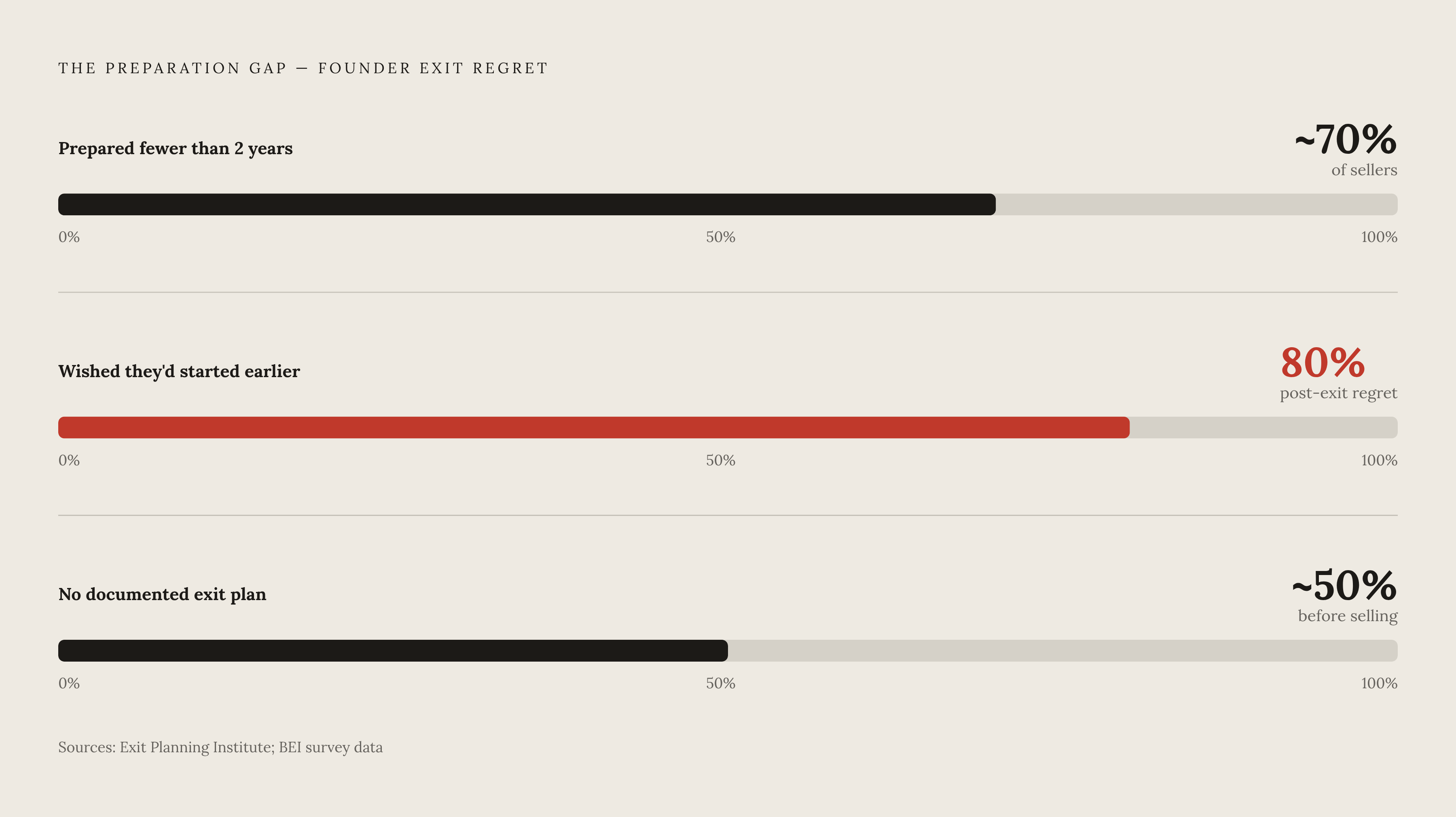
The numbers back this up. Roughly 70% of sellers spent fewer than two years preparing for their exit, and 80% said afterward that they wished they'd started earlier. The real runway needed is substantial: enough time to build value that doesn't depend entirely on the founder showing up every day, and enough time to create real competition among buyers rather than negotiating with whoever happens to be interested first.
Selling from exhaustion or distress produces predictable results: lower multiples, fewer buyers at the table, less leverage on every term of the deal, and a much higher chance of accepting structures, earnouts especially, that seed the exact regret described earlier in this piece. Planning to exit and actually preparing for one are two different projects, and the gap between them is where timing regret gets manufactured. Market conditions and bad luck explain less of that gap than the simple fact that preparation started too late.
The coping mistake that makes post-exit regret worse: rushing into the next thing
High achievers respond to a void the same way almost every time: announce the next venture, join three boards, fill the calendar back up, find some new organizing principle to replace the one that just disappeared. Anything to avoid sitting in the empty space for more than a week. This impulse deserves more scrutiny than it gets, because "staying busy" gets treated as a virtue when it's often just avoidance with better branding.
The next thing chosen out of grief rarely lasts. The next thing chosen from actual clarity usually does. The Exit Planning Institute's data on this is telling: only about a third of sellers had a documented exit plan in place before selling, and close to half had no exit strategy whatsoever. That same lack of planning tends to repeat itself on the other side of the transaction, where founders skip straight past the discomfort into a new project without ever processing what just ended.
Apply the dual-process model from earlier, and the pattern gets clearer: skipping the "facing the loss" phase and jumping straight to "rebuilding" doesn't skip the grief, it collapses it, and collapsed grief tends to resurface later, usually at a worse time. What looks like resilience from the outside is often avoidance wearing a nicer outfit. The alternative the research points toward is almost boringly simple: allow an actual transition period, name the loss out loud instead of pretending it isn't there, and treat rebuilding an identity as a deliberate project rather than a symptom to medicate with busyness.
Worth noting too: not every post-exit grief looks the same. Founders who stay on through an earnout watch their company evolve under someone else's stewardship in real time, a slower, more visible kind of loss. Founders who exit cleanly get a sharper, more final break: no daily reminder, but also no gradual adjustment period. Neither version is easier. They're just different shapes of the same problem.
What founders who avoided regret did differently — and when they started
Everything above points toward one conclusion, and it's the one founders resist hearing most: the founders who exit without lasting regret redefined what success meant well before the signing, and built the exit around identity and legacy goals with the same seriousness applied to the valuation. Chasing a bigger multiple while skipping that work optimizes for the wrong variable, and it's the single most common mistake in this entire pattern.
In practice, that meant starting preparation years ahead of the transaction, not waiting for burnout to force the decision. It meant getting independent valuation clarity early enough to build the business to be sold, not just to be run profitably in the meantime. It meant defining legacy goals explicitly, for employees, culture, and mission, and negotiating those goals into the structure of the deal rather than trusting an acquirer to honor them informally. It meant stress-testing earnout terms against actual post-exit life goals before signing anything, and building a real post-exit identity plan alongside the financial plan, not after the money had already landed. It meant resisting the reflex to fill the void immediately, letting the transition actually be a transition instead of rushing past it.
Founders who worked with advisors fluent in both the financial and human sides of an exit consistently reported better outcomes, in the terms of the deal itself and in how they felt a year out from closing. For Canadian founders running businesses in the $500,000 to $50 million revenue range, pairing AI-driven buyer matching with investment banking advisory changes the math on preparation. Entering a sale process with real clarity on value and options well ahead of time, rather than blind to what buyers will actually pay or which buyers are the right fit, makes both timing regret and valuation regret far less likely to take hold.
Regret, in the end, traces back almost every time to a specific, identifiable gap between what a founder prepared for and what actually happened after the wire cleared. The founders who close that gap treated the exit as a life transition first, and a transaction second.