Women Founders Selling Profitable Businesses in Canada
A succession crisis looms as Canadian business owners exit without buyers prepared to step in.
The Canadian Federation of Independent Business found that 76% of small business owners planned to exit within a decade, and only one in ten had a formal plan written down. BDC's figures on the nearer-term slice sharpen the picture further: over 142,000 entrepreneurs, 17.4% of Canadian SMEs, expect to close, transfer, or sell within five years. That is a generational handoff, not a market correction, and most owners are not ready for it.
Most people assume the bottleneck is the decision to sell, or a fight over price. It is neither. Owners named finding a suitable buyer or successor as the single biggest obstacle, ahead of valuation disputes and financing gaps. Only 34% of Canadian family businesses report having an adequate succession plan. So the real bottleneck is structural: sellers who have already decided to exit and buyers who do not know those businesses exist are failing to find each other, and no amount of price flexibility fixes a matching problem. Advisors who treat this as a pricing exercise are solving the wrong problem.
Women sit on both sides of that failure. Plenty built businesses over the last decade that are now reaching exit-ready scale, and some will be the ones stepping into businesses that retiring owners leave behind. But women remain underrepresented as successors. Quebec data puts women at roughly 26% of business successors, a figure that barely moved between 2015 and 2022. That gap is not a side note in a piece about selling. It means the buyer pool itself skews in ways that shape who gets found, and how fast.
The specific challenges women founders face when preparing to sell
Start with what this section is not about: capability. Women-owned businesses were less likely to report a revenue decline in 2025 (28.3%) than the private sector average (32.2%), according to Statistics Canada. So why does the path to a strong exit remain harder for so many of these founders anyway? The answer sits upstream, in how the business was financed and networked years before anyone started talking about a sale.
Women founders receive about 4% of venture capital dollars in Canada, and ISED data shows the average financing men-owned businesses receive runs roughly 150% higher than what women-owned businesses receive. That gap does not make a business weaker on its own merits. But it can produce lower recorded revenue at a given stage and a thinner balance sheet relative to what the business might have achieved with fuller capital access. The business grew on less fuel, and the valuation conversation does not always account for that. It should, and an advisor who fails to make that argument explicitly is leaving money on the table before negotiations even start.
The real price damage happens downstream, in the network. A narrower reach into buyer circles tends to mean fewer competitive bids, and fewer bidders depress price. There is no way around that math. Layer onto it the well-documented discount buyers apply when a business appears too dependent on its founder personally — a concern that can weigh more heavily in sectors where women are still building visibility. Something harder to quantify but just as real shows up in how the work itself gets distributed, too. The deep community ties and employee relationships that many women-founded businesses are built around can complicate a succession decision that a purely financial actor would move through faster.
None of this is a reason to doubt the business. It is a reason the market needs a push to see it clearly, and that push is what the rest of this piece is actually about.
What Joanna Griffiths's $400M Knix exit reveals about how a high-value deal actually unfolds
Joanna Griffiths founded Knix in 2013. By 2021 the company had reported CAD 133.6 million in net sales, growing 97% year over year. In September 2022, Swedish company Essity acquired 80% of Knix in a deal valued at USD 320 million on a cash and debt-free basis for that stake, putting the whole company's value at roughly $400 million USD, one of the largest publicly disclosed sales of a direct-to-consumer company by a female founder in Canada.
Griffiths told the Globe and Mail she was not running an active sale process. The deal came down to finding the right partner, a meaningfully different posture than shopping a business to the highest bidder. So if the deal found her, what actually made it work?
Structure did a lot of the labor. Griffiths kept 20% of the company and stayed on as President, which was not a financing footnote so much as how she kept a hand on the brand while gaining a much larger partner's resources. Growth did the rest of the work on valuation: a 97% year-over-year growth rate is the kind of number that reframes every other line item in a negotiation. And mission alignment turned out to be negotiable rather than a casualty of the deal. Knix's identity did not get swallowed into a faceless parent company overnight.
Most exits do not look anything like this one, and that is worth saying directly instead of letting the headline number do the talking. Knix sits at the high end of outcomes; most founders sell quietly, at lower multiples, with no press release at all. But the structural lessons scale down regardless of the size of the check. Positioning the business well before a buyer shows up, understanding what a deal structure can preserve beyond the headline number, and having someone who can weigh an offer against the market instead of in isolation: those apply whether the business is worth a few million or $400 million.
How buyers think about valuing a business, and where women-founded companies can close the perception gap
Buyers price earnings consistency, growth trajectory, customer concentration, how much revenue recurs without new sales effort, and how dependent the operation is on the owner walking in every morning. Gender is not a line item on a term sheet. But how a business tells its story to a buyer, and how much of that story rests on documented evidence rather than founder testimony, shapes the number directly. This is exactly where sellers leave money on the table: a business that cannot produce the paper trail loses the negotiation before it starts, no matter how strong the underlying numbers actually are.
The capital efficiency argument gets missed constantly, and it should be leading the pitch more often than it does. Research from BCG found female-founded startups generate 2.5 times higher revenue per dollar invested than male-founded startups. That flips the undercapitalization story on its head. Instead of "built with less," the pitch becomes "built more efficiently," a fundamentally different conversation with a buyer trying to underwrite future returns. But that argument only lands if an advisor surfaces it deliberately in the data room. Buyers do not go looking for it on their own, and founders who assume the numbers speak for themselves are usually the ones who leave this argument unmade.
Where does the perception gap actually surface on paper? Founder-dependent operations get discounted hardest, the kind where supplier relationships or technical know-how live only in one person's head, and the fix is operational documentation done well before the business goes to market, not during due diligence when it is too late to look proactive. Buyers unfamiliar with a sector, particularly in industries where women are still building a track record like construction or manufacturing, apply higher risk premiums out of unfamiliarity rather than anything in the numbers. And the informal assets many women-founded businesses build, deep customer loyalty, tight community ties, only count in a valuation once they are converted into figures: retention rates, repeat revenue percentage, net promoter scores. A buyer cannot underwrite a relationship. A buyer can underwrite a retention curve.
Timing compounds all of it. Businesses that spend 12 to 24 months deliberately positioning before going to market land better terms than those sold reactively, regardless of the founder's gender.
What the exit process actually involves, from preparation through close
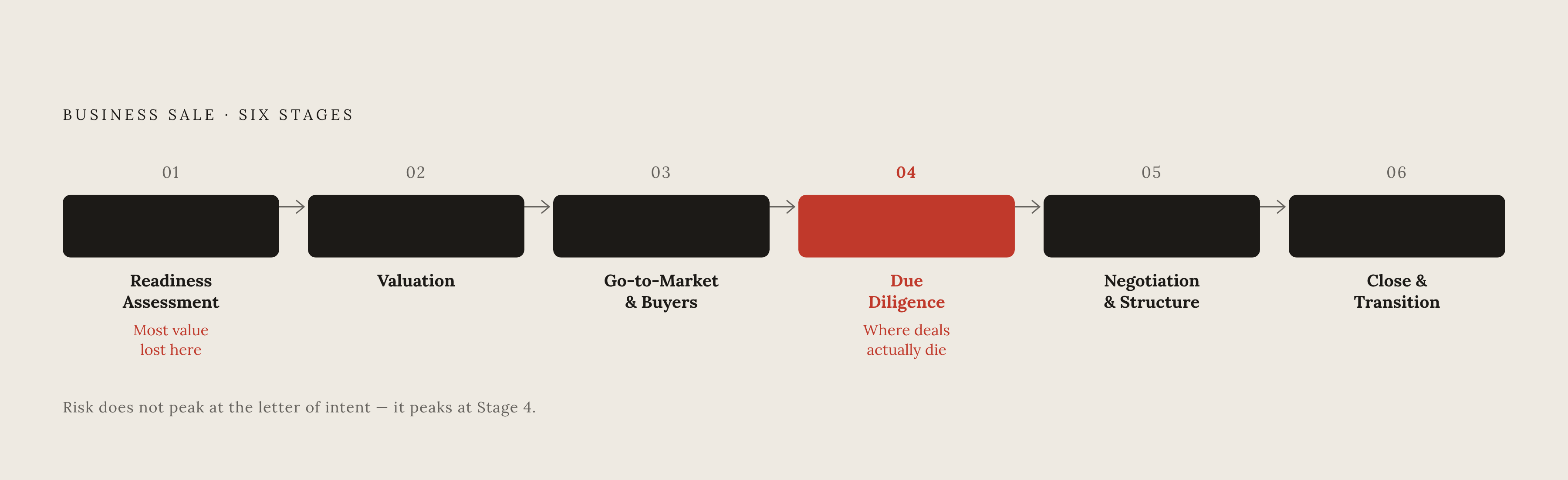
A sale moves through six stages, in order: readiness assessment, valuation, go-to-market work to find and qualify buyers, due diligence, negotiation and deal structuring, then close and transition. Skipping or rushing the first stage is where most value gets left behind, and it is also the stage founders are most tempted to rush, because it does not feel like forward motion the way a term sheet does.
Clean financials matter more than almost anything else in that early window: three years minimum, ideally reviewed or audited, EBITDA normalized, recurring revenue documented in a way a stranger could verify. Buyers also want proof the business survives the founder's exit, which makes a transition plan a condition of closing rather than a nice-to-have. Growth levers the buyer can pull after the deal closes often matter more to the final number than current earnings, because a buyer is underwriting the next five years, not the last one.
Buyer type changes the entire calculus downstream. Strategic buyers, usually larger companies in adjacent sectors, pay for synergies and market position. Financial buyers like private equity firms or search funds price off cash flow and risk-adjusted returns. Individual acquirers behave differently again, and reaching the right pool of buyers matters as much as any single price negotiation. Arguably more.
Due diligence is where deals actually die, not at the letter of intent stage where most founders assume the risk lives. Legal, financial, operational, sometimes HR diligence, and for women founders in male-dominated sectors, sometimes heightened scrutiny on whether sector relationships will survive a change in ownership. Documented evidence, signed contracts, retention data, holds up under that scrutiny far better than anecdotes about relationships, however genuine those relationships are.
Then there is the structure beneath the headline price, where a deal's real risk actually lives. Earnouts, equity rollovers like the one Griffiths negotiated, seller financing, transition employment periods: each changes how much risk the seller carries and when they actually get paid. A well-run process from mandate to close typically takes several months; reactive or distressed sales move faster and produce worse outcomes. Founders also routinely underestimate how much time a sale demands while they are still running the business day to day. That is not a scheduling inconvenience. It is a real operational strain that blindsides a lot of owners mid-process.
Why who advises you shapes the outcome as much as the business itself
Circle back to that CFIB finding: the biggest obstacle to succession was not valuation or financing, it was finding a suitable buyer. That is an information problem wearing a network problem's clothes, and it is exactly what a qualified M&A advisor exists to solve. Skipping that hire to save on fees is the single most expensive shortcut a founder can take. Do not run a sale process without one.
A good advisor runs a competitive process instead of a bilateral negotiation, and competition among multiple bidders drives price more than any single negotiating tactic does. Advisors reach buyer pools a founder simply does not know exist, manage confidentiality while the business is quietly on the market (a leak to employees or competitors mid-process can do real damage), negotiate structure rather than just the headline number, and keep a deal alive through diligence friction, which, as covered above, is where most deals actually collapse.
There is a gender-specific wrinkle worth naming directly instead of glossing over. Because women remain underrepresented in M&A and finance broadly, a founder's existing network does not always include anyone with actual transaction experience. That makes the choice of advisor unusually consequential, not a box to check on a to-do list.
What should a founder actually screen for? Specific experience with founder-led businesses in a comparable revenue range, real knowledge of Canadian buyers and market conditions, access to both strategic and financial buyer pools, and a willingness to treat the founder as an informed principal rather than someone who signs where indicated. AI-driven buyer matching, paired with actual investment banking judgment, is increasingly how well-positioned founders find qualified buyers faster and skip months of mismatched conversations.
Engage an advisor years before a planned sale, not months. Years out, an advisor can flag what actually builds value. Months out, the advisor can only execute a transaction on whatever the business happens to look like the day it hits the market, and by then most of the upside is already fixed in place.
Government programs and institutional capital that women sellers and buyers can access
The Women Entrepreneurship Strategy, launched in 2018, has directed significant federal investment across multiple departments, agencies, and Crown corporations to help women access financing, networks, and mentorship. In 2026 the program was renewed with hundreds of millions of dollars over five years, including continued support for the Women Entrepreneurship Loan Fund and the WES Ecosystem Fund.
On the buyer side, BDC runs a $50 million fund built specifically to help women entrepreneurs acquire businesses from aging owners, a direct response to the succession wave described earlier and squarely aimed at closing the successor gap.
Why does any of this matter to someone thinking about selling rather than buying? Because the capital access problem shows up years before the exit conversation ever starts. Women-only firms face higher rejection rates on funding applications, against the average across all enterprises. Programs like the WES Loan Fund and BDC's acquisition fund respond to that gap directly, and they matter far more in the years leading up to a sale than at the closing table itself, where private market buyers set price regardless of what public programs exist on paper.
The practical takeaway for a founder three to five years out is to figure out now which of these programs actually apply. Growth capital deployed before a sale compounds directly into a higher valuation at the finish line, and waiting until the sale feels imminent to think about this means most of the leverage is already gone by the time anyone asks.
What a woman founder selling a profitable Canadian business should do before she needs to
The pattern across the succession research cited here is blunt. Founders who plan early get better outcomes, and founders who sell reactively, because of a health scare, burnout, or an unsolicited offer that shows up out of nowhere, tend to leave value on the table. That holds regardless of gender, but given everything above about networks, capital history, and perception gaps, the cost of selling reactively runs higher for women founders specifically. Reactive selling is the single biggest unforced error a founder can make, and it is almost entirely avoidable.
Three to five years out, a few things matter most. Get a preliminary valuation, not to sell yet, but to see the actual gap between where the business sits today and where it needs to be, and what is driving that gap. Work on reducing founder dependency: document processes, build out the management bench, systematize the customer relationships that currently live in one person's head. Clean up the financials, move to reviewed statements, normalize earnings, separate personal and business expenses cleanly. Use the growth capital available now, through WES programs or BDC facilities, to build revenue and EBITDA while there is still runway left to do it.
One to two years out, the work shifts from building to positioning. Bring in an M&A advisor with real experience in Canadian founder-led businesses. Map the buyer universe, strategic versus financial, domestic versus international, so there are no surprises about who is actually interested when the time comes. Understand the deal structures on the table beyond a clean cash sale: equity rollovers, earnouts, transition employment, each carries a different risk and reward profile.
None of this commits a founder to selling. Planning early buys choices; it does not sign away the business. The founders who come out of a sale satisfied, by every account in this research, are consistently the ones who sold on their own terms and their own timeline, not the ones forced into a decision by a health event or a burnout moment. Firms offering AI-driven buyer matching alongside real investment banking advisory, built specifically for Canadian founder-led businesses, exist precisely to give founders that competitive process and that expert guidance, whether the sale happens this year or five years from now.