AI Buyer Matching Algorithms in Lower Middle Market M&A
Algorithms are reshaping how founders connect with the right acquirers in fragmented M&A markets.

Lower middle market M&A occupies a peculiar position in the private capital ecosystem. It generates more deal volume by count than any other segment of U.S. private equity, yet it remains the least institutionalized, the most fragmented, and the most dependent on relationships that were built before the internet made global buyer discovery theoretically possible. The founder who has spent thirty years building a mid-sized EBITDA manufacturing business deserves the same quality of buyer matching that a large platform company receives. For most of M&A history, that founder has not gotten it. That may be changing.
Why the Buyer Universe Has Expanded Dramatically and Become Harder to Navigate Without Help
The buyer universe for lower middle market businesses, defined here by deal dynamics rather than just size, has never been larger or more heterogeneous. Enterprise values in the lower to mid millions range, owner-operated businesses built over decades by founders selling for the first time, with all the attendant complexity around succession, legacy, and employee welfare: this is the segment in question. And the capital competing to acquire assets in this segment has compounded in ways that defy a simple description.
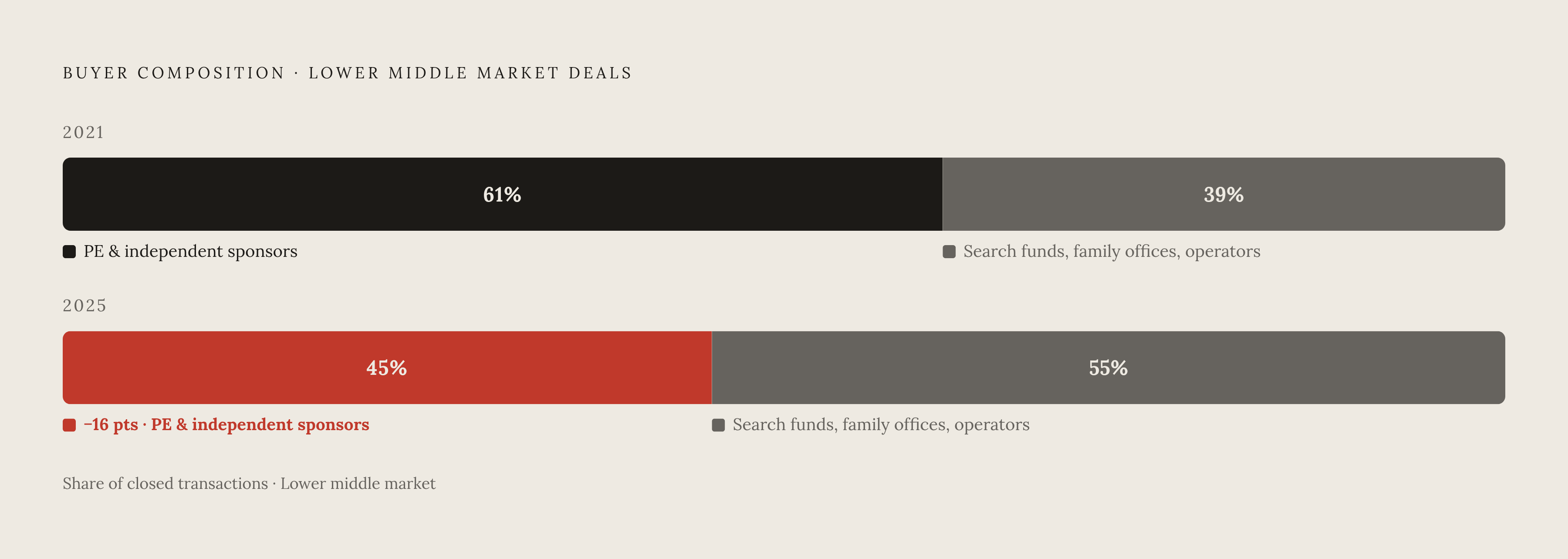
Global private equity dry powder reached an estimated $3.9 trillion in early 2026. That capital needs to be deployed into a finite pool of quality assets, and financial sponsor participation in the middle market approached 45% of deal flow by late 2025. But the composition of who is deploying that capital has shifted in ways that a seller's intuition, or a traditional advisor's contact list, is unlikely to capture. Search funds, which were a novelty a decade ago, reached a meaningful share of closed lower middle market transactions in 2025. Individual investors and family offices have grown as a share of deal activity, while traditional PE and independent sponsors fell to 45% of closed transactions in recent data from private deal networks, down from 61% in 2021.
What that means in practice is that the buyer who closes on a founder's business in 2026 may be a former executive backed by a search fund, a family office with a generational investment horizon, or an individual operator who wants to run something rather than flip it. Categories that barely registered five years ago now represent a material share of deal flow. A seller who walks into a process assuming the buyers are PE firms competing on EBITDA multiples is operating with an outdated map. The advisor who hands over the same outreach list they used in 2019 is compounding that problem.
The Core Problem Traditional Advisory Has Never Solved: Most Qualified Buyers Are Never Reached
I have sat across from enough sellers in the lower middle market to know that the conversation almost always starts the same way. The founder wants to know who the buyers are. The advisor names a handful of firms. The founder nods. And somewhere in that exchange, an enormous amount of potential value quietly exits the room.
The structural limitation of traditional advisory is not a matter of effort or intelligence. It is a matter of bandwidth and data. Most advisory firms maintain buyer lists numbering in the hundreds to low thousands of contacts, a fraction of the actual acquirer universe for any given business. Deloitte's M&A Trends Survey found that a substantial majority of potential strategic buyers are never contacted in a typical M&A process, not because advisors are negligent, but because the research, qualification, and outreach required to reach them exhausts the available human hours before the list is anywhere near complete. Senior advisors, by most industry accounts, spend the majority of their working time on administrative coordination rather than strategic buyer identification. That is a structural problem, not a personal failure.
The data problem compounds the bandwidth problem. Private market information on lower middle market companies is fragmented, inconsistent across jurisdictions, and arrives almost entirely as unstructured text: confidential information memoranda, management accounts, partnership agreements, press releases, LinkedIn posts from executives hinting at strategic priorities. None of that is queryable at scale without significant technology infrastructure. Even the broadest private equity data platforms have materially thinner coverage below a certain revenue threshold. The buyer who would pay a premium for a specific business, because the acquisition fills a gap in their portfolio or accelerates a strategic objective they have not publicly articulated, may simply not appear in the advisor's database.
There is a telling empirical signal here. Proprietary deal sourcing, where a buyer finds a target directly outside a formal intermediated process, consistently generates meaningfully better returns for the buyer than intermediated transactions. The delta exists because buyers who find a target on their own terms, before competitive tension is introduced, capture more of the value. For a seller, that same dynamic describes value that leaked. It leaked because the process never surfaced the buyers who would have competed hardest for the business.
How AI Buyer Matching Algorithms Actually Work Under the Hood
The phrase "AI buyer matching" gets used loosely enough that it has started to obscure more than it reveals. It is worth being precise about what these systems actually do, because the architecture determines both the capability and the limitation.
At the core, these systems combine large language models trained on deal history, strategy documents, and company communications with machine learning clustering algorithms that group potential buyers by attributes: business model, growth profile, sector adjacency, acquisition history, capital availability, and management commentary about strategic priorities. The output is not a list sorted by size or sector. It is a ranked set of candidates scored by fit, financial alignment, and deal likelihood.
The signal ingestion is where the differentiation lives. Sophisticated matching systems pull from sources that a human analyst would struggle to synthesize at speed: funding rounds that signal capital availability and appetite; patent filings and technology acquisitions that reveal strategic direction; hiring patterns that show where a company is expanding and what capabilities it is trying to build; online mentions and management commentary that surface stated acquisition intent before it becomes public knowledge. A PE firm that has been quietly hiring operational leadership in a specific vertical is a different buyer than one that has been hiring IR staff. An algorithm that reads both signals is doing something a Rolodex categorically cannot.
The handling of unstructured data is particularly relevant for the lower middle market, where the information environment is messier than in large-cap transactions. AI agents can read and extract from CIMs, teasers, and diligence files, normalize inconsistent formats across hundreds of documents, and surface comparable attributes that a human analyst would spend hours compiling from a single file. That compression of research time is what allows a matching process to consider orders of magnitude more potential buyers than a manual process ever could.
The adjacency identification may be the most underappreciated capability. Algorithms can surface buyers whose existing portfolio or business model creates synergies that the seller, and the seller's advisor, might not have anticipated. A building products distributor may be an obvious target for a national distribution platform but a non-obvious target for a private label consumer goods firm looking to control its supply chain. The algorithm that has indexed both companies' acquisition histories, hiring patterns, and strategic communications will surface that connection. The advisor relying on sector classification alone will not.
What AI does not do is worth stating plainly. It does not negotiate. It does not read a room. It cannot determine whether a buyer's stated culture fits the seller's deep concern for the employees who have worked there for twenty years. The algorithm surfaces candidates; human judgment determines which candidates are actually right.
Where AI Adoption in M&A Actually Stands, and the Gap Between Large-Deal and LMM Access
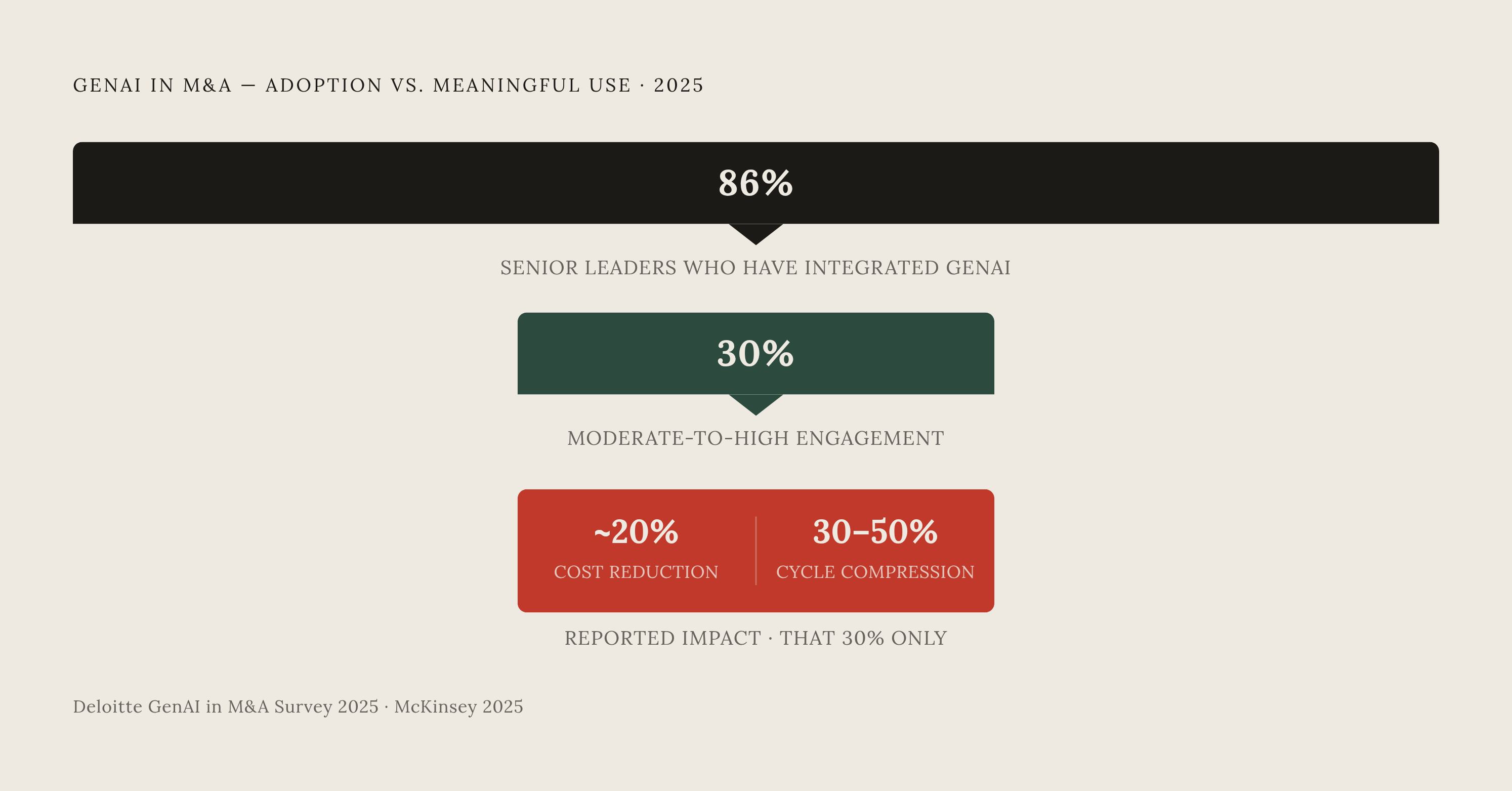
The adoption curve for generative AI in M&A has moved faster than most practitioners anticipated even two years ago. Deloitte's 2025 GenAI in M&A Survey, drawing on approximately 1,000 senior leaders across U.S. corporate and PE organizations, found that 86% had integrated generative AI into M&A workflows, with 65% having done so within the prior year. Among PE firms specifically, 88% had invested $1 million or more in generative AI for M&A purposes.
McKinsey's 2025 survey of generative AI in M&A found that adopters reported roughly a 20% average cost reduction, and 40% of respondents reported deal cycles compressing by 30 to 50%. Those are material numbers. But the same survey found that only 30% of respondents were engaging with generative AI at moderate to high levels, meaning the majority of practitioners are still in early or experimental stages. The headline adoption statistics and the depth of integration are telling different stories.
The more important asymmetry is between who has access to institutional-grade AI tools and who does not. A large PE firm deploying multi-million-dollar proprietary AI stacks for deal sourcing and buyer identification is not competing on the same informational footing as a regional advisory boutique running the same outreach process it used a decade ago. The founder of a mid-sized EBITDA specialty manufacturer does not have an in-house data science team. She has a trusted advisor, and increasingly, the quality of that advisor's technology infrastructure determines how much of the buyer universe she actually reaches, which is the access problem Succession AI, a tech-enabled exit platform that uses AI-driven buyer matching to connect founder-led businesses in the $500K–$50M revenue range with a vetted network of over 10,000 acquirers, was built to address.
Survey data from private deal networks suggests that a substantial majority of LMM advisors are now using AI in deal sourcing or market research. But using AI, in this context, often means general-purpose tools applied to tasks those tools were not specifically designed for: drafting CIM language, summarizing research, generating outreach templates. Purpose-built buyer matching, which indexes proprietary data on private company acquisition behavior at scale, is a different capability. The gap between having a ChatGPT account and having a system that has ingested years of closed lower middle market deal data is wide enough to matter in a single transaction.
What Better Buyer Matching Changes About the Outcome for a Seller
The leading reason lower middle market deals failed to close in 2025 was valuation expectations, cited by more than a quarter of surveyed participants. Diligence findings ranked second. Those two failure modes are almost always discussed as discrete problems, but they share a common upstream cause: buyer fit.
When a seller reaches only a subset of the available buyer universe, price discovery is incomplete. The competitive tension that drives a buyer to stretch on valuation, or to move quickly to preempt competition, does not materialize if the buyer never saw the opportunity. The valuation gap between what a seller expects and what a limited buyer pool offers is not primarily a psychological problem; it is an information problem. More buyers in the process means more data points about what the market actually values in the specific business, more competitive pressure on serious acquirers, and a better probability of finding the buyer for whom the acquisition is strategically irreplaceable rather than merely attractive.
Speed is a related benefit that deserves more attention than it typically receives in discussions of buyer matching. A prolonged pre-LOI process is not just frustrating. It drains management attention at exactly the moment when the business needs to perform well to survive diligence. It creates deal fatigue. It gives acquirers time to cool on an opportunity or find an alternative. Faster identification of qualified, motivated buyers compresses the timeline between initial outreach and signed LOI, which is the interval most vulnerable to process entropy.
The diligence failure rate is also partly a fit problem dressed up as a data problem. When a buyer discovers during diligence that the business's customer concentration, growth profile, or operational structure does not match what the acquisition thesis requires, the deal dies. Better fit scoring upstream, before LOI, reduces the probability of that outcome. It does not eliminate it, but it shifts the population of buyers who enter diligence toward those whose thesis accommodates the business as it actually is.
For a seller, the cumulative effect of better buyer matching is not primarily about technology. It is about certainty: the knowledge that the process surfaced the real market, not just the reachable market.
How Platforms and Advisors Are Combining AI Matching with Human Judgment in Practice
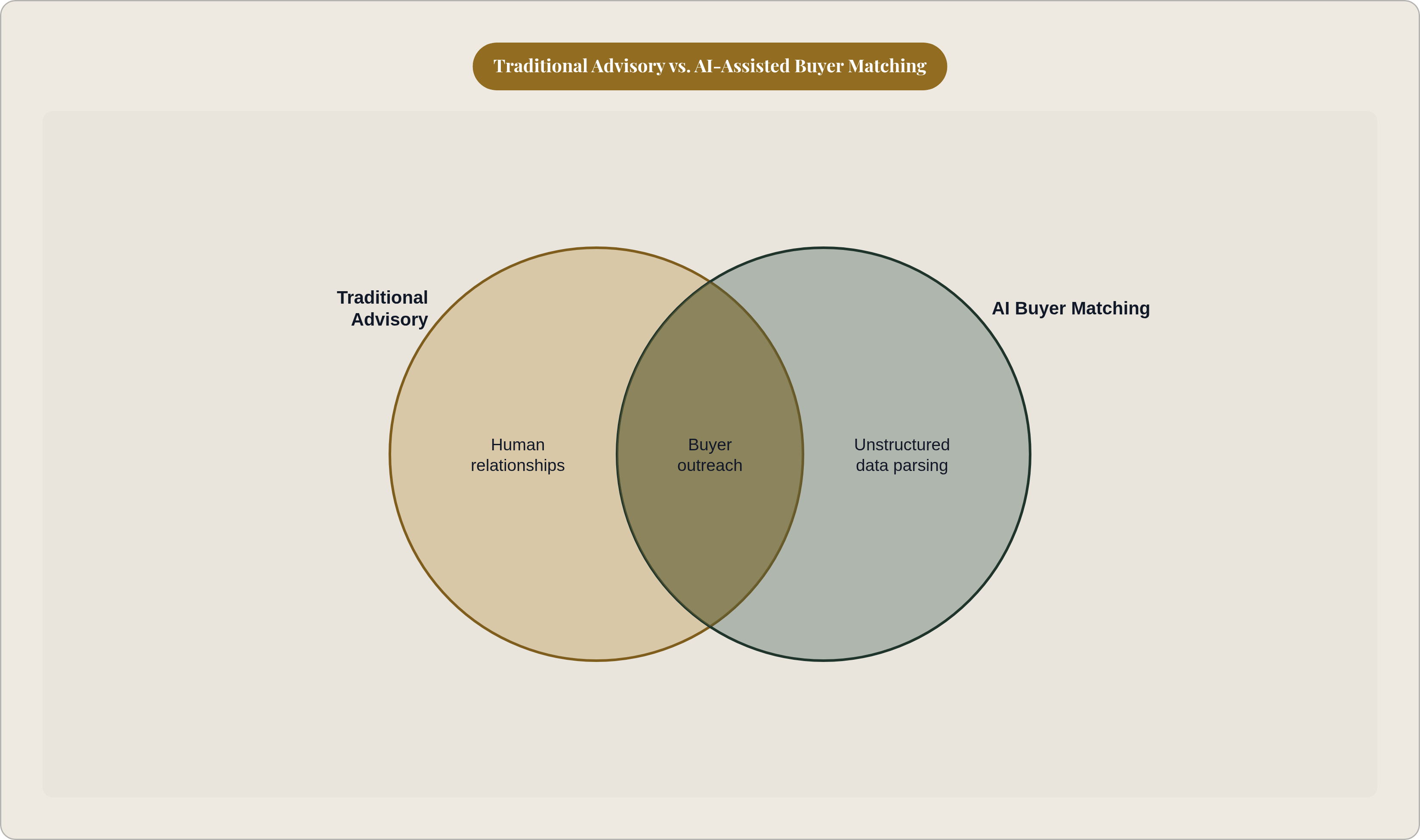
The most effective models I have observed pair AI-generated buyer lists and fit scores with experienced investment banking judgment, rather than treating them as alternatives. The algorithm surfaces candidates the advisor would have missed; the advisor filters for relationship quality, timing, and cultural factors the algorithm cannot assess. Neither input is sufficient alone.
Several platforms have built meaningful infrastructure in this space. Grata has developed a proprietary data science engine specifically designed to index private company data that traditional databases miss, filling the coverage gap that has historically made lower middle market buyer identification so labor-intensive. Cyndx applies AI to buyer targeting and outreach prioritization, reducing the manual effort of building and maintaining buyer lists for active processes. These tools are not advisory firms; they are infrastructure that advisors can deploy to extend their effective reach.
Syndi occupies a distinct position in this landscape. Built specifically for founder-led businesses in Canada doing hundreds of thousands to tens of millions in revenue, Syndi combines AI-driven buyer matching with institutional investment banking advisory. The model is designed for exactly the segment where the access gap is widest: profitable owner-operated businesses with no prior M&A experience, no in-house advisory team, and no institutional counterpart to advocate for their interests in a market that has historically favored the capitalized and the connected. The distinction worth drawing is between access to AI tools and access to AI-powered advisory. A founder navigating a single transaction benefits most from a firm that has already built the data infrastructure, the buyer relationships, and the judgment layer, rather than one that provides a software license and leaves the integration to the client.
The human layer in these combined models does work that no algorithm currently approximates. An advisor who knows that a particular family office just closed a platform acquisition and is actively looking for add-ons, or that a search fund principal has been quietly building relationships in a specific sector, brings information that is not yet in any database. The best AI-assisted processes treat the algorithm's output as a starting point for human judgment, not a substitute for it.
What a Founder-Led Business Should Expect from an AI-Assisted Sale Process Today
The first thing worth clarifying is what AI buyer matching does not change. It does not substitute for business preparation. The algorithm surfaces buyers; the business still needs clean financials, a coherent growth narrative, a defensible EBITDA, and a clear picture of what the right owner looks like. Founders who approach a sale process expecting technology to compensate for preparation gaps will be disappointed.
What a founder should expect, and what a rigorous advisor should be able to demonstrate, is a buyer identification process that draws on data sources beyond the firm's internal contact list. The right questions to ask any advisor about their buyer matching process are concrete: how many active buyer relationships does the firm maintain, what proprietary or third-party data sources does it use beyond its own database, and how does it identify buyers outside the obvious sector peers, including search funds, family offices, and individual operators who have become a material share of deal flow?
Timing is underappreciated in most founder conversations about M&A. Sell-side readiness and buyer appetite are dynamic; they are not constants to be observed at the moment of decision. A business that engages with an AI-assisted advisor two to three years before a planned exit can track how buyer market conditions are evolving and position itself for the window when competition among buyers is highest. Survey data from 2026 identifies limited quality deal flow as the top constraint for buyers actively deploying capital. A motivated, well-positioned seller in the right segment is in demand, but only reaches that demand if the matching process is systematic enough to find the right buyers.
The realistic expectation is not a guarantee of a premium outcome. It is a systematic reduction in the probability of leaving value on the table because the right buyer was never reached. For a founder who has spent decades building something, that reduction in information asymmetry is not a technology feature. It is the difference between the exit they planned for and the one they settled for.