Qualified Buyer Criteria for Canadian Mid-Market Business Sales
Align buyer qualification to your business's specific value band.

Nobody agrees on what "mid-market" means in Canada. Ask five advisors and you'll get five different EBITDA bands back. What most practitioners settle on, roughly, is a lower middle market running from about CAD five million to one hundred million in enterprise value, with EBITDA somewhere in the low-single to low-double-digit millions. Above that you're in territory that starts pulling in larger PE funds and strategics, the ones with balance sheets and integration playbooks built for scale.
Deal count, not deal size, tells you where the market actually lives. Mid-market transactions make up the largest share of Canadian M&A by number of deals every year, even though the mega-deal headlines soak up the column inches. The real volume sits quietly in that five-to-hundred-million band and just above it, closing without a press release.
So why does the definition matter for qualifying a specific buyer? A buyer who's completely credible at the lower end, say an individual operator with liquidity suited to a smaller deal, can be structurally wrong at the top of that range, where check size and operational complexity both jump by an order of magnitude. It runs the other direction too: a PE fund built for platform deals north of fifty million in EBITDA has no real business circling a six-million-dollar target. If one shows up anyway, that's worth a second look, not a warm welcome. Sellers need to calibrate "qualified" against the specific band their business actually sits in. Not against some generic notion of what a mid-market buyer is supposed to look like.
What "qualified buyer" actually means before any information changes hands
A qualified buyer has three things at once: real financial means, relevant experience, and intent you can verify. Miss one and the other two don't save you. I've seen cash-rich buyers who'd never run a business like the target, and sharp operators who simply couldn't fund the deal. Neither one counts, and I've stopped being surprised by how often sellers conflate the two.
Qualification exists to do one job: keep confidential information (financials, customer lists, supplier terms, pricing) away from people who can't or won't close. Most first-time sellers think it does something else.
This is where the expensive confusion sets in. A signed NDA is a legal precondition. Qualification is a separate signal entirely. The NDA protects you after the fact, if someone leaks or misuses what you gave them; qualification protects you before the fact, by making sure the wrong person never gets the file at all. Treating a signed NDA as sufficient vetting, then handing detailed financials to whoever asked politely, is one of the more expensive mistakes a first-time seller makes. It happens constantly, because the NDA feels like the process when it's really just a formality inside the process.
Qualification isn't one gate. It's staged. Early screening is coarse, just enough to weed out the obvious non-starters, while diligence-stage vetting is far tighter, because by then the exposure is real. What counts as "qualified" also shifts depending on what the seller actually wants. A founder who wants the culture preserved is running a different screen than one who wants the highest number and a clean exit. Those two sellers shouldn't end up talking to the same shortlist. Usually, in my experience, they don't.
Financial capacity as the threshold criterion — and where it stops mattering on its own
Financial capacity is the floor. It's not the ceiling, and treating it like one is how sellers get burned. Before anything confidential moves, a buyer needs to produce proof: liquidity on hand, a signed equity commitment, a financing pre-approval letter. No proof, no financials. That part isn't a judgment call worth agonizing over.
For individual buyers, especially lower in the mid-market, the liquidity bar has to cover more than the down payment; it has to cover working capital after close too. I've watched a buyer stretch every dollar to reach the closing table, only to have nothing left for payroll in month two. Technically they closed the deal. Practically, the seller heard about it within a quarter, usually through an anxious phone call from an employee who used to work for them.
PE and institutional buyers get qualified differently. Less bank statement, more track record: has the fund actually deployed capital in comparable deals? Is there confirmation the specific fund vehicle has capital available right now, or is "we've got dry powder" a claim that quietly falls apart the moment you check the fund's public size and vintage?
But how does capacity alone stack up against the seller's real goal, which is maximum value at close? Taken by itself, it can actively mislead you. A well-funded buyer with zero operational fit can close the deal and quietly wreck the business within eighteen months. A buyer pitching a heavy earnout might look perfectly capable on paper while shifting execution risk onto the seller, who now has to hit someone else's targets just to get paid in full. And buyers whose capacity depends on deal financing carry a separate exposure: if credit tightens between the LOI and the closing date, their qualification can evaporate without anyone doing a single thing wrong. Capacity sets the floor. The rest of the criteria tell you whether the buyer is worth your time at all.
Sector knowledge and management experience as qualifiers for operational fit
Does the buyer actually get the industry, or do they just think they do? That's the real question, and it goes past general familiarity into specifics: competitive dynamics, the customer relationships that took a decade to build, the seasonal rhythms that never show up in a financial model. A buyer coming from an adjacent sector can still qualify. The question is whether their learning curve is manageable or a slow-motion disaster waiting on the other side of closing.
This one matters most for individual owner-operators, the buyers who'll actually run the place day to day rather than watch it from a portfolio dashboard three time zones away. Lenders scrutinize this as hard as sellers should. A buyer financing through SBA-equivalent lending structures in Canada has to show real operating capacity, not just the ability to service a loan. Relocation belongs in this bucket too, as a practical sub-test: a buyer who won't move, or can't, isn't operationally qualified, whatever the resume says.
PE buyers get judged at the portfolio level instead. Have they bought, run, and exited businesses in this vertical, or something close? The portfolio is the evidence, and a fund's own list of prior platform investments on its website often tells you more than any pitch deck will.
Strategic buyers raise a related but distinct question: how do they integrate? Do they have a documented history of absorbing acquisitions without gutting whatever made the target valuable in the first place? That history is checkable, so check it.
One wrinkle worth naming plainly: a direct competitor can clear every financial and operational bar and still be a genuine information risk. Qualifying them means weighing how sensitive what they'd see actually is against how legitimate their acquisition interest really looks. Those two things don't always point the same direction, and sometimes they pull hard against each other.
How to read a buyer's intent before they've made an offer
Watch what a buyer does, not what they say. A buyer who says all the right things on the intro call and then vanishes for three weeks has told you something real. So has the buyer who answers within a day, every time, without fail.
The good signals tend to travel together. A buyer willing to complete a personal financial disclosure early is telling you they're serious. So is a buyer asking granular, operational questions, about supplier contracts, customer concentration, lease terms, instead of circling back to the asking price every five minutes. Buyers who move through process steps without needing three follow-up emails are behaving like people who intend to finish. And buyers who're upfront about how much capital they've actually committed to their search tend, in my experience, to be the easiest people in the room to deal with.
The red flags run the other way, and they disqualify on intent, not on money. A buyer who wants your full financials but won't share anything about themselves is asking for an imbalance no seller should accept. A buyer who wants confidential information on the first call, before any qualification has happened, is skipping a sequence, and probably for a reason. Vague or shifting answers about why they want this business, in this industry, are worth pressing on twice, not once. A competitor more curious about your market intelligence than about actually owning the company deserves real suspicion, whatever their email signature says.
Here's a rule that's held up more often than not in my own dealings: a buyer who resists qualification has already answered the question you were about to ask. Proceeding anyway rarely ends well. Even after the NDA is signed, hold some information back until there's a letter of intent and a deposit on the table, because intent gets proven in stages. It doesn't get assumed from one good meeting, no matter how good the meeting felt at the time.
Strategic and cultural fit — the qualification criteria that determine whether maximum value is achievable
Strategic fit asks something specific: does buying this business actually make sense inside the buyer's existing strategy or portfolio? A buyer who can articulate a clear rationale (entering a new market, filling a capability gap, establishing a geographic foothold) is the one most likely to pay a premium rather than book value. A buyer for whom the deal is opportunistic, the business just happened to come up and it looked interesting, tends to anchor on asset value instead. That anchoring compresses the multiple you end up getting offered, more often than sellers expect.
Geographic preference is worth screening for on the first call, because it's binary and costs nothing to ask. Some buyers have hard regional requirements. If your business sits outside that footprint, no amount of diligence later changes the answer, and finding that out on day one saves both sides months of wasted motion.
Cultural fit is harder to measure and no less real for it. For founder-led businesses, culture often is the asset: the team that's stuck around for fifteen years, the customer relationships built on trust rather than a contract clause, the way decisions actually get made instead of how the org chart says they get made. A buyer whose playbook is standardize-and-strip is taking on real risk, to earnout performance, to retention, to customer continuity, even if nobody writes it that way into the LOI. You assess this in conversation: how they talk about past acquisitions, what they say about the employees they'd be inheriting, whether they ask anything at all about what you hope happens to the place after you're gone.
Which loops back to where qualification has to start in the first place. A seller who wants the team protected and the business running as a going concern needs to weight cultural fit heavily. A seller chasing a clean exit and the biggest possible check might weight it less. Both are legitimate. But you can't build a precise screen until you've said, out loud, which one you're actually optimizing for.
How the three main buyer types qualify differently in Canadian mid-market deals
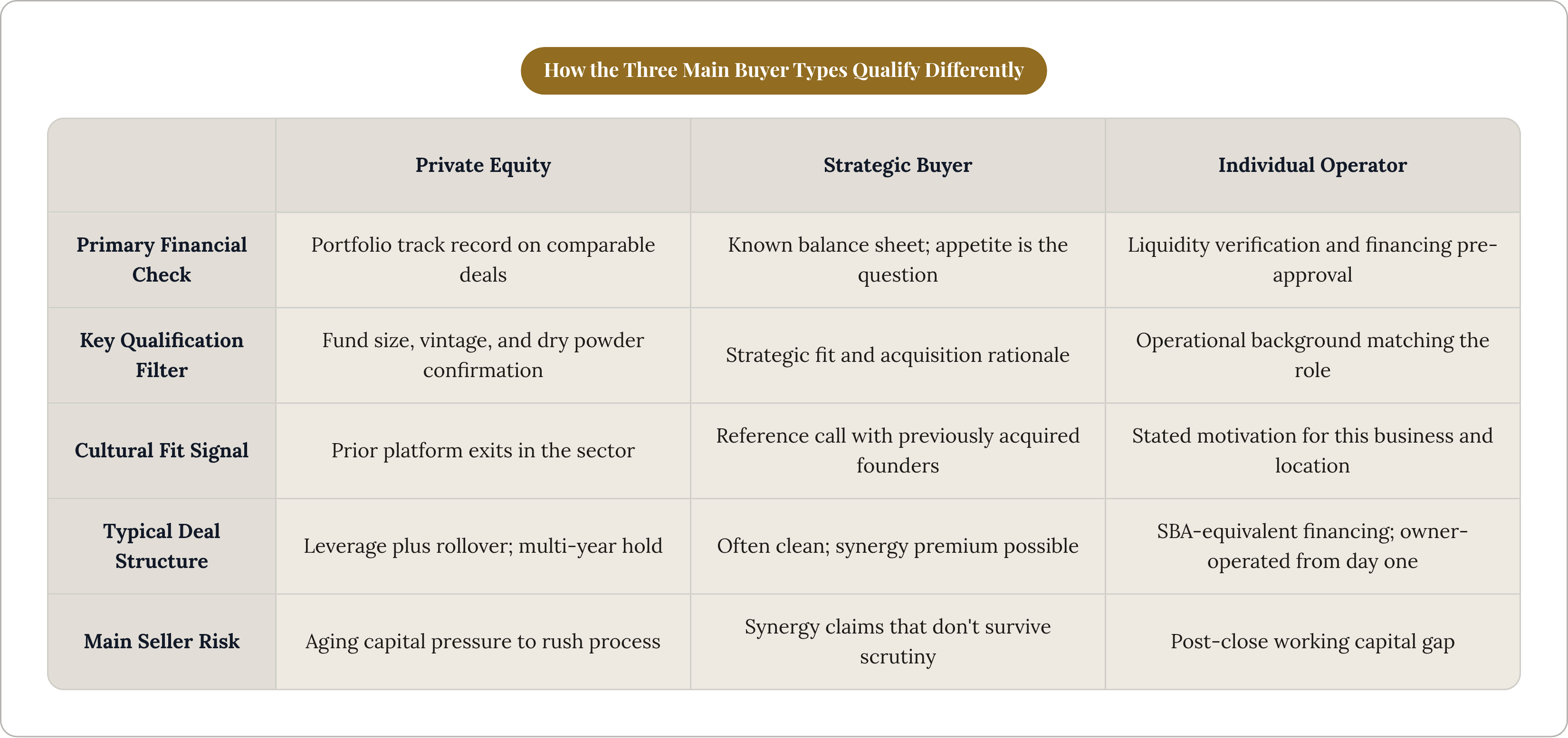
Private equity, strategics, and individual owner-operators do not get qualified the same way. Treating them as interchangeable during screening wastes everyone's time.
PE buyers get qualified financially through portfolio evidence rather than a personal bank statement; their track record on comparable deals substitutes for the balance sheet check you'd run on an individual. Most PE firms have EBITDA minimums for platform acquisitions, though a business below that line can still qualify as an add-on if the real buyer is a portfolio company rather than the fund itself. Structurally these deals tend to run with moderate leverage, frequent rollover requests, and hold periods stretching several years, so a seller wanting a full, clean break needs to sit with whether that structure actually fits what they want. PE activity in Canada spans sectors broadly, with B2B services and technology pulling a meaningful share of deal count, and sector fit here is usually verifiable in ten minutes against a fund's disclosed portfolio. One thing worth flagging: funds sitting on aging capital face real pressure to deploy it, which can push a motivated fund to move faster than its reputation for slow, diligence-heavy process would suggest.
Strategic buyers carry a lighter financial qualification burden most of the time. Publicly traded or large private strategics generally have known balance sheets, so the real question becomes appetite, not capacity. Strategic fit becomes the primary filter instead: why do they actually want this business, and does the stated logic survive a second look? Their acquisition history doubles as a cultural fit proxy, and a reference call with a founder they've previously bought out carries real weight here. When the synergies a strategic describes are genuine rather than aspirational, they can pay meaningfully above what a financial buyer would offer, which is exactly why qualifying on strategic fit before jumping to price tends to produce the best outcomes. Inbound interest from U.S. and international strategics has grown noticeably in recent years, and those buyers need one more layer of qualification: how well do they actually understand Canadian regulatory and employment frameworks? It's an easy thing to assume and an expensive thing to get wrong.
Individual and owner-operator buyers face the most granular, most personal financial qualification of the three: liquidity verification, financing pre-approval, confirmation that post-close working capital is actually enough to run the place without white-knuckling month two. Operational qualification matters enormously here, since this buyer will be running the business themselves starting day one, and their background has to credibly match what the job requires. Relocation and physical presence commitments matter to lenders, and they should matter just as much to sellers, since an absentee owner is a transition risk almost by default. Motivation carries more weight with this buyer type than with any institutional buyer. Why this person, why this industry, why this particular town, is worth asking directly, out loud, because the answer usually tells you whether you're dealing with real conviction or curiosity dressed up as a search.
Deal structure preferences as a qualification signal, not just a negotiation detail
How a buyer wants to structure the deal tells you something about how confident they actually are, in the business and in themselves. Too often this gets treated as a late-stage negotiation detail, when it's really an early qualification signal hiding in plain sight. Most sellers miss it because they're not looking yet.
Earnouts are legitimate when there's a genuine valuation gap between buyer and seller. But a buyer who leads with a heavy earnout before diligence has even started may be telling you something else: they're uncertain about the business, or they're shifting execution risk onto your shoulders while still calling it full value. Earnout use has climbed across lower middle market deals in recent years, so treat a proposed earnout as an opening position to negotiate, not an industry standard you're obligated to accept. A buyer who's actually done the homework usually shows up with a tighter valuation view and a cleaner structure from the start.
Leverage tolerance matters too. Buyers stacking multiple layers of debt to fund the deal carry closing risk that's easy to underweight in the moment. If credit conditions shift even modestly between the LOI and closing, the deal can fall apart through no fault of yours. Hybrid stacks, senior bank debt layered with private credit, show up constantly in Canadian sponsor-driven deals, so that alone isn't a red flag. What's worth watching is how comfortably the buyer talks through that structure when you press on it.
Equity rollover requests cut two ways. A buyer asking you to retain a meaningful stake going forward might genuinely believe in where the business is headed, or they might be papering over a financing gap they'd rather not talk about directly. Figuring out which one it is usually takes one or two blunt questions, answered plainly or dodged.
Timeline preference rounds this out. A buyer willing to move deliberately through a structured process is, generally, more qualified than one pushing hard for shortcuts. Shortcuts are usually what a buyer reaches for when they're hoping to renegotiate terms later, once they've got leverage you no longer have any way to counter.
What a disciplined buyer qualification process looks like in practice
Everything above points to one conclusion: qualification starts with the seller's goals, not with buyer outreach. Price, certainty of close, speed, legacy, employee continuity pull in different directions, and you cannot define qualification criteria with any precision until you've named which of them matters most. Skip that step, jump straight to building a buyer list, and you end up qualifying buyers against no standard at all.
Once the goals are clear, build the buyer list before any outreach happens, rather than assembling it reactively as inquiries trickle in. That means identifying the real universe of plausible buyers, relevant PE funds active in the sector, strategics whose portfolios make the fit obvious, individual buyers with the right financial and operational profile, and ranking them by fit before the first phone call.
Disclosure should move in stages, and this staging is the real structural safeguard underneath everything discussed here. Stage one is an NDA paired with basic financial qualification: proof of liquidity, a pre-approval letter, confirmation of committed capital, nothing more granular yet. Later stages open up progressively more, financial statements, customer concentration data, contract terms, only as the buyer proves, through actual behavior rather than stated interest, that they've earned the next level of access.
That's the discipline this whole framework rests on: a graduated sequence, calibrated to what the seller actually wants, that keeps the wrong people out at every stage instead of catching the problem after the confidential file has already gone out the door.