Inbound Buyer Inquiries vs Advisor-Run Processes Compared by Outcome
Hiring an M&A advisor yields 15-25% higher sale prices than negotiating alone.
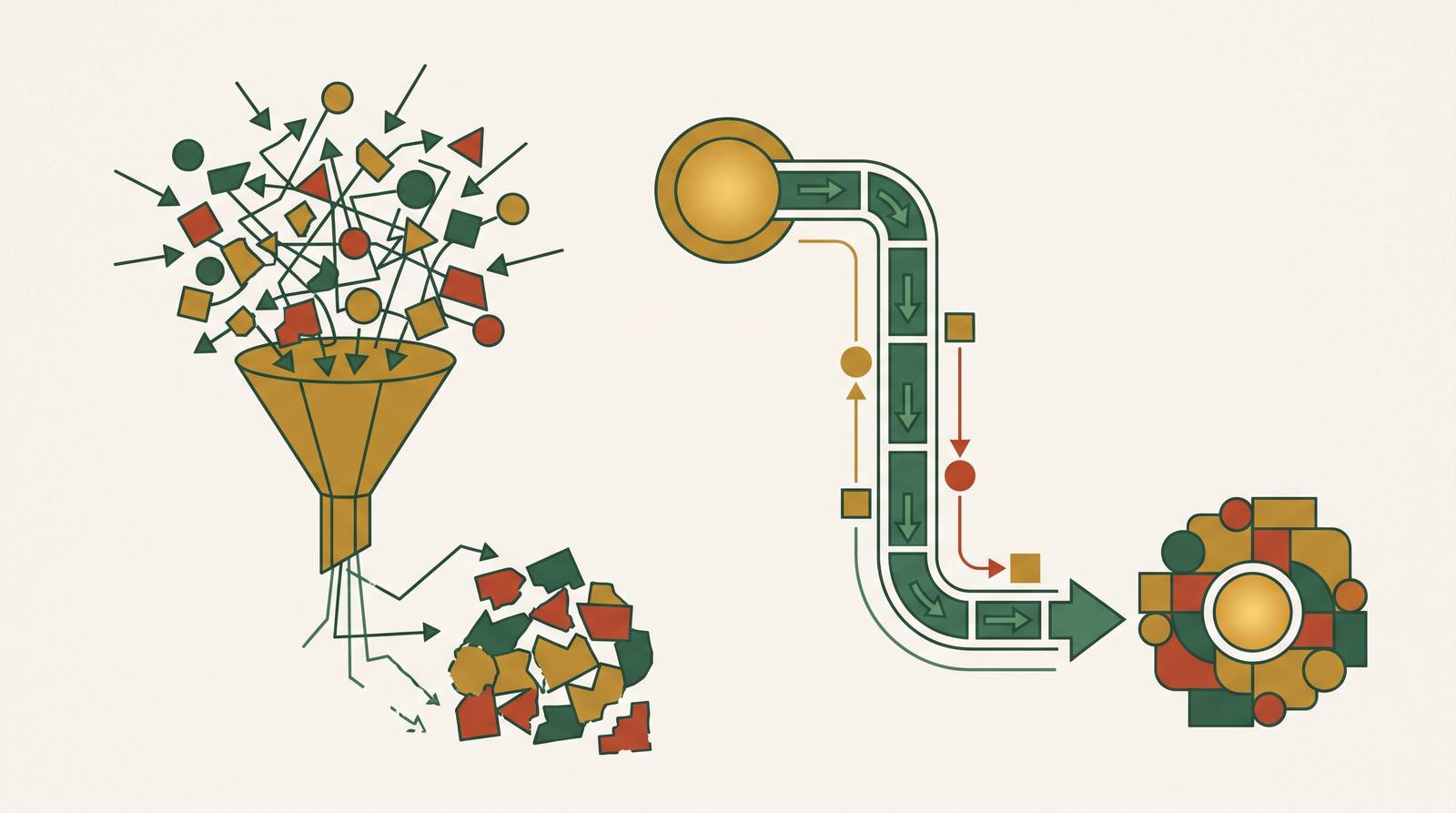
Professional acquirers, whether strategic buyers or private equity firms, spend considerable resources identifying targets with no active sale process underway. This is deliberate. The absence of a process is itself a pricing advantage for the buyer, and they know it before they pick up the phone.
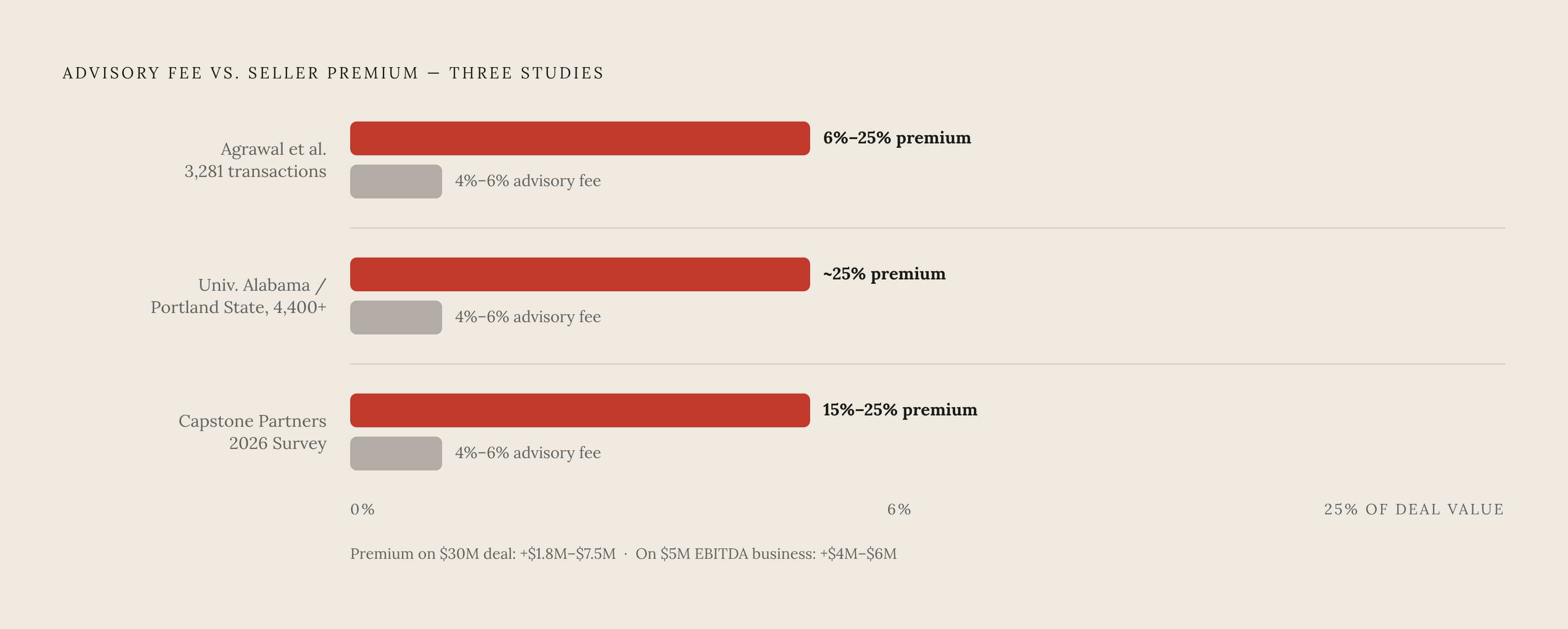
Hiring an M&A advisor to sell your business produces measurably better outcomes than negotiating directly with an inbound buyer. Agrawal et al., analyzing 3,281 private company transactions, found acquisition premiums of 6% to 25% when sellers engaged an advisor; on a $30 million offer, that gap is $1.8 million to $7.5 million. Capstone Partners' 2026 Lower Middle Market Survey puts the enterprise value premium from an investment banking process at 15% to 25% over a single-buyer negotiation, with advisory fees of 3% to 7% representing a smaller percentage of a materially larger number. Beyond price, represented sellers received predominantly cash deals 65% of the time versus 44% for unrepresented sellers, and Software Equity Group documents that well over 80% of founders who managed their own process experienced a retrade, valuation reduction, or unfavorable term shift during diligence.
By the time an offer lands in a founder's inbox, the buyer has already mapped the target against an acquisition thesis, run preliminary numbers on what the business is worth to them specifically, and concluded there is no competing process. That conclusion is priced into the offer. As Stillwater Capital has observed, inbound offer prices typically reflect what the buyer believes they can get away with on both price and terms, rather than what the market would bear under competition.
The seller, by contrast, is reacting. No confidential information memorandum has been prepared. No buyer list has been built. No competitive tension exists. One side has done months of preparation; the other is starting from zero on someone else's timeline. This asymmetry is not incidental. It is the condition under which all subsequent negotiation happens.
The Price Gap Between Represented and Unrepresented Sellers, by the Numbers
The data here is consistent enough across sources that it deserves to be treated as a finding rather than an observation.
Agrawal et al., publishing in the Quarterly Journal of Finance (2023), analyzed 3,281 private company transactions and found acquisition premiums of 6% to 25% when sellers engaged an M&A advisor. On a $30 million unsolicited offer, that gap represents $1.8 million to $7.5 million of value left on the table. A separate study drawing on more than 4,400 transactions, conducted by researchers at the University of Alabama and Portland State, found that represented sellers received valuation premiums of approximately 25%, many multiples of the typical 4% to 6% advisory fee.
The Agrawal study's methodology is worth examining carefully. It controls for selection effects, the concern that sellers hire advisors only in situations where representation already made sense, and the premium survives even after adjusting for deal complexity and seller sophistication. More telling: acquirer returns decline by approximately 7% when sellers are represented. That finding confirms the premium is not a pricing artifact. Value transfers from buyer to seller.
Capstone Partners' 2026 Lower Middle Market Survey reinforces this at the deal-size level most relevant to founder-led businesses: an investment banking process generates a 15% to 25% enterprise value premium over a single-buyer negotiation. On a company generating $5 million of EBITDA, that is $4 million to $6 million of additional sale price. Advisory fees of 3% to 7% are not a cost in the traditional sense; they are a smaller percentage of a materially larger number.
How Competitive Tension Mechanically Produces Higher Prices
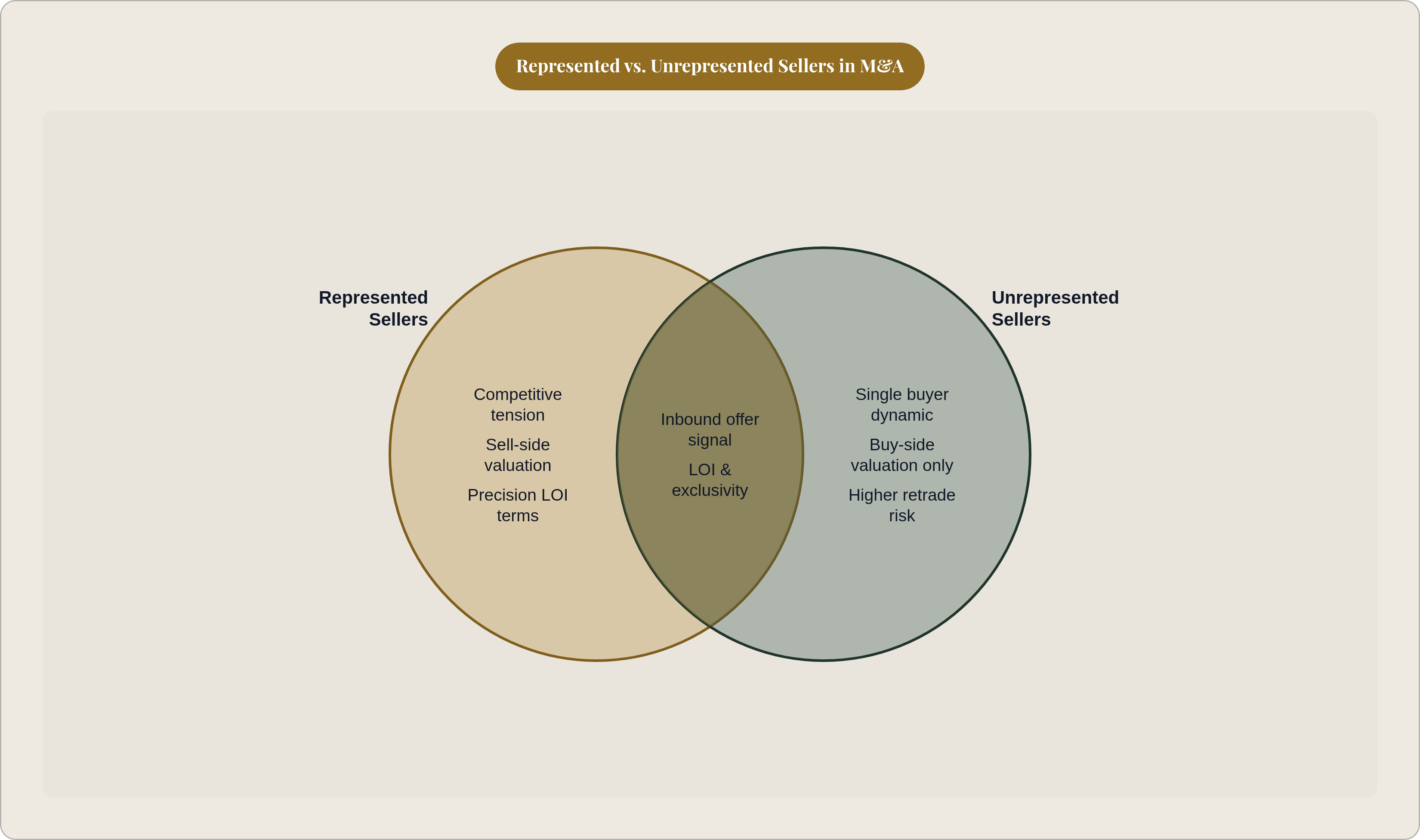
Competition is the most reliable mechanism for price discovery in private M&A, for the same reason it works in any auction market. When multiple qualified buyers evaluate a business simultaneously, no individual buyer can afford to submit a low-ball offer, because they understand others are in the room. Each party's bid reflects their honest assessment of what the business is worth to them, synergy value included, rather than the lowest number they believe an unrepresented seller will accept. The valuation floor rises; the ceiling is set by the most motivated buyer, not the median.
In a structured advisor-run process, the advisor builds a target buyer list of 100 to 300 companies and private equity firms, reaches decision-makers directly with confidential, time-boxed outreach, and manages simultaneous engagement across that universe. Advisors can also share, selectively and skillfully, information surfaced during preliminary diligence that causes buyers to revise their synergy assumptions upward, per FOCUS Investment Banking's documented process approach. Even without a formal auction, the credible impression of competing buyers generates tension that moves price.
Real-world data from Yellow Cardinal M&A shows that marketed transactions in the last 24 months closed on average 36% above their mid-point valuation. SRG's 2025 data, covering 176 transactions and $13.3 billion in aggregate value across calendar year 2024, found that advocated sales obtained 6.91% more value compared to the prior year's average multiple of 3.07x, driven by an average of five offers per listing, up from three in 2023.
A single inbound offer is a single data point. It is not market value; it is one buyer's opening position, presented as though it were.
Cash at Close and Deal Structure Diverge Sharply Between the Two Paths
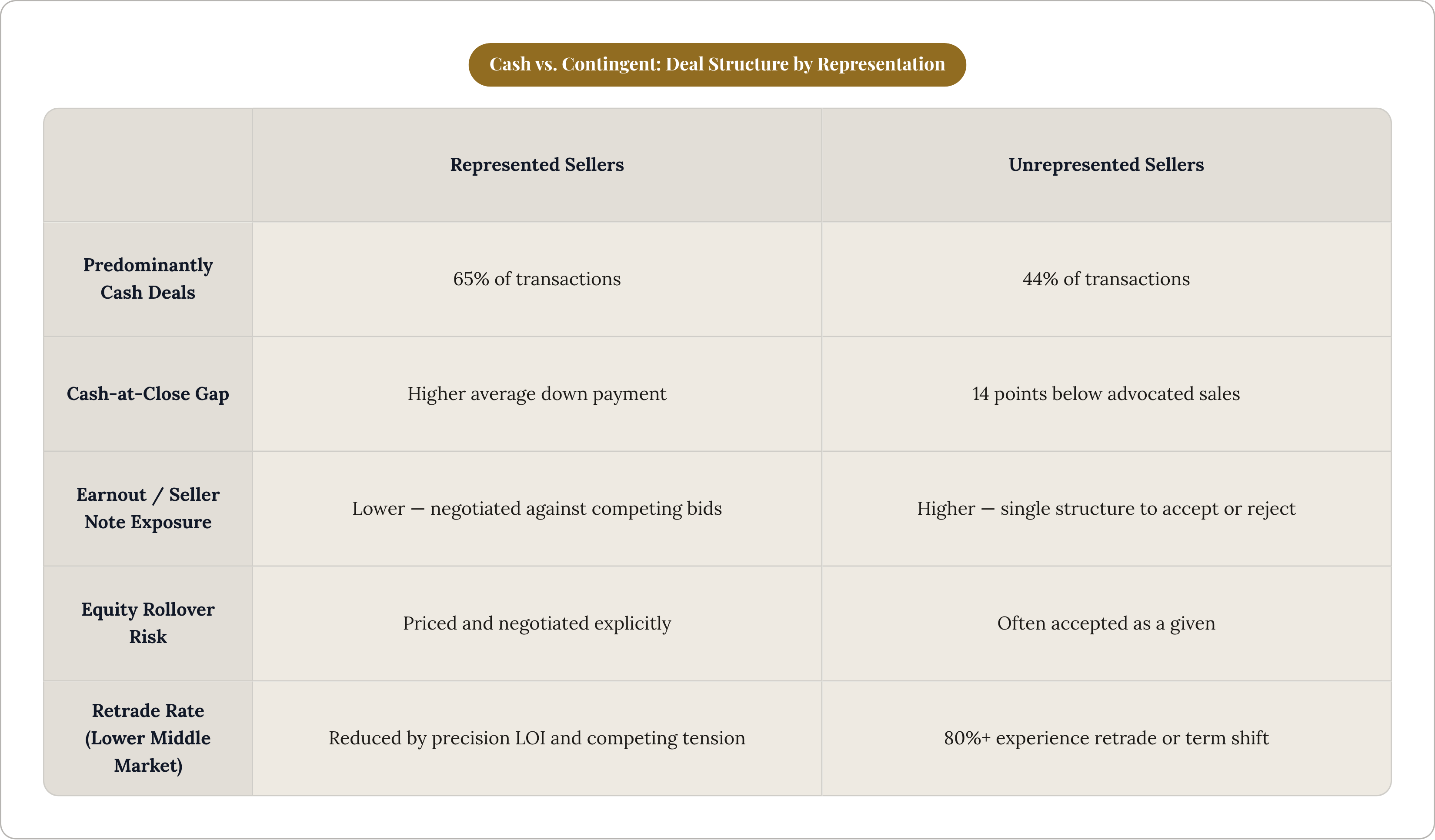
Price captures the headline; structure is where value quietly migrates back to the buyer. An unrepresented seller comparing offer prices may not realize they are comparing a predominantly cash deal against a predominantly contingent one.
Agrawal et al. found that 65% of deals involving top M&A advisors were predominantly cash deals, versus 44% of deals with no representation. That 21-percentage-point gap means unrepresented sellers are far more likely to accept earnouts, seller notes, and equity rollovers. Each instrument transfers risk back to the seller in a specific way. Earnouts make payment contingent on post-close performance the seller no longer controls. Seller notes recast the seller as a creditor of the acquirer. Equity rollovers leave the seller's wealth tied to a business they no longer run. None of these structures are automatically disqualifying, but all of them represent risk that should be priced and negotiated explicitly, not accepted as a given because there is nothing to compare them against.
SRG's 2025 sector data reinforces the structural divergence: advocated sales received a substantially higher average down payment, compared to a meaningfully lower share for non-advocated or private deals, a 14-percentage-point cash-at-close gap. A structured process surfaces these differences across competing bids and creates leverage to negotiate them. A single-buyer inbound negotiation typically presents one structure to accept or reject, incrementally, with no external reference point.
Who Actually Shows Up When There Is No Advisor Running the Process
The buyers who submit unsolicited inbound offers are not a random sample of the acquisition market. They are self-selected, and the selection is not favorable to sellers.
PitchBook's 2024 data shows that the vast majority of private equity add-on transactions are sourced through investment banker or M&A advisor outreach. Add-ons accounted for 8,473 of 11,167 U.S. PE deals in 2024, representing 75.9% of all PE deal volume. These buyers, among the most active and sophisticated participants in the lower middle market, are not submitting cold inbound inquiries. They work through advisor networks. When they do reach out directly, it is because they have identified a target without a process running, and they intend to use that absence as a pricing advantage. Add-on multiples clear at a discount to platform multiples in every size band, in part because the seller is negotiating against one buyer rather than a field.
Broker-listed deals, by contrast, attract a buyer pool that is approximately 46% first-time buyers and 32% serial entrepreneurs, per IBBA's Q4 2025 data. This is a shallower pool with less capital and less deal execution capability. Strategic acquirers with synergy-adjusted valuations, the buyers with the highest willingness to pay, are reached through advisor networks. That access does not exist in the inbound path.
It is also instructive to observe what private equity firms do when they are on the sell side: they hire M&A advisors to run competitive processes. They understand the mechanism from the inside.
Retrade Risk: The Hidden Cost That Shows Up After the LOI Is Signed
A retrade is a post-LOI reduction in purchase price or worsening of deal terms, typically surfaced during diligence after a seller has entered exclusivity and surrendered competing options. Roughly 30% to 40% of lower middle market deals experience at least one retrade between LOI and close. The rates vary by buyer type: search funds and independent sponsors exhibit retrade rates in the 45% to 65% range; strategic acquirers run closer to 15% to 25%. The median retrade in lower middle market transactions represents 5% to 12% of headline purchase price.
The structural problem is a misalignment in how each party reads the LOI. Sophisticated buyers treat it as a placeholder that secures exclusivity while diligence refines the model. Many sellers treat the signed LOI as near-final. FOCUS Investment Banking has named this gap explicitly as one of the primary mechanisms through which value erodes in self-represented transactions.
The sequence can be deliberate. A buyer submits a strong initial offer, earns exclusivity on the strength of it, and then uses diligence findings, some legitimate, some manufactured, to renegotiate downward. Software Equity Group's advisory experience documents that well over 80% of founders who managed their own process experienced a retrade, valuation reduction, or unfavorable term shift during diligence. The cause is not always bad faith; buyers genuinely update their models as information accumulates. But when there is no competing tension to constrain the revision, nothing limits how far the model can move.
Once in exclusivity with a single buyer, the seller has already surrendered the only leverage that was protecting the price.
How Advisors Structurally Reduce Retrade Exposure Before and After LOI
The LOI is where process discipline pays off most visibly. FOCUS Investment Banking's stated approach is to have 93% to 95% of deal terms negotiated before execution, converting the LOI from a placeholder into a near-binding commercial agreement. This reframes the diligence period from an opportunity for the buyer to rebuild the deal on their terms into a confirmatory exercise with limited room to maneuver.
Exclusivity windows matter: advisors push for 45 to 60 days, short enough to preserve competitive leverage while diligence runs. Purchase price mechanics require precision, including working capital pegs, earnout definitions, and adjustment baskets. Representations and warranties scope should be negotiated in advance, not left to buyer's counsel to draft unilaterally. A clean sell-side quality-of-earnings report, combined with multiple live bidders and a precision LOI, eliminates the vast majority of retrade leverage before it can be exercised.
The "multiple live buyers" element is only available inside a structured process. It cannot be recreated after a seller has entered exclusivity with a single inbound buyer; at that point, the competitive tension that was the primary source of leverage is gone.
Deals still fall apart regardless of process quality. Roughly one-third of signed transactions do not close; leading causes include diligence findings, quality-of-earnings discrepancies, financing failure, retrade-triggered seller walkaway, and regulatory or consent breakdowns. Most of these are either prevented or identified earlier inside an advisor-managed process, which is a meaningfully different outcome from encountering them mid-exclusivity with no competing bid in reserve.
How Sell-Side and Buy-Side Advisors Approach Valuation from Opposite Directions
Valuation is not a neutral calculation. It is an argument constructed from methodology choices, and different parties build arguments in opposite directions.
Sell-side advisors anchor to the highest defensible number: precedent transaction multiples, synergy-adjusted strategic value, management-case DCF assumptions. Every methodology choice moves the seller's floor up. Buy-side advisors do the inverse: trading comparables, conservative DCF, leveraged buyout affordability analysis. Every methodology choice justifies the lowest price that still clears the deal.
An unrepresented seller negotiating an inbound offer is confronting a professionally constructed buy-side argument with no equivalent sell-side counterpart. There is no advocate in the room building the other side of the case.
Capstone Partners' 2026 Lower Middle Market Survey adds a refinement worth considering: EBITDA-band-matched advisors generate process outcomes 18% above the median, while mismatched engagements, either over-tiered or under-tiered relative to deal size, underperform by 8% to 12%. The implication is that advisor quality and deal-size fit both matter. For founder-led businesses in the lower-middle-market revenue range, platforms like Succession AI, a tech-enabled exit platform for small and mid-market owners with a network of vetted buyers, illustrate one approach, but the relevant question is not simply whether to hire an advisor but whether the advisor has the buyer relationships, sector expertise, and process infrastructure to execute within that specific market segment. Those are distinct criteria, and conflating them is a mistake that shows up in outcomes.
Is It Worth Hiring an M&A Advisor, or Can You Negotiate Directly with an Inbound Buyer?
The research does not argue that inbound offers should be dismissed. An unsolicited offer is a useful signal that the business is attractive to buyers. It is not useful as a basis for price negotiation when the seller has no alternatives in play.
The consistent finding across academic studies, sector-specific datasets, and practitioner evidence is that a seller's leverage is highest before exclusivity, when competition is real or credible, and when an advisor has negotiated LOI terms with sufficient precision to constrain post-signing erosion. The sequence that produces the best outcomes is not complicated, but it requires resisting the pull of the inbound buyer's timeline. Acknowledge the inquiry without disclosing financials or signaling urgency. Use it as a trigger to assess whether a structured process is warranted. Let the process, not the buyer's calendar, set the pace.
The information asymmetry, the competitive structure, and the terms of engagement are all established at first contact. By the time a founder is comparing an LOI to their expectations, much of what determined the outcome has already happened.