Exclusivity Period Risks for Sellers in M&A Negotiations
Exclusivity periods have doubled in length, shifting negotiating power decisively to buyers.

Standard exclusivity windows have not stayed standard. For PE deals, 60 to 90 days is now typical. Strategic acquirers often move faster, closer to 30 to 60 days, but complex regulated transactions routinely exceed 90 days. These are not outliers; they are the center of the range.
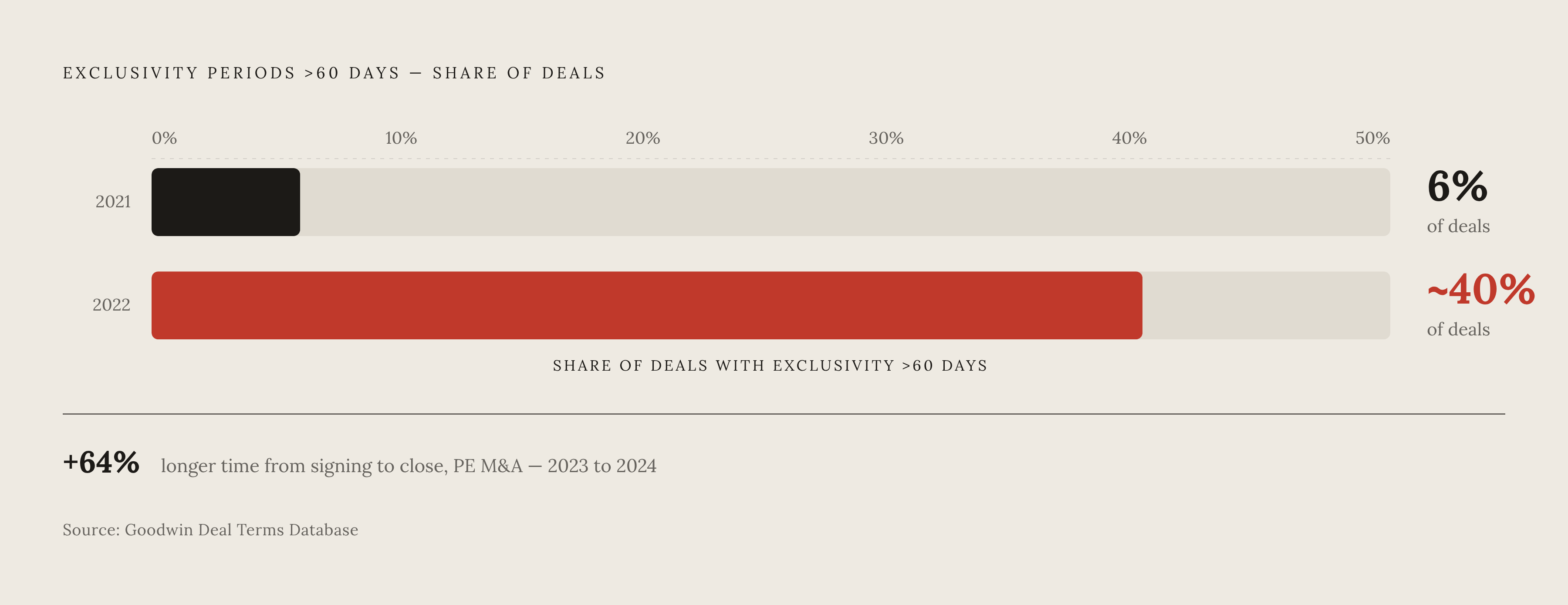
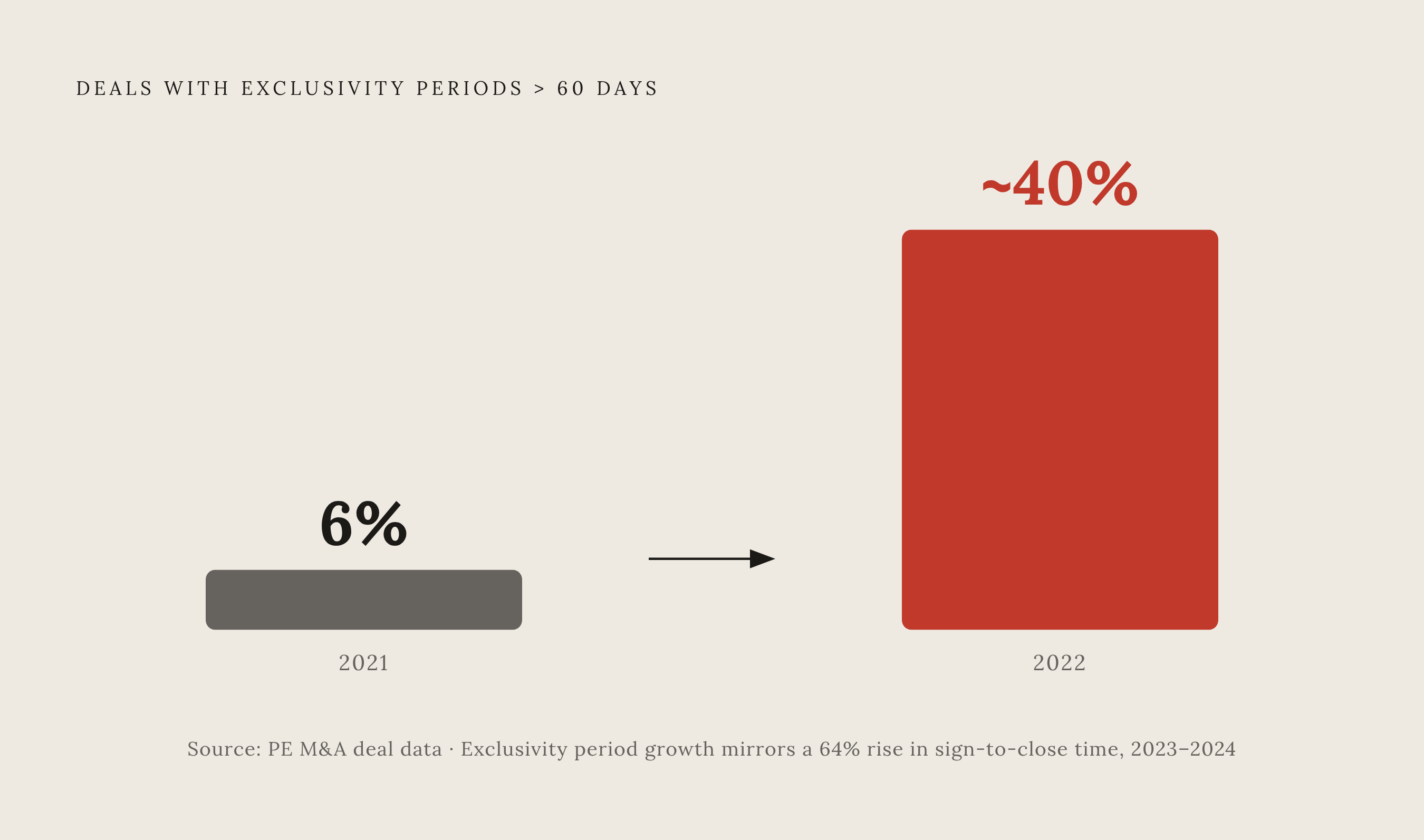
The drift has been measurable. In 2021, only 6% of deals carried exclusivity periods longer than 60 days. By 2022, that figure had risen to nearly 40%, according to Goodwin's Deal Terms Database. The same data shows that time between signing and closing PE M&A deals increased 64% from 2023 to 2024. Longer closings require longer exclusivity runway, and buyers have internalized that logic at the LOI stage.
Several forces compound the trend. Slower deal flow in certain segments has shifted bargaining power toward buyers precisely when exclusivity terms are being set. Heightened diligence standards mean buyers want more time before committing capital. And institutional buyers, whether PE firms or large strategics, have learned to fill whatever window they are given; the workload expands to match the time available, not the other way around. The pressure is most acute for sellers engaging institutional buyers, who near-universally require extended windows as a condition of proceeding. Granting exclusivity today often means committing to a duration that would have felt aggressive just a few years ago.
Why Competitive Tension Disappears the Moment Exclusivity Is Signed
Before exclusivity, a seller's most durable negotiating asset is the credible threat of alternatives. Competing buyer interest does not need to be explicit to be effective; it simply needs to be plausible. That plausibility disciplines buyer behavior throughout early-stage negotiation.
The moment exclusivity is signed, that threat becomes legally unenforceable. A better offer could materialize the following week, and the seller could not pursue it without breaching a binding contract. Buyers understand this. The competitive urgency that pushed them to move quickly and price aggressively dissipates once they have the window secured.
There is a subtler cost that often goes unexamined. Granting exclusivity too early, before other buyers have had a real opportunity to engage, reduces the incentive for those parties to move at all. Why accelerate when the target is already off the market? The overall timeline lengthens while the seller's ability to benefit from competition simultaneously shrinks. The leverage a seller retains inside the window is narrow: walking away entirely terminates months of work and forces a restart from a weaker market position, and threatening to let exclusivity expire is only credible if the seller is willing to act on it. As time passes, that willingness typically erodes.
Exclusivity signals that a deal is progressing. It also, structurally, marks the moment when the seller's capacity to improve terms reaches its floor.
How the Loss of Competition Creates the Conditions for a Retrade
A retrade is a post-LOI reduction in price or adverse change in terms, initiated by the buyer and typically justified by something surfaced during diligence. In the lower middle market, retrades are not rare; when they occur, the headline price reduction commonly falls in the range of 5 to 12% of the original figure.
The most common triggers are working-capital adjustments, quality-of-earnings EBITDA normalizations, and customer concentration findings. All three are foreseeable categories of diligence inquiry. None requires bad faith from the buyer; they are the legitimate outputs of thorough review. The problem is what the structure of exclusivity does to the seller's ability to respond when a buyer deploys them.
By the time a retrade arrives, the buyer has invested weeks of professional fees and management attention. The seller, meanwhile, has no competing bid to anchor against. The argument that another buyer valued the business higher is only persuasive if there is actually another buyer. Exclusivity has foreclosed that possibility. Retrades tend to arrive late in the window, when the seller's sunk costs are highest, the emotional investment in the deal is deepest, and the prospect of restarting from scratch feels most punishing. Exclusivity windows longer than roughly 75 days are associated with substantially higher retrade risk, precisely because they give the buyer's diligence process more surface area to find issues and give the seller's reluctance to walk more time to calcify into something closer to paralysis.
What Happens When the Deal Falls Apart Inside the Exclusivity Window
Roughly one third of signed letters of intent do not result in a closed transaction. More than 60% of failed deals trace to something discovered in diligence or to the retrade that discovery produced, according to transaction data covering a sample of unsuccessful lower-middle-market deals. Financing-related failures, once a significant driver of dead deals, have declined as a share of the total even as diligence-driven failures have grown.
Consider what a seller absorbs when a deal collapses in week ten of a 90-day window. Three or more months of management attention have been consumed, attention that was not applied to running and growing the business. Legal and advisory fees have been paid with no transaction to show for them. The return to market raises a question every subsequent buyer will ask: why did the last buyer walk? And the information shared during diligence cannot be un-shared.
The 2025 SEC filing related to the Big 5 Sporting Goods process captures this dynamic in compressed form. A buyer entered confirmatory diligence, discovered a debt balance materially above budget mid-period, and the window required a 15-day extension before negotiations could resolve. Late-stage discovery, a shift in negotiating dynamics, a process that extended beyond its original boundaries under pressure. None of it was unusual. That is precisely what makes the timeline instructive.
How Confidential Information Shared During Diligence Becomes a Lasting Exposure
The information transferred during diligence is not abstract. Customer lists, supplier terms, margin data by product line, key employee compensation structures: these are the operational details a competitor could use and a sophisticated buyer will study closely. Confidentiality agreements are standard and necessary. They are also imperfect; they constrain formal misuse but do not reach the informal knowledge a buyer's deal team carries away from months of immersion in the seller's business.
The more immediate risk, though, is not the buyer's post-deal conduct. It is what leaks outward during the process itself. When word of a potential sale reaches employees, a predictable cascade follows: key people begin assessing their options, competitors approach the seller's customers directly, vendors may tighten credit terms in anticipation of an ownership change that may or may not materialize.
Customer attrition during a prolonged process has direct valuation consequences. In a business priced at a revenue multiple, a modest loss of customers mid-process reduces the purchase price by a multiple of the revenue lost, before closing. I have watched sellers arrive at this arithmetic mid-process, penciling it out on a legal pad during a call that was supposed to be about something else entirely, and you could see the moment it landed. The conversation usually gets quieter after that.
The longer the exclusivity period, the greater the probability of a leak. Each additional week of activity, site visits, consultant interviews, third-party surveys, introduces additional vectors for disclosure. Exposure does not arrive as a single event. It accumulates quietly, eroding business value in the background while the formal negotiation continues in the foreground.
The Sunk-Cost Dynamic That Keeps Sellers Negotiating Past the Point of Rationality
When exclusivity expires without a signed definitive agreement, the seller is technically free to re-engage other buyers. In practice, they rarely do.
Legal and advisory fees already paid represent real money with no return yet attached. Months of management attention have been diverted from operations. More powerfully, the seller has often already internalized the deal narrative: this is the buyer, this is the number, the announcement is being drafted somewhere in imagination. Abandoning that narrative requires accepting not just financial cost but something closer to psychological defeat.
Buyers who understand this dynamic, and experienced acquirers do, have an incentive to allow the process to drift inside a long window, applying quiet pressure without formal renegotiation. The result is de facto exclusivity that extends beyond the legal period. The seller, no longer contractually bound, behaves as though they still are.
The behavioral economics literature on sunk costs is well established: people systematically overweight prior investment when making forward-looking decisions, even when that investment is irrecoverable. In M&A, this tendency is acute and expensive. The seller who has spent 90 days and substantial professional fees in a process is not evaluating the next 30 days with fresh eyes. They are evaluating through the lens of everything already spent, which is precisely the wrong frame for the decision in front of them. The moment to establish a firm, internally agreed walk-away point is before the process begins. By week twelve, when the buyer has just submitted a revised term sheet, that conversation is nearly impossible to have with any clarity.
What Sellers Can Negotiate Before Signing to Limit Each of These Exposures
The exclusivity clause is negotiable. Most sellers do not push on it aggressively because the LOI stage feels like the wrong moment to create friction with a buyer who has just made an offer. That instinct is understandable; it is also costly.
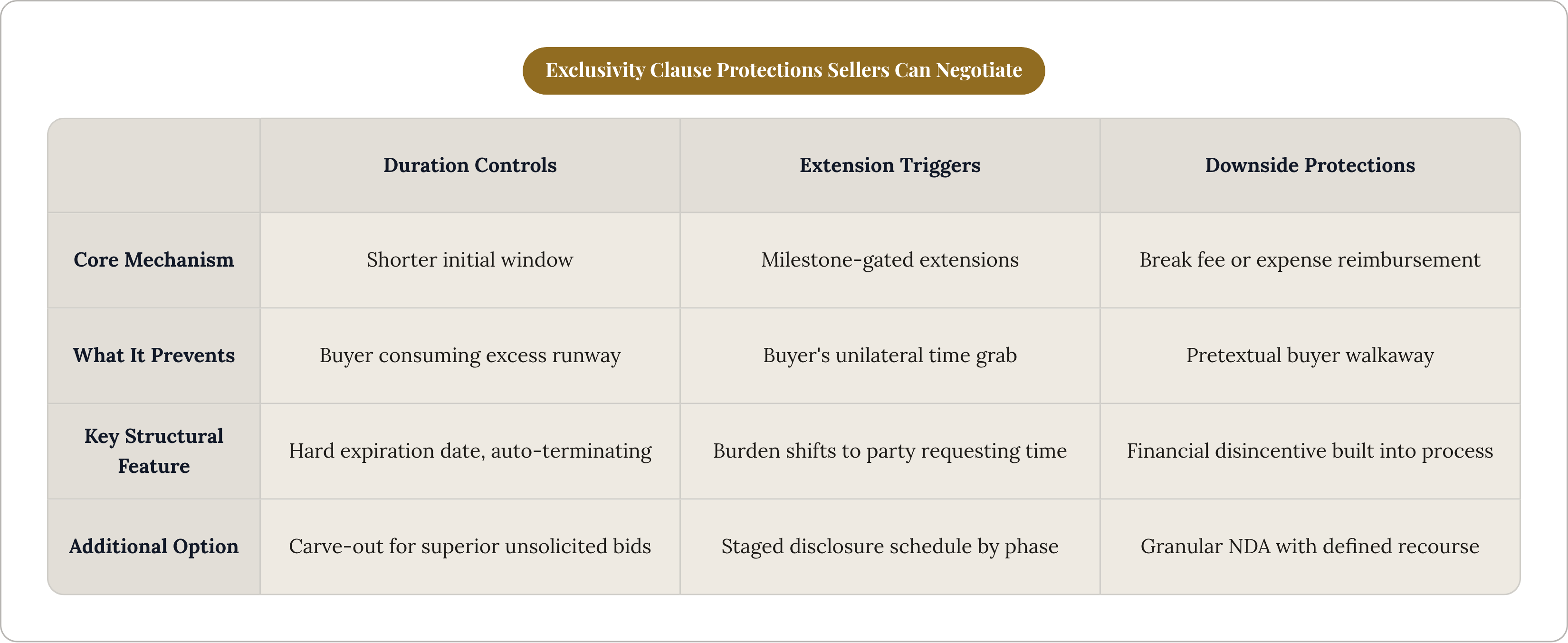
Duration is the most obvious lever. A shorter initial window, with extensions available only upon satisfaction of defined conditions, is a reasonable starting position. A seller with documented competing interest has real grounds to compress a timeline the buyer is treating as standard. Automatic expiration on a hard date, without requiring the seller to take affirmative action to terminate, prevents passive extension by buyer inaction; without this provision, ambiguity about whether exclusivity has technically lapsed becomes a tool. Milestone requirements for any extension convert that extension from a buyer's unilateral option into a mutual checkpoint, shifting the burden to the party asking for more time.
Carve-outs for unsolicited superior proposals matter most for seller boards with explicit fiduciary obligations, but they are worth pursuing in any transaction where the seller is uncertain whether the current offer reflects full market value. The carve-out does not break exclusivity; it ensures that an inbound offer of clear superiority can be evaluated without triggering breach. Break fees or expense reimbursement provisions, payable if the buyer terminates without cause, shift some of the sunk-cost exposure back across the table. The Big 5 process shows that these mechanics are actively negotiated even in less complex transactions. They do not make the seller whole if the deal dies, but they create a financial disincentive for the buyer to walk on pretextual grounds.
Confidentiality provisions with staged disclosure schedules, defining exactly what information can be shared at each phase and what happens to it if the deal does not close, add specificity that a generic NDA does not provide. Granularity here is not bureaucratic fastidiousness; it is what establishes recourse if misuse occurs.
None of these clauses, individually, is the point. A seller who arrives at the LOI stage with multiple credible, documented bids from qualified buyers negotiates every one of these terms from a position of real strength. That strength is built in the competitive process that precedes exclusivity. It does not evaporate because exclusivity is signed; it is preserved in the terms the seller extracted before signing.
How Working with Experienced Advisors Changes the Exclusivity Negotiation
The information asymmetry in an exclusivity negotiation has a straightforward source. Institutional buyers negotiate these clauses repeatedly, across dozens of transactions, with dedicated legal counsel tracking market precedents across the industry. Most founders negotiate exclusivity once. The gap in pattern recognition has nothing to do with the seller's sophistication in their own business; it is simply a function of how frequently each side has done this particular thing.
Experienced M&A advisors bring specific and measurable capabilities to this stage. They carry benchmark data on durations, carve-out norms, and break-fee ranges for comparable transactions. They can run the competitive process before exclusivity is granted, so the seller arrives at the LOI stage with verified competing interest rather than a single offer and implicit pressure to accept its terms. Withsuccession, an AI-powered M&A platform for founder-led businesses that combines algorithmic buyer matching with investment banking advisory to help owners in the $500k–$50M revenue range run structured competitive processes, is one example of how that pre-exclusivity groundwork gets built. Pushback on aggressive provisions is more credible coming from a professional acting on behalf of a client than from a founder directly, and it is less likely to damage a relationship the seller will need to sustain through closing. Advisors also remain present during the exclusivity window, where their primary value is distinguishing a negotiating tactic from a substantive concern worth conceding on. Those two things look nearly identical from inside the process.
For founder-led businesses in the middle and lower-middle market, the cost of a poorly negotiated exclusivity clause, measured in lost competitive tension, a meaningful retrade, or a failed process that consumes months and leaves the seller weaker than they started, typically exceeds the cost of professional advisory support. That is a pattern observable across enough transactions to treat seriously, not a guarantee.
The sellers who fare best are not the ones who refuse exclusivity or treat the clause as a battle to be won. They are the ones who arrive at that conversation having already done the hard work: extracted maximum competitive value from the process that preceded it, established internally what they will and will not accept, and negotiated terms that distribute the risks of the window more fairly between the parties.