Founder Health Events That Accelerate an Unplanned Business Exit
Half of all founder exits are involuntary, driven by health crises you can prevent.
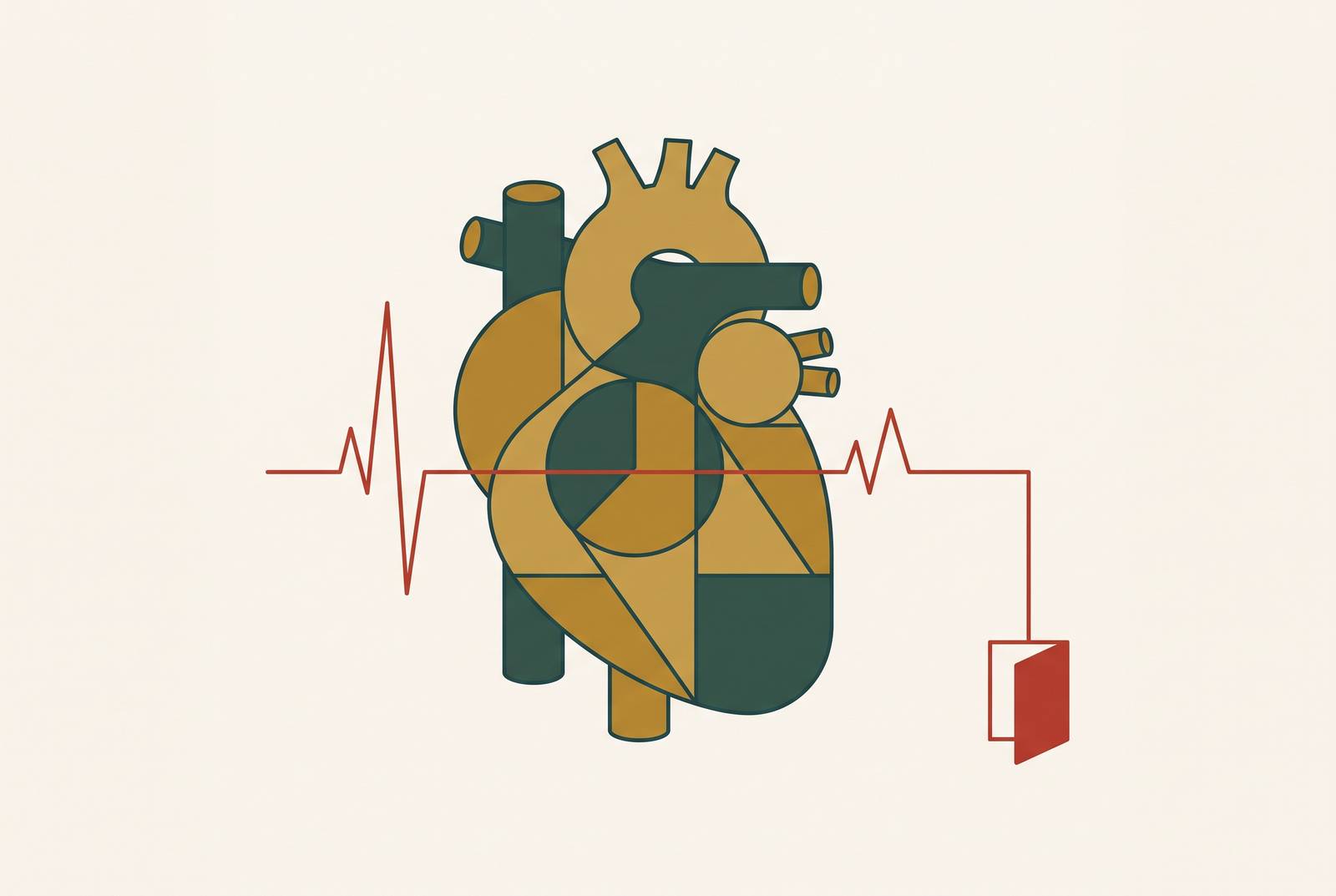
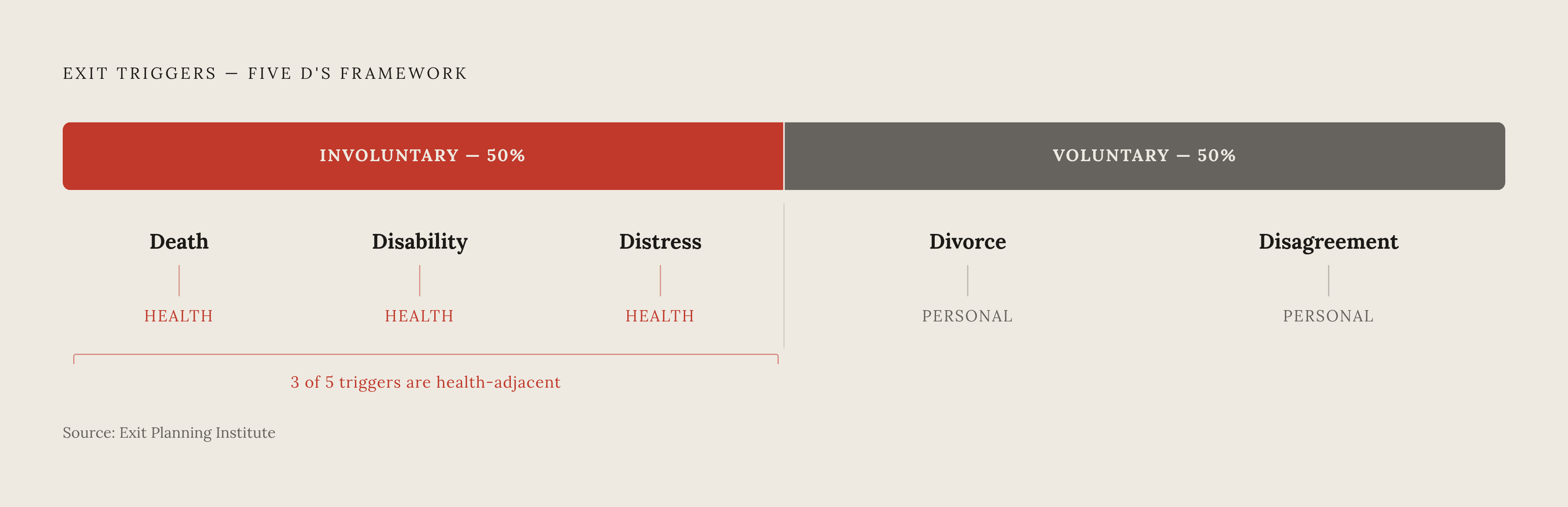
Most founders picture their exit as a choice: a negotiated sale, timed on their own terms, at the top of the market. The Exit Planning Institute's research says otherwise. Its "Five D's" framework, death, disability, divorce, disagreement, and distress, shows that roughly half of all owner exits are involuntary, and three of those five triggers, death, disability, and distress, are health-adjacent. Together they form the dominant path by which founders lose control of their own exit. This piece walks through the mechanics of each one, because understanding how they unfold is the only way to build defenses before the crisis, not during it.
What a founder's death does to the business left behind
Death is the trigger every founder nods along to and almost none plan for. It gets acknowledged in the abstract, filed under "someday," and buried beneath the fifty more urgent things on this week's calendar. There is always something more pressing, until there isn't, and by then the calendar problem has become a legal one.
The research on what actually happens is stark. Academic studies of founder death document steep revenue drops, real job losses, and materially lower survival rates for the firm in the two years that follow. Available research puts the failure rate at roughly 70% of businesses collapsing within a decade of the founder's death. The ones that survive often do so only after absorbing enormous value destruction along the way, which means "survival" in this context is a low bar, not a reassuring one.
Here's what ought to reframe how owners think about it: for most founders, the business is the single largest asset the family holds, larger than the house, larger than any retirement account. It is also the one asset with no liquid market and no guaranteed buyer waiting in the wings. Stocks sell Monday morning, while a privately held company does not.
The mechanism behind the collapse is almost always identical, and it is worth naming precisely because it is so preventable. Without a named successor, without documented signing authority, and without a funded buy-sell agreement in place, the company falls into a legal and operational vacuum the moment the founder dies. Who can sign checks? Who has authority over payroll? Who owns the equity now, and can that person actually run the business, or do they just inherit a piece of paper? These are not rhetorical questions; they are the exact questions a probate court, a bank, and a panicked management team all end up asking simultaneously, usually with no good answer on file. Planning for death is not pessimism; it is the foundation everything else in this piece rests on, and skipping it is the single most avoidable failure among the five.
Why disability is more likely than death to disrupt a business mid-career, and harder to manage
Consider odds most founders have never actually been told: a 40-year-old founder faces roughly a one-in-three chance of experiencing a disability lasting 90 days or more before reaching retirement age, according to the Council for Disability Awareness. Death planning at least deals with a single, final event, whereas disability is messier, because the founder might come back, and that "might" is the whole problem.
Disability creates a holding pattern. The business has to keep functioning during an absence of unknown length, while employees, clients, and lenders wait to find out if the founder is returning next month or never. Nobody knows how long to wait, so nobody plans around a fixed date. Co-founders or partners either overstep their authority trying to fill the gap, or freeze entirely out of deference to a boss who technically still owns the company but isn't there to lead it. Neither response is wrong exactly; both are what happens when nobody wrote down what should happen instead.
Even a successful recovery can create its own instability. A founder who returns after months away often comes back to a business that reorganized around the absence, and reintegrating into a company that learned to run without them can generate the kind of internal conflict that destabilizes operations right as things were stabilizing.
Reporting from physicianleaders.org illustrates how this plays out: a founder's sudden health crisis forced an abrupt exit with no succession plan in place, and the person who stepped in lacked the skills to lead at the scale the business had grown to, leaving the company to falter under the transition. That is not a failure of effort, but a failure of preparation, and it is exactly what a buy-sell agreement and a documented authority structure exist to prevent.
Disability planning requires two things death planning doesn't. First, a temporary authority structure covering the recovery window, someone empowered to act now, not after a court sorts it out. Second, a clear trigger definition specifying exactly when a buy-sell provision activates, so "how long do we wait" isn't a question anyone improvises under pressure.
How burnout becomes a slow-motion forced exit
Burnout doesn't announce itself the way a heart attack or a diagnosis does, and there's no single moment of incapacity to point to. Performance degrades gradually instead, and the founder rationalizes each decline as temporary: a rough quarter, a bad month, something that'll pass once the current fire is out.
The scale of the damage is larger than most founders assume, and it deserves to be said plainly: burnout kills more companies than competitors do. Octopus Ventures data, cited by Stealth Agents in 2026, attributes 65% of startup failures to founder burnout or internal conflict, not market conditions, not product-market fit, not a failure to raise capital. It isn't the competitor down the street that ends most companies; it's exhaustion, and founders who spend their risk-planning energy watching the market instead of watching their own capacity are watching the wrong thing.
What makes this trigger dangerous is how well it hides. Research from psalmlog.com in 2025 found that 73% of tech founders report experiencing "shadow burnout," continuing to hit surface-level business goals while their health quietly deteriorates underneath. The dashboards still look fine, and revenue might even still be climbing. Meanwhile the founder's judgment, patience, and capacity for long-term thinking erode in ways that don't show up on any report until they suddenly do.
The Built to Sell PREScore dataset, drawing on more than 10,000 assessments collected over six years, found that burnout, not retirement readiness, was the single leading reason founders wanted out of their businesses. Sit with that: most owners aren't exiting because they hit a planned milestone; they're exiting because they can't keep going. That means most of these exits are reactive rather than strategic, decided under duress rather than timed for value.
That reactive posture shows up directly in deal outcomes. A burned-out founder walking into due diligence brings eroded trust and emotional exhaustion into every negotiating session, and buyers notice. Sophisticated acquirers price in operational risk tied to a founder who seems distracted or depleted, and that shows up as a valuation haircut, sometimes a significant one. Employee morale tends to slide in parallel, since staff notice a checked-out founder well before any outside buyer does.
Call it the fire sale dynamic. A founder who waits until burnout is severe before starting a sale process has already lost the ability to time the market. The sale isn't driven by favorable conditions anymore; it's driven by the founder's internal state, and buyers can tell the difference. Research consistently finds that businesses without a succession plan lose a significant portion of their value during an unplanned ownership transition, and burnout-driven exits sit squarely among the least planned of all.
The mental health conditions underneath the burnout numbers
Burnout is often just the visible surface of something that's gone undiagnosed for far longer. Depression, anxiety, or ADHD sit beneath the exhaustion, and these conditions rarely get named, either because founders are too busy running the business to notice, or too wary of what naming them might cost.
UCSF research on entrepreneurial mental health found rates of depression and anxiety among founders that far exceed general population benchmarks. That gap is worth pausing on. Founders are not simply people running businesses under stress; they are, as a population, disproportionately carrying conditions that stress makes worse.
So why doesn't more get done about it? Stigma is a large part of the answer, and it isn't abstract. Research has found that a significant share of HR managers said they would not hire someone with a depression diagnosis into an executive role. Founders absorb that signal fast, and the response is predictable: stay quiet, push through, defer treatment until the condition has already started shaping strategic decisions in ways nobody can undo after the fact.
The care gap compounds the silence. Research has found that only a small minority of founders actually engage with a psychologist or a coach, and among those who don't, cost and time are the dominant cited barriers. That's a solvable problem in theory, but in practice it rarely gets solved, because solving it requires admitting there's something to treat, and admitting that is precisely what the stigma above makes expensive.
Here's the exit-relevant part: untreated mental health conditions don't stay contained to the founder's personal wellbeing. They shape strategic judgment, affect staff retention, and degrade the quality of decisions made during exactly the moments, like a sale process, that require the clearest thinking a founder can offer. And because underreporting is baked into every statistic above, the true share of founders affected is probably higher than any of these numbers suggest.
The physical health pathway: how chronic stress compounds into cardiovascular risk
Chronic occupational stress isn't only a mental health story. It carries a documented physical toll, and the cardiovascular pathway deserves more attention than founders typically give it, in part because it produces no symptom until it produces an emergency.
Work-related stress has been associated with a meaningfully increased risk of cardiovascular disease. Research goes further, linking chronic mental stress independently to coronary artery disease and stroke, separate from the conventional risk factors like diet, weight, or family history that founders might assume are the only things worth watching.
The mechanism runs on two timelines at once. Chronic stress accelerates atherosclerosis gradually, over years, while acute stress events, a sudden crisis, a brutal week, a blowup with a partner or investor, can trigger acute coronary events in the moment. The founder grinding through ongoing burnout isn't only risking a mental health collapse; that same founder is accumulating physical risk on a separate but connected track, and the two tracks tend to arrive together, not politely one after the other.
Sleep is the amplifier tying both tracks together. Under chronic stress, sleep becomes fragmented, and according to Diana Chu, LMFT, writing in 2026, the brain under those conditions starts prioritizing threat detection over deliberation. That degrades the quality of every decision the founder makes, not just the big strategic ones but the small daily judgment calls that accumulate into a company's direction. The path from "founder under pressure" to "founder who cannot run the business" runs through a cardiac event just as easily as it runs through a mental health collapse, and neither one arrives with a warning label attached.
Why founder-dependent businesses suffer more when any of these events hits
None of the damage above is fixed in size. It scales directly with how much of the business runs through the founder personally: their relationships, their knowledge, their daily approvals.
Most founders never built that dependency on purpose; it accumulated. Clients got used to calling the founder's cell phone directly, and approvals started routing through the founder's inbox because it was faster than building a process. Institutional knowledge, who the difficult vendor is, why one client needs special handling, how the pricing model actually works, ended up living in the founder's head instead of in any document. Truliance Consulting's 2026 research frames this plainly: if a business can't function when the founder steps away temporarily, it's carrying hidden risk every day it operates. A health event doesn't create that risk; it exposes what was already there.
Each trigger interacts with this dependency differently, and the differences matter enough to separate out. With death, the knowledge walks out permanently, with no recovery window to plan around. With disability, operations need to continue for an undefined stretch without the person everything used to route through. With burnout, the founder is still physically present, which is almost worse, because the degradation happens below the surface until it suddenly shows up as client churn or a wave of staff departures nobody saw coming.
Buyers already know all this, which is exactly why the founder should not be the last one to figure it out. Sophisticated acquirers run founder-dependency tests as a standard part of due diligence, and a business that can't demonstrably operate without its founder gets one of two outcomes: a lower offer, or a longer earnout period designed to force the founder to stick around and prove the business survives the transition. Dependency gets priced in, every time, and pretending otherwise doesn't change the number on the term sheet.
The fix is the same no matter which trigger a founder happens to worry about most: documented processes that don't live only in someone's head, delegated authority that's actually been exercised and tested, and a leadership bench deep enough that no single person's absence stops the business cold.
How few founders have the legal and financial structures to survive any of these events
Here's the disconnect worth sitting with: most founders know, intellectually, that exit planning matters, yet far fewer have done anything about it, and that gap between knowing and doing is the real subject of this section.
Brown Brothers Harriman's research from October 2025 found that roughly half of private business owners have a formal succession plan in progress, while nearly a third have none at all. The U.S. Bank Small Business Perspective Survey, also from 2025, drawing on a sample of 1,000 owners, found similar numbers: the majority of owners who said building generational wealth mattered to them had never formalized a plan to protect it. Wanting something and preparing for it turn out to be two different behaviors, and the data says most owners are stuck on the wanting.
The pattern holds outside the U.S. too. A Deloitte survey of Canadian family-owned companies found that half had only an informal succession plan in place, a third had none at all, and only a small minority had gone so far as to formally designate a successor. That leaves the large majority of these businesses exposed to exactly the kind of untimely death or disability scenario described earlier, with no structure ready to absorb the shock.
The timing pressure is only getting worse. An estimated 2.3 to 3 million baby-boomer-owned businesses in the U.S. are expected to change hands this decade, and with only roughly 30% of listed small businesses actually succeeding in selling, preparation is increasingly what separates the owners who capture the value they built from the owners who don't.
What's missing, in most cases, comes down to three documents, and it's worth being blunt about how few founders have all three: a funded buy-sell agreement covering death, disability, and voluntary departure; a documented temporary authority structure specifically for disability scenarios; and a formal succession plan with a named, prepared successor or a clearly defined exit pathway. The Exit Planning Institute's 2023 research adds a wrinkle worth noting: a large majority of owners said they'd sought advice on business transitions, yet an even larger share still lacked a formal transition team in place. Seeking advice is not the same as acting on it, and the businesses that fail under one of these five triggers are disproportionately the ones that stopped at the advice stage.
What the window for preparation actually looks like — and when it closes
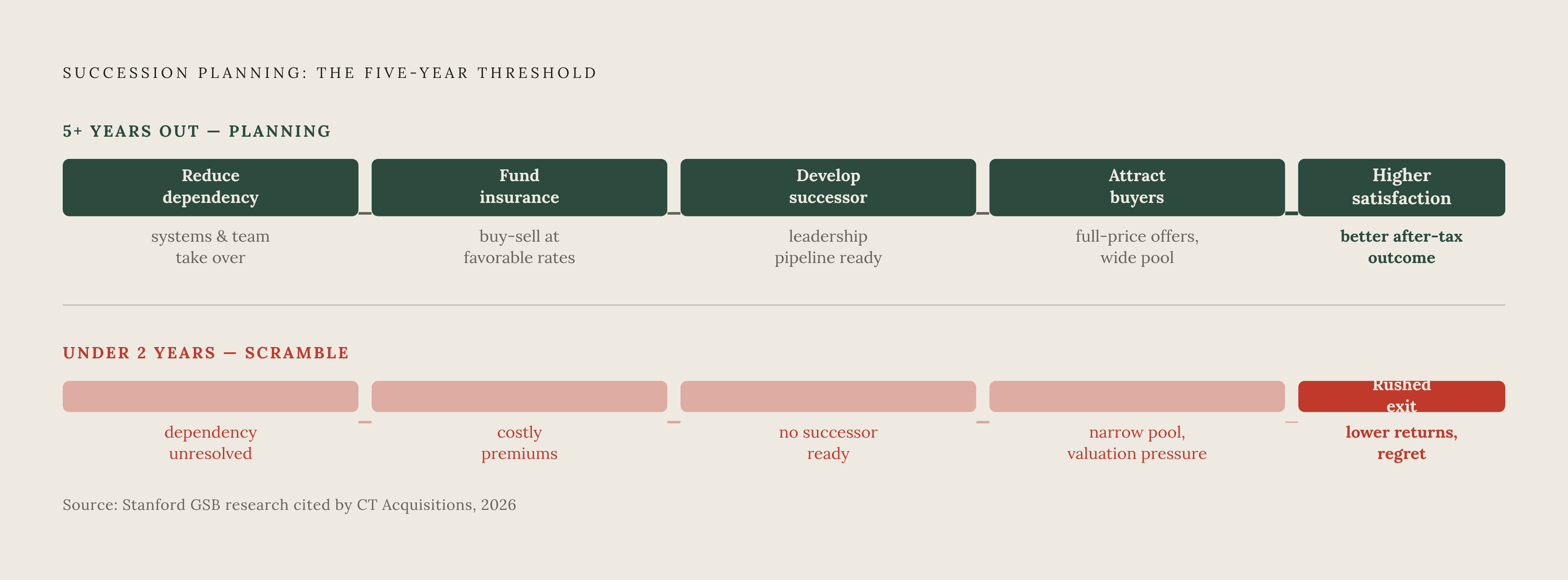
Stanford's Graduate School of Business ran a Family Business Survey that found something worth internalizing: owners who start formal succession and exit planning more than five years before a transition report significantly higher post-sale satisfaction and better after-tax outcomes than owners who start inside a two-year window, according to figures cited by CT Acquisitions in 2026.
Five years isn't a round number chosen for convenience. It's roughly the span it takes to do four things properly: reduce operational dependency in a methodical way rather than a last-minute scramble; fund a buy-sell agreement through life and disability insurance at rates that are still favorable, since insurance costs only rise as a founder ages or health issues emerge; identify a successor, develop that person, and test them in the role before the founder's exit becomes real; and position the business to attract buyers willing to pay a price reflecting what the company is genuinely worth, not a discount reflecting rushed circumstances.
Compress that same process into under two years and the picture changes considerably: rushed decisions, a narrower buyer outreach, operational dependency that can't be unwound on short notice, and valuation pressure stacking up from every direction at once. Two years is not a planning window, but a scramble with a deadline attached.
There's a timing wrinkle worth flagging too. U.S. Bank's 2025 research found that a growing share of owners have seen their own expected exit dates move earlier than originally planned, which raises an uncomfortable question worth asking directly: how many founders reading this are already inside that five-year window without having registered it yet? Whether a founder is three years out from a planned sale, or simply aware that any of the triggers covered in this piece could arrive without warning, the preparation steps don't change, and earlier beats later, without exception.
The concrete steps that reduce exposure to each trigger
Every step below does two things at once: it reduces exposure to a health-triggered exit, and it makes the business more valuable to whoever eventually buys it. That's not a coincidence, since buyers and life circumstances end up asking for the same thing.
For death, three things matter most. A funded buy-sell agreement that specifies the valuation methodology up front and legally obligates the company or co-owners to purchase the founder's interest when the time comes. Key-person life insurance sized to cover the revenue disruption that follows a founder's death and to fund the buyout without straining cash flow at the worst possible moment. And a named successor, or at minimum a documented sale pathway, so an estate doesn't end up holding an unsellable minority stake in a business nobody can run or price.
For disability, the list shifts. Buy-sell provisions need a disability trigger built in, with a defined waiting period spelled out before it activates, so nobody is guessing how long is too long. Signing authority and decision rights need to be documented and delegated to a second person, effective immediately upon incapacitation, not activated by a committee vote after the fact. And disability insurance needs to be sized for two separate things at once: personal income replacement for the founder, and business overhead coverage during whatever the recovery window turns out to be.
Burnout requires a different kind of preparation, since there's no single triggering event to plan around. It starts with recognizing the early behavioral signals: persistent sleep disruption, a founder pulling back emotionally from the business, a noticeable decline in decision quality, an inability to engage with anything longer-term than this week's fire. From there, the priority is reducing operational dependency before burnout peaks, not after, so the business can run through a deliberate, longer exit process instead of a rushed one. And where possible, starting a structured sale process while the founder still has the capacity to negotiate well, rather than waiting until crisis forces the timeline and strips away all the leverage.
Across all three triggers, one preparation step outranks the rest, regardless of which one arrives first: a formal exit plan, built around a documented valuation, an identified universe of potential buyers, and an actual transition roadmap. Everything else in this piece, the insurance, the authority documents, the successor development, feeds into that plan, and none of it substitutes for having one. For Canadian founders specifically, combining AI-driven buyer matching with investment banking advisory can meaningfully compress the time between the decision to sell and an actual close, and that compression matters most precisely when a health event has already shortened the runway. Technology that surfaces qualified buyers faster, paired with experienced human guidance through the negotiation itself, tends to produce better outcomes than either one manages alone.