Indemnification Escrow Mechanics in Lower Middle Market Deals
Multiple escrow pools in LMM deals cost sellers far more than headline numbers suggest.

Escrow appears in almost every lower middle market deal, but the number printed on the purchase agreement's cover page rarely tells a seller what they'll actually walk away with. SRS Acquiom's 2026 M&A Deal Terms Study, covering more than 2,300 acquisitions worth a combined $569 billion, found that 88% of 2025 private-target deals included some form of escrow or holdback. That baseline is what most sellers get wrong, treating it as a single line item, when in the LMM segment it's rarely just one pool of money with one release date. What most sellers get wrong is treating that baseline as a single line item, when in the LMM segment it's rarely just one pool of money with one release date.
How common escrow is in LMM deals, including how often sellers face multiple escrow obligations at once
Inside the LMM segment, 61% of deals carried a general indemnification escrow in 2025 (up from 57% the year before), 22% carried a special escrow layered on top of that, and 43% carried multiple escrows running at the same time. Nearly half of LMM sellers are juggling more than one pool of withheld money, and each pool comes with its own release date, its own claim triggers, and its own agent instructions. That's the detail a seller modeling proceeds off a single "escrow" figure will miss.
Holdbacks make the picture messier still. LMM sellers agreed to a buyer-held structure 31% of the time, a notably higher rate than the broader market. That gap isn't random, and it isn't a coincidence buyers are comfortable with. A holdback means the buyer keeps the money itself rather than parking it with a neutral agent, and buyers push for that arrangement precisely when a seller lacks the leverage to say no. Smaller sellers get less negotiating weight at the table, and buyers price that in.
Adding the purchase price adjustment escrow (covered in the next section) brings the real picture into focus: virtually every LMM deal carries at least one escrow or holdback obligation, and more than half of the smallest deals carry two or more running simultaneously. A seller who anchors net proceeds on the headline indemnification number alone is going to be short at closing, sometimes by a meaningful margin. Add up every bucket first, not after the letter of intent is signed.
How much of the purchase price goes into escrow as deal size and RWI reshape that number
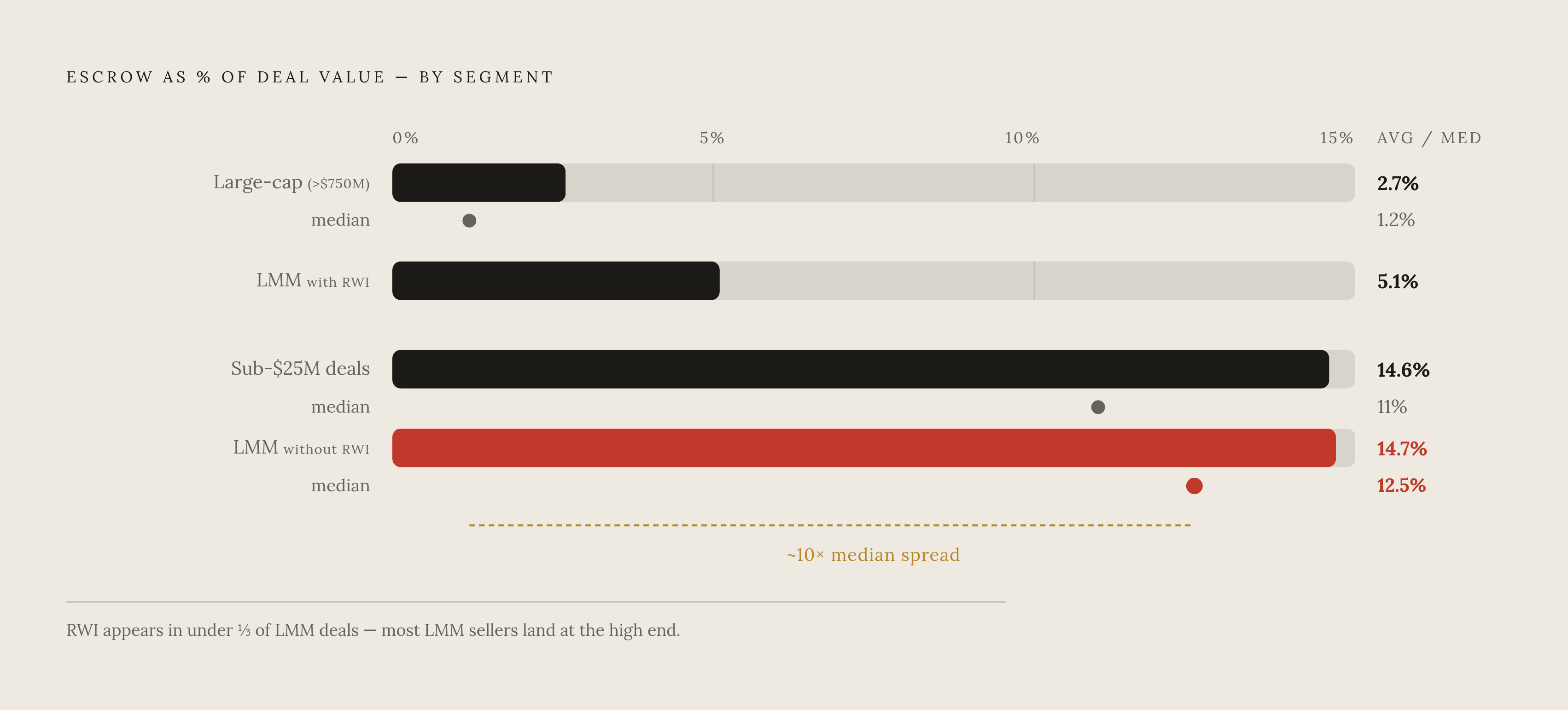
Benchmarking a mid-sized deal against large-cap headlines is a direct mistake. Deals above $750 million average just 2.7% of transaction value in escrow, with a median of 1.2%. LMM deals with a traditional, non-RWI indemnification structure carry a median of 12.5%, and deals under $25 million average 14.6% with an 11% median, roughly five times the large-cap figure. That's roughly five times the large-cap figure. A seller reading about a billion-dollar acquisition's small escrow percentage and expecting anything close to that on a much smaller deal is negotiating from a dataset that has nothing to do with the transaction in front of them.
Deal size explains part of the gap. Reps and warranties insurance explains most of the rest, and it isn't close. LMM deals without RWI carry an average escrow of 14.7% of transaction value. LMM deals with RWI average 5.1%, nearly a threefold difference. The mechanism is straightforward: without insurance, the seller's own cash is the only real recovery source if a rep turns out to be wrong, so buyers want more of it parked where they can reach it. With insurance, the insurer absorbs the risk above a small retention, and the escrow shrinks because it no longer has to substitute for a policy that doesn't exist.
Access to that insurance is the catch, and it's the part sellers can't simply negotiate their way around. RWI appears in less than a third of LMM deals, versus roughly 40% of all deals market-wide, because insurers underwrite on deal size and target quality, and plenty of LMM transactions don't clear that bar. Most LMM sellers carry the higher escrow because the insurance market hasn't scaled down to meet them.
Outside SRS Acquiom's numbers, the Seyfarth Shaw 2025 SurveyBook, covering more than 150 agreements in the non-insured middle market, found the median indemnity escrow climbed to roughly 9% of purchase price, up from 8% the year before. Escrow percentages in the non-insured segment are moving up, not down, so a seller negotiating today should expect a number higher than what a predecessor signed two years ago.
None of this settles the real exposure on its own, though. A smaller escrow paired with loose claim language, vague breach definitions, or generous notice windows can end up costing a seller more than a larger escrow with tightly scoped triggers. The percentage is the headline figure everyone quotes. The drafting, how a breach gets defined, how much time a buyer gets to bring a claim, is what actually determines how much money a seller sees again.
The PPA escrow: why purchase price adjustment money is usually a separate pool
Purchase price adjustments are close to standard in LMM, appearing in 92% of deals, typically as a working capital true-up measured against a closing statement prepared after the deal closes. Nearly half of LMM deals now fund that adjustment through a dedicated PPA escrow, separate from the general indemnification pool, with a median size around 1.23% of transaction value, roughly 40% higher than the PPA escrow median across all M&A deals.
Why keep the pools separate? Because working capital disputes and indemnification claims run on entirely different clocks. A working capital true-up resolves on a shorter timeline than a rep-breach claim, which can drag out much longer. Mix the two into one general pool and a real conflict appears fast: the working capital dispute resolves while a breach claim is still open. Which funds release, and which stay frozen? A single pool forces an answer that a separate PPA escrow avoids by design, simply by keeping the clocks from ever touching.
The share of PPA escrow funds buyers actually end up claiming has fallen sharply, from a large majority in the earlier period down to under a fifth by the third quarter of 2024. That drop likely reflects tighter diligence, buyers and sellers agreeing on working capital targets before closing rather than fighting over them after, not any structural change to the escrow mechanism itself.
Model the PPA escrow as its own line item, not an appendage of the general pool. It resolves faster, and it deserves its own negotiated terms, separate from the survival periods and claim triggers governing everything else.
How long escrow money stays locked up, with LMM survival periods running longer than the market median
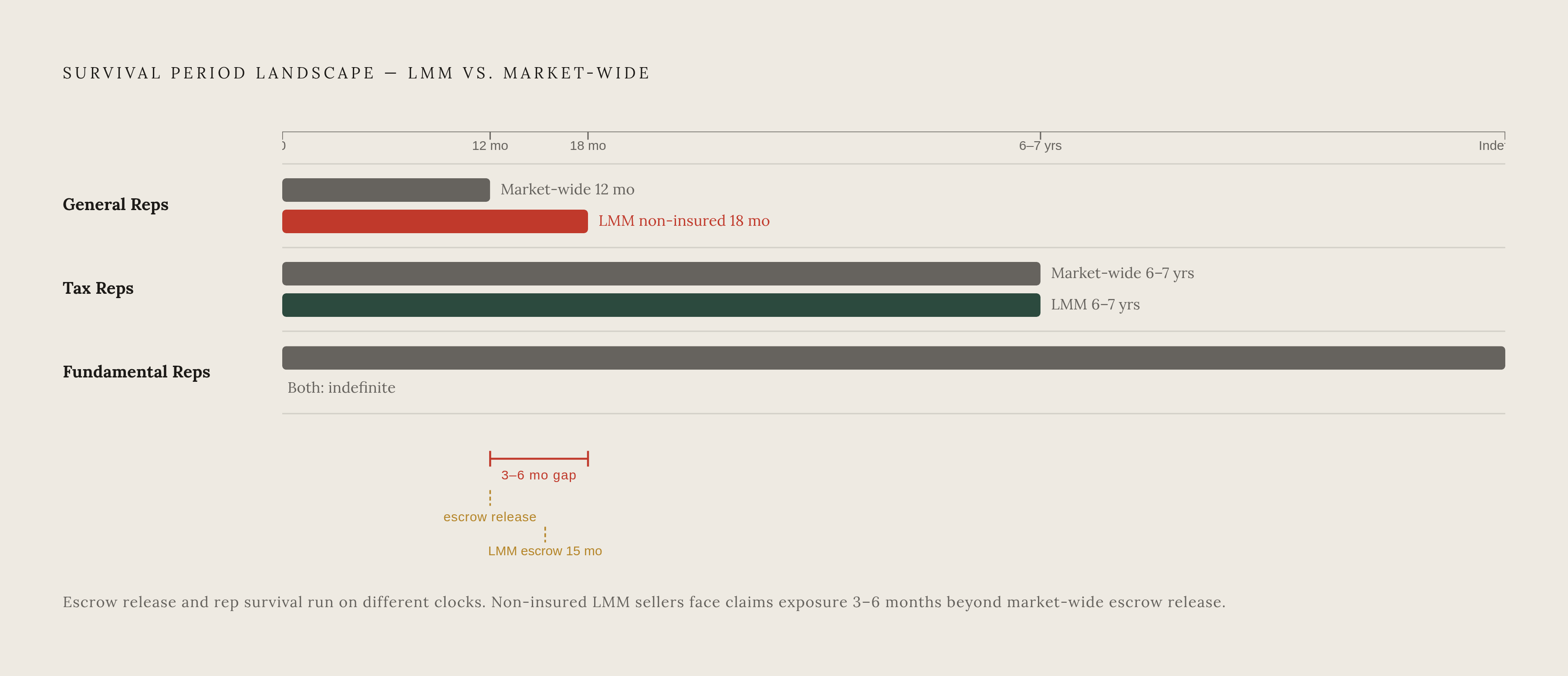
Duration is where LMM sellers get the worse end of the deal, and the trend isn't moving in their favor. The market-wide median indemnity escrow period has held at 12 months across both insured and non-insured deals. LMM deals run 15 months, three months longer, and three extra months of locked-up cash across an entire escrow balance is real money sitting idle, earning next to nothing, while the seller waits.
Break it down further and the gap widens rather than closes. Non-insured LMM deals carry a median general survival period of 18 months. The market-wide median indemnity escrow period holds at 12 months across both insured and non-insured deals. Without RWI, an LMM seller's general reps survive beyond the 15-month overall median 96% of the time. LMM sellers land on the long end of the survival spectrum more often than the market as a whole, and the absence of RWI is the reason.
Available deal points data covering mid-market transactions consistently shows survival periods spread across 12, 18, and 24-month buckets, with no single term dominating. A seller assuming escrow money frees up after 12 months is working from an assumption the current data doesn't support.
General survival periods only cover part of the exposure, and this is where sellers get caught flat. Fundamental reps (title, corporate authority, capitalization, absence of liens, due organization) typically survive indefinitely, often paired with a meaningfully higher cap than general reps. Tax reps commonly survive to the statute of limitations, frequently six to seven years, under a separate and higher cap. Special indemnities tied to specific diligence findings carry their own bespoke terms, negotiated deal by deal, with no standard to anchor against.
The detail that actually catches sellers off guard: survival and escrow release aren't the same clock, and nothing in the agreement automatically syncs them. A tax rep can survive six years while the escrow funding it releases at 15 months, leaving a gap where the buyer's right to bring a claim outlives the pool of money set aside to pay it. That gap needs to be negotiated explicitly, because left alone, a seller can walk away from closing believing the exposure ended when the escrow released, when in fact the rep, and the buyer's right to sue on it, is still fully alive.
Partial release schedules as a tool for unlocking proceeds before the full escrow period ends
The default structure holds the full escrow balance untouched until survival ends, then releases it in one lump sum minus whatever's tied up in pending claims. It's clean to draft and it's a bad deal for the seller, who sits on cash earning almost nothing for the entire window, even though most of the risk that justified the escrow in the first place tends to appear early, not late.
Staged release fixes that, and a seller who doesn't push for it is leaving money on the table. One common structure splits the balance in two: roughly 50% at 12 months, timed to when general indemnity expires under shorter-survival deals, with the remainder at 18 months. A three-tranche version spreads it further, releasing a portion early in the period to cover shorter-tail items, another portion at 12 months, and the balance at 18 to 24.
Escrow funds typically sit in money-market instruments or short-term Treasuries, earning modest interest, far less than what that cash could generate redeployed into a new venture, debt paydown, or retirement funding. Partial release doesn't erase that opportunity cost, but it shrinks it, and it gives sellers a liquidity timeline they can actually plan around instead of one lump sum sitting at the finish line.
Buyers won't hand this over automatically, and there's a reason for that beyond simple resistance. Accepting a partial release means trusting that whatever's left in the pool after each tranche still covers the claims realistically still outstanding. A pending customer dispute, an open tax audit, ambiguity in a key contract flagged during diligence: any one of these will make a buyer dig in against tranching until the issue clears.
Partial release in 2026 LMM deals functions as a negotiable standard now, not a rare seller-favorable concession, so it needs to go on the table early. Waiting until after the escrow percentage is locked in means negotiating from a weaker position on a term that should have been part of the opening conversation.
One mechanical detail deserves attention here too, and it trips up more sellers than it should. Some agreements let the escrow agent release funds automatically on a set date without checking whether a claim notice is pending. That becomes a real problem if claim notices go only to the seller and never get copied to the agent, because the agent then has no way of knowing a claim even exists. The fix is simple: require that any claim notice sent to the seller go to the escrow agent at the same time, otherwise the release mechanics and the claim mechanics run on tracks that never intersect.
How a claim moves through the escrow from notice to resolution
The sequence is fixed, and knowing it in advance turns what sounds like a black box into something closer to a checklist.
It starts with a claim notice. The buyer delivers formal written notice to both the seller and the escrow agent, describing the alleged breach and the amount claimed. Missing the deadline tied to the release date with that notice means the claim never attaches to the escrow at all, no matter how strong it might be on the merits.
The seller then gets a defined objection window, commonly 30 to 60 days, to accept, dispute, or defend against the claim. Silence usually counts as acceptance, so that clock is not a formality to let lapse. Once disputed, the escrow agent freezes the contested amount and does nothing else: it doesn't investigate, doesn't weigh evidence, doesn't take a side. It holds the money until it receives a joint written instruction from both parties or a final award from a court or arbitrator. That neutrality is the entire reason to use an agent instead of a buyer-held holdback.
A disputed claim should freeze only the contested amount, not the whole escrow, but that only happens if the agreement says so in writing. Undisputed funds should keep releasing on schedule regardless. Assume nothing here; negotiate it into the agreement directly, because silence in the drafting tends to favor whoever's holding the money.
Most claims resolve through negotiated settlement or whatever dispute mechanism the purchase agreement names. Working capital disputes specifically tend to route to an independent accounting firm acting as referee rather than to litigation.
How often does any of this actually happen? A Morgan 2025 M&A Holdback Escrow Study, covering more than 2,400 transactions, found that 39% of deals see at least one claim brought against escrow. Of those, 70% resolve in under six months and 81% within a year. Most of that activity is ordinary friction from closing on incomplete information: working capital adjustments needing reconciling, expense allocations getting revisited, tax items appearing once the post-close accounting review actually happens. Paperwork friction, far more often than litigation.
Naming a known escrow agent, SRS Acquiom or Wilmington Trust, for example, in the letter of intent rather than leaving agent selection to the buyer locks in the claim notice procedures a seller will actually face, instead of inheriting whatever a buyer-chosen agent defaults to. That default may not be as neutral in practice as sellers assume going in, and locking in the agent early is a small negotiating move with outsized downstream effect.
Escrowed funds generally earn interest while they sit, invested in money-market instruments or short-term Treasuries, and that interest typically flows to the seller even while the principal stays contingent on no valid claims arising before release. Not every escrow agreement treats interest the same way, so confirm how the agreement handles it before signing, not at the moment of release when there's nothing left to negotiate.
Indemnification caps and baskets: how the escrow interacts with the broader indemnification structure
The escrow doesn't operate on its own. It sits inside a larger indemnification structure built on caps (the maximum a seller can be forced to pay) and baskets (the loss threshold that has to accumulate before a claim can even be brought).
In sub-$100 million deals, caps on non-fundamental reps typically run 15% to 20% of purchase price. Because escrow is commonly sized at or below that cap, the escrow, not the cap, ends up functioning as the real ceiling on what a buyer can collect without a fight. If the escrow holds a modest slice of transaction value while the cap sits well above it, a buyer with a claim bigger than the escrow balance has to chase the seller directly for the rest. That's a slower, harder path than drawing down money already sitting with a neutral agent, and it shapes how aggressively a buyer actually pursues a claim near the edge of what escrow covers.
The cap is the theoretical ceiling on liability. The escrow is the practical ceiling on what's collectible without further legal action, and the two rarely land at the same number. A seller who negotiates the escrow percentage in isolation, without checking it against the cap, the basket, and the survival period, is negotiating half the deal at best. None of these four terms should get finalized as though the other three don't exist, because in practice, each one only means what the other three let it mean.