Selling a Sub-$10M Canadian Business Through Confidential AI-Matched Buyer Outreach
AI-matched buyer identification reaches qualified acquirers while keeping the sale confidential.
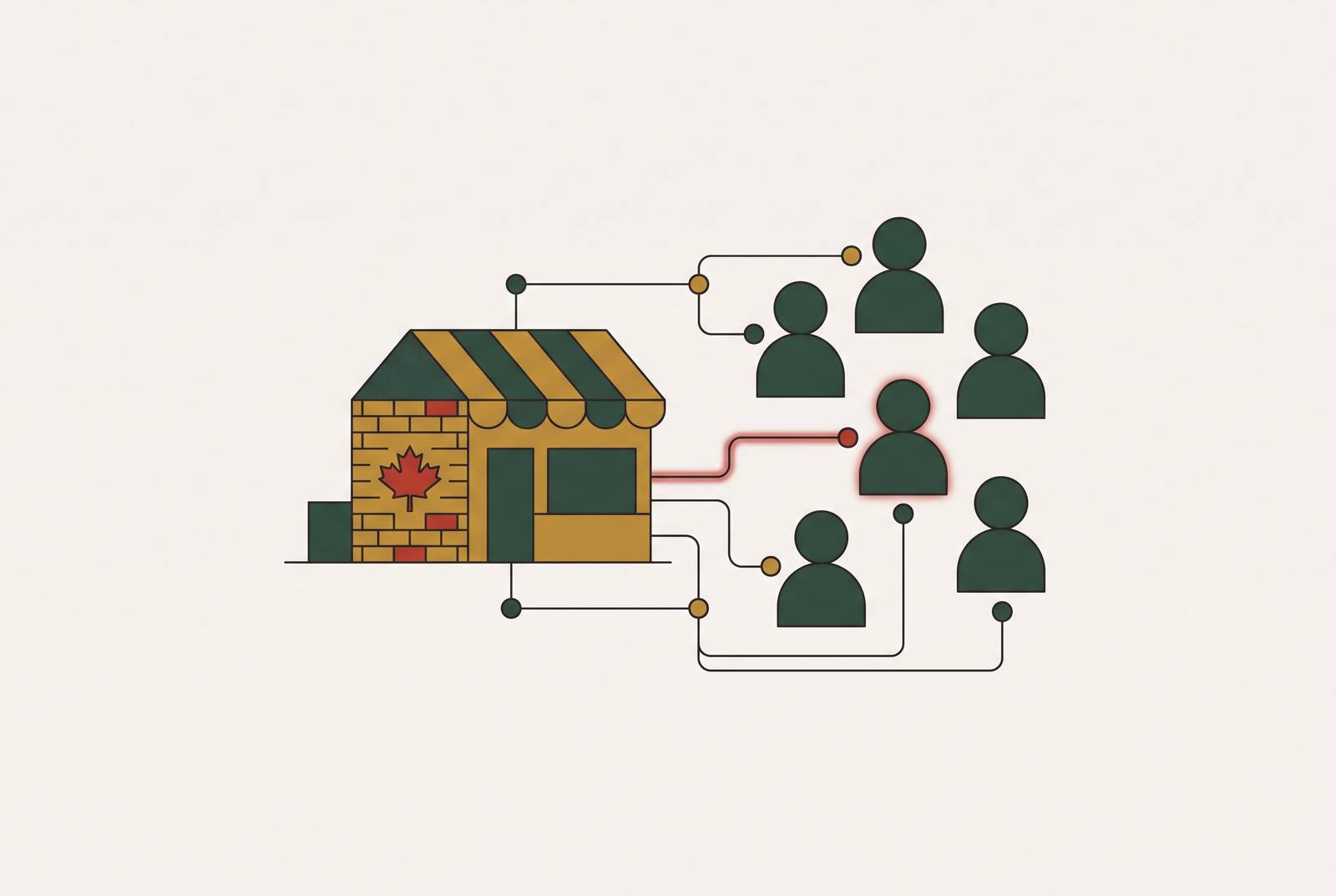
Selling a smaller Canadian business does not require a public listing site or a traditional broker's contact book. A confidentiality-first process, built on AI-matched buyer identification, can reach qualified strategic acquirers, search funds, and cross-border buyers without ever putting the business's name in front of an employee, supplier, or competitor before the owner is ready. That distinction, reach without exposure, is the structural problem this piece works through, and the solution that has emerged to address it.
Why selling a smaller Canadian business is structurally different
Most owners of businesses in this size range will sell exactly once. There is no repeat-transaction learning curve, no internal corporate development team, and no standing relationship with three investment banks competing for the mandate. A first-time seller is building the process infrastructure, legal documentation, valuation discipline, buyer outreach strategy, at the same time they are trying to run the sale itself.
That timing problem compounds when it happens at scale. Before confidentiality ever enters the conversation, the basic math of buyer discovery is already working against the seller.
Where a sale goes wrong before the first buyer conversation
The conventional path to finding a buyer, public listing sites, word-of-mouth through the owner's own network, broadcast marketing to anyone who might be interested, creates exposure before a single buyer has been vetted. That exposure is not a minor inconvenience. It can destroy value on its own, independent of whether a deal ever materializes.
Employees sense the business is for sale, even through rumor rather than announcement, and react accordingly. None of this requires a formal leak. It only requires enough ambiguity for people whose livelihoods depend on the business to start protecting themselves.
Competitors present a sharper risk. A competitor who sees that a substantial share of revenue sits with just two customers now knows exactly where to apply pressure.
None of this is theoretical. Lower-middle-market businesses tend to be more owner-dependent and more visible within their local or sector community than a larger enterprise would be, which makes this risk sharper still. The same network that generates referrals and goodwill is the network through which news of a sale travels fastest, and the business depends on that same network to keep operating normally while the sale is underway.
What a confidentiality-first sale process requires
Protecting confidentiality through a sale takes more than an owner's discretion. It requires a tiered, deliberately sequenced disclosure process in which buyers are qualified and legally bound before they ever learn which business they are looking at.
The sequence has a specific shape: an anonymous teaser goes out first, followed by a signed non-disclosure agreement, then a confidential information memorandum, then a management meeting, and only then diligence. Each gate has to be enforced before the next one opens. Skipping a step to move faster, for instance sending a CIM to a buyer who has only verbally agreed to confidentiality, defeats the entire structure.
The NDA itself needs to do more work than a standard financial-confidentiality agreement. A seller's name and the business's name should not appear anywhere in outreach material until that NDA is signed. The entire buyer identification and first-contact phase has to happen without naming the business.
The tension with public listing becomes structural here. Confidentiality and public listing are, for most owner-operated businesses, mutually exclusive.
Enforcing this kind of tiered disclosure sequence by hand is demanding. When buyer identification happens manually, someone has to track who has signed what, who is cleared for which level of information, and whether outreach has accidentally named the business before a gate was cleared. Research from Aprio on Canadian family enterprise succession points to a related lesson: owners benefit from engaging advisors early, in part because these transitions often take up to a decade to move from initial planning to final transfer, and accountants, lawyers, bankers, and consultants are what bring structure to valuation, legal documentation, and training along the way.
The reach-confidentiality tradeoff in traditional broker outreach
A traditional business broker can run a confidential process. A buyer in another province, a search fund operator scanning several industries for a platform acquisition, a cross-border acquirer looking at Canadian targets, none of these show up in a regional broker's personal contact list, no matter how confidential the process otherwise is.
The BC Chamber of Commerce has identified access to cost-effective professional advice as one of the top barriers to succession in Canada, and the economics explain why: a full-scale advisory process costs roughly the same to run regardless of deal size, so smaller sellers are often underserved relative to what that process would cost at a larger deal size. The buyers most likely to pay a premium for a well-run smaller business, search funds, independent sponsors, strategic acquirers pursuing geographic expansion, rarely browse broker networks or marketplace listings. They are off-market unless someone reaches them directly.
How AI-matched buyer outreach targets qualified buyers quietly
AI-matched outreach identifies and scores a large universe of potential buyers algorithmically, then delivers outreach only to the subset that match, turning the process into a targeted, gated sequence that buyers experience as a direct approach.
The identification step scans large databases of private companies to surface buyers based on acquisition history, financial capacity, industry fit, and growth signals, reaching firms that would never appear in a broker's contact list or on a listing platform because they are not actively browsing for deals, they are simply positioned to make one when the right target appears. The targeting step is what makes the process selective rather than exhaustive: instead of sending the same message to every company in a database, a well-built matching engine scores and ranks buyers by fit, so outreach reaches fewer contacts, but better-qualified ones. That selectivity is itself a confidentiality advantage. Fewer people learn the business is for sale at any given moment, which narrows the window in which a leak can happen.
The gating step keeps those two advantages connected. The AI system and the legal gating process run in sequence, not side by side, so a buyer never receives information their NDA status hasn't earned yet. The scale of the ownership transition underway in Canada over the next decade is why proprietary buyer identification of this kind matters: the businesses that transact successfully tend to be the ones whose sellers reach buyers actively looking for that type of acquisition, not the ones who happened to scroll past a listing.
The tension between reach and confidentiality is partly structural and partly economic.
The Canadian tax and legal environment and the urgency of a structured process
A slow or poorly structured process is not simply frustrating, it is expensive in ways that compound the longer it drags on.
1205 Consulting has noted that estate freezes, LCGE planning, and holding company structures take years to implement properly, not months, and sellers who engage a tax advisor late in the process can lose access to structures that would have meaningfully reduced what they owed.
Bill C-208 and its subsequent amendments added further conditions around intergenerational share transfers, conditions the BC Chamber of Commerce has documented in detail, and a seller needs to satisfy them before a sale closes, not retrofit them afterward. Confidentiality and timing are connected here in a direct way: a process that drags on, because buyers are poorly matched, outreach is unfocused, or early conversations collapse and have to restart, gives more people more time to learn the sale is happening. Every extra month of exposure makes the tax and legal structure cost more to get wrong.
What sellers need in order before outreach begins
AI-matched outreach widens the pool of buyers a seller can reach. It cannot fix the transferability problems that cause most smaller deals to collapse after an interested buyer has already been found. A seller who enters the market without clean financials, documented operations, and a realistic valuation will generate real interest, and then watch it evaporate once diligence starts.
Owner dependency is the second structural risk, and it is one sellers need to confront honestly. A business whose operations, customer relationships, or supplier terms all run through the owner personally is not something a buyer can confidently acquire. It functions more like a job the owner happens to own than a business with value independent of the person running it. Documented processes, an independent management layer, and diversified revenue are what buyers actually look for as evidence the business can run without its founder.
The practical checklist is specific: three years of reconciled financial statements, a quality-of-earnings narrative that explains the numbers rather than just presenting them, documented standard operating procedures, a customer concentration analysis, and a clear ownership and share structure that has already been reviewed for LCGE eligibility. AI-matched outreach performs best against this kind of preparation. A well-matched buyer who reaches diligence and finds the documentation they expected will move toward close. A well-matched buyer who reaches diligence and finds surprises, undocumented liabilities, unreconciled statements, an owner who turns out to be irreplaceable, will not.
Evaluating advisory options for a confidential, AI-matched sale process in Canada
For a Canadian owner weighing advisory options, the right partner combines AI-driven buyer identification with actual investment banking expertise and a working understanding of Canadian tax structure, LCGE eligibility, and the buyer market specifically. Each piece alone is insufficient: AI matching without deal experience produces a list of names and no closed transaction, and investment banking expertise without AI-driven reach runs into the same network limits as a traditional broker.
A full advisory process covers preparation, valuation, buyer outreach, NDA management, negotiation, and close, beyond just the matching step that gets a buyer's attention first. It should also be built to serve an owner at either end of the timeline, someone three years from a planned exit who needs to start structuring now, and someone ready to go to market immediately.
Looking at what exists in the market today is instructive. Eilla positions itself as an AI-native M&A advisory for small and mid-sized businesses, and it pairs M&A advisors with AI tools that screen a database of more than 8 million companies for acquisition history, synergies, and financial capacity. Its confirmed client outcome, two digital agencies, CreateX and Native Digital, finding an international acquirer through its process, demonstrates real cross-border matching capability. Its coverage skews international, and Canadian tax-specific advisory isn't a stated focus of the platform. Grata takes a different approach: it's a private market intelligence platform built for the lower and middle market, using AI-powered search across a large database of private companies enriched with ownership structure, funding history, and founder- and family-owned business data. With Intelligence acquired Sutton Place Strategies in November 2024 to add deal data and analytics to that platform. Grata works as a sourcing tool rather than a full advisory, so if a seller uses it, they still need to arrange separate legal, tax, and deal management support alongside it.
A disciplined, advisor-guided approach to identifying qualified buyers before any public exposure happens is what preserves deal value at this scale, more than any single tool or database can on its own.
A confidential, AI-matched sale process from first conversation to close
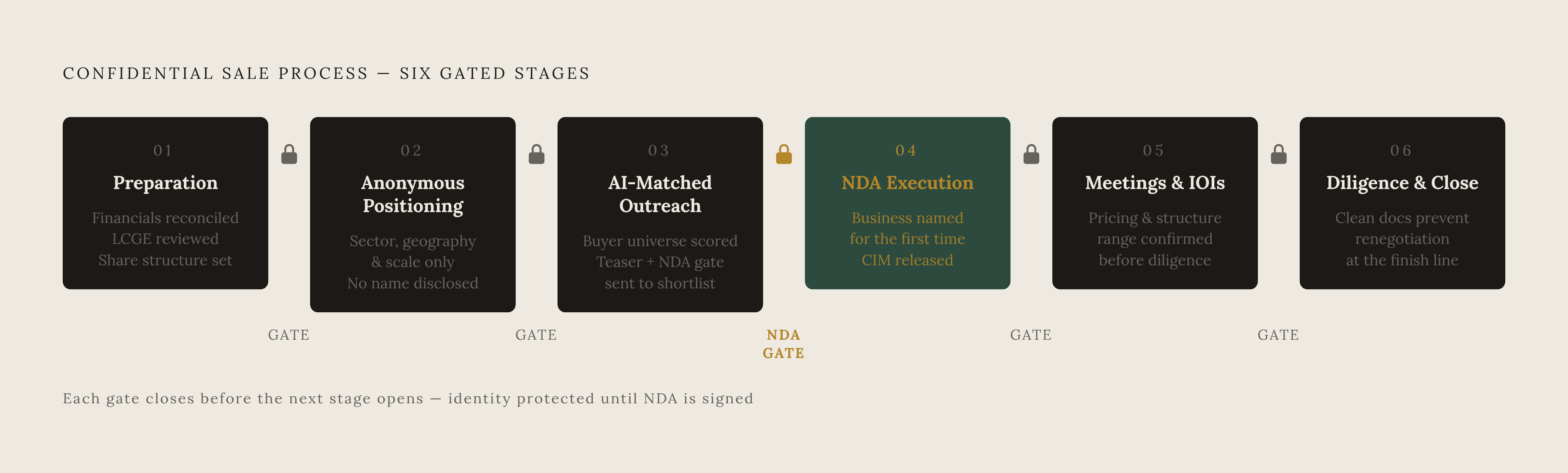
A well-run confidential sale moves through a defined sequence of gates, each one protecting confidentiality at the exact moment exposure would be most damaging. By the time a buyer is deep in diligence, the process should feel nearly irreversible.
Preparation comes first, typically months before any outreach launches: financial documentation gets reconciled, a quality-of-earnings narrative gets built, LCGE eligibility gets reviewed with a tax advisor, share structure gets confirmed, and the ownership transition plan gets documented. Anonymous positioning follows. A teaser describes the business by sector, general geography, scale, and financial profile, enough for a qualified buyer to judge fit, not enough for anyone to identify the company by name.
AI-matched outreach is the stage that scores the buyer universe and surfaces the best-fit targets. Outreach goes to those targets, carrying the anonymous teaser and a clear NDA gate that stands between them and any further disclosure. Buyers who respond with genuine interest execute a fully drafted NDA, covering financial information, customer and employee data, and non-solicitation, before they ever receive the confidential information memorandum that actually names the business. Qualified signatories then move to structured management meetings, where indications of interest establish a pricing and structure range before diligence begins in earnest.
Diligence and close come last, and this is where preparation pays off directly. If a seller has clean financials, documented operations, and a clear ownership structure, they move through diligence without surprises, and the deal closes on the terms the IOI already established, instead of getting renegotiated at the finish line under pressure. The Canadian tax clock keeps running throughout all six stages: an advisor who understands LCGE eligibility, capital gains treatment, and intergenerational transfer conditions needs to be involved early enough to structure the transaction correctly before closing, because none of that structure can be added back in afterward.
A prepared seller running a disciplined, confidential process holds more leverage than most sellers currently bring to market, simply because most of the market is still running on referrals, listings, and hope.