How to Sell Your Business to a Competitor Without Handing Them Your Secrets
Staged disclosure protects your secrets while capturing the competitor premium.
Selling to a competitor is the fastest route to the highest price a business will ever command, and it also hands a rival the exact data it needs to hurt that business if the deal never closes. Capturing that premium without giving away what makes it possible depends on how information moves, not on whether it moves.
Competitors as buyers: danger and value
Selling a company is not one transaction with interchangeable buyers behind it. A financial buyer, a private equity fund or a family office, is competing on capital rather than market position, so the confidentiality risk of handing over a confidential information memorandum is close to zero because that buyer has no operation to run against yours tomorrow. A competitor is a different animal. They already understand the industry cold, so they move faster, ask fewer basic questions, and often put a bigger number on the table than anyone else in the process, and that same familiarity is what makes the information they see during diligence genuinely dangerous if the deal falls apart.
It helps to separate competitor buyers into three groups, because each one carries a different mix of opportunity and exposure. Vertical strategics, a customer or supplier looking to absorb margin or lock down supply, sit a step removed from direct rivalry but still gain real leverage from what they learn.
One category deserves early attention precisely because it hides in plain sight: the PE-backed roll-up. Owners who assume a roll-up platform is "basically a financial buyer" because a PE fund sits behind it are missing that the operating company doing the diligence may compete directly against them: it may operate directly against them in three zip codes. Clarifying which hat a roll-up is wearing, strategic or financial, should happen before a single document moves, not after.
The Synergy Premium
The reason any of this risk is worth taking on comes down to price.
Running the math on a typical lower-middle-market deal shows the gap is not theoretical. A strategic buyer pricing the same business on a blended basis, EBITDA plus the synergies it expects to realize, or simply at a higher multiple because the business is worth more inside its existing footprint, can land on an enterprise value that is meaningfully higher than the financial offer, not just a rounding difference.
That premium is not guaranteed, and owners who assume every competitor will pay up are setting themselves up for disappointment. The premium can be meaningfully higher than the financial offer, and it is worth structuring a deal to protect. That is the entire argument for everything that follows.
When a Standard Sale Process Falls Apart
The risk in selling to a competitor was never about the moment of signing an NDA and handing over a folder. It sits in what the other side's deal team remembers once the data room closes and the deal doesn't, and in what they choose to do with that memory months later.
Walk through what a standard, unstaged process actually exposes. Once an NDA is signed and a data room opens the normal way, a competitor sees customer concentration, average order value, pricing by product line, gross margin by product, and individual salesperson compensation. That is not a sampling of the business. That is the operating picture of a company the competitor fights against in the market every single day.
When deals fall apart after that kind of disclosure, the consequences are not hypothetical.
Owners often assume trade secret law is a backstop here, and it can be, but only under conditions many sellers don't meet. Most trade secret protection only holds if the owner took reasonable steps to guard the information's secrecy. A process that hands over pricing, margin and compensation data without a properly structured agreement can be read by a court as a failure to take those reasonable steps, and once a court reaches that conclusion, the information may lose trade secret protection altogether.
Deal teams increasingly run diligence materials through AI tools, and unsecured tools can pass confidential data into AI training systems or to third parties who were never supposed to see it, which stacks a new exposure on top of the existing NDA and trade secret risk.
Some sellers respond to all of this by pointing to the NDA they've already signed and assuming the legal paper covers them. For most sellers in the lower middle market, that is not a realistic remedy, even if they would eventually win. Legal documents set a floor under the process. The real protection comes from controlling what gets shared and when, which is a process design question first and a legal question second.
Staged disclosure: how releasing information in layers controls what a competitor can take away
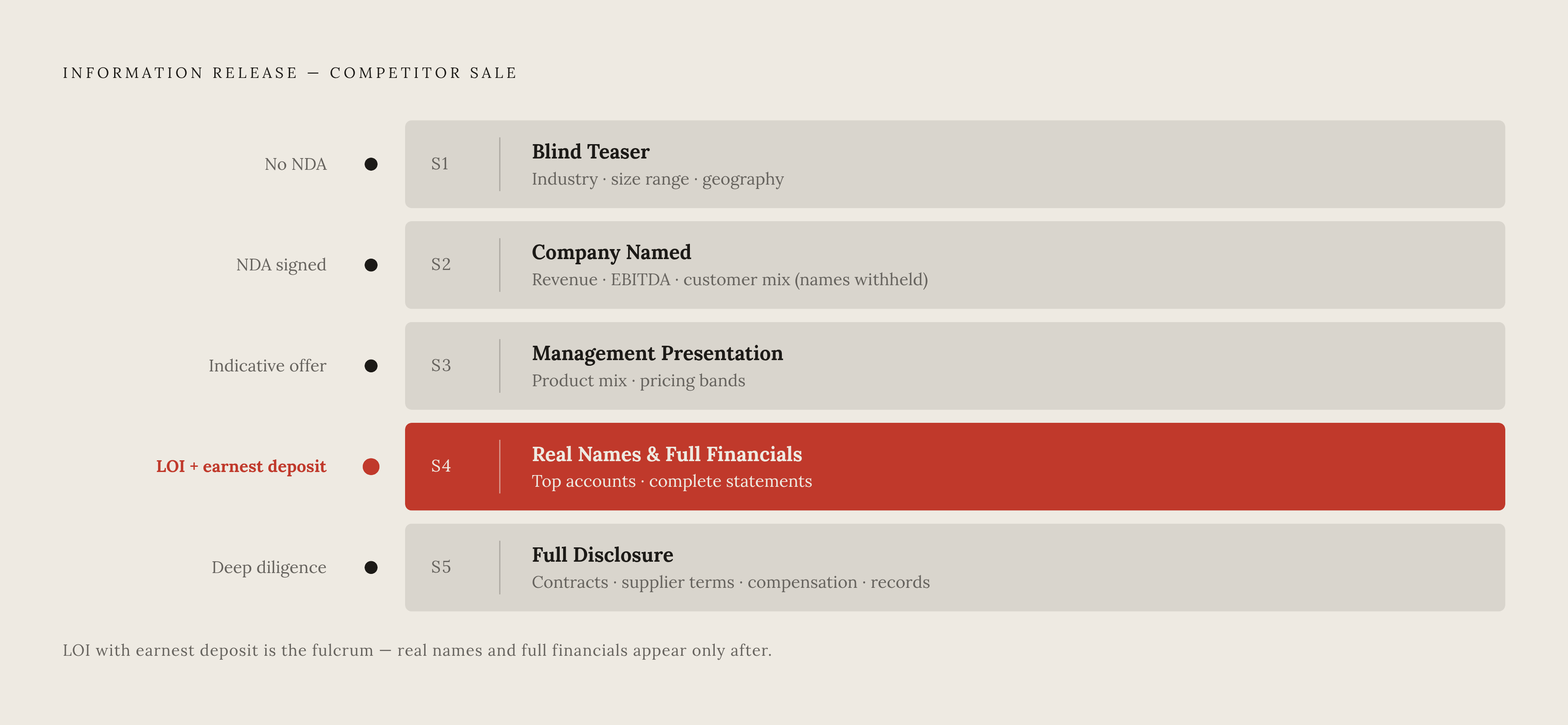
The fix for all of this is sequencing, though a better NDA matters too: tying what a competitor sees to how much commitment they've actually put behind the deal, so the most sensitive material only reaches them once the transaction is close to locked.
A disclosure ladder used in lower-middle-market deals runs through roughly five stages. Before any NDA is signed, marketing uses a blind teaser: industry, size range, and geography, with no company name, no branded materials, and nothing that would let a reader identify the business. After the NDA is signed, the business is named for the first time, and the buyer receives historical revenue and EBITDA along with a top-line view of customer mix, though names remain withheld. Once the buyer has gone further and submitted an indicative offer, they see a management presentation, the product mix, and pricing bands at a general level, still short of per-account detail. Once a letter of intent is signed with exclusivity and an earnest deposit attached, the buyer earns customer names, though top accounts may still appear under masked initials, along with full financial detail. Only in deep diligence, after all of that, do customer contracts, supplier terms, individual compensation, and operational records come out, and even then, typically under clean team controls rather than open access.
A qualified M&A advisor coordinates this release so that confidentiality holds without stalling the deal's momentum, releasing sensitive material only once a buyer has shown real intent to close. The earliest marketing materials stay deliberately generic: business category, broad geography, a revenue and cash flow range, and a label of B2B or B2C, with the company name, exact address, branded photos, website references, and any niche detail that could identify the business in a small market all left out.
None of this works if screening is weak at the front door. Verifying who a buyer actually is, what they intend to do with the business, whether they have the financial capacity to close, and whether a conflict of interest exists, functions as a confidentiality control in its own right, not merely a qualification step, and no NDA repairs the damage done by skipping it.
The logic underneath the ladder is simple once it's laid out. A buyer who loses interest early has seen almost nothing of value. A buyer who walks away after signing a letter of intent has also made commitments that carry their own consequences.
The NDA designed for a competitor sale
Staged disclosure needs a legal structure wrapped around it, and the NDA that structure depends on looks different from the one most sellers default to. A confidentiality agreement built for a sale to a competitor has to cover risks that simply don't exist when the buyer is a financial sponsor, and sellers who pull a generic template off the shelf usually end up unprotected in exactly the places that matter most.
Standard provisions, general confidentiality obligations, a definition of what counts as confidential information, and a restriction on permitted use, are necessary groundwork, but they were never built to handle a buyer who competes in the same market. A competitor-specific agreement needs to go further. It should bar the buyer from recruiting employees identified through the process, usually for one to two years after the deal ends, closing off the exact kind of poaching seen in real disputes. It should prevent the buyer from contacting named customers or suppliers without the seller's consent, since that contact is precisely what causes damage when a deal collapses. The confidentiality period itself needs real teeth: general information commonly carries a three-to-five-year term, while trade secrets should be protected indefinitely. Given how deal teams now work, it should also bar the use of AI tools that could route confidential data into training systems or hand it to parties who were never authorized to see it, an addition that barely existed in NDA templates a few years ago and is becoming standard now. Finally, it needs to reach every outside party who touches the data, attorneys, accountants, lenders, consultants, binding each of them and making the buyer contractually responsible if any of them breaches the agreement.
None of this turns litigation cheap. The NDA functions as a backstop behind the process; the process itself, staged disclosure, careful screening, clean team controls, is what actually does the protecting.
Clean team agreements: how the most sensitive competitive data gets shared without crossing the room
Some information is too sensitive to show to a buyer's general deal team at any stage, no matter how far along the deal is or how airtight the NDA looks on paper. That is the problem a clean team agreement solves, and it is not a niche tool reserved for billion-dollar transactions. Public filings from 2026 show it used in exactly this context: MarketAxess and Intercontinental Exchange entered into a clean team agreement on February 24, 2026, specifically to govern review of competitively sensitive information, and Organon and Sun Pharma did the same on March 1, 2026, giving select Sun Pharma representatives access to a dedicated clean team folder inside the virtual data room immediately afterward.
A clean room works by walling off the most sensitive files into a separate, permission-restricted section of the data room. Material that belongs in that room includes customer-level and SKU-level pricing, gross margin broken out by customer or region where the buyer directly competes, unredacted customer and supplier contracts, live pipeline and bid data, and compensation figures tied to named individuals. Disclosing any of that to a buyer's ordinary deal team would do damage on its own, independent of whether the deal ever closes.
Sellers also have more leverage over who sits on the other side of that wall than most realize. Pushing back on an oversized or poorly composed clean team list is standard practice, not an aggressive move, and sellers who accept whatever list a buyer proposes are giving up a protection that is theirs to negotiate.
Clean teams carry one more function: regulators recognize clean rooms as a legitimate way for two still-independent companies to share competitively sensitive data without that sharing itself becoming a problem. That legitimacy is not automatic. It depends on getting the structure right, which is exactly where gun-jumping risk enters the picture.
The antitrust constraint sellers rarely see coming: gun-jumping
Most sellers think about confidentiality as a one-way risk: the fear that a competitor learns too much and uses it if the deal dies. There is a second, less visible risk running in the opposite direction, and it involves government regulators rather than the competitor itself. Sharing competitively sensitive information with a buyer who is still a legally independent competitor can expose both companies to antitrust enforcement, and enforcement activity in 2025 made clear that regulators are watching this closely.
The legal term for this conduct is gun-jumping: coordinating pricing, strategy, or other competitively sensitive information, or sharing it outright, before a deal has closed, and in some cases before HSR clearance has even come through, while the companies remain separate and competing businesses in the eyes of the law. The violation isn't limited to formally merging operations early. It covers behavior that looks a lot like what an overeager diligence process can produce: a buyer's team getting early access to pricing strategy, customer-by-customer margin, or competitive plans before any closing has occurred.
Staged disclosure and clean team agreements matter on two fronts at once, not just one. They protect the seller's business if the deal falls through, and they also keep both companies on the right side of a legal line that has nothing to do with confidentiality and everything to do with competition law. A process that releases detailed pricing and strategic data too early does not just raise the odds of a competitor misusing it later. It can turn an ordinary acquisition into a regulatory problem before either side has even reached a closing date.
Structuring a layered disclosure process well requires a clear sense of what the business is actually worth to the buyer sitting across the table, since the information worth protecting tends to scale with that number.
Sources
- How To Sell Your Business To A Competitor Safely
- How to Sell Your Business to a Competitor - Nolan & Associates
- How to Maintain Confidentiality When Selling a Business in ...
- M&A Guide
- How To Maintain Confidentiality When Selling Your Business - Morgan & Westfield
- Customizing Your NDA for Competitors - Morgan & Westfield
- Trade Secrets in M&A Negotiations: Transparency vs. Confidentiality - Patentskart
- Organon & Co. - Form PREM14A - FY2026