How a Chinese-Canadian Couple Structured Their Sale Around Two Retirements
Tax planning makes the sale proceeds function as their retirement income.
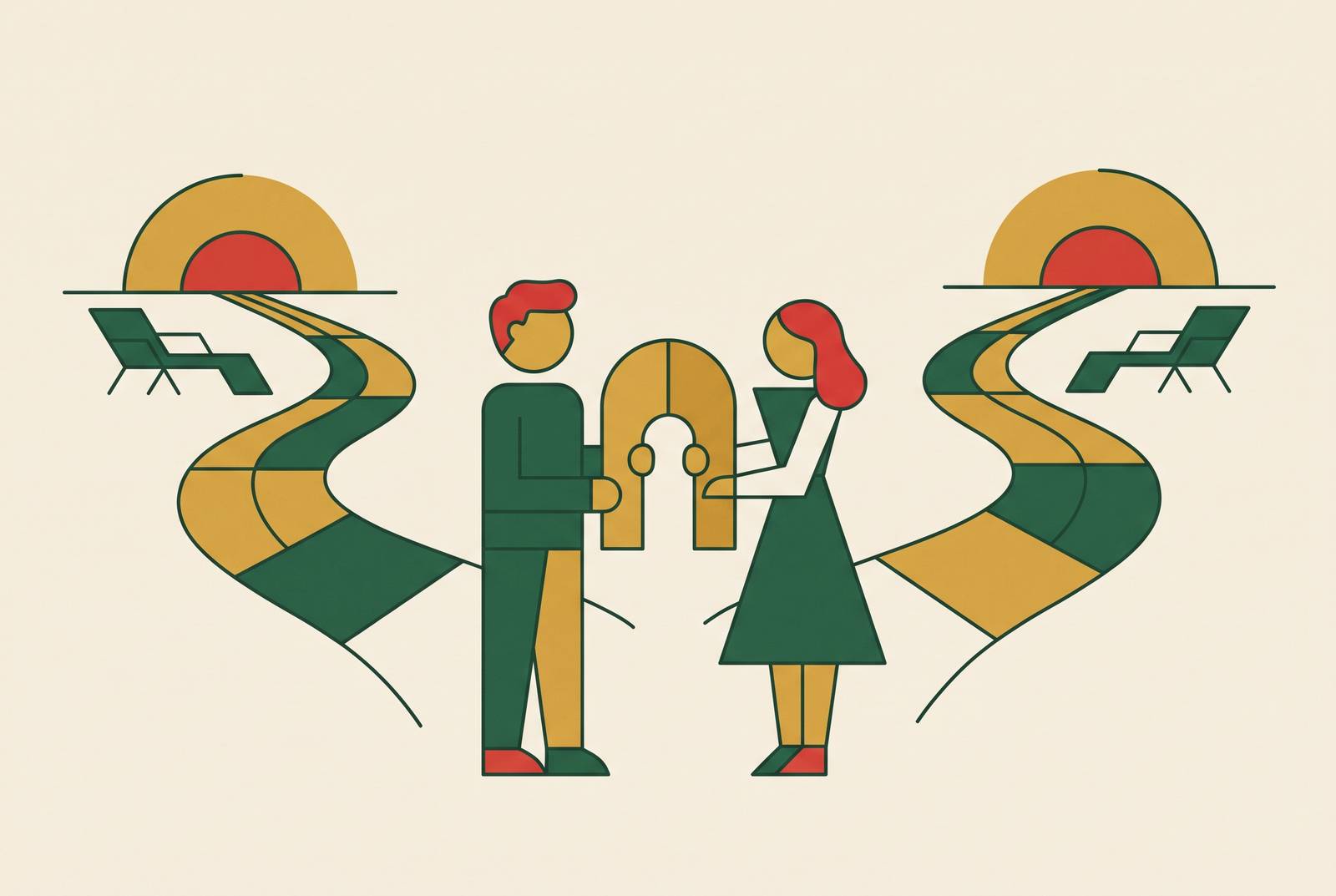
For a Chinese-Canadian couple who built their business as the primary vehicle for their savings, the proceeds of its sale have to perform a function that CPP and OAS will not fully perform on their own. That single fact changes what the exit transaction actually is. It is not a liquidity event to be optimized after the fact for tax efficiency; the tax structure and the retirement plan are the same decision, made at the same time. Self-employed immigrant business owners frequently extend their working lives, actively or passively, because the business itself has displaced the savings that employed Canadians accumulate in pension plans and employer-matched RRSPs. The business became the retirement account, in other words. It doubles, because when both spouses are co-owners, the sale must be engineered to replace two pension gaps simultaneously, not just one. Every section that follows, the share-sale mechanics, the LCGE multiplication, the trust, the income staggering, the post-sale drawdown, exists to close that doubled shortfall, and none of it makes sense without first sitting with the gap it's meant to close.
The immigrant pension gap in dollar terms
The shortfall is large enough that sale proceeds have to function as a private pension rather than a lump-sum windfall to be spent down casually, and that claim is what gives every subsequent structural decision its urgency. OAS is calculated on years of Canadian residency, not on age alone, so a spouse who immigrated at 40 and retires at 65 has accumulated only a fraction of the residency years that a lifetime Canadian resident would have, and the monthly OAS payment is reduced proportionally against 2026 rates. Residency years convert directly into a fraction of the full benefit, so the later in life someone immigrates, the thinner their eventual OAS cheque, regardless of how long they go on to work and pay taxes in Canada, which determines how much of the full OAS amount they will ever receive. Apply that same logic twice, once for each spouse. The household's combined government income floor can fall to a fraction of what a Canadian-born couple of the same age would receive. An age gap between the spouses makes the arithmetic worse rather than better, because it creates a stretch of years where one partner has already stopped working while the other has not yet reached the age where any government benefit begins to flow. The business, built over decades, is typically the only pool of capital large enough to bridge that gap. The sale has to be treated as part of the retirement plan itself. It is the retirement plan's foundation. There is a cultural pressure layered on top of this arithmetic that deserves to be named rather than glossed over: stigma around visible retirement difficulty, present in some Chinese-Canadian communities, can push a couple toward selling before the corporate structure is actually ready for sale. That timing pressure is corrosive precisely because it collides with the mechanics in the next section. Selling too early sacrifices the Lifetime Capital Gains Exemption entirely, and a couple who sells under that kind of pressure doesn't shrink the gap they were trying to escape. They widen it.
The sale must be a share sale, and the corporation must be clean before it closes
The LCGE is only available on a share sale of a qualifying small business corporation, which makes the structure of the transaction itself the first and most consequential decision in the entire plan. Selling the assets of the business rather than its shares exposes those assets to double taxation and forecloses the LCGE on the proceeds altogether, so the share-sale route is not a preference among equals; it is the only path that keeps the exemption on the table at all. An owner-operated business often accumulates passive assets over the decades it is run, and often fails the qualification tests unless it is deliberately purified well before a sale. Three QSBC tests must all be satisfied at closing, the same guide states. At least 90% of the corporation's assets must be active-business assets at the moment the sale closes, and the shares being sold must have been held by the seller or a related person for the full 24 months preceding the sale. A business that has quietly built up passive investments over years of profitable operation is the textbook failure case here, since profitability and passive accumulation tend to arrive together. Fixing that problem, known as purification, generally means paying out a dividend, repaying outstanding shareholder loans, or moving the passive assets into a separate holding company, and each of those routes carries its own tax cost that depends on how much has accumulated and how much time remains before the sale is expected to close. Purification is not something that happens over a weekend. It typically takes 12 to 24 months to complete properly. A couple who feels pressure, cultural or otherwise, to sell quickly runs a real risk of closing the deal before the corporation actually qualifies, forfeiting the exemption at precisely the moment they need it most. CIBC Private Wealth's transition planning report adds a related warning: a valuation that can withstand scrutiny matters because, absent an arm's-length buyer actually validating the sale price, the agency is inclined to examine the transaction more closely, a risk that rises further when shares are also being distributed among family members.
Engineering two LCGE claims from a single business
Once the corporation qualifies, the mechanism that makes dual spousal ownership so valuable becomes clear: each spouse who holds qualifying shares can claim the full exemption independently on the same sale. A single business exit can shelter up to twice the individual ceiling. This is the structural answer to the doubled pension gap described at the outset, and it is the reason the rest of the planning exists. The 2026 LCGE ceiling is $1.275 million per individual, a figure confirmed in the Money.ca LCGE guide published August 2026, raised from the prior year's level as annual indexation resumed under the Budget 2025 Implementation Act, No. 1. Two spouses each claiming that full amount can together shelter a combined gain double the individual ceiling from one transaction, which is the arithmetic that makes spousal co-ownership so valuable specifically in this retirement scenario. That multiplication requires each spouse to independently satisfy the QSBC tests on their own shares, held in their own name or through a qualifying trust, for the required holding period, and a transfer of shares to a spouse arranged at the last minute purely to manufacture a second claim will not hold up under CRA scrutiny. Owners planning around these numbers can at least work from a stable inclusion rate: the capital gains inclusion rate was not raised in 2026, since the proposal to increase it was cancelled on March 21, 2025, which gives a measure of certainty to what the after-tax value of the LCGE is actually worth under current planning. One proposed enhancement did not survive into the current rules. The Canadian Entrepreneurs' Incentive would have stacked an additional deduction on top of the LCGE for qualifying dispositions, but it was cancelled in Budget 2025 and is not available for 2026 dispositions, so planning built around it needs to be revisited. None of this multiplication happens by accident at the moment of sale. It has to be built years in advance, typically through an estate freeze, where the founder exchanges common shares for fixed-value preferred shares, capping their own capital gains exposure at today's value and pushing all future growth onto new common shares that can be allocated toward the LCGE plan being constructed.
Adding a family trust, and its cost to the couple if they skip it
A family trust holding those growth common shares can extend the multiplication further, allocating capital gains to adult children as additional LCGE claimants and potentially sheltering millions beyond what the spousal pair alone could shelter. The scale of the saving is not abstract. A 2026 case study at jahid.ca illustrates a $7.2 million share sale where spreading the trust's capital gains across multiple LCGE claimants cut the combined tax bill by more than a million dollars compared to a single-owner sale, and with a spouse and two adult children each claiming the full exemption, a family trust can shelter a substantially larger combined capital gain at 2026 LCGE limits than the spousal pair could manage alone. But what if the children never wanted the shares? The question of whether the children actually want the shares sits underneath the entire trust decision, and it cannot be resolved after the fact. The trust has to be established, and the shares have to sit inside it for the full 24-month qualifying period, before the sale closes; a trust assembled after a buyer has already appeared is simply too late to qualify. The harder complication is not legal but relational. Chinese immigrant parents who spent decades building a business often carry an expectation that a child will eventually take it over, and naming adult children as trust beneficiaries purely to multiply the LCGE, without first settling whether those children actually want the business or even want the shares, can create friction that outlasts the sale itself and reshapes the family long after the transaction has closed. It is the central tension of this entire planning exercise, because it asks a family to resolve a succession question under the time pressure of a tax deadline. Whatever structure the family lands on, it has to clear a legal bar before it goes anywhere near implementation: LCGE multiplication through crystallization has to satisfy the CRA's anti-avoidance rules, and a tax adviser needs to confirm the structure holds up before it's put in place, not after a reassessment arrives.
Staggering the income so the sale doesn't destroy OAS eligibility in year one
Even a sale that clears every QSBC test and multiplies the LCGE correctly can still backfire if the resulting income lands badly. A sale that concentrates all of the taxable proceeds into a single calendar year can push one spouse's net income above the threshold at which OAS begins to be clawed back, undoing part of the very government pension the household was counting on, which makes the timing of the income every bit as important as the exemption structure itself. The clawback rule is specific: it activates once an individual's net income crosses a defined threshold, and a large capital gain realized in one year, even one that is partially sheltered by the LCGE, can push a spouse's net income over that line and trigger a reduction in OAS payments. In a Chinese-Canadian co-owner couple, the spouse who ran the business day-to-day and drew the larger salary typically also holds the larger RRSP contribution room, which can leave the other spouse, often the one with fewer Canadian working years and a smaller CPP entitlement, retiring into a weaker income position than the household had expected. Spousal RRSP contributions made during the years the business was operating are the main tool for correcting that imbalance ahead of time: the higher earner gets the deduction, the lower earner reports the income on withdrawal, and the effect is to shift income into a lower tax bracket before the sale ever happens. Where that groundwork wasn't done in advance, a second tool exists after the sale closes. A portion of eligible pension income, including RRIF withdrawals starting at age 65, can be allocated to the lower-income spouse through pension income splitting, filed jointly on Form T1032 with both spouses' tax returns. One more trap belongs in the same year-of-sale tax return: the Alternative Minimum Tax basic exemption rose substantially starting in 2024, which gives some room to work with, but a large single-year LCGE claim can still trigger AMT, and that calculation needs to be part of the tax return preparation for the year the sale closes, not an afterthought discovered the following spring.
Building post-sale cash flow to replace what no pension will provide
After the sale closes and the tax is settled, the couple still faces the problem of how to draw down the after-tax proceeds over a joint retirement that may span 25 to 30 years, across two different government-pension timelines, without running out of capital or paying more tax than necessary. This is where the phrase "retirement plan" actually earns its meaning for a couple whose CPP and OAS entitlements are structurally thin. There is no defined-benefit pension sitting in the background to smooth over a bad year or a market downturn, so the drawdown has to be built around the specific shape of this household's constraints: two fractional OAS entitlements that started at different ages, quite possibly two different retirement dates, and a complete absence of any employer-sponsored income to lean on. What does a drawdown plan look like when it has to account for all of that at once? It has to sequence withdrawals from registered and non-registered accounts in a way that keeps both spouses below the OAS clawback threshold year after year, not just in the year the sale closed, while coordinating RRIF conversions, pension income splitting, and the timing of each spouse's CPP start date against the actual spending the household needs. None of that planning is generic. It has to be built around the specific residency history, the specific age gap, and the specific asset mix this couple carries out of the transaction. None of it is possible without the work done earlier: the clean corporation, the two LCGE claims, the resolved question of the family trust, the income staggered to protect OAS. Those decisions are what create the capital base this entire drawdown plan depends on. Get the structure wrong at the sale, and there is no amount of post-sale planning that can recover what the exemption and the clawback protection would have provided.