AI Buyer Matching Platforms Evaluated for Canadian Founder-Led Business Sales Under $50M
Buy-side AI tools misread founder-led firms, so sellers need different help.

Canada has a large group of small and medium-sized business owners approaching retirement age at the same time, so the country faces a transfer of ownership on a defined timeline, not a slow drift toward new owners. If you're a founder selling without a public listing, the platforms built to help have mostly been built for someone else. That gap sits at the center of this evaluation, and it shapes everything that follows.
A national small business association, in its research on succession planning, found that finding a suitable buyer is the obstacle owners name most often, ahead of business valuation and ahead of the business's reliance on the owner for day-to-day operations. For a well-prepared business in this country, buyers are outnumbered by sellers, so the task facing a founder is locating the right buyer, at the right price, without blowing up the confidentiality the business needs to keep running normally during a sale.
Most owners heading toward exit have no formal succession plan in place. Most of these owners are also selling by choice. Having time and using it are different things, and the fact that most owners aren't using the runway available to them is part of what makes this moment urgent despite nobody being under duress.
Put those two facts together, a large and growing group of sellers with limited formal readiness, concentrated in the lower middle market, and you can see the shape of the problem. Dominant deal-sourcing platforms stop being useful right at that revenue band, because they were built to solve a different problem for a different buyer. The rest of this piece works through why that mismatch exists, what you should look for instead as a sell-side founder, and how you can tell which approach fits your situation before a sale process starts.
Three Platform Categories for a Sell-Side Founder
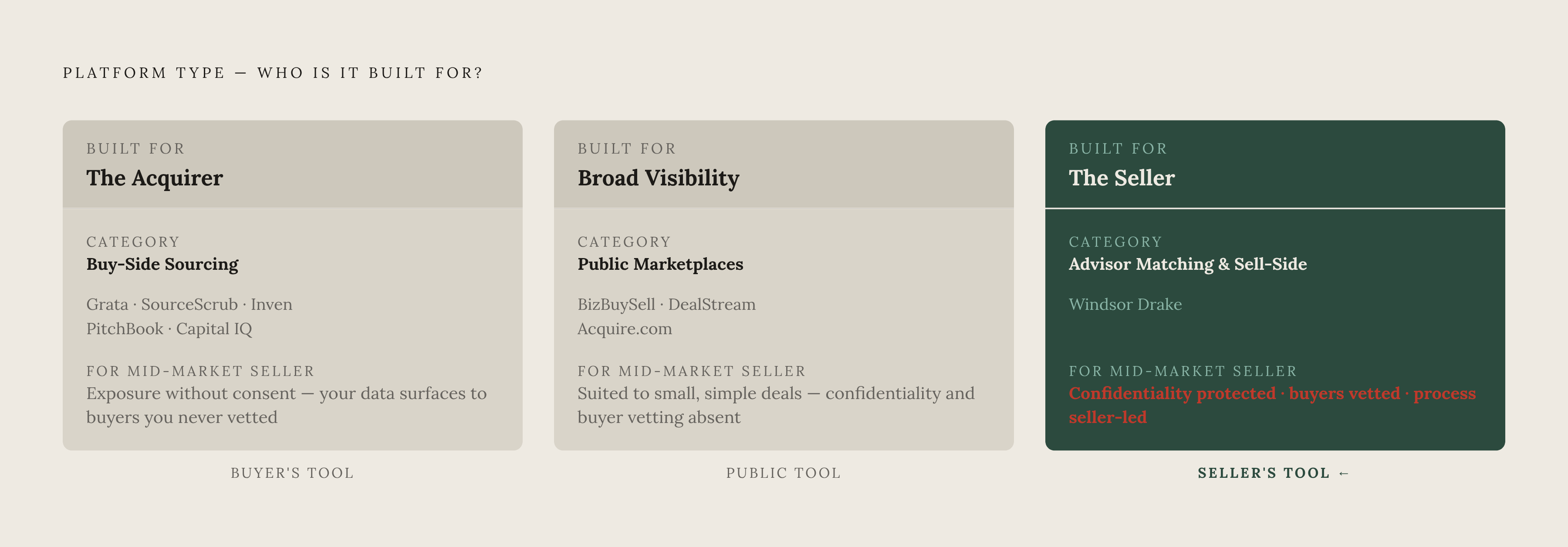
If you search for help selling a business, the platforms you find split into three categories that serve three different people. Confusing them is the single most common mistake a first-time seller makes, because the tools look similar on the surface, dashboards, search filters, company profiles, while solving opposite problems underneath.
The first category is buy-side sourcing and intelligence: platforms like Grata, SourceScrub, Inven, Cyndx, PitchBook, and Capital IQ. These exist to help acquirers, private equity firms, strategics, search funds, find companies worth buying. A founder who logs into one of these tools directly is stepping into a system built to profile businesses like theirs for someone else's benefit, not to represent their interests in a negotiation. Inven works from its own database of more than 28 million companies and tends to surface more founder-owned, lower-middle-market targets than institutional terminals typically catch, generating one-pagers and overview slides automatically. Both are diligence and valuation tools built for people doing research on a target, not matching platforms built for a founder trying to find a buyer.
The second category covers public marketplaces, sites like BizBuySell, DealStream, and Acquire.com, where listings are visible to anyone browsing. These serve a real function for smaller, simpler businesses where individual buyers are the natural audience and a public listing carries limited risk. For a founder-led company doing meaningful revenue, the trade-off changes: a listing or a leaked process can unsettle employees, worry customers, and give competitors information they have no business having.
The third category is advisor matching and sell-side-focused services, platforms and firms that connect founders to vetted advisors who then run a confidential process using whatever channels make sense for that specific company. This category is built around the seller's actual need, not an acquirer's workflow, which is why it fits the mid-market Canadian founder more closely than either of the other two. Windsor Drake is one example of a firm built specifically to advise founder-led companies sitting in that gap. A confidential, advisor-run sale process in this segment typically takes the better part of a year from engagement to close, slower than the speed a public listing seems to promise.
Why Buy-Side AI Tools Fail the Sell-Side Founder
The problem with pointing a sell-side founder at a buy-side platform is that the data underneath its features gets worse exactly where founder-led businesses in Canada tend to live, even though the tools don't lack features.
PitchBook has published its own internal testing on this point: only 39.67% of the companies tested had estimated valuations falling within 15% of their actual, verified value. If a leading platform's internal testing shows this kind of miss rate on companies it's actively tracking, the estimates get less reliable, not more, for businesses that raised no venture funding, generated no financing events, and never appeared on anyone's radar as a potential deal.
These platforms are built around signals that come from public markets, venture financings, and press coverage, and that design means founder-owned, bootstrapped, lower-middle-market businesses generate almost none of that signal. A business that has never taken outside capital and never issued a press release isn't an edge case these tools occasionally miss. The result is a widening error band exactly where a seller in this segment needs precision most.
A founder who tries to use one of these buy-side tools directly is asking a system built to profile their business for someone else's benefit to instead represent their own interests. The output of a buy-side platform tells an acquirer where to look. It doesn't tell a founder which acquirer actually fits their business, what that acquirer would realistically pay, or how to protect the business's confidentiality while finding out. Purpose-built sell-side platforms exist to answer a different question entirely, not what a business might be worth to an anonymous buyer pool, but which specific, verified buyers are actually ready, able, and mandated to acquire a business like this one, without putting the business's name in front of anyone who hasn't been screened first.
What AI buyer matching does in a sell-side process
Genuine sell-side AI buyer matching does a narrower, more specific job than buy-side sourcing: it takes a company's profile and ranks it against a database of acquirers, mandates, and capital sources to surface the buyers most likely to be a real fit, confidentially, as part of a managed sale process. The mechanism replaces the old method, where a sell-side advisor works the phone and a personal contact list, with a ranked, qualified shortlist built from proprietary buyer data.
The matching has to satisfy confidentiality before it delivers any value. A founder's identity and financial details should route to a matched advisor or a pre-screened buyer, never into a database anyone with a login can search. The screening itself is where this kind of matching earns its keep over a simple marketplace search: ruling out buyers by deal size appetite, sector history, acquisition mandate, and actual capital availability before a single conversation happens, so the founder isn't fielding calls from parties who were never going to close.
This kind of matching handles the data; the parts of a sale that depend on judgment still fall to the advisor. Founder dependency is one example: when a founder personally owns the key customer relationships or signs off on every major decision, buyers read that as retention risk the moment they see it, and no algorithm resolves that risk without real operational changes made before the business goes to market. Tax structuring is another: Canada's Lifetime Capital Gains Exemption and the interest cross-border buyers often bring to Canadian targets create planning opportunities specific to this jurisdiction, and matching software has no reason to touch any of it. Competitive tension is the third: above a certain deal size, getting multiple qualified buyers bidding against each other at the same time is what actually moves price, and running that kind of process takes a person managing timing, information flow, and leverage, not a platform generating a match and stepping back.
The practitioner consensus across the sell-side advisory world is that the strongest outcomes come from combining AI's speed at the identification stage with a human advisor's judgment in running the process that follows. An Ontario manufacturing case shows that combination in practice: a prepared data room, a vendor due-diligence review that caught inaccurate inventory accounting and intellectual property rights that had never been formally assigned, and multiple competing strategic bidders by the time the process reached its close, outcomes a matching tool alone would not have surfaced or fixed.
The lesson is that no buyer-matching mechanism, however well designed, substitutes for the groundwork a business needs before it's ready to withstand scrutiny.
This is where the structural mismatch described earlier becomes concrete. A large cohort of Canadian founder-led businesses in this revenue band is approaching exit at the same time, and the dominant platforms, built for buy-side sourcing or for enterprise-scale M&A, don't solve the actual problem a sell-side founder has: finding the right qualified buyer without exposing the business publicly. Platforms built specifically for this segment start from the opposite direction, built around the seller's need for vetted, acquisition-ready buyers rather than around visibility for the buyer's benefit. One model in this space combines AI-driven buyer matching with institutional investment banking advisory, the two-layer structure the practitioner consensus points to as outperforming either half alone, and does so across the full Canadian and US lower-middle-market range of profitable businesses, which lines up closely with the segment buy-side tools underserve and Main Street brokers tend to outgrow. The underlying premise, replacing guesswork with structured, expert-guided certainty, speaks directly to the two failures that most often derail a founder-led exit: going to market before the business is actually ready, and running a process with only one interested buyer instead of several competing for the deal.
How other sell-side and advisor-matching options compare
Vista Point Advisors offers a useful contrast as a sell-side-only boutique built around founder-led software companies specifically. Its 2025 and 2026 closings include sales to Zoom and Valsoft, which shows the range of buyer types a specialized boutique can reach when it has deep relationships in a narrow sector. The trade-off is scope: Vista Point's focus is software, and its orientation is US-first, so a Canadian founder running a manufacturing or services business sits outside its lane even though the advisory model itself, sell-side-only, specialist, relationship-driven, is sound.
Public marketplaces, BizBuySell, DealStream, Acquire.com among them, remain a reasonable starting point for smaller, simpler transactions where individual buyers make up most of the demand and the business can tolerate being visible before a deal closes. For a mid-market founder-led company, that visibility is the problem, not a convenience, since a public listing can reach employees, customers, and competitors before a founder is ready for any of them to know. These marketplaces work best as one channel inside a broader process an advisor is managing, suited to smaller transactions rather than the entire strategy for a business of meaningful size.
Matching your situation to the right platform or process before starting a sale
Three variables decide which approach actually fits a given founder's situation: deal size, readiness, and confidentiality requirements. Most sellers get at least one of these wrong before they ever start a process, often because they default to whatever platform turns up first in a search rather than working backward from their own circumstances.
Deal size sets the channel. A smaller, simpler business can reasonably start with a public marketplace, where individual buyers are common and the stakes of visibility are lower. A business doing meaningful revenue in the mid-market range gets materially better outcomes from a confidential, advisor-run process using AI-assisted buyer matching than from any self-directed platform search, because the matching needs to be paired with negotiation, structuring, and process management that a platform alone doesn't provide.
Readiness sets the timeline, and a founder with three or more years before a target exit date has room to fix owner dependency, clean up financial statements, and walk into a process from a position of strength instead of catching problems mid-diligence the way that founder did. Engaging early is the single highest-leverage decision a founder can make in this whole process. Founders who wait until they're under time pressure have fewer paths available to them and tend to settle for lower multiples simply because they've run out of runway to fix what a buyer will eventually find anyway.
Confidentiality requirements rule out entire categories of platform for anyone above a certain size. Any channel that makes a business visible publicly before an NDA is signed creates real risk to customer relationships and staff morale, risk that's avoidable with the right process but very hard to undo once it's happened. Before you engage any platform, get a professional valuation or readiness assessment first, since knowing where the business actually stands relative to what buyers expect shapes every decision that follows, from which channel to use to how long the process should take. The founders who end up with the strongest outcomes are consistently the ones who started that work early and built a process around their own timeline, rather than discovering what buyers wanted only after the business was already for sale.