Vetted Buyer Networks as the Architecture Behind Advisor-Led Confidential Exits
Pre-screened buyer pools let sellers share sensitive data safely.

A confidential business sale is, before anything else, a problem of controlling who learns what and when. An owner hands over customer lists, margins, and employee data to strangers before knowing whether any of them will actually buy the business, and the entire sale rests on managing that exposure in a deliberate sequence. That engineering challenge is why the right advisor, the right documents, and the right buyer network matter more than any marketing plan.
Why a confidential business sale is an information-control problem
Selling a business privately means releasing sensitive operating detail to outside parties with no guarantee that any of them will sign on the dotted line. Treat the sale as a marketing campaign, built to generate the widest possible interest, and the owner has the sequence backwards.
The cost of getting the sequence wrong is not theoretical. None of these outcomes needs a lawsuit to register. A confidentiality failure during the sale process appears directly in the financial performance the buyer is diligencing, which can shrink the very number the owner is trying to maximize.
Most owners think about confidentiality as a single problem: keep the sale quiet. A careless comment to a key vendor or a staff member who notices unusual visitors at the office does more damage than most NDA violations ever do.
The four tools that constitute the confidentiality system, each necessary but not sufficient alone
No single document or step protects a confidential sale on its own. The blind teaser, the non-disclosure agreement, the virtual data room, and a qualified intermediary only function as a system, where each tool closes a gap the others leave open.
The blind teaser comes first, and it functions as a filter. Chelsis Financial's guide sets the actual bar here: an effective teaser is written so that a competitor, vendor, or employee could not identify the seller from reading it. Its job is to generate qualified interest, nothing more. Everything that follows in the process depends on this first document doing its job correctly.
The NDA matters, but it solves a narrower problem than most owners assume. Chelsis Financial's guide is direct on this point: an NDA creates legal recourse after a breach occurs, it does nothing to prevent the operational damage already done by the time anyone notices. The employee who already quit, the customer who already paused their contract, none of that gets undone by a signed agreement. That makes NDA execution a necessary step, but an insufficient one on its own, and it means the NDA has to come after pre-qualification, not before it.
The virtual data room is where controlled disclosure actually happens. It is a secure online environment for sharing due diligence materials, and its access logs record exactly what was viewed and by whom. That log becomes the evidentiary record if a confidentiality dispute arises later in the process or after closing.
The most practical tool in the whole system is the qualified intermediary acting as process manager. These platforms keep a vetted network of thousands of buyers and run algorithmic matching before any disclosure happens, so they institutionalize this intermediary discipline at scale, and the buffer between seller and market stays consistent instead of depending on one advisor's judgment on a given day. The intermediary's quality determines whether the first three tools function as intended, which sets up the next question: what exactly does qualification screen for, and why does the order matter so much?
What buyer pre-qualification screens for
Buyer qualification is a commercial test with two distinct parts, attached to but separate from NDA paperwork, and passing it determines whether a buyer ever sees material information about the business at all.
The first part is legal protection: the signed NDA establishes accountability for a breach, but only for buyers who have already cleared a commercial screen. Sequencing is the whole point here. Present the NDA before any qualification has happened, and it screens out nobody, while potentially signaling to an unqualified party that the business is actively for sale, which is itself a confidentiality leak.
The second part is the substantive filter, and this is where the real work happens. A buyer who cannot or will not answer these questions does not receive the Confidential Information Memorandum, full stop.
The CIM deserves special attention here because it is the most sensitive document in the entire process, the primary record of the business's financial, operational, and customer detail. Consider what happens when a buyer bypasses this screen entirely: a party posing as interested obtains pricing and client information without ever signing an NDA, using it to compete more effectively against the seller while the actual sale process stalls. That is the two-part test failing on both halves at once, legal and commercial, and it illustrates why qualification has to come first rather than get treated as a formality attached to the paperwork afterward.
Why staged disclosure produces a funnel structure
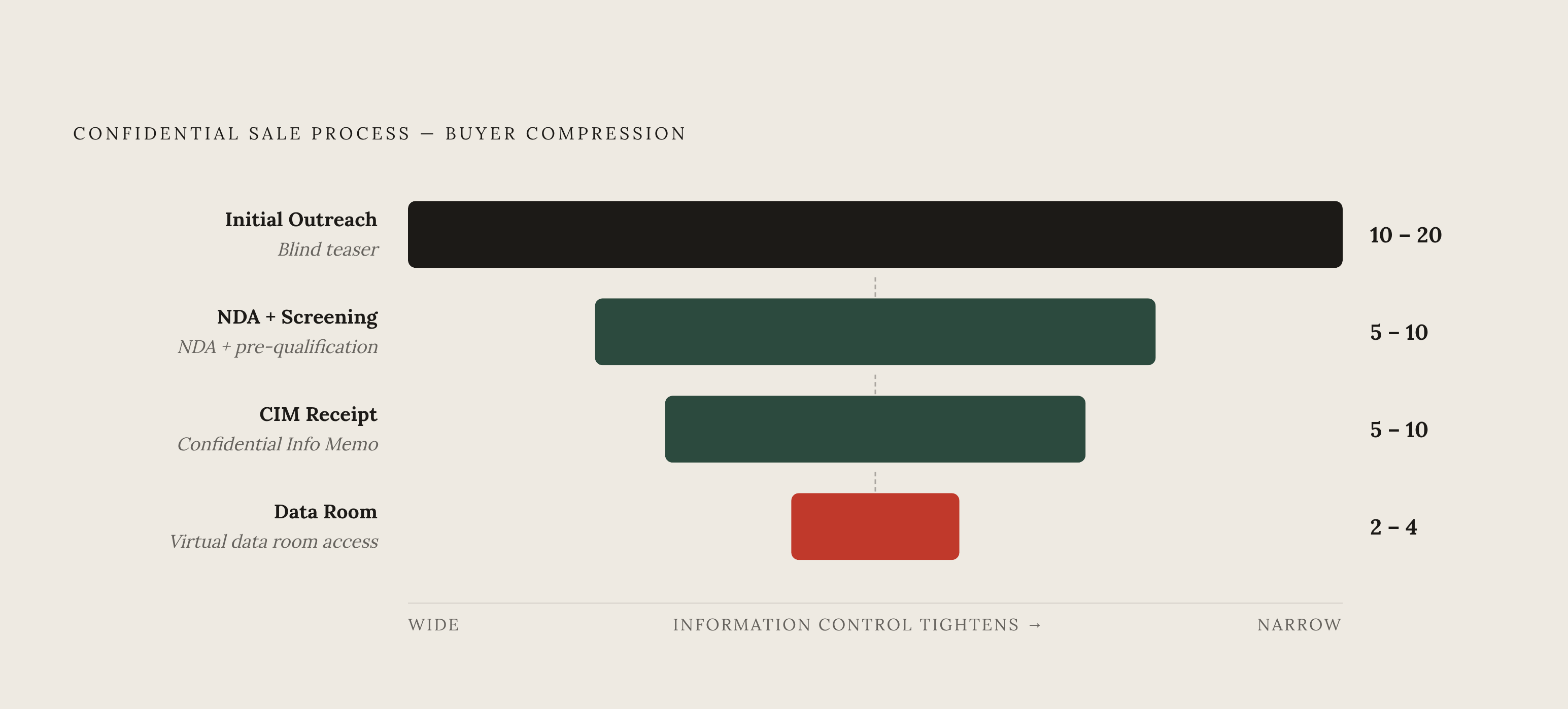
Run the qualification logic forward through an actual deal and it produces a specific shape: broad anonymous interest at the top, narrowing stage by stage down to a small group competing seriously at the bottom. Managing that shape is the core operational work of running a confidential process.
The numbers tend to follow a consistent pattern. Five to ten of those advance to CIM receipt, but only after NDA execution and commercial screening clear them. Two to four make it into the data room, where full financial and operational detail finally gets disclosed. Push too few through and the competitive tension that produces a strong price disappears entirely.
That competitive tension is not an abstraction, it is the actual mechanism that turns information control into deal value. One might argue that a lone interested buyer still represents a deal, and that is true, but it is a deal struck from a position with no leverage behind it.
Speed compounds this effect. Off-market sequential processes running pre-qualified buyers tend to close considerably faster than traditional broker auctions, and most of that time difference sits in the marketing phase specifically. That timing matters for confidentiality reasons as much as efficiency ones: the longer a process drags on, the more people learn about it, and the more chances there are for a leak somewhere in the chain. But where does that initial list of ten to twenty names actually come from? Advisors do not generate it from scratch for every deal. It comes from somewhere built in advance.
What a vetted buyer network is
A vetted buyer network is a continuously maintained, pre-screened pool of buyers whose financial capacity, acquisition mandates, and transaction history are already documented, so that qualification at the top of the funnel becomes a verification step.
A vetted network stands apart from an unstructured list of names because of how deep its documentation goes. And the advisor knows which buyers are early in their investment period, hungry to deploy capital, versus which are late and running out of runway, a distinction that shapes how aggressively each will bid and how fast they can actually close.
This layer makes the whole funnel reliable. The network is the infrastructure. Everything described in the earlier sections, the teaser, the NDA, the data room, depends on this infrastructure existing before the process starts.
The demand-side reality that makes advisory network access consequential, not just convenient
The pool of buyers who can acquire a lower middle market business has grown substantially larger and more varied in recent years, in ways you cannot track or reach alone as an individual owner.
The number of US private equity firms active in lower middle market targets has grown well past four thousand, and the dry powder behind them is at a scale that is pushing capital into smaller deals than these firms would have considered a decade ago. Middle-market buyout firms have been moving down-market specifically in search of value: PitchBook reported the median middle-market deal value fell to $151.9 million in the first half of 2026, down from $179 million the prior year, as firms targeted smaller transactions. Below that tier, independent sponsor and search fund activity has expanded the buyer universe even further.
An owner-operator selling without advisory relationships typically sees only a slice of this buyer pool, limited mostly to parties who found the business through public filings, LinkedIn searches, or an unsolicited inbound call. It is structural: the buyer universe has genuinely diversified into categories, independent sponsors and search funds especially, that an unadvised seller has almost no practical way to find on their own.
The outcome gap between advised and unadvised processes
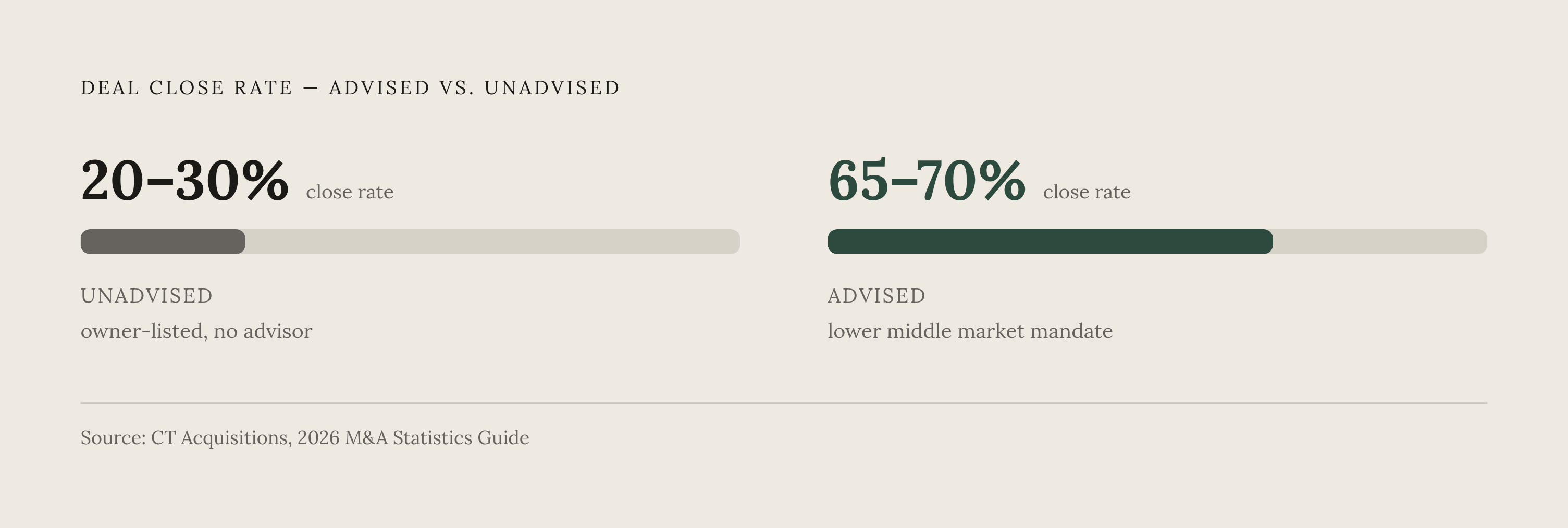
The numbers bear this out in a way that is hard to dismiss as coincidence. CT Acquisitions' 2026 M&A statistics guide reconciles two different data sources on close rates: owner-listed and unadvised businesses close somewhere between twenty and thirty percent of the time, while advisor-engaged lower middle market mandates close between sixty-five and seventy percent of the time.
That gap is not two studies disagreeing with each other. The selection happening at intake, the advisor deciding which deals are worth pursuing, accounts for most of that spread, not superior marketing or a cleverer pitch deck.
Even within advised processes, close to a third still end without a transaction. What kills them? The 2026 Pepperdine data points to a buyer-seller valuation gap as the single most common cause, not a shortage of interested buyers and not a confidentiality failure. This is exactly where competitive tension earns its keep: multiple qualified buyers in a process give the seller a reference point and a floor, which reduces the odds that any one buyer's gap on price is enough to kill the whole deal. Closing that preparation gap early is what the final section comes back to, but it also sets up a related question: does the sector an advisor specializes in change the shape of this outcome?
Why sector-specific buyer networks outperform generalist networks
A sector-specific buyer network outperforms a generalist one because it pre-qualifies buyers on strategic fit, which is the single variable that most determines whether a process produces real competitive tension or just surface-level interest.
A few advisory firms illustrate what sector depth actually looks like in practice. iMerge Advisors works exclusively in SaaS, software, and AI M&A, and its buyer network is concentrated among PE firms running SaaS roll-up strategies, buyers who already know what ARR, churn, and net revenue retention mean without needing the seller to explain the business model from scratch. FOCUS Investment Banking, headquartered in Vienna, VA in the Washington DC metro area, works in government services and defense, bringing buyer relationships that a generalist advisor simply would not have for a founder in that space.
Sector depth also pays off directly on the confidentiality side of the equation. An advisor who already knows which buyers in a given sector are active, well-capitalized, and mandate-aligned can populate the top of the funnel with ten to fifteen precisely targeted parties, rather than casting a wide net and filtering reactively after the fact. So fewer total recipients at the teaser stage means less aggregate exposure across the board. Sector focus functions as a risk-management discipline as much as a valuation strategy.
The strongest objection to the tight-network model
But what if a narrow, tightly controlled process actually limits the competitive tension it is supposed to create? This objection deserves to be taken seriously rather than waved off, because it gets at something real: volume of outreach and depth of qualification are two different variables, and conflating them is a mistake in either direction.
Why doesn't that apply to most founder-led confidential exits? For a founder-led business, where the owner's ongoing relationships with staff and customers carry much of the company's value, a leak during the process can destroy the very thing the process exists to protect.
The qualification gap is what actually kills deals, and raising outreach volume does nothing to close it. The 2026 Pepperdine data is clear that the most common deal-killer is a valuation gap between buyer and seller, not too few interested parties. Two to four buyers who are pre-qualified, mandate-aligned, and aware of each other's presence produce more genuine price pressure than twenty unvetted parties who were never going to close in the first place. The vetted buyer network is what makes that kind of concentrated, disciplined competition possible, which is exactly the resolution the earlier sections were building toward.
Evaluating an advisor's buyer network
The vetted buyer network is the structural layer everything else in this process depends on, so if you are a founder evaluating advisors, you should look at the network's characteristics before much else about the firm.
A few questions reveal whether a network has real depth or just size. Can the advisor explain the funnel structure directly, how many teaser recipients, how many CIM recipients, how many data room invitees, and why that particular shape fits this specific business?
That raises an important question about timing, too. Advisors who engage founders two to five years before a planned exit, rather than only at the point of going to market, can work systematically through the issues that become buyer objections later: owner dependence, customer concentration, incomplete financial documentation. A business that has addressed these in advance reduces its odds of hitting the most common deal-killer, a valuation gap that has no competitive tension strong enough to absorb it. Exit planning and M&A advisory function as two distinct phases of the same journey, and owners who treat them as a single event tend to leave real preparation value on the table.
Pre-qualification itself works better as a systematic, repeatable filter than as subjective judgment exercised case by case. For a founder weighing when to start this conversation, the honest answer is earlier than most expect, and the network should be evaluated at the front of that conversation. Succession AI, a Toronto-based AI-powered M&A platform that runs private, advisor-led sales for founder-led businesses through a network of 10,000+ vetted buyers, is one such option.