Confidential Sale Architecture Canadian Founders Use When a Listing Is Not on the Table
A staged-disclosure process lets founders sell without going public.

Selling a smaller Canadian business without a public listing or a traditional broker engagement is possible through a confidential, competitive sale process. An M&A advisor or buyer-matching platform combined with advisory can approach screened buyers through staged disclosure. The essential distinction is that confidentiality controls who learns what and when, without surrendering the competition needed to support price and terms.
Why Canadian founders cannot afford a public listing
A founder can spend decades building a business, then watch its value erode because employees and customers learn about a possible sale before a deal exists. Employable staff may begin looking elsewhere, taking with them the talent buyers want to acquire. Customers may seek backup suppliers, delay renewals or reduce orders. Competitors gain an opening to approach both groups. The business becomes less stable just when buyers are taking a close look at it.
The risk falls unevenly on the seller. Broad exposure may attract more initial interest, but a rumour can damage earnings before any buyer commits. That damage does not depend on a transaction closing. Where employee continuity, customer confidence and competitive discretion underpin value, a public listing puts those assets at risk unnecessarily. A curated process can reach credible buyers without making the ownership decision public.
What confidential sale architecture actually is — and what it is not
A confidential sale architecture is a structured, competitive, multi-buyer process conducted off-market through sequenced information gates. It is not simply a quiet conversation with one interested acquirer. In a sole-source negotiation, there is usually too little competition to keep the price and protections honest. Nor is confidentiality another name for distributing sensitive information widely while asking recipients to remain discreet.
The distinction lies in who enters the process. “Curated” means pre-qualified by capital, acquisition mandate, sector fit and transaction seriousness. Buyers receive enough information to decide whether to advance, but not unrestricted access to the business. Controlled outreach waves give the seller alternatives without creating a crowd of people who know the company is available. The advisor’s task is to balance confidentiality against competition.
The five-stage disclosure sequence, gate by gate
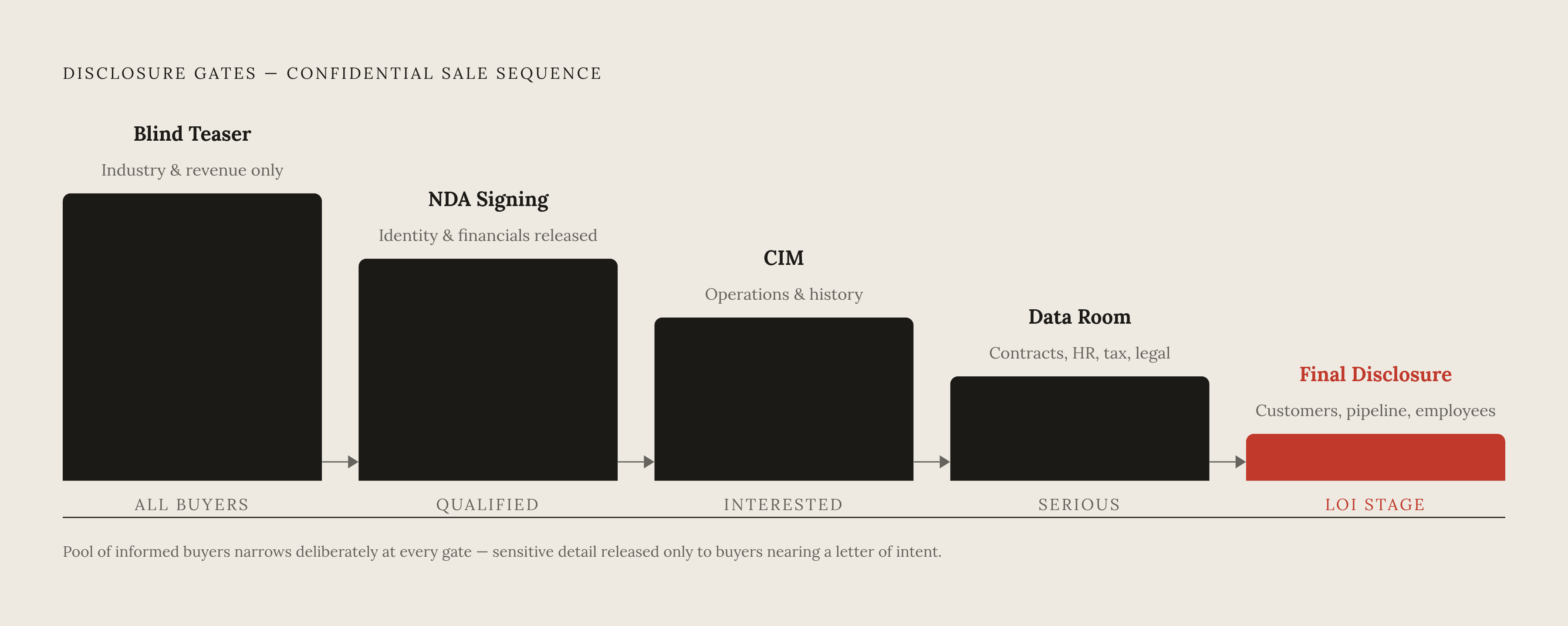
The first gate is the blind teaser. This one-to-two-page anonymous profile describes the industry, geography in general terms, approximate revenue scale and ownership transition thesis. It gives a buyer enough to assess fit without identifying the company. The sell-side advisor controls off-market distribution to a curated list.
The second gate requires an interested buyer to sign a non-disclosure agreement before receiving identity, financials or identifying details. Its protections extend beyond the accounts. The NDA typically restricts solicitation of employees and customers and disclosure that the business is for sale. A buyer who resists reasonable restrictions is revealing something useful about process fit.
At the third gate, qualified buyers receive the Confidential Information Memorandum, or CIM. It presents the history, operations, financial performance, market position, management, growth opportunities and investment thesis. Customer names are often anonymized, while copies are numbered and recipients tracked. The fourth gate opens permissioned access to the virtual data room, including contracts, monthly accounts, HR records, tax filings and legal materials. An audit trail records who opened what.
At the fifth gate, only serious buyers nearing a letter of intent receive detailed information on customers, suppliers, employees and the pipeline under the process rules. Access remains selective even at this stage. Broad employee and customer announcements wait until at or just after signing, when the transaction is essentially certain. Collapsing the gates gives away information before buyers have demonstrated corresponding intent.
Getting the business ready before the first teaser goes out
These gates work only if the underlying business can withstand scrutiny. An off-market process compresses the interval between buyer interest and commitment, leaving little room to reconstruct records or repair governance. Buyers expect to see financial records for at least three years. Institutional buyers also expect accrual-basis accounts and add-backs backed by records, with income statements, balance sheets and cash flow statements that show which cash comes from operations and which comes from loans or asset sales.
Legal preparation serves the same purpose. Missing corporate records, unassigned intellectual property, unresolved disputes and unfamiliar change-of-control clauses can weaken the seller during negotiations. The minute book needs its incorporation documents, resolutions, share certificates, securities register and any shareholders agreements. A pre-sale legal audit finds what is missing and which consents are needed while the founder still controls the timetable.
Continuity needs preparation too. Buyers require confidence that the business can operate without its founder. That requires delegated decisions, documented workflows, cross-trained staff and client relationships shared across the team. Those changes take time to become credible. Starting two to three years before a planned exit allows financial, legal and operational weaknesses to be addressed before outreach. The accountant, transactional lawyer and M&A advisor should all be in place before the teaser is drafted.
How normalized EBITDA determines what the business is actually worth in a confidential process
Prepared accounts establish what happened, but buyers also need to understand which earnings will persist under new ownership. Normalized EBITDA adjusts reported earnings for above- or below-market owner compensation, personal expenses, one-time items and related-party transactions. The adjustment can work in either direction. Its purpose is to show underlying earnings power.
Tax-minimization decisions can obscure that earnings power. An expense treatment that served the owner during operations may depress stated earnings unless its relevance to a new owner is explained and documented. Because valuation applies a multiple to earnings, an unsupported adjustment can have an outsized effect on enterprise value.
For smaller owner-operated businesses without a management team, seller’s discretionary earnings may be the more appropriate measure. Size also affects the multiple, so meaningful EBITDA growth before outreach can improve both the earnings base and its valuation. Neither point substitutes for evidence about the particular business. In a confidential process, a credible, well-documented normalized EBITDA gives the CIM authority with institutional buyers who cannot rely on public information to assess the opportunity.
Who the right buyers are for a confidential Canadian process — and how to vet them
What does the founder want after closing? Maximum headline price, certainty, legacy and team continuity can lead to different buyer choices. Strategic acquirers buy market share, capabilities or customer relationships and may pay for synergies, but integration risk can be higher and timelines longer. Private equity firms and PE-backed platforms may treat the business as an add-on acquisition, with an earn-out or rollover equity forming part of the economics.
Other buyers offer different ownership paths. Family offices often bring patient capital, hold businesses for longer and interfere less in how they are run than private equity does. Search funds back an individual who acquires one company and becomes its operator as a standalone business. They are most active in the sub-$5M EBITDA range. Neither category is automatically preferable, because fit depends on the founder’s intended transition.
Screening must test capacity as well as compatibility. Whether interest turns into a deal depends on the buyer’s capital, sector mandate, geography and how serious they are about buying. Requests for identity before an NDA, or data room access before an indication of interest, are process risks. AI-driven matching combined with investment banking advisory can connect the company with a network of buyers who have already been vetted, without hiring a traditional broker, by checking it against active buyer mandates while human advisors run the process.
The share sale versus asset sale decision and its effect on what the founder keeps
Finding a suitable buyer does not settle what the founder will retain. In a share sale, the buyer acquires the corporation and the seller disposes of shares, with capital gains treatment. In an asset sale, the buyer acquires selected assets. The tax consequences can include recaptured depreciation, capital gains and corporate income tax on proceeds.
The parties often begin with opposing preferences. Buyers tend to prefer asset purchases because they can choose the assets, get a stepped-up cost base for depreciation and avoid corporate liabilities they do not know about. Sellers generally prefer share sales because they get capital gains treatment and may be able to use the Lifetime Capital Gains Exemption. That conflict makes structure a negotiating variable.
The practical implication is to quantify the difference before conceding it. Agreeing to an asset sale without working out the value of the lost exemption can greatly change how much the seller keeps. Structure belongs in the process before the letter of intent is signed, rather than becoming an unwelcome discovery after the parties have settled on a price.
The Lifetime Capital Gains Exemption and why it must be built into the architecture years before closing
The Lifetime Capital Gains Exemption, or LCGE, explains why early preparation is also a tax requirement. A qualifying share sale can unlock a substantial personal tax benefit, but eligibility depends on corporate structure, assets and holding periods established before the transaction. It cannot be improvised at closing. With the right shareholding arrangements, including direct ownership or a family trust with an estate freeze, the total benefit can be spread across family members who qualify.
Three qualification tests shape that planning. At sale, substantially all of the corporation’s asset value must be used in an active business, so excess cash, investments or real estate not used in operations can create problems. The 24-month holding-period requirement makes last-minute trust planning unsuitable. The shares must also qualify as shares of a small business corporation, with an active Canadian-controlled private corporation underlying the sale.
These requirements involve both closing conditions and a lookback period. The founder’s CPA should check the asset test each year during the three years before a planned sale and review the holding-period and active-business requirements that apply. That makes the pre-sale accounting and legal audit an LCGE qualification audit too. The detailed work belongs with the tax advisors, but the founder must leave enough time for it before launching outreach.
Managing the people inside the business while the process runs
Founders often want to be candid with employees who helped build it, and withholding a possible sale can feel uncomfortable. Yet premature disclosure creates questions that cannot be answered honestly while the outcome remains uncertain. An aborted transaction can leave employees anxious without giving them a new owner or a settled plan.
A small inner circle may need to be told sooner. The CFO, COO or operations lead whose cooperation is essential may need retention agreements and stay bonuses to support continuity through the process. Management presentations can take place off-site, after hours or virtually so they do not expose the sale to staff, customers or competitors. The broader team is typically told at or just after signing, with a clear account of what changes and what remains stable. This is a planned communication sequence that protects employees from uncertainty.
How can a Canadian founder sell a smaller business without a traditional broker?
An institutional M&A advisor or a buyer-matching platform combined with advisory can provide an alternative to a traditional broker or public listing site. The distinction is who builds and runs the confidential process. A database introduction alone does not supply the disclosure gates, screening or transaction discipline described here. The engagement must cover those functions.
Traditional brokers typically charge eight to fifteen percent of the sale price on a success-fee basis. Their buyer reach is widest with public or semi-public exposure, which can create tension with a founder’s confidentiality needs. Institutional investment banks and boutique M&A advisors instead run structured confidential processes for businesses whose earnings justify the engagement.
For a founder-led lower middle-market business too small to attract a traditional bulge-bracket advisor, AI-driven matching combined with human advisory can offer a way to reach buyers and run a confidential sale. Matching sector, size, geography and transition profile against active mandates can improve the speed and precision of buyer identification without public exposure. The founder still needs to check how the fees work, since using technology alone does not make the service affordable.
The selection test is practical. Does the fee model support confidentiality, does the advisor have active buyers in the right sector and size range, and will the advisor recommend building value first if the business is not ready? The founder’s job is to start early enough that every gate can be used as designed.