What a Broker Will Do to Your Number and How to Stress-Test It First
A four-part stress test shows whether your valuation will survive buyer scrutiny.

For SMB owners who plan an exit, a business valuation tool needs an adjusted earnings statement, comparable transactions and a calculation of what the owner will receive at closing. A broker reconstructs earnings and applies a risk-adjusted multiple, so both inputs need testing. Before talking to buyers, an owner can use a four-part stress test to distinguish a defensible valuation from an attractive headline.
Why the number a broker gives you is not the number your business will sell for
An industry multiple answers a narrower question than most owners think. It describes the relationship between earnings and sale prices in comparable transactions. Treating that ratio as a settled price skips the work that makes a comparison valid. Which earnings measure was used, how large were the businesses, and how dependent were they on their owners?
East Coast Advisory uses the industry average to check whether an estimate is reasonable. A broker’s estimate becomes more useful when it explains how the business differs from that average. Yet an estimate is still not a sale. Buyers must agree with the earnings reconstruction, the risk assessment and the deal terms before an owner can receive that amount.
The two earnings metrics brokers use and why mixing them produces the wrong number
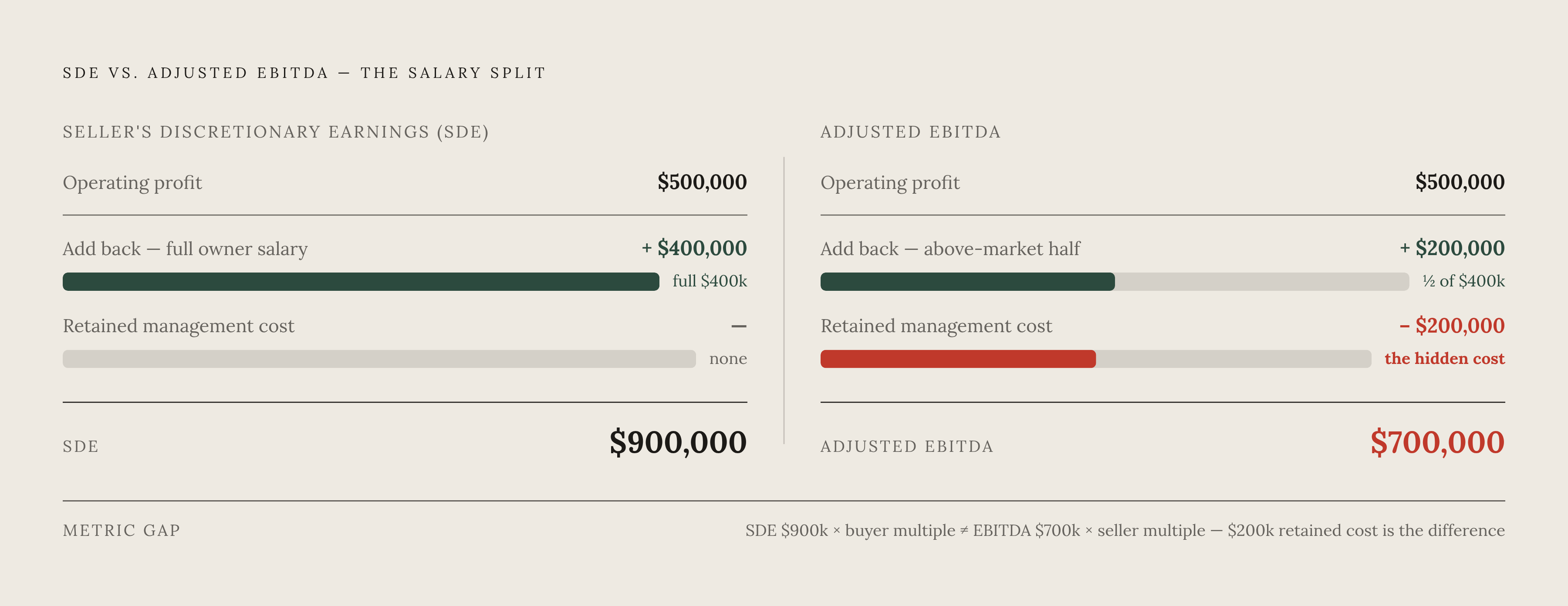
Seller’s discretionary earnings, or SDE, measures the economic benefit available to a single owner-operator. ARX Brokers describes it as “the total financial benefit to a single owner-operator”. Its calculation starts with net profit and adds back owner salary and benefits, personal expenses run through the business, non-cash charges such as depreciation, interest and one-time items. The buyer is buying both the earnings and a role in running the business.
EBITDA treats the business as a managed asset. In an adjusted EBITDA calculation, a market-rate salary for the owner’s replacement remains an expense, while compensation above that rate can be added back. Someone still has to do the work. The distinction is therefore not simply between smaller and larger earnings figures, but between a buyer replacing the owner and a buyer paying management to run the company.
Consider a business where the owner salary is twice what it would cost to hire a replacement manager at the market rate. Holding all other adjustments constant, SDE adds back the full salary, while adjusted EBITDA adds back half the salary and retains half as a management expense. Applying an EBITDA multiple to SDE would ignore that cost, while applying an SDE multiple to EBITDA would compare unlike measures.
How deal size moves the multiple more than industry does
East Coast Advisory states that “Deal size moves multiples more than industry does”. Smaller owner-operated companies tend to trade at lower SDE multiples, while greater earnings scale and management depth support higher valuation tiers. Industry comes after that size baseline. A multiple from a large company run by managers is therefore a poor starting point for a smaller business whose owner runs it day to day, even if both sell the same service.
The staircase also explains why operational change can outweigh an individual add-back. A business that becomes management-run and crosses into a larger deal-size band can reach a different multiple tier. That shift is not automatic. Even when a business ends its owner dependence, it still needs enough earnings to be compared with larger companies in its sector. Both the economics and the operating structure have to support the comparison.
Sector characteristics then move the starting range. In 2026, HVAC, plumbing, dental, insurance and car washes sit toward the higher end, supported by recurring revenue, licensing barriers and active private equity consolidation. Single-unit restaurants, independent retail and small Amazon FBA businesses fall in lower ranges linked to fewer buyers, owner dependence or platform concentration. Small manufacturing and professional services fall in the middle of the SDE range, while managed IT can draw higher EBITDA multiples because it has recurring monthly revenue. These are reference bands specific to each sector and earnings measure.
The four adjustments a broker makes to your multiple — and what each one actually costs
Customer concentration is the first adjustment to examine within that baseline. A large account can make earnings look strong now while leaving future earnings at the mercy of one decision the company cannot control. Buyers and lenders take that risk into account when they set a price. The observable test measures how losing the largest customer affects profit, accounting for the revenue that disappears. If the earnings left cannot cover acquisition debt, the concentration limits what a buyer can pay.
Recurring revenue works in the opposite direction because contractual income makes future earnings more dependable. An HVAC company built around maintenance contracts can get a higher multiple than one that relies on new construction projects. The sector label is identical, but the income pattern is not. An owner can distinguish revenue under continuing contracts from work that must be won again. The cost of weak recurrence is a lower position within the sector’s range, even when recent earnings match those of a more predictable business.
Financial documentation determines how much confidence buyers can place in those earnings. Clean, audited or reviewed financials remove uncertainty that otherwise becomes a discount. A strong profit figure is not enough. An owner can check whether the monthly accounts reconcile and whether there is evidence for each proposed adjustment. Poor records can hurt twice, first by weakening the multiple and then by leaving otherwise legitimate earnings adjustments unsupported.
Owner dependency is the most consequential adjustment because it defines what transfers at closing. Could the owner take four consecutive weeks off, with the phone off, and return to normal business performance? The answer exposes where customer relationships, bidding, training and daily decisions depend on one person. Buyers are purchasing continuity as well as historical profit. If that continuity requires the seller’s ongoing presence, alternatives to a straightforward price reduction may include a lower multiple, a larger earnout or a longer transition.
How the add-back reconstruction works and where it goes wrong
Add-backs normalize reported profit by removing costs that qualify because they do not reflect how the business will run under the buyer. They are not inherently aggressive accounting. A documented personal expense omitted from the reconstruction understates earnings, and applying a multiple magnifies that omission. The owner needs to recover the value the business has without counting earnings it does not make.
ARX builds an adjusted cash flow statement from three years of monthly profit-and-loss statements and checks each line for add-backs. Standard candidates include owner compensation, one-time legal costs, personal vehicle expenses, unusual repairs and documented family payroll, with treatment depending on the earnings metric and the expense itself. A label alone does not establish eligibility. Compensation for work that must continue cannot simply disappear from an EBITDA calculation, and calling a repair unusual does not establish that it will not recur.
Diligence tests whether an adjustment is measurable, documented and appropriate to remove from continuing costs. Owner-specific and one-time expenses can satisfy that test, but “lost revenue” and aspirational forecasts do not become historical earnings because a seller includes them in a schedule. Evidence draws the boundary. Unsupported adjustments can shrink the accepted earnings base during diligence, leaving a gap between the asking price and the amount a buyer will fund at closing. That gap may reappear as an earnout, deferred payment or seller note.
The resulting price also needs a precise definition. Enterprise value describes the cash-free, debt-free operating asset, while equity value deducts debt assumed, adds excess cash and adjusts working capital against the normalized peg. Headline price is the figure in the letter of intent, before the payment structure determines what arrives at closing. These amounts answer different questions. Earnouts, seller notes, rollover equity and escrows can leave day-one cash well below the headline, so a stress test has to follow the money through to proceeds.
How can an owner stress-test business value before engaging a broker?
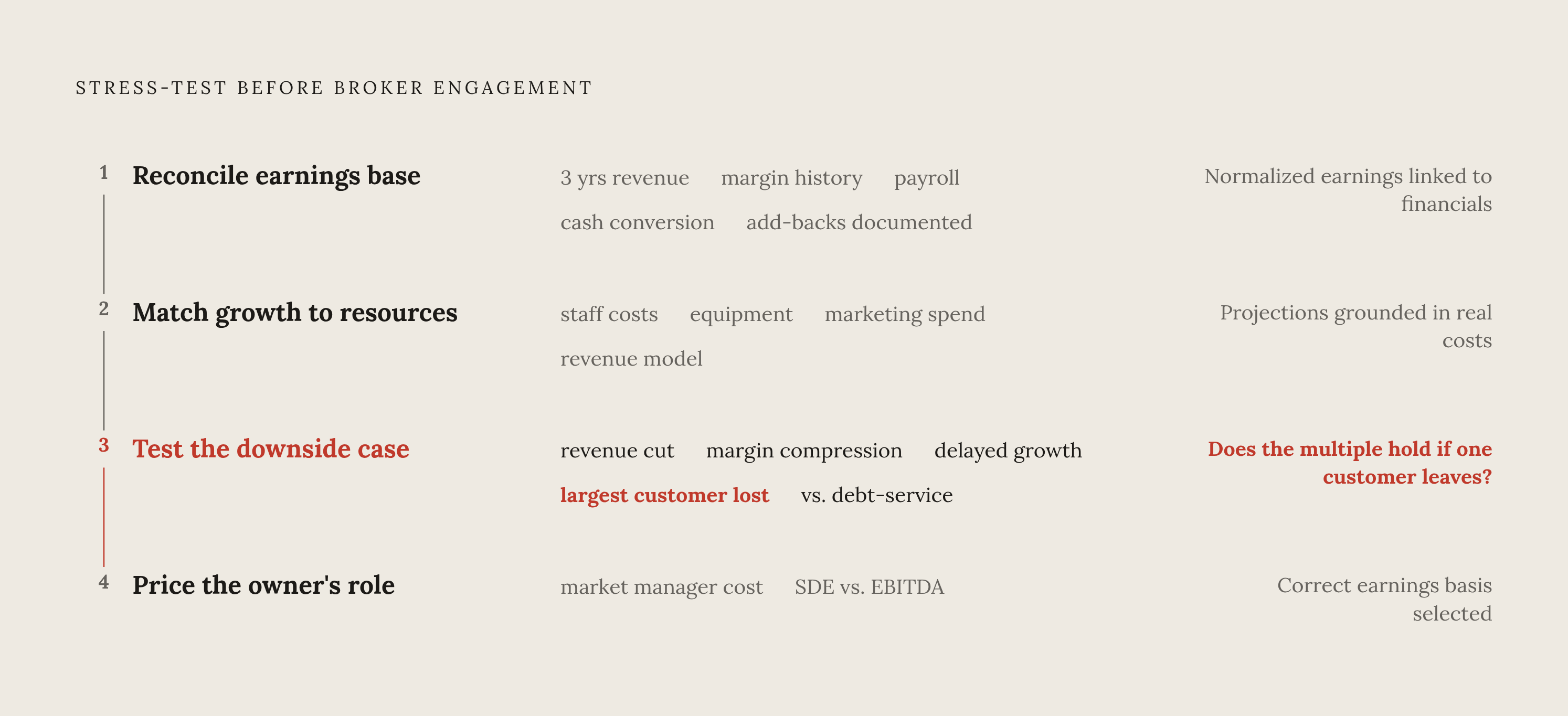
The practical test begins with the owner reconciling the earnings base. The owner uses monthly accounts to build a three-year adjusted cash flow view that links normalized earnings to past revenue, gross margin, payroll and cash conversion. Each add-back has its own supporting record. Any material improvement in the trailing period is investigated before it becomes the basis of the valuation. The owner checks whether the figure reflects demonstrated performance and investigates any unexplained jump or unusually strong period.
Second, the owner matches growth assumptions to resources. If the model depends on more staff, equipment or marketing, those costs enter the same model as the expected revenue. Growth is not free of operating costs. A projection that records the benefit but omits the investment presents an incomplete earnings picture.
Third, the owner tests a downside case by reducing revenue, compressing margins, delaying growth and modelling the loss of the largest customer. The purpose is not to manufacture a catastrophe, but to ask whether the business can withstand a reasonable setback at the proposed purchase price. Debt service provides a concrete pressure point. If a customer departure would impair the buyer’s ability to service acquisition debt, the proposed multiple needs to reflect that exposure. The owner discovers the constraint before a buyer uses it to challenge the price.
Fourth, the owner prices their operational role out of the business at market compensation. The calculation retains the cost of a replacement manager rather than assuming the owner’s work vanishes after closing. This tests the appropriate earnings measure directly. It also shows how the cost of management differs from the wider dependency risk, since paying a salary alone does not pass on relationships or institutional knowledge. The profit the business can earn without the owner helps show whether SDE or adjusted EBITDA best describes what is being sold.
The owner then tests the multiple against what buyers do in the business’s size band and sector, keeping headline prices for large platforms in their own context. The range includes low, midpoint and high proceeds cases, with a bridge from enterprise value through debt, working capital, transaction expenses and deal terms, including earnouts and escrows. A single estimate leaves those sensitivities hidden. For an owner planning an exit in the next year or two, a professional valuation and this stress test create a preparation window. That time allows weaknesses in documentation, customer diversity or management depth to be addressed before they become negotiating concessions.
What the stress test reveals about whether the business is ready to go to market
A business is ready for serious engagement when its earnings survive scrutiny, its multiple fits comparable transactions and its proceeds meet the owner’s financial goal. That establishes a number worth defending and a clear basis for discussing it with advisers and buyers. The remaining uncertainty belongs to the market process, rather than to unresolved assumptions in the owner’s own calculation.
Partial success produces a different decision. If the earnings are sound but concentration, documentation or dependency depresses the multiple, the findings become a prioritized repair plan, with a higher asking price dependent on addressing those weaknesses. Owner dependency requires particular care. Processes and institutional knowledge that exist only in the owner’s head require operating infrastructure. An owner three years from exit has time to build a team and improve continuity before buyers assess the transition risk.
If the proceeds range still falls short, it may be better to plan ahead than to put the business up for sale. Discovering that mismatch before signing an engagement letter preserves time to address it. Expert guidance then has a defined purpose, whether it comes from an investment banker, an M&A adviser or an advisory model combining AI-driven buyer matching with human investment banking support for profitable businesses across a range of sizes. The choice follows the diagnosis. The business must be able to support an adviser’s highest number through diligence and convert it into the proceeds the owner needs.