The Pre-LOI Valuation Checklist Every Canadian SMB Owner Should Run Before Going to Market
Prepare your financials and normalize earnings before the buyer's offer arrives.

A useful business valuation tool for Canadian SMB owners planning an exit combines normalized earnings, a sector multiple and evidence that the business can transfer to a buyer. This pre-LOI checklist turns those inputs into a defensible estimate before a letter of intent arrives. Its central point is that preparation shapes both the earnings a buyer accepts and the multiple they will pay.
Why most Canadian SMB owners arrive at the LOI table without knowing their real number
CFIB’s succession research shows that a large majority of small business owners plan to leave within the next decade, but only a small fraction have a formal succession plan. For many, their largest asset remains informally valued. A hallway benchmark cannot distinguish what a business earns from what a buyer can reliably inherit. Underestimating invites a low offer, while overestimating builds retirement plans around wealth that may not exist. The useful response is a working valuation framework.
How buyers calculate the number they put in the LOI
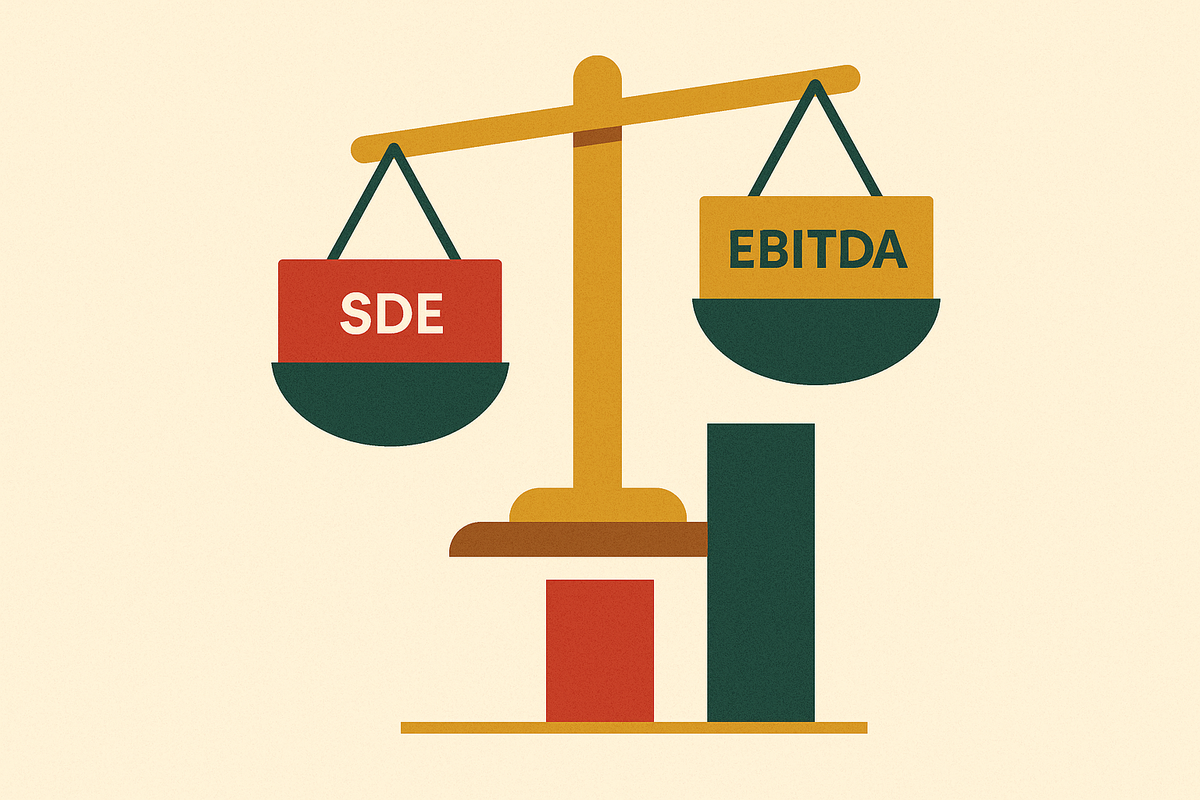
For most profitable Canadian SMEs, the starting calculation is normalized EBITDA multiplied by an industry multiple to estimate enterprise value. Smaller owner-operated businesses often use Seller’s Discretionary Earnings, or SDE, instead. The distinction is who does the work. SDE combines net profit with owner compensation and personal expenses, plus interest, depreciation, amortization and non-recurring expenses. EBITDA assumes the business must retain management at market pay, so the owner’s entire wage is not simply added back.
If the owner still performs the core work daily, SDE is generally the more relevant benchmark. Rough multiples range from 1–2× when the business is essentially the owner’s job, to 2–3× for a typical owner-operator trade business, and up to 4× or higher with a crew, recurring contracts and documented systems. Once a foreman or operations manager runs the business without the owner, buyers turn to EBITDA and comparable companies. Other methods serve different purposes. Market comparables inform the multiple, while discounted cash flow and asset-based approaches apply in specific situations, with asset value providing a floor.
What industry your business is in, and where it sits within that industry's multiple range
The sector benchmark is a range. The Canadian SME EBITDA ranges in this checklist are 6–10× for technology and SaaS, 4–7× for software services, and 3–6× for professional services such as consulting, accounting and legal. Manufacturing spans 2.5–5×, brick-and-mortar retail 1.5–3×, and construction 2.5–4×. These EBITDA benchmarks are distinct from SDE multiples used in an owner-operated business.
What explains the distance between the endpoints? Within a sector, buyers price the reliability of earnings and the risk of taking over operations. Two businesses with equal earnings can therefore attract different offers because one has transferable customer relationships and dependable management while the other does not. Preparation affects that position within the range. The first evidence a buyer uses to judge it is usually the financial record.
Checkpoint 1 — Financial records — three to five years, clean, consistent, and reconciled
Buyers usually ask for three to five years of financial statements and check them line by line. The quality of the record shapes their confidence. Earnings are harder to check when personal spending is mixed into business costs, accounting policies vary, accounts are unreconciled or notes are missing. Differences between ASPE and IFRS policies can also distort EBITDA in Canadian private-company targets.
The pre-LOI action is to pull those statements now and annotate years containing unusual owner compensation, personal expenses or one-time items. Resolve inconsistencies before they become buyer findings. This is not simply a tidying exercise. Buyers discount earnings they cannot check for themselves, so clear records support the earnings on which the valuation rests. Those records are the raw material for normalization, which separates reported profit from sustainable earnings.
Checkpoint 2 — EBITDA normalization — every legitimate add-back multiplies into sale price
Normalization adjusts earnings to account for owner compensation above or below market rates, personal expenses, non-recurring items and related-party transactions at non-arm’s-length prices. It can move earnings down as well as up. An owner paid below market creates a replacement cost. Each defensible adjustment then flows through the multiple used to value the business.
That multiplication makes documentation essential. Questionable add-backs can inflate expectations only to collapse when the buyer commissions a Quality of Earnings review. What remains is not just a lower earnings figure but a credibility problem. The practical action is to build a normalization schedule with supporting documents for every adjustment and exclude anything that cannot be documented. That schedule will later give an independent reviewer a clear basis for testing the number.
Checkpoint 3 — Owner dependency — the factor that compresses multiples across every sector
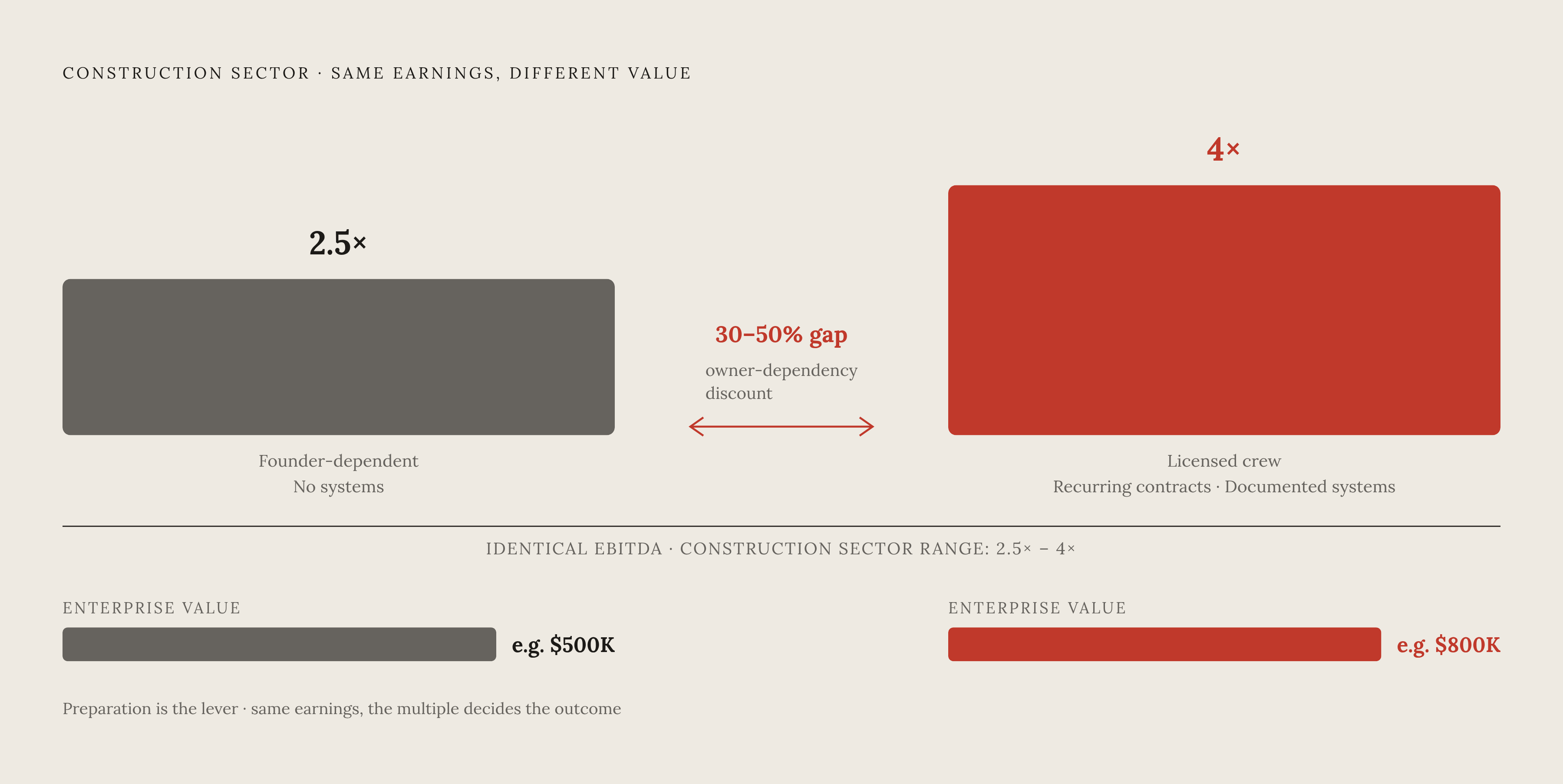
What exactly continues working when the founder leaves? Heavy dependence on the owner can produce valuation discounts of 30–50%, because the buyer must assess whether operations, customer relationships and decisions will survive the transfer. The electrical contractor illustration in the brief makes the mechanism concrete. Even when earnings stay the same, a licensed crew, documented systems and recurring commercial contracts can nearly double the sale price.
For an owner who built the company around personal expertise, reducing that dependence can feel like dismantling the source of its success. It takes time to change that pattern. Promoting or hiring a strong second-in-command gives the business someone who can run it day to day, but the title alone proves little. A common failure is to claim that management exists while the founder still makes every major decision. Buyers test that claim by speaking with senior staff about who actually has authority.
Evidence of transferability includes operating procedures staff can follow, customer relationships held by the business, and managers with a decision-making track record. Key contracts and supplier relationships should not depend on the founder’s signature or presence. Customer concentration creates a parallel dependency when one or two clients dominate revenue. The pre-LOI action is to map the decisions, relationships and functions only the owner can perform, then build a 12-month transfer plan assigning each to a named person with documented authority. Diversifying the customer base addresses the corresponding revenue risk.
Checkpoint 4 — Recurring revenue — why contracted and subscription income is valued differently
Subscriptions, retainers, maintenance contracts and memberships reduce uncertainty because revenue renews without active reselling. Buyers pay for that predictability through a higher multiple. For trade and service businesses, maintenance contracts or service agreements are the practical comparison with one-time projects. The work may be similar, but the revenue commitment differs.
The pre-LOI action is to measure the contracted or subscription share of revenue and model what annual service agreements with top project clients would change. Yet a contract is only useful if it survives the sale. Change-of-control or assignment provisions may call for customer consent, so revenue that seems recurring may not transfer automatically. Reviewing those provisions before the LOI tests whether contracted revenue can transfer with the business.
Checkpoint 5 — Corporate records and structure — the title problems that delay or kill deals
Corporate housekeeping protects value. Missing resolutions, unsigned share certificates and minute-book gaps leave doubts about title that must be cleared up before closing, often at the seller’s cost. Corporations Canada requires federal businesses incorporated under the Canada Business Corporations Act to file information on individuals with significant control from January 22, 2024. An outstanding filing can therefore show that the business has not met the filing requirement.
Other exposures can change the buyer’s terms directly. Unremitted HST or PST arising from operations across provinces can become inherited exposure in a share deal, prompting an escrow or price adjustment. Provincial licences may not transfer automatically, and senior employees may be owed more than 24 months of common law reasonable notice. The pre-LOI action is to hire a business lawyer to check corporate records, deal with outstanding ISC obligations, confirm that licences can transfer in each province where the business operates and review employment agreements. Identifying liabilities before negotiation is stronger than defending them after discovery.
Checkpoint 6 — LCGE eligibility — the tax structure decision that must be made before the LOI, not after
A valuation estimate alone cannot tell the owner how much they will keep. The Lifetime Capital Gains Exemption, or LCGE, can shield approximately $1.25 million in capital gains in 2026 on qualifying shares. Eligibility depends on Qualifying Small Business Corporation, or QSBC, conditions. Among them is a historical asset test requiring more than half of the corporation’s asset value to have been used in an active Canadian business throughout the preceding 24 months. That history cannot be created at closing.
Retained cash, investment portfolios and real estate not used in the business can push the corporation below the required active-business proportion. Dividends, selling passive assets or moving them to a separate holding company may help, but the right choice depends on what the eligibility analysis shows. The pre-LOI action is to engage a tax advisor, model the passive asset position and establish whether restructuring and a 24-month qualifying period are needed. Owners planning an exit within that window cannot assume eligibility can be repaired in time.
Buyers usually prefer asset purchases for the stepped-up adjusted cost base and to avoid taking on inherited liabilities, while sellers usually prefer share purchases so they can use the LCGE. That difference becomes a negotiation over structure. A corporation that has not been prepared for QSBC eligibility loses a central tax advantage of the seller’s preferred route.
Checkpoint 7 — Sell-side Quality of Earnings — why validating your own number before a buyer does it is worth the cost
An independent accounting firm’s sell-side Quality of Earnings review tests the normalization schedule, earnings sustainability and accounting policies before the business goes to market. Sophisticated buyers commonly commission their own review, so the question is less whether the number will be tested than when a review will reveal weaknesses in it. A finding after the LOI becomes a negotiating event during exclusivity, when the seller has less leverage. The same finding before market can be addressed, explained or reflected in the asking price.
The cost is meaningful but bounded, while the earnings being tested determine a much larger valuation. The review also gives buyers a credible starting point that can shorten diligence. It does not remove the buyer’s scrutiny. The practical action is to commission it during formal market preparation and share the report selectively with qualified buyers under NDA.
How preparation timeline determines where on the multiple range you actually land
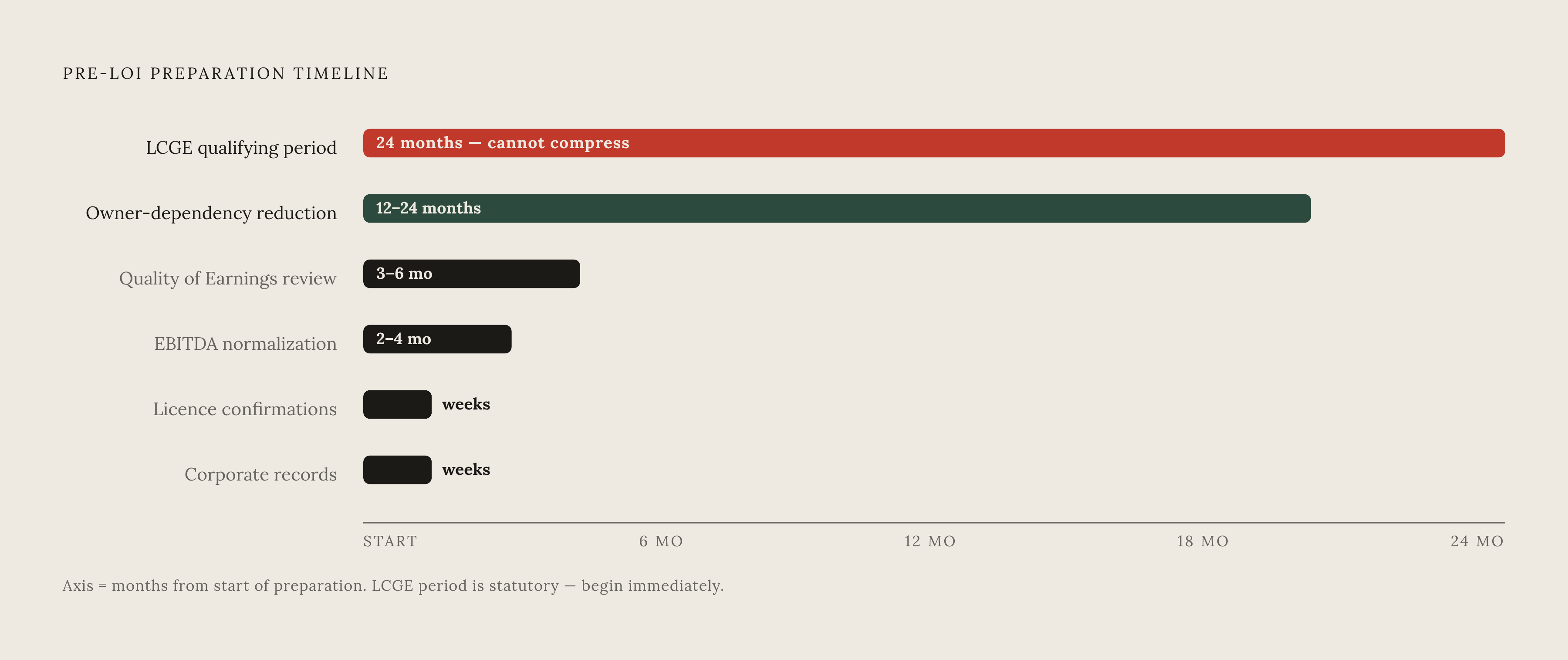
Time changes what the same preparation effort can accomplish. Owners beginning three to five years before a target sale have room to reshape operations and establish evidence that the changes endure. Owner-dependency reduction realistically takes 12–24 months to become credible in diligence. By contrast, legal records and licence confirmations can often be addressed within a few months. The distinction is between correcting a document and proving a business now operates differently.
For owners 12–18 months from an intended exit, the lesson is to triage normalization, records, LCGE eligibility and owner dependency. A tax review may reveal that the proposed date conflicts with a required qualifying period, while delegation begun now may still build useful evidence before diligence. Compression limits what can be demonstrated, even when the work is sound. The sale process itself typically takes several months to over a year. Preparation belongs before that clock starts, rather than being treated as work that can all happen during it.
What to do with the number once you have it — how do you go to market with a defensible valuation?
A defensible valuation needs a process that exposes it to qualified buyers. Accepting the first offer from a familiar competitor, supplier or customer forfeits the competitive tension that can support a stronger price. Familiarity is not a substitute for competition. Strategic acquirers, financial buyers and employee ownership trusts broaden the field beyond the most obvious contact.
The pre-LOI action is to engage an M&A advisor before setting a price or approaching buyers. Buyer matching and investment banking expertise are useful only insofar as they connect the prepared business with a disciplined, competitive process. The valuation is then a supported position to test. An owner planning an exit in the next year or two faces a concrete decision now. Begin the work that can improve the evidence and transferability, or take the existing business to market with the limitations it already has.