Tax Steps to Take in the Two Years Before You Sell Your Business
Plan structural changes now to minimize the tax hit when you sell.

Selling a business is also a tax-planning exercise, and the most useful decisions usually precede the buyer’s offer. The two years before a sale are the last practical window for many changes to ownership, structure, and residency. The task is to put those decisions in the right order, while recognizing that some tax benefits already require a longer runway.
Why the two years before a sale are the last window for meaningful tax planning
An owner may spend years building value, then only weeks preparing to sell it. That can cost the owner because talks over the deal cannot push back tax planning deadlines. By the time a letter of intent is signed, most of the tax outcome may already be fixed. The closing documents cannot manufacture a qualifying ownership history.
Two years is therefore a deadline. A C-to-S conversion starts a five-year built-in-gains period, while trust planning and residency changes need time for execution and defensible documentation. Real estate separations may need even more time. Choosing a strategy requires considering both its savings and its availability before the expected sale.
What is actually being taxed, and at what rates, before any strategy is applied
Gain depends on basis, while the character of that gain depends on what is sold and how the price is allocated. The top federal rate on long-term capital gain is 20%. Equipment depreciation recapture under Section 1245 and non-compete payments instead face ordinary-income treatment, as can an earn-out treated as compensation. At top rates, the tax rate on those ordinary-income allocations can be nearly twice the long-term capital gains rate.
Other layers depend on the seller’s circumstances. Section 1411 excludes gain from a business in which the seller materially participated from the net investment income tax, so that distinction deserves attention. A C corporation asset sale can produce corporate tax followed by shareholder tax on the distribution. State income tax adds another potential burden. Before considering any strategy, the owner needs to know which of these exposures the proposed transaction creates.
First, get your records, ownership documents, and basis calculations in order
To turn those exposures into a plan, gather at least three years of financial statements and tax returns, all ownership agreements, and documentation showing how each asset is titled. For a business with more than one owner, work out each person’s basis on its own. Basis determines the gain. Without it, advisors cannot reliably compare structures or explain why owners may owe different amounts from the same transaction.
Get a professional third-party valuation before serious talks with buyers. A Certified Valuation Analyst or Accredited Business Valuation holder gives an objective benchmark to use in place of what an owner thinks years of work should be worth. Have the CPA, tax counsel, and investment advisor work together using those records and that valuation. The CPA’s first assignment should compare asset and stock sales, lump-sum and installment payments, and a sale this year versus next year.
Resolve the entity structure question — this is the decision with the longest lead time
Buyers usually want assets because they get a stepped-up basis and avoid unknown liabilities, while sellers usually want stock sales with one level of capital gains tax. S corporations and LLCs avoid the C corporation’s double-tax problem, but an asset sale can still lead to ordinary income. A Section 338(h)(10) or 336(e) election can give a buyer asset-sale tax treatment in a legal stock sale. The seller should be compensated for that concession.
Converting a C corporation to an S corporation starts a five-year period during which appreciation existing at conversion remains exposed to corporate tax on a sale. Starting now will not complete that period within two years. For an existing S corporation, an F reorganization with an LLC drop-down may provide a more practical route to single-level seller taxation and buyer asset treatment. That process takes weeks to months, but it is not a substitute for resolving a C corporation’s built-in gains.
For C corporation shareholders, check the rules for qualified small business stock under Section 1202 before changing anything. The exclusion is substantial, but eligibility is narrow. The traditional holding requirement exceeds five years, while the One Big Beautiful Bill Act, enacted July 4, 2025, added partial-exclusion tiers rising to full exclusion at five years. It also raised the fixed-dollar exclusion limit for stock issued after that date, with a basis-based alternative.
Eligibility depends on more than the holding period. Statutory exclusions include many professional services, consulting, financial businesses, farming, and hospitality businesses. S corporation stock does not qualify, and converting restarts the clock. Gifting qualifying shares to non-grantor trusts well before a sale can multiply exclusions across taxpayers, but California does not conform to the federal exclusion. Have the CPA and M&A advisor assess the actual fact pattern rather than choosing a structure by its most attractive advertised benefit.
Personal goodwill — the tax lever most service-business owners leave on the table
For a relationship-driven business, ask who owns the relationships. Personal goodwill attaches to the founder’s reputation, expertise, and connections. When properly supported and allocated in the purchase agreement, its sale can receive capital gains treatment at the individual level. For a C corporation owner, that can remove part of the price from double taxation.
The immediate task is to review the founder’s contracts with the company. A non-compete with the owner’s own S corporation or C corporation can support the IRS position that the goodwill belongs to the company. Any unwinding or restructuring needs legal analysis before the deal. Get the CPA involved before the letter of intent, then negotiate the allocation among goodwill, equipment, inventory, and non-compete payments before signing the definitive agreement. Buyer and seller incentives differ, so allocation requires negotiation.
State residency — establishing domicile in a lower-tax state before the sale closes
Planning for residency takes place alongside planning for the entity. A move to a lower-tax state requires genuine relocation, and a move shortly before closing invites scrutiny from the departing state. California and New York are particularly aggressive in enforcement. This is not a closing-week adjustment.
In a moving year, the owner is typically a part-year resident and owes the former state tax on income earned while still resident there. The move’s timing therefore needs to be considered together with the sale’s timing. If relocation is under consideration, begin the move and documentation now with legal guidance. A defensible domicile takes more than a new mailing address.
Spreading the gain — installment sales, charitable structures, and what the two-year window changes
Installment treatment under Section 453 can be arranged in the deal itself. With at least one payment after the sale year, the seller reports gain as payments arrive using a gross profit ratio fixed at closing. This can reduce annual income spikes and, where applicable, exposure to NIIT thresholds. But not every component can be deferred. Depreciation recapture is taxed in full in the sale year regardless of cash received.
Section 453A charges interest on deferred tax above $5 million of outstanding installment obligations, and pledging the note as loan collateral accelerates gain recognition. Future tax rates could be higher. The buyer could also default, so the tax comparison must account for the risk of waiting to collect.
Charitable planning has a different deadline. A Charitable Remainder Trust must be funded before the sale reaches practical certainty, because a contribution after terms are effectively agreed can leave the donor taxable on the gain. If set up properly, it can give the founder an immediate charitable deduction, defer capital gains, and pay income to the founder. A Donor-Advised Fund funded before the sale can provide a deduction without the trust’s complexity. Make these decisions before talks begin, and gifts to family, trusts, or charities before the deal can also keep future appreciation out of the taxable estate.
Narrower alternatives have their own eligibility tests and calendars. C corporation owners considering an ESOP deferral need a three-year stock holding period and a qualifying ESOP ownership threshold. Opportunity-zone reinvestment generally has a 180-day window, but original-program deferred gain is recognized on December 31, 2026. A 2026 investment therefore offers almost no initial deferral and should be evaluated for the ten-year elimination of future appreciation. The post-2026 framework replaces that fixed date with a rolling holding period and offers a five-year basis step-up, with a larger step-up for rural investments.
The Medicare premium consequence that an installment election can soften
Income spreading can also affect life after closing. Medicare Part B and Part D income-related surcharges use income from two tax years earlier, so a sale-year spike can raise premiums two years later. Because the cost comes later, it is easy to miss when comparing offers. Model the Medicare effect together with the installment election rather than treating it as a separate retirement issue. Changing the closing date or spreading gain may cut or remove the surcharge, depending on how much income there is as a result.
How business value itself is determined, and what compresses it in the pre-sale years
A smaller tax bill is not the whole objective. If operational weaknesses depress the sale price, their cost can outweigh the benefit of a more favorable tax structure. Customer concentration reduces buyer confidence, owner dependence weakens transferability, and disorganized financials invite a discount for uncertainty. Work on those weaknesses during the same period as tax planning.
Ideally, the business has operating procedures and capable management in place three to five years before sale, with its financial records in order at least three years ahead. Within a shorter runway, the work still includes reducing dependence on key customers, empowering employees, and improving cash flow. The valuation must also use the right earnings measure. Seller’s Discretionary Earnings, or SDE, is relevant for smaller owner-operated businesses, while applying EBITDA multiples to an SDE business can produce a materially wrong estimate. An accurate benchmark supports both price expectations and the tax model.
The personal readiness gap that derails transactions at the finish line
When identity, family legacy, and business ownership are intertwined, unresolved expectations can cause an owner to delay or disrupt a transaction at the final stage. That disruption can waste preparation and force time-sensitive structures to be reassessed. Personal readiness is therefore a practical execution risk for the tax plan.
To deal with that risk, work out income needs and goals for life after the sale with the financial planner before talks get more intense. Build a full post-sale financial plan, including goals for charitable giving and family wealth where they apply. What will replace the role the business now provides? Mentorship, board involvement, entrepreneurship, or community roles can give that question a concrete answer. Clarity about the next chapter helps the owner resolve reservations before signing and negotiate decisively.
How to sequence the steps and who to bring in at each stage
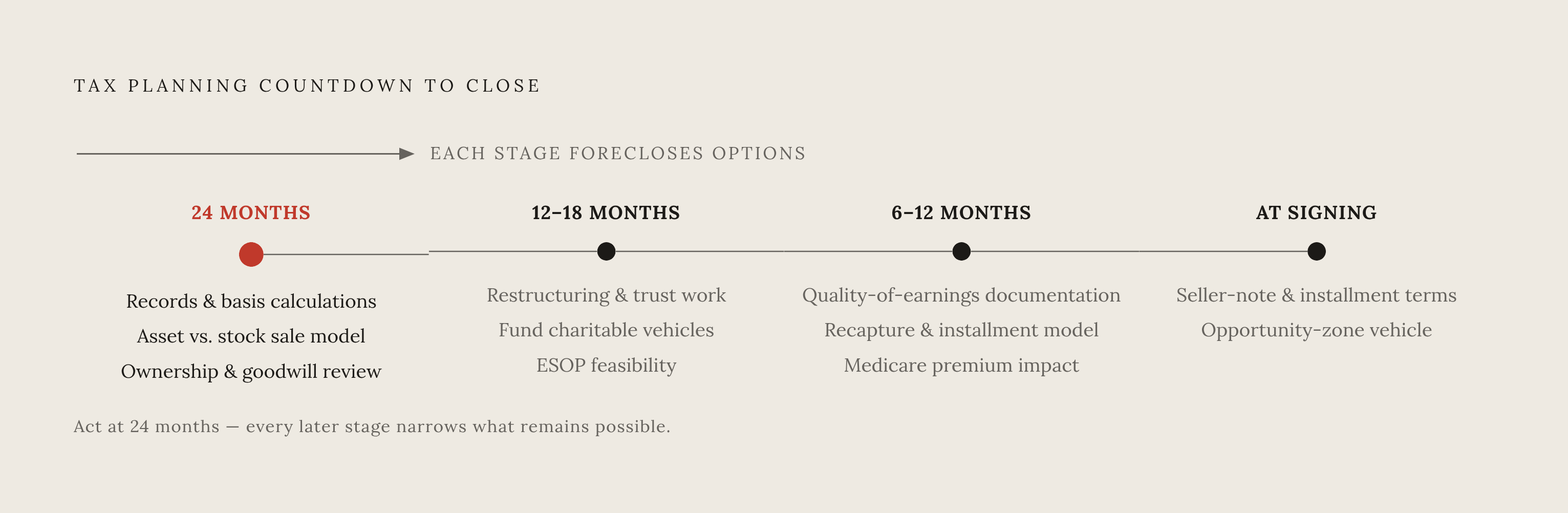
At 24 months, get the facts before choosing structures. The CPA needs records, basis calculations, and a valuation to model alternatives, while tax counsel reviews ownership documents, goodwill contracts, trust possibilities, and any proposed residency change. Bring in the M&A advisor early enough to weigh the tax effects of the deal when choosing a buyer. Have the investment advisor or financial planner check whether the likely proceeds will meet the owner’s needs after the sale.
At 12 to 18 months, execute eligible restructuring and trust work on the timetable counsel supports. Do not count on having enough time for every waiting period. Fund charitable vehicles before negotiations create sale certainty, and begin ESOP feasibility work if that route is relevant. Operational improvements and personal readiness work should proceed during this period, before an offer.
At six to 12 months, prepare quality-of-earnings documentation and update estimates as deal terms emerge. The CPA should model recapture and installment treatment, tax counsel should negotiate allocations, and the financial planner should work out how the deal affects Medicare and retirement income. At signing, settle seller-note terms and any installment structure, with the deployment vehicle prepared for time-limited opportunity-zone reinvestment after closing. Then put the post-sale financial plan into effect.
This week, call the CPA and commission a professional valuation.
Sources
- Tax Planning Before Selling a Business: A Clear Checklist
- Selling a Business Tax Strategies
- Prepare to Sell Your Business: A Multi-Year Roadmap - Mathis Wealth Management
- Exit Tax Planning for Business Owners: Keep More When You Sell
- Selling your business: Tax planning strategies to consider well before you pull the trigger
- Tax Planning Strategies for Your Business Exit