How Founders Choose Between Exit Options When the Business Is Healthy
Founders should clarify priorities before choosing an exit path.

A healthy business gives its founder several ways to exit, but no single definition of a good outcome. The strongest decision begins with personal, financial, and operational priorities, then tests each path against those priorities before a buyer or a change in circumstances makes the choice instead.
Why a thriving business makes the exit decision harder, not easier
A poor exit decision can sacrifice the most in a healthy business because the owner has valuable alternatives to give up. A distressed owner may have only one realistic route, while a thriving owner can consider seven paths with different financial, tax, operational, and personal consequences.
The familiar response is to find a buyer and take the money. But what if the founder wants employees to retain control, needs a gradual transition, or values future growth more than immediate liquidity? A sale can succeed on price and still disappoint on those terms. The hard work is to write down what matters most before negotiations begin. Without that work, acknowledging that exit planning is important does little to prevent a reactive decision when an offer arrives.
The seven paths a privately held business can actually take
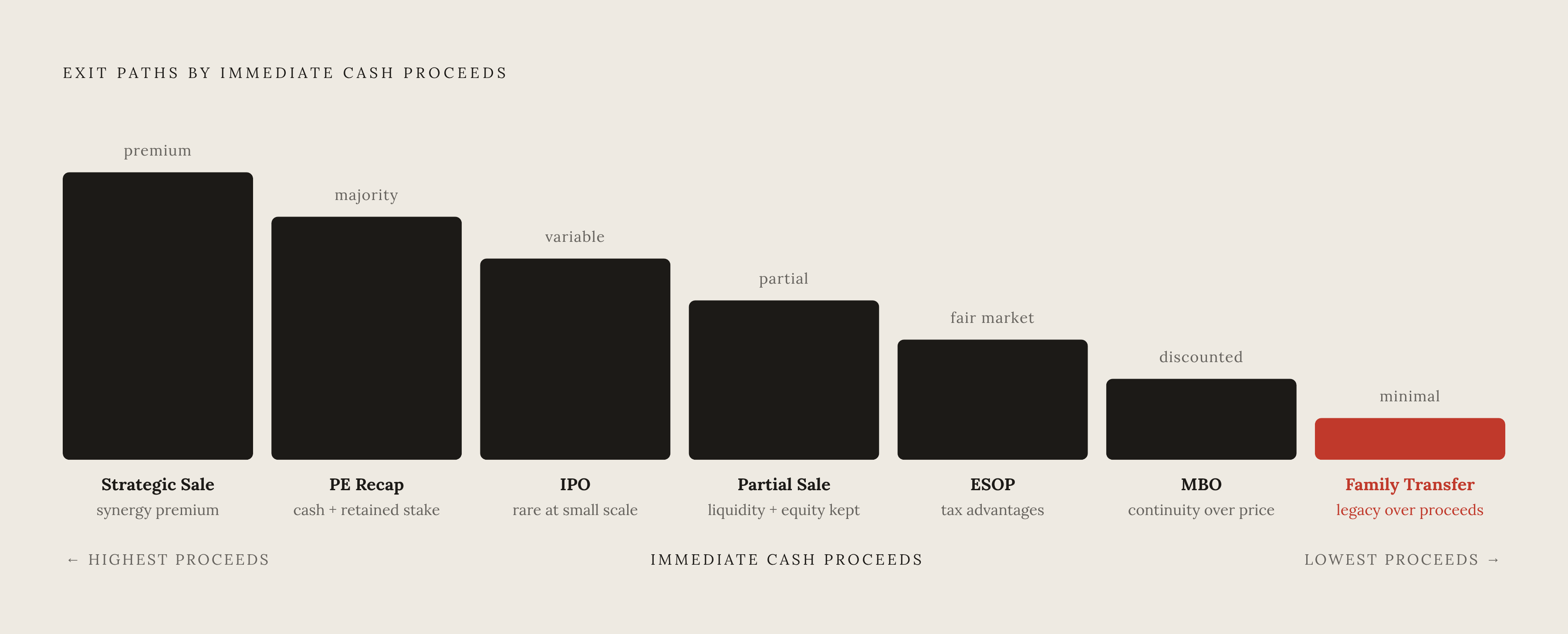
The map begins with two kinds of third-party sale. A strategic buyer acquires the business for its fit with an existing operation and can justify a premium through synergies. A financial buyer, including a private equity firm, family office, or search fund, evaluates the investment through its financial returns, often with the founder retaining equity. An initial public offering is another path, although it is rare below the scale needed to make it realistic. Its inclusion is useful chiefly because founders who assume it is available need to rule it out deliberately.
Recapitalization or a partial sale gives the founder liquidity now and leaves equity invested for a later sale. This category describes the founder’s ownership choice and overlaps with financial-buyer transactions. An employee stock ownership plan, or ESOP, transfers ownership to employees at fair market value, with significant tax advantages for qualifying structures. A management buyout, or MBO, transfers ownership to the existing management team, typically at a discount that reflects its financing constraints. A family transfer gives the founder the least cash right away and puts the most weight on legacy.
These are distinct routes. Their rough ordering runs from strategic-sale premiums toward family transfers with limited immediate proceeds, but price alone does not define the outcome. They also differ in tax treatment, how much the founder must stay involved post-close, and what happens to employees and culture. Choosing a route therefore determines the process that follows, rather than emerging as a by-product of finding a buyer.
How valuation actually works differs by path and by business size
“What is the business worth?” requires a second question. Worth to whom, and with what ownership structure? Smaller owner-operated businesses are usually valued on Seller’s Discretionary Earnings, or SDE, which is the cash flow available to an owner-operator. That measure fits a buyer who will also take over the operating role. EBITDA becomes more appropriate when an independent management team runs the business, with the shift broadly following business size.
Strategic acquirers can pay for synergies that a financial buyer cannot justify through standalone returns, although actual pricing also depends on the sector. Transferability is the central driver of multiple expansion or compression. A business whose earnings depend on the departing owner presents a handover problem and is worth less than one supported by systems and trained staff.
The structure of payment adds another distinction. A financial buyer typically purchases a majority stake, holds the investment for a defined period, then seeks an exit of its own. A founder retaining equity through a private equity recapitalization is committing to that next transaction cycle. The potential proceeds from that future sale are not equivalent to cash received today.
The four variables that should filter the seven paths down to a shortlist
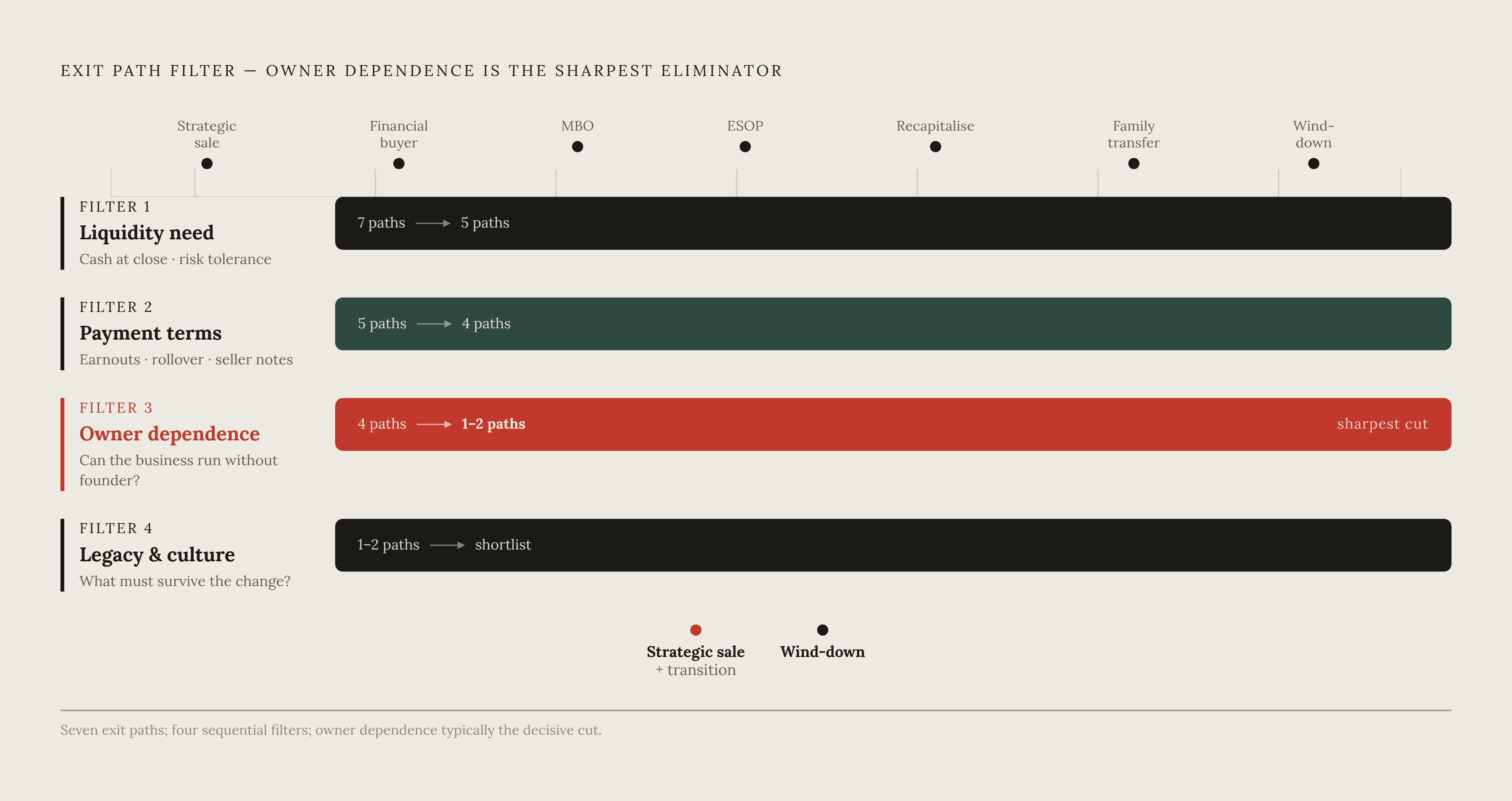
The founder must first determine how much cash they need at close and how much uncertainty they can accept afterward. An owner who wants the most liquidity right away is drawn toward a strategic sale, while one willing to keep equity can consider recapitalization or a partial sale. The founder should look closely at payment terms before headline price. Earnouts, rollover equity, and seller notes all defer proceeds and expose the founder to performance or credit risk. For an owner who needs certainty, those exposures can outweigh an apparently attractive valuation.
The next question concerns dependence on the founder. Can the business run without the person selling it? An independent management team is required for an MBO and helps support an ESOP or private equity recapitalization. Heavy owner dependence sharply narrows the choices, potentially leaving a strategic sale with a negotiated transition period or, absent a workable transfer, wind-down. This condition can change through preparation, which makes the timing of the analysis important.
Only then can the founder assess what should survive the change in ownership. Strategic buyers may fold the business into their own or restructure it, while private equity buyers plan when to exit based on the returns they seek. ESOPs and MBOs offer stronger prospects for continuity. Family succession puts legacy first, but only when a capable successor actually wants the role. Culture is not a soft afterthought if preserving it is one of the owner’s reasons for choosing a particular path.
Finally, tax and entity structure can change the ranking. Qualifying C-corporation owners can defer capital gains under ESOP Section 1042 treatment, an advantage S-corporation owners do not access in the same way. Buyers and sellers also tend to want different things from asset and stock purchases, since buyers generally prefer stepped-up basis and sellers generally prefer capital gains treatment. The founder should have the entity and its tax treatment reviewed before going to market. There are fewer ways to restructure as a transaction moves forward, so waiting until negotiation to address this question can close off options.
What each path looks like when the four variables are applied
A strategic sale fits a founder seeking maximum cash at close and a clean exit, provided the business can demonstrate transferability. Having multiple buyers compete helps protect the seller against price re-trades during diligence, while negotiating with just one buyer leaves the seller exposed to the acquirer’s opening valuation and later changes. For founders who prioritize culture, the lesson is to negotiate protections explicitly rather than assume a premium price implies continuity.
A financial-buyer transaction, especially a private equity recapitalization or partial sale, fits an owner who wants liquidity but believes the business has more room to grow. The retained stake makes future performance consequential. The “second bite of the apple” pays only if the business performs through the hold period. Meanwhile, the founder enters a new operating relationship with a partner working toward a defined exit. Agreement on growth strategy and pace is therefore part of choosing the path.
An ESOP fits a qualifying C-corporation owner who wants tax efficiency, wants employees to stay, and wants to hand over the business in stages. It does not offer a strategic premium. Fair market value, potential tax advantages, and legacy preservation must instead be weighed against complexity and ongoing governance obligations. Experienced ESOP counsel and a trustee are necessary, and administrative and fiduciary requirements can make the process longer and more expensive than an owner expects.
An MBO fits a founder willing to exchange some price for continuity under a capable management team. Operational competence alone is not enough, however. The team must also be able to execute a leveraged acquisition and obtain capital, while the seller often finances part of the transaction. A discounted price and deferred payment may be acceptable, but they need to be deliberate concessions.
A family transfer fits when legacy clearly outweighs liquidity and a capable, willing successor exists. Planning takes years. Assuming a family member wants ownership without resolving governance and succession readiness makes this route especially risky. An IPO is generally not a realistic route for the smaller privately held businesses considered here, while wind-down is the fallback when no workable succession or sale exists.
Why the preparation work is the same regardless of which path wins
Uncertainty about the final path does not justify postponing preparation. Strategic buyers, financial buyers, ESOP trustees, and management teams all need clean, auditable financials presented on an accrual basis. Reporting designed primarily around tax minimization creates obstacles across those processes. It also makes transferable earnings harder to establish, widening the gap between what the founder expects and what a buyer can support. That gap is a frequent cause of failed sale engagements.
Operational preparation has similarly broad value. Documented SOPs, a capable leadership layer, and written customer and supplier contracts reduce dependence on the owner. Customer concentration remains a risk discount regardless of buyer type, because a large share of revenue tied to one customer weakens the earnings case. Addressing these conditions expands the available paths as well as supporting valuation. Preparation often uncovers further problems, so a late start can leave the owner choosing between delay and an underprepared sale.
The practical sequence is to set goals, de-risk operations, build value, then structure the transaction and go to market. Each stage supports the next decision. During that preparation, the founder should test the expected price against what buyers can support, before an offer reveals a gap.
How industry context shapes which paths are realistic
The shortlist must then pass through an industry filter. Founder preferences cannot determine which buyers are active or what risks they will accept. Strategic buyers in that sector tend to pay meaningfully higher multiples than financial buyers, while private equity pricing can exceed strategic pricing in other industries. The buyer category is a starting hypothesis for sector-specific comparison.
Manufacturing diligence can also overturn an optimistic price expectation. Customer concentration above roughly a quarter of revenue leads to a risk discount, and equipment maintenance that has been put off leads to a purchase price adjustment. Environmental liability creates a separate threat. Undisclosed contamination can stop a transaction or lead to price reductions, escrow holdbacks, or indemnities. Buyers use third-party equipment assessments and environmental site assessments, so problems left unresolved can decide the fate of the deal late in the process.
Food and beverage businesses face a similar concentration test. Dependence on a single major grocery or foodservice customer for more than roughly a quarter of revenue produces multiple compression. Buyers view this as a structural risk. A founder’s preferred path must therefore be evaluated against the durability of that customer relationship and the concentration already present in the business.
In professional and business services, buyers pay a premium for earnings they can forecast and apply a discount when earnings are hard to predict. Converting ad hoc work into recurring contracts is consequently one of the strongest preparation steps available to a services founder. Scale adds another consideration in business services. Multiples rise as EBITDA grows, so it can pay to wait until the business is large enough for an investment banker to lead a competitive process. Timing the exit is thus partly a question of whether the business has reached the scale at which a different process becomes viable.
What happens when a healthy business reaches the market without a chosen path
An unsolicited offer can turn an unresolved exit question into a negotiation on the buyer’s terms. Without a chosen path, the owner may anchor to the first number, lack competing offers, and face re-trades when diligence uncovers gaps that preparation could have addressed. A business can be healthy and still be difficult to transfer.
The more severe outcome is no transfer at all. Profitable businesses can close because they remain unlisted, unplanned, and unable to pass to another owner when health or circumstances force the issue. Waiting has not preserved the full range of choices.
For an unhurried sale, choose deliberately, allow enough preparation time, and engage advisors able to run a competitive process when appropriate. Structured advisory and AI-driven buyer matching combined with investment banking expertise are designed to connect founder goals with a qualified buyer pool. The immediate decision is therefore not which offer to accept, but which future the founder wants the preparation to make possible.