How Far Out Should You Start Planning a Business Exit
Five years of preparation gives buyers the proof that a business can thrive without its owner.

Business exit planning is about giving a future buyer enough evidence to pay for the business an owner has built. For a lower-middle-market company, the best time to start is almost always five years before the owner plans to sell. The changes that add the most value take years to put in place and prove, so an owner who waits until they feel ready to leave may be unable to get the price they want.
Why most owners start exit planning far too late
The intuitive approach is to begin planning when leaving starts to feel right. That treats preparation as the opening stage of a transaction rather than the work that makes a good transaction possible. An owner may feel ready to sell, but the business may still depend on relationships, decisions, and knowledge that cannot leave with them.
Pepperdine's 2026 Private Capital Markets Report found that most sellers who had a broker had done no formal exit planning before hiring one. The Exit Planning Institute's 2025 Generational State of Owner Readiness research found that only a small share of owners had a formal exit plan, with an even smaller share of Baby Boomer owners having a full advisory team assembled. The gap is not simply missing paperwork. It means decisions about succession, ownership, and preparation often remain unresolved until a sale is becoming immediate.
Why does that gap persist? Owners feel they can do without a plan as long as they expect to choose when they leave. Yet an intended exit date is not a guarantee. If an owner has to leave sooner, the business must face that transition in its current condition. An involuntary exit therefore changes the purpose of planning from improving a future outcome to managing a present risk.
Why the right start date is almost always five years out
Five years gives a lower-middle-market business time both to change and to establish a record of that change. Buyers want at least three years of trailing financials that show how the business has done since the cleanup. Improvements therefore have to begin before that record can accumulate.
This distinction answers a reasonable objection. Does a business that is doing well still need five years? Usually, yes, because health under its current owner is not the same as documented strength under new ownership. Strong earnings may coexist with customer concentration or dependence on the owner's judgment and relationships. It takes time to fix those weaknesses, and the financial record must show that the business is still strong after the changes.
Five years is an anchor for preparation. A prepared third-party sale may close within a year once the company is ready, while a family succession typically needs five or more years to develop the successor and establish governance. These are different clocks. One measures how long a transfer takes to execute, while the other measures how long the business and its next leadership need to become ready. The phases below follow the preparation clock, beginning with the owner's goals and ending with a business that can support its asking price.
Years five and four: establishing baseline and choosing a direction
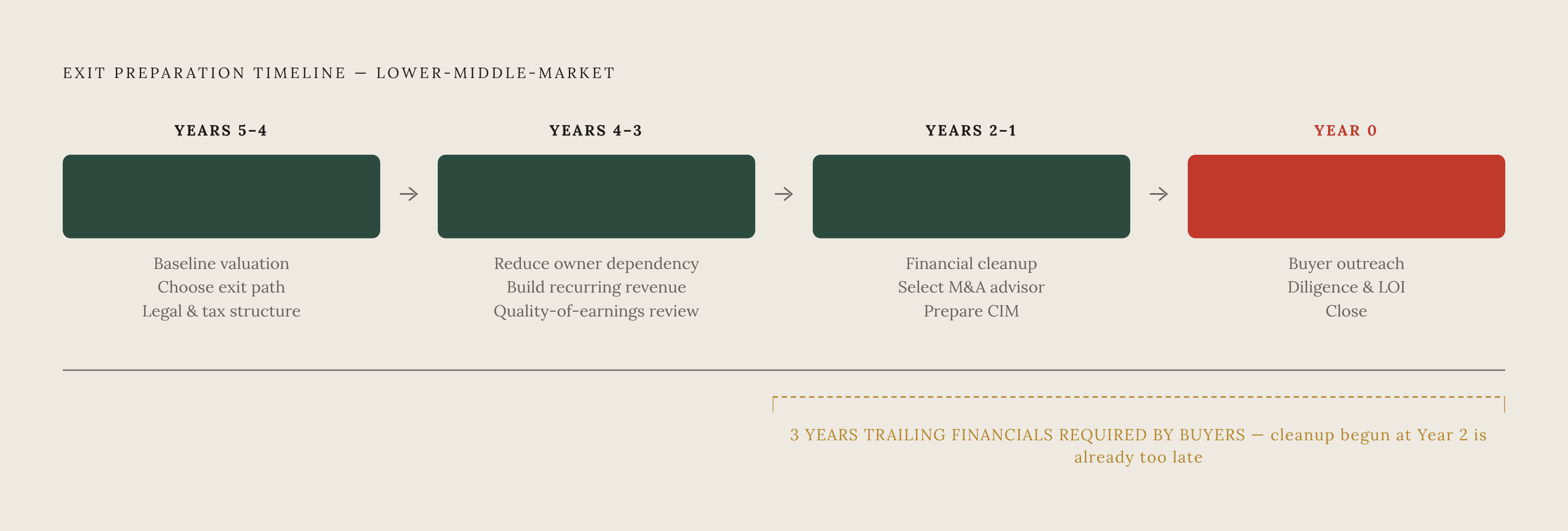
What is the owner exiting to, and what must the transaction make possible? Without an answer, even an acceptable offer may expose unresolved questions about income, involvement, or the next stage of life. Owners who postpone them risk reconsidering their goals during negotiations or regretting the outcome after closing.
Once the personal goal is clear, the next step is a formal baseline valuation from a credentialed appraiser. Its purpose is not merely to supply a number. It establishes current value, identifies the drivers that increase or decrease worth, and reveals the gap between today's business and the owner's target. An owner's mental number can differ materially from what the market will pay. The baseline gives the owner time to address that difference through planning before negotiations begin.
The exit path also needs attention at this stage. A strategic sale, private equity recapitalization, ESOP, management buyout, and family transfer differ in tax treatment, liquidity timelines, and valuation multiples. Choosing among them changes what preparation must accomplish. Year five is also a reason to get legal and tax advice immediately about the enhanced QSBS exclusion introduced by the OBBBA for qualifying C-Corp shares acquired after July 4, 2025. Its exclusion percentage rises with additional years of holding, making early structural planning potentially worth seven figures.
If there are co-owners, they need to review or draw up buy-sell agreements, and owners should start taking personal expenses out of the business P&L on a regular basis. Customer contracts, supplier agreements, IP ownership, leases, and employee agreements also need documentation. This work helps get the business ready for diligence later. Gaps left unresolved can become buyer negotiating leverage precisely when the owner has the least time to fix them.
Years four and three: the operational changes that move the multiple
With the baseline established, the next question is which weaknesses make the business less valuable to someone other than its owner. Owner dependency is often central to that distinction. Reducing it means hiring or promoting a second-in-command, transferring key customer relationships to that leader, and documenting processes and decisions that currently live in the owner's head. A title alone does not complete the transfer. Buyers need to see that responsibility has moved and that the business works under the new arrangement.
This is how key person risk affects price. If buyers believe earnings depend on the departing owner, they apply a lower multiple to those earnings. When the transition has already happened and its results are visible, businesses can typically recover most of that dependency discount. The earnings figure may be similar, but the risk attached to it is different.
Recurring revenue takes time for much the same reason. Converting project-based or transactional revenue into contracted recurring streams can lift the multiple, but buyers need evidence that the new model is stable. Customer concentration creates a parallel challenge. Reducing it requires new customer relationships that can take months or years to generate material revenue. Until then, a buyer seeing one customer account for a large share of revenue will price the possible loss of that customer into its assessment.
The lesson for this phase is to complete the operational transition early enough for results to follow. A quality-of-earnings review several years before a sale can also uncover problems before buyers do. Finding them early preserves time for correction. Finding them during a transaction leaves the owner explaining weaknesses that preparation was supposed to resolve.
Years two and one: financial cleanup and positioning the business for market
The final two years shift the emphasis from changing the business to presenting it for scrutiny. Financial records, legal documents, and the advisor team must come together, but this work depends on what happened earlier. Presentation cannot substitute for an operating record. If owner dependency remains unresolved, cleaner accounts do not remove the risk a buyer sees in the owner's departure.
The same constraint applies to financial cleanup itself. Buyers want at least three years of trailing financials reflecting the cleaned-up business, so starting that work at year two leaves the record incomplete before the intended sale. The final period is for assembling and presenting that history. Otherwise, the owner reaches the market with less evidence than buyers want.
Year two is also the point to select an M&A advisor, before the transaction becomes immediate. Early involvement connects succession choices with valuation readiness, buyer expectations, and the competitive process. Buyer matching need not wait until launch. AI-driven buyer matching combined with experienced investment banking advisory can help identify potential buyers earlier, while leaving the operating preparation on its necessary timetable.
By year one, the work moves into preparing the Confidential Information Memorandum, running buyer outreach, managing diligence, and negotiating the letter of intent. These transaction tasks give buyers a way to assess the company that earlier work has produced. If that work is incomplete, the process may still move forward, but the price will reflect the business as it exists.
What compressing the timeline actually costs in dollars
Starting late does not produce a separate penalty on the closing statement. Its cost appears in the multiple that buyers are willing to apply to EBITDA. On a business generating several million dollars in EBITDA, a lower multiple reduces value by millions of dollars compared with a higher multiple. This is not a basis-point adjustment. The lost value comes from improvements the company never completed or never had time to demonstrate.
A single turn of the EBITDA multiple is worth the business's annual EBITDA, so losing multiple turns on several million in earnings makes a big difference in value. The earlier phases explain where that gap comes from. An owner-dependent business with concentrated revenue and gaps in its financial history carries different risks from one that has fixed those weaknesses. Negotiation cannot supply the missing performance record.
Changes in the market can add to what an owner loses by waiting. Mid-market purchase price multiples fluctuate quarter to quarter, so a seller who is not ready may be unable to act during favorable conditions. Preparation preserves the ability to transact when conditions support the owner's goals by completing years of necessary work in advance.
These two effects operate differently but can reinforce each other. Business preparation influences the multiple a buyer will offer relative to the risks it sees, while market conditions influence the setting in which that offer is made. The owner has fewer opportunities to demonstrate a stronger business and less freedom to choose when that business goes to market.
What "starting early" looks like when you're three or more years from a sale
For an owner turning this timeline into action, the first step is a baseline valuation and a personal financial plan. The remaining work depends on the distance to exit. That distance determines which improvements still have time to become part of the record a buyer will examine.
Ten or more years out, the emphasis can be on exploring succession paths and beginning long-term operational improvements. That includes building a record of stronger margins, reducing owner dependency, and looking at how the business is set up, including its entity type. Three to five years out, owners should focus on changes that need a record of results. Stronger earnings, lower customer concentration, and reduced owner dependency need several reporting periods before buyers can assess them. The available time should shape the plan.
Inside one year, preparation is still worthwhile, but the objective changes. Improvements that need several reporting periods will not have time to demonstrate their effect on a buyer's valuation. The task becomes presenting what exists as cleanly as possible. Across these time horizons, periodic valuation updates allow the owner to measure progress and adjust for changing market conditions, rather than treating the original estimate as a fixed destination.
Early advisor involvement makes this an ongoing preparation process. It connects the intended succession route with valuation readiness and the likely buyer pool. AI-driven matching and experienced investment banking advisory can compress the interval from ready to closed without compressing the years that determine price. Owners therefore need to consider when they want to leave, what a buyer must be able to see by then, and how much time remains to make that evidence real.