How Canadian Business Owners Should Spend the Three Years Before Selling
A three-year runway lets you fix finances, cut legal risks, and prove the business runs without you.

Canadian business owners should start exit planning three to five years before selling, with at least three years for deliberate preparation. The work is a construction project, with Year One building trustworthy financials, Year Two removing operational and legal risks, and Year Three positioning the business for the right buyers. Working in that order helps the owner keep their bargaining power and more of the money from the sale.
Why most Canadian business owners will not be ready when it matters
An owner who assumes a profitable business will “sell itself” mistakes the ability to earn money for the ability to transfer that earning power. A buyer needs evidence that the records are reliable, the relationships will survive, and the business can function after the owner leaves. Producing that evidence takes time that many owners have not allowed. Statistics Canada's Q3 2026 survey found that roughly one in five Canadian businesses plans to sell or transfer within the next ten years. Among those intending to sell within two years, only about one in four expect to have sufficient time and resources for the process.
The gap is therefore not simply between wanting to sell and finding a buyer. It is between an owner's confidence in the business and what a buyer can substantiate. Succession AI reports that its substantial network of vetted buyers consistently identifies businesses prepared over 24–36 months as most likely to command full market value. Businesses arriving without that preparation face repricing or failed negotiations.
Why the three-year window is not a rule of thumb but a structural requirement
Financial records need a clean history, managers need to show they can run the business on their own, and legal issues need to be settled before buyers look into them. A rushed six-to-twelve-month preparation typically means a lower multiple or a failed deal. CIBC's February 2026 account quotes Dan Simile of Hollandia Bakeries, which sold in 2025, explaining that the formal sale process alone took over a year. CIBC's advisors recommend starting preparations two years or more before that process.
Canada's Lifetime Capital Gains Exemption has a 24-month asset-use test and a 24-month share-ownership condition that must be met, and corporate purification takes at least 24 months to carry out safely. These conditions must be satisfied before closing. Canada's Spring Economic Update of April 28, 2026 made the temporary capital gains exemption for sales to Employee Ownership Trusts permanent, so it would no longer expire on December 31, 2026 as first planned. That change removes one deadline, but it does not make financial cleanup, operational restructuring, or buyer readiness compressible.
Year One: building a financial foundation buyers will trust
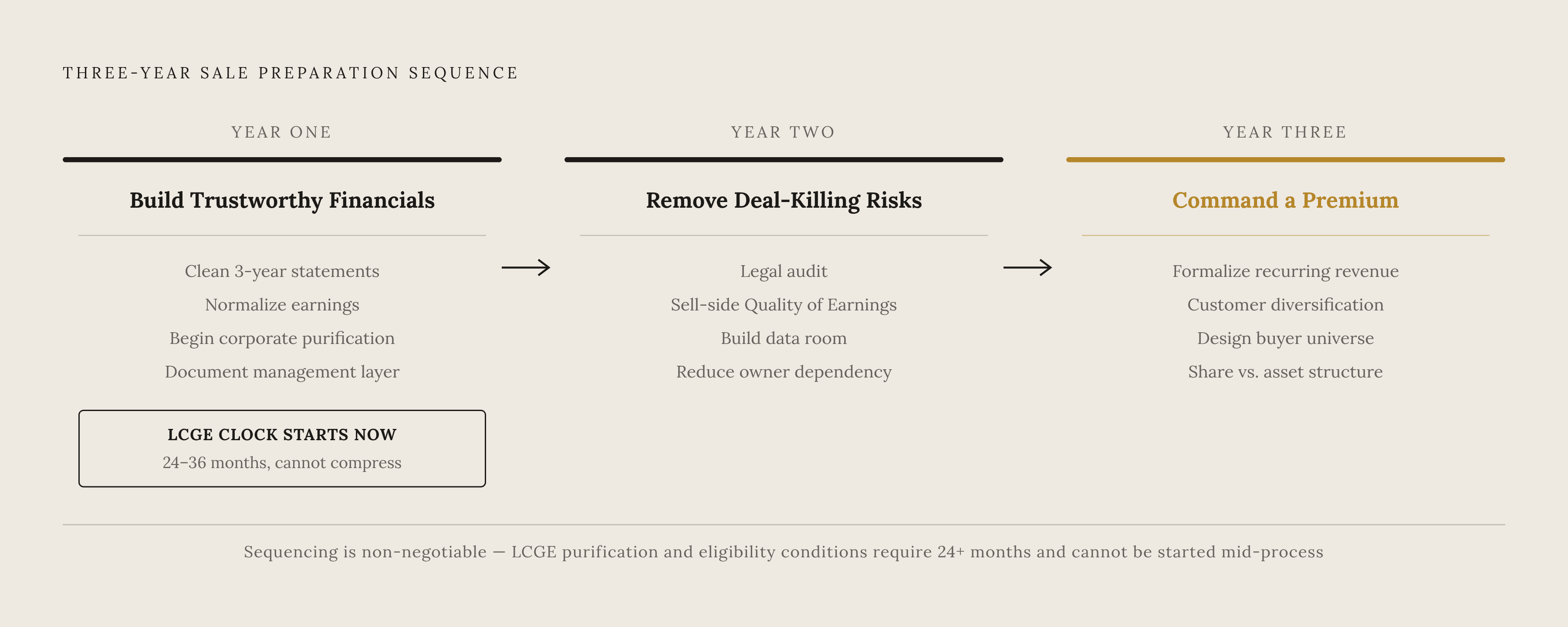
A vendor due-diligence review before the sale of a manufacturing business found errors in inventory accounting and unassigned IP rights before a buyer found them. The significance was not just what the review discovered, but when it discovered it. Early identification left the seller time to correct the records and address ownership of the IP. The same discoveries during buyer due diligence could instead have become grounds for renegotiation. Year One is when a manageable repair should be kept from becoming an expensive transaction problem.
Start with three years of clean, accurate financial statements from which buyers can reconstruct earnings. Normalization then shows how the business performs on an ongoing basis by making adjustments for one-time expenses, owner compensation above market rate, and personal expenses run through the business. These adjustments need to be defensible. AI-driven business valuation tools, including those offered by Succession AI, can help flag normalization adjustments and inconsistencies in financial records while there is time to address them. CIBC's transition planning guide identifies poor record-keeping and declining performance as factors that tarnish a business's presentation, so improving the records cannot substitute for addressing the performance they reveal.
Corporate structure belongs in this same first-year review. Passive assets such as excess cash, investment portfolios, and real estate may keep the corporation from meeting the CRA's 90% active-asset threshold for LCGE eligibility. Extracting or restructuring those assets safely takes 24 to 36 months, making Year One an on-time start. Families should also look at whether restructuring that involves a spouse, adult children, or a family trust could give more people access to the LCGE while meeting CRA anti-avoidance rules. Documenting the management layer belongs here too, because authority concentrated entirely in the owner is a financial risk as well as an organizational weakness.
Year Two: removing the issues that kill deals after they start
With the foundation established, Year Two tests whether the business can withstand a buyer's investigation. A legal audit should examine contracts, IP ownership, compliance obligations, customer agreement transferability, and employment contracts. Cancellation clauses and non-transferable agreements are particularly important because they can undermine the continuity the buyer expects to acquire. Found by the seller, they are problems to resolve before launch. Found by the buyer, they become reasons to revisit the price or terms.
The natural objection is why an owner should pay for scrutiny before having a buyer. The owner gains control over both the remedy and the explanation. Commissioning a sell-side Quality of Earnings report twelve months before going to market lets the seller validate revenue sustainability and working-capital needs before a buyer's advisor challenges them. BDC says a QoE report prepared by an accountant is often part of financial due diligence. Its cost is small relative to the value a seller can surrender when a late discovery resets the negotiation.
This work also needs an orderly home. The data room should be built in Year Two as a secure virtual repository of financial, legal, and operational documents, rather than assembled under pressure after buyer interest arrives. Records that are in order speed up due diligence and make the business easier to judge. By this stage, the core advisory team should also be assembled so that financial, legal, valuation, and transaction questions do not fall between separate reviews.
Why owner dependency is the most expensive problem to leave unsolved
A business that cannot operate without its owner is not worth what its EBITDA alone suggests. Buyers are purchasing future earnings, and those earnings are less secure if customer relationships and institutional knowledge leave with the seller. Valuation professionals reflect this exposure through a “key person discount”. BDC says a business needs operational independence, strong financials, and clear market positioning for an external sale. Independence therefore spans the entire preparation period, but it demands concrete action by Year Two.
The work takes 12 to 24 months at minimum and includes documenting processes, hiring or promoting a second-in-command, and transferring customer relationships. A sustained absence test then establishes whether those changes work without the owner present. Hollandia Bakeries illustrates what a buyer can recognize when capability resides in the business. CIBC's account says Graham Partners/Commercial Bakeries approached Hollandia because of its size, its ability to do commercial manufacturing, its readiness to grow, and the industry relationships it had built. Dan Simile had built something a sophisticated buyer could acquire without relying solely on him.
Hub Equipment shows the discipline behind that result. Tom Stevenson ran the business “every day like we were going to remain independent” before its sale to Cooper Equipment Rentals in 2023. The vast majority of his fifteen employees transitioned, with several holding key positions. That continuity makes the principle tangible. Preparation is not making the owner look less important on an organizational chart, but proving that the business has depth beyond the owner.
Year Three: positioning the business to command a premium rather than accept a market price
Year Three should convert established strengths into reasons for the right buyers to compete. Recurring revenue, customer diversification, documented proprietary processes, and strategic partnerships need to be formalized and made legible to a buyer's analyst. Customer concentration deserves particular attention because an outsized dependence on one client weakens the cash flow case. Relying less on that client removes a common reason for purchase-price adjustments. The aim is not a more polished description of the same risk, but evidence that the risk has changed.
The sale process should now be designed with an M&A advisor around a defined buyer universe, giving the seller options. Meanwhile, the operating business still needs attention. CIBC cautions owners against coasting toward retirement and stresses having a management team that can step up when the owner steps down. Retention bonuses for senior employees essential to closing can support continuity and reassure buyers that key people will remain. Year Three is the time to demonstrate that the team functions.
The share sale versus asset sale structure should also be finalized in light of what earlier purification work made possible. That decision connects market positioning to the owner's eventual proceeds. A seller arriving after three years of deliberate preparation is not in the same negotiation as an owner who listed because the time felt right. The buyer can see the difference in the evidence, and that difference can carry through to the price.
What a sector's timing profile means for when Year One actually starts
Statistics Canada's Q3 2026 data shows that more than one-third of accommodation and food services owners intend to sell or transfer within ten years. Among those businesses, nearly half intend to do so within two years. Those owners are already working with less time than the full preparation plan assumes. An owner in food service with an eighteen-month horizon should therefore triage the Year One work immediately, recognizing the possible tradeoffs in valuation or deal certainty.
Manufacturing and wholesale trade have intended sale or transfer rates of 27.7% and 27.3%, respectively. Their equipment, the complexity of their operations, and their customer contracts make due diligence hard work that is difficult to speed up. For a manufacturing owner with a five-year horizon, Year One can start now, leaving room for deliberate preparation and the sale process itself. Agriculture requires a different calibration because older operators, land values that impede buyer access, and industry consolidation shape the pool of qualified buyers. The same construction plan applies, but owners need advice on finding buyers in their sector that takes account of how markets differ.
How to assemble the advisory team and what each role actually does
A corporate lawyer addresses contracts, IP, and legal structure, while a tax accountant with M&A experience handles LCGE qualification, corporate purification, and share-versus-asset-sale modelling. A Chartered Business Valuator provides an independent valuation to anchor expectations. An M&A advisor or investment banker identifies buyers, manages the process, and negotiates. Each role catches a category of problem that the others are not positioned to resolve.
The tax accountant and CBV belong in Year One because their findings influence decisions that take years to implement. The M&A advisor should be engaged in Year Two or early Year Three, with the team assembled before the formal process begins. Dan Simile sought advisory support immediately after Hollandia received its unsolicited approach, assembling a team before responding substantively. An available buyer and the right transaction are different things.
For founder-led businesses across a broad range of revenues, advisors can now use AI-driven buyer matching alongside advice from people on the deal. One option, Succession AI, pairs buyer matching with institutional investment banking advisory to help find buyers and check that they qualify. That combination should produce a prepared buyer list and a well-managed process. Faster matching matters most when the business is ready, because it cannot replace the tax and operational work that preserves negotiating power.
The after-tax proceeds question every owner should model before Year One ends
Preparation is ultimately measured by what the owner keeps. Canada's Lifetime Capital Gains Exemption shelters up to C$1,275,000 of capital gains per eligible individual from tax in 2026. In families with more than one shareholder, each person who qualifies may be able to claim an exemption if ownership is set up the right way. That potential benefit warrants assessing family restructuring in Year One.
The share-versus-asset-sale model should make those consequences explicit before Year One ends. A qualifying share sale preserves access to the LCGE but transfers historical liabilities to the buyer, who may seek a price concession. An asset sale gives the buyer flexibility but forfeits LCGE eligibility and typically produces a worse after-tax outcome for the seller. Three years of deliberate preparation is ultimately a financial decision, because an owner who builds a transferable business, structures it for the right tax treatment, and reaches market with a prepared buyer list is better positioned both to close and to keep materially more of what the business earned.