Common Exit Planning Mistakes Canadian Founders Make Too Late
Delayed exit preparation locks in mistakes that compound into lower valuations.

Canada is entering an ownership transition without precedent. Over $2 trillion in business assets could change hands within the next decade, driven by the more than three-quarters of small business owners planning to exit. For most of them, that exit will be compressed into a timeline nobody chose.
Retirement is the dominant trigger, and it arrives with its own urgency. The decision to sell often lands at the same moment the founder wants to be done, collapsing what should be a multi-year preparation into months. Burnout and the desire to step back from day-to-day operations run a close second, and both conditions further shrink whatever runway might otherwise have existed. Plan on two to three years of preparation, because buyers expect three years of clean financial documentation. The gap between that and the time most founders actually take is wide, and it is the gap where every mistake in this article lives.
How a cluster of smaller mistakes compounds differently than one big error
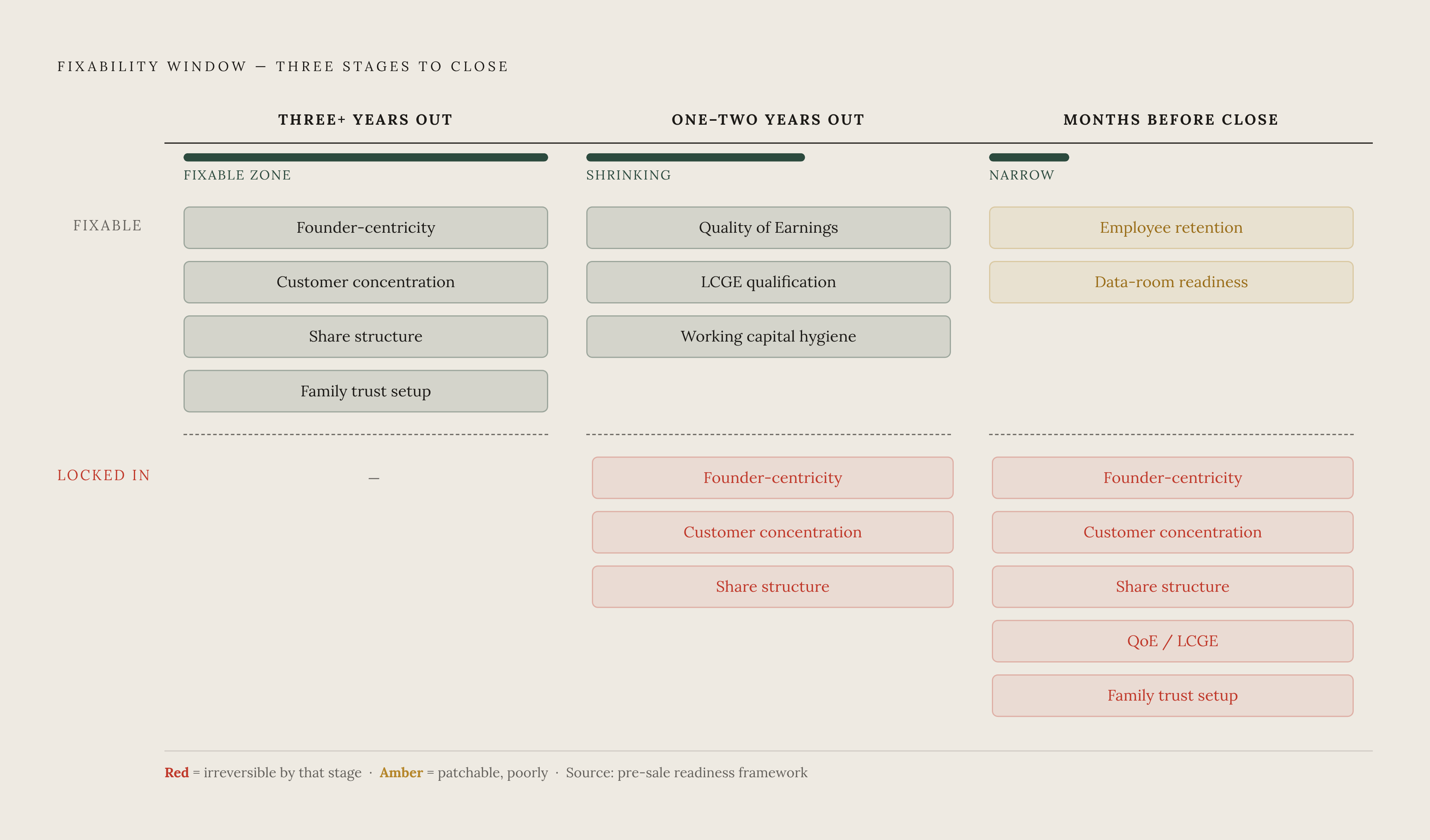
The danger of a late exit is not a single ruinous decision. It is the simultaneous arrival of several ordinary oversights, each making the others harder to fix. When preparation time shrinks, a mistake that would have been correctable in year three becomes irreversible in month six before close. Compounding works in both directions. A business with clean financials, a strong management team, and diversified customers commands a premium multiple. Carry all three problems, and the same business trades at a discount. Founded Partners' 2026 framework names the mechanism "deal fatigue." The friction of a poorly prepared business drains the founder's energy, and that exhaustion leads to concessions. Those concessions accumulate.
One might argue that any single one of these issues is manageable. That is precisely the trap. The sequence matters here: structural problems such as founder-centricity and customer concentration become locked in years out, while financial and tax problems can sometimes be addressed in the final twelve to eighteen months, though with diminishing returns. Read the sections that follow as a connected system, not a menu.
Treating the business as inseparable from its founder
A business whose revenue, relationships, and decisions flow through one person is not a sellable asset. It is a high-paying job that a buyer cannot acquire without also acquiring the person. Sophisticated buyers, and strategic acquirers in particular, who drive the majority of Canadian tech exits, are not purchasing past performance. They are purchasing future cash flows that must continue after the founder leaves. That is why key-person risk triggers what the market calls a valuation haircut. The diagnostic is simple enough to state plainly: can the business pass the vacation test? If the founder is absent for two weeks and operations continue normally, the business is a system. If not, buyers price in the probability of revenue attrition after close.
Founded Partners' 2026 framework calls this the Founder-Centric Trap. Founder magic fuels early growth, but it reads as a red flag to any buyer who wants a durable, scalable operation rather than a personality. Founders who build organizational independence earlier can show the business runs without them, which gives them a far stronger negotiating position. A platform that connects founder-led businesses with vetted acquirers routinely shows during valuation how much organizational independence moves what a buyer will pay.
Some founders argue that their personal relationships are a feature, not a bug, and that a buyer will value them. The answer is that strategic buyers may value the founder's knowledge during a transition period, but they price the business on what happens after that period ends. Not during it. The fix, building a leadership bench, documenting processes, proving the team can operate independently, takes years of deliberate organizational work.
Customer concentration that only looks like a problem when a buyer finds it
Customer concentration is a specific legal vulnerability, not just a business risk. Sophisticated buyers price it aggressively or use it to exit deals entirely. The threshold that reliably raises buyer concern is one client representing more than roughly 10 to 20 percent of total revenue, with 20 percent the most commonly cited figure. Above that line, acquirers see a fragile revenue base rather than a durable enterprise. Fasken's Exit InSights study analyzes more than 250 deal points from Canadian tech M&A transactions completed between 2019 and 2024, and it found that Material Adverse Effect clauses specifically capture customer concentration as a trigger. These clauses let buyers walk away or renegotiate if something seriously harms the business.
The mechanism deserves attention. If a business is hit worse than others in its industry, say by losing a key customer, the broad market-event protections in the MAE clause disappear and the clause bites. A concentrated revenue base that looked stable at signing can become a renegotiation lever before closing. By the time a founder is in active exit conversations, revenue concentration has already calcified into deal risk. Buyers with access to detailed customer analytics price that concentration months before any offer is made, and AI-driven M&A platforms can assess those analytics during early valuation, so late-moving founders are left with shrinking room to negotiate.
Supplier and platform dependency work the same way on the cost and operations side. Run your operations through a single vendor, and you carry analogous risk. Founders who disclose concentration vulnerabilities proactively and early tend to avoid last-minute renegotiations, when leverage has shifted to the buyer. Those who do not face the worst of both worlds: discovery during diligence and no time to explain or remediate. Diversifying a customer base typically takes years of deliberate sales strategy, so the compressed timeline converts a correctable problem into a permanent valuation drag.
Financial records that were built for tax efficiency, not for a buyer's scrutiny
Most Canadian owner-managed businesses have been run to minimize taxable income. The financial statements that result tell the wrong story to a buyer building a Quality of Earnings model. The tax strategies were entirely rational during operations. Accelerated depreciation, personal expenses run through the company, income-splitting structures: if you use these, you suppress reported EBITDA. At exit they become liabilities. They trigger buyer adjustments and invite depreciation recapture that reduces after-tax proceeds. Buyers do not take the income statement at face value. A Quality of Earnings report normalizes earnings, and increasingly a prepared seller commissions that work first through vendor due diligence. If the seller has not done the work, the buyer controls the narrative and the adjustments.
Completing it before going to market exposes deal-killing issues early and mitigates price chipping, the buyer practice of lowering the price after discovering issues. Three years of clean financial records is the standard requirement. Buyers expect immediate access to accurate, organized information in a virtual data room. Sellers who arrive without one signal operational immaturity and slow the process at exactly the moment buyers are deciding whether to stay in. Founders who begin the cleanup in the final months before going to market cannot retroactively restate prior years.
Getting the share-versus-asset sale decision wrong, or getting it right too late
The choice between a share sale and an asset sale is the highest-leverage tax decision of an exit. Founders who have not structured their business years in advance may find the more favourable option unavailable when they need it. Share sales open the door to Canada's Lifetime Capital Gains Exemption. The 2026 LCGE limit is $1,275,000, now indexed to inflation, with the $1,250,000 base having applied to dispositions on or after June 25, 2024, and the indexed figure applying from the 2026 tax year onward. For qualifying family structures, shares held in a properly structured discretionary family trust with adult beneficiaries, each beneficiary can access their own LCGE. A single CCPC exit could shelter a multiple of the base exemption across the family.
The traps are numerous. Asset sales are often what buyers prefer, since they get a clean asset base without inherited liabilities, but sellers face double taxation: once at the corporate level on the sale and again at the personal level on dividends, with the LCGE forfeited entirely. The QSBC qualification test is unforgiving. Shares must be held for 24 months, the business must have been a CCPC throughout that period, assets must be primarily used in active business, and too much cash or passive investment inside the corporation can disqualify the shares. Businesses converted from sole proprietorships without proper share structure often fail this test.
The inclusion rate has been its own source of confusion. The proposed increase from 50 percent to 66.67 percent, announced in Budget 2024, was cancelled in Budget 2025 and never became law. The rate remains at 50 percent, but the uncertainty caused many founders to make or defer decisions based on a rate that never applied. Older resources may still reference the Canadian Entrepreneurs' Incentive, announced in Budget 2024 to apply on top of the LCGE. It was cancelled in the 2025 federal budget and should not be relied upon.
The structural readiness problem cannot be overstated. Trusts must be set up years before the sale, share structures must be in place for 24 months, and passive asset levels must be managed continuously. None of this can be done in the months before closing.
Underestimating what happens to deal value between signing and closing
Founders who understand their valuation multiple but not the adjustments applied after signing routinely receive less than they expected. The gap is rarely recoverable. Nearly nine out of ten Canadian tech M&A deals include purchase price adjustments, typically calculated by the buyer, based on cash in the business, outstanding debt, and working capital at close. The buyer calculates this, not the seller. If accounting is inconsistent, working capital definitions are vague, or expense tracking is messy, the adjustment becomes a negotiation the seller is poorly positioned to win. Financial hygiene from earlier either pays off or fails here.
They carry their own risk. If the founder no longer controls the business levers needed to hit the performance targets, the earnout becomes effectively unachievable. Representations and warranties now routinely include privacy practices, cybersecurity, and regulatory compliance, areas once lightly scrutinized and now deal-table standard. Rep and warranty insurance can reduce founder liability in larger deals, but only if the underlying representations are clean.
The strategic buyer reality should reshape how a founder tells the story. More than four-fifths of Canadian tech exits go to strategic buyers, not private equity. Strategic buyers care about operational integration, not financial engineering. Founders who have optimized their story for financial buyers may be misaligned with the actual acquirer pool.
Leaving key employees out of the exit plan until it's too late to keep them
Roughly two-fifths of Canadian business owners have considered which staff members are critical during a transition. The majority have not, and a significant fraction have not addressed employee retention in any form. This is the execution-level counterpart to the founder-centricity problem. Where the structural mistake is a business that depends on one person, the execution mistake is failing to secure the team that would make the business independent. Buyers, strategic acquirers especially, evaluate whether the management team can run the business after close. A seller who cannot demonstrate leadership depth or offer retention assurances is selling a riskier business than the numbers suggest.
Deal mechanics create expectation traps. Employee stock options often do not fully accelerate at closing. Earnout participation for employees is rare. If a team has been told, or has assumed, that an exit will be a financial windfall, the reality of the deal structure can collapse morale at exactly the moment continuity matters most. Retention agreements, incentive structures, and leadership development need to be in place before a deal is announced, not drafted in the weeks after signing when employees are already processing the news.
Optimizing for the highest price when the goal should be the right outcome
Founders who define exit success as the headline purchase price alone routinely make decisions that maximize that number while producing an outcome they regret. The regret is not sentimental. It is a direct consequence of not defining goals early enough.
Employee stability, brand integrity, and cultural continuity are outcomes founders say matter to them, and they require deliberate deal structuring, not just price negotiation. Market timing is a related trap. Founders who wait for perfect external conditions while their internal readiness deteriorates end up with neither the timing they wanted nor the preparation they needed. Internal readiness outweighs external cycles.
The earliest decisions in exit planning, choosing advisors, defining objectives, deciding on a buyer type, shape everything that follows. Founders who enter those conversations with only a price target in mind have made a mistake before the process has begun. AI-driven buyer matching with investment banking expertise addresses exactly this. Matching to the right buyer type, strategic versus financial, Canadian versus cross-border, is as consequential as the valuation multiple, because the right buyer preserves more of what the founder built while also delivering competitive terms. Platforms that combine AI-driven valuation with access to vetted acquirers sit among the options available to founders in the $500K to $50M revenue range who are three years out.
That timeframe matters because every mistake documented above shares the same cure. Time and the right advisory structure, put in place before urgency removes the option, are the structural answer. For a Canadian founder three years from a potential sale, the practical implication is straightforward. Start now.