Rewiring Your Business for Acquirer Due Diligence Three Years Before a Canadian Sale
Start fixing your financials and records now if you want top dollar when a buyer comes calling.

Canadian business owners should start exit planning three years before selling, or earlier, so buyers can judge how the business has run over time. The work begins with financial and corporate records, moves to operational independence and transferable contracts, and ends with regulatory readiness and a well-supported marketing package. The aim is to make acquirer due diligence confirm value rather than uncover reasons to reduce the price or abandon the sale.
Why most Canadian founders will exit unprepared — and what that costs them
A founder can build a viable business and still struggle to transfer it. Customers may depend on personal relationships, earnings may be obscured by discretionary expenses, and ownership records may be incomplete. Without planning, owners may have to close the business, with even a sale for less than they hoped out of reach.
CFIB’s Passing the Torch report, dated October 22, 2026, describes a structural exit problem, with Canadian business exits outpacing new entries since early 2024. It identifies finding a qualified buyer as the leading barrier, followed by being too busy to plan and difficulty valuing the business. Nearly half of owners do not know which professionals to approach. A three-year runway gives owners time to work on records, management and legal arrangements in order and let them take hold before a buyer judges them.
How buyers actually value a Canadian business — and what moves the number
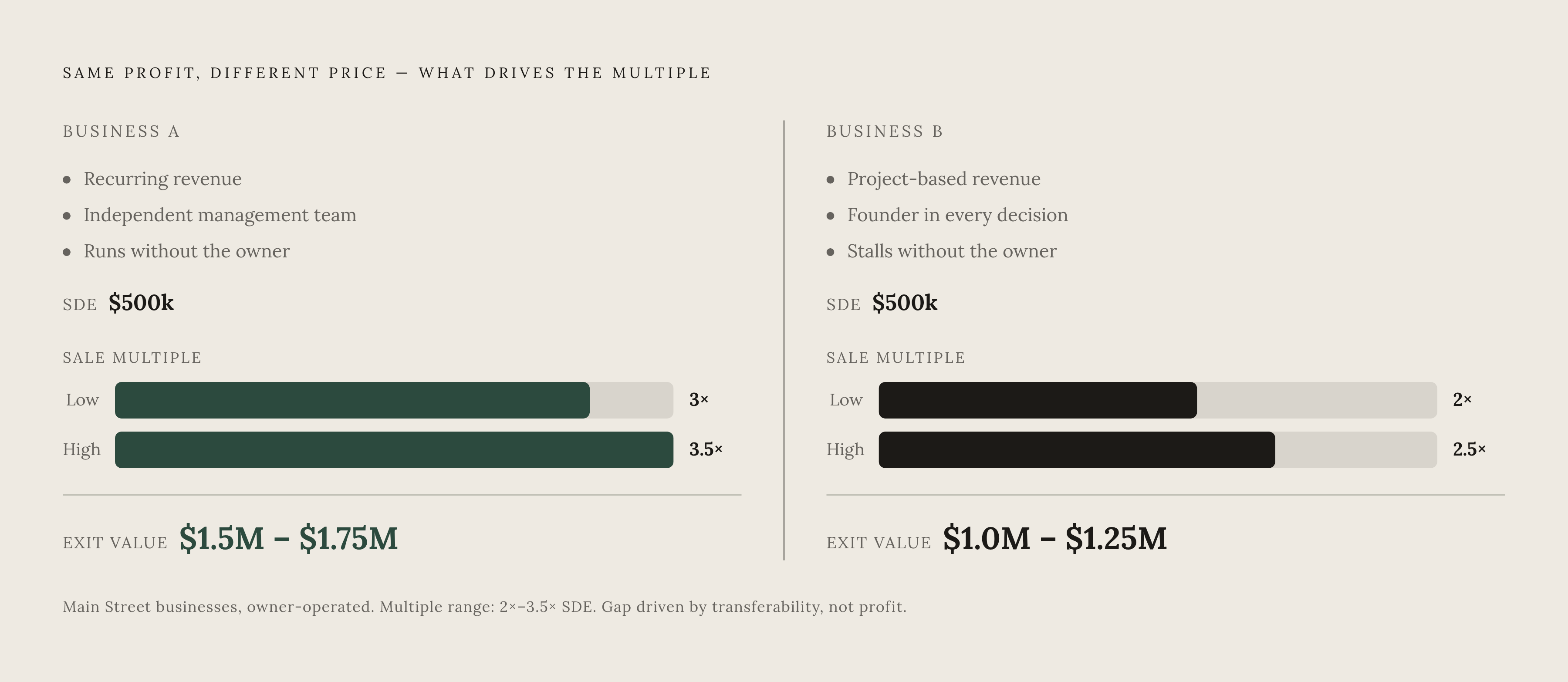
Buyers price future earnings through the risks attached to receiving them. For smaller owner-operated businesses, Seller’s Discretionary Earnings, or SDE, is the primary income measure, while EBITDA multiples become more relevant as size increases. Canadian mid-market private businesses often sell for roughly 3–6× EBITDA, with the price depending on their industry, size, growth and recurring revenue. Most owner-operated Main Street businesses fall between 2× and 3.5× SDE.
Consider two businesses with identical revenue and profit. One has recurring revenue and a functioning management team, while the other depends on projects and the founder’s daily presence. The first can command roughly double the multiple in the same sector. Recurring revenue and owner dependency can each swing the multiplier by 1.5–2 turns because they change what survives the transfer.
Price is only part of the seller’s outcome. Share sales generally offer better after-tax results for Canadian sellers because qualifying small business corporation shares can qualify for the Lifetime Capital Gains Exemption, or LCGE. Eligibility depends on how the company has been structured and maintained. Preparation therefore has two distinct targets, which are improving transferable earnings and protecting the proceeds the founder keeps.
What a buyer's due diligence process actually examines — in the order it will break a deal
Once a letter of intent, or LOI, is signed, diligence turns claims into document requests. A mid-market Canadian transaction can generate thousands of documents, but the requests do not have equal consequences. Corporate ownership and disclosure failures, unpaid taxes, undisclosed employment liabilities and regulatory obstacles sit near the dealbreaker end. Weak support for earnings or customer concentration may instead change the price or the payment terms. Standard checks establish completeness, though a routine request can expose a serious defect.
The early questions are fundamental to the acquisition. Does the company have complete corporate records and the required ownership disclosures? Have federal and provincial taxes been remitted wherever it operates? The employment review then looks at contracts, severance and change-of-control provisions, while the regulatory review checks whether licences and approvals allow the deal to close. IP and material contracts receive separate scrutiny because valuable rights may belong to the founder or terminate when control changes.
Quebec requires a parallel civil law review. Notarial deeds, Civil Code hypothec searches and employment successorship rules cannot simply be folded into a common law checklist. Across jurisdictions, disorganized records prolong review and increase exposure to shifting market conditions or fading buyer interest. Preparation starts with evidence of ownership and earnings.
Year one — what should a Canadian business owner do three years before selling?
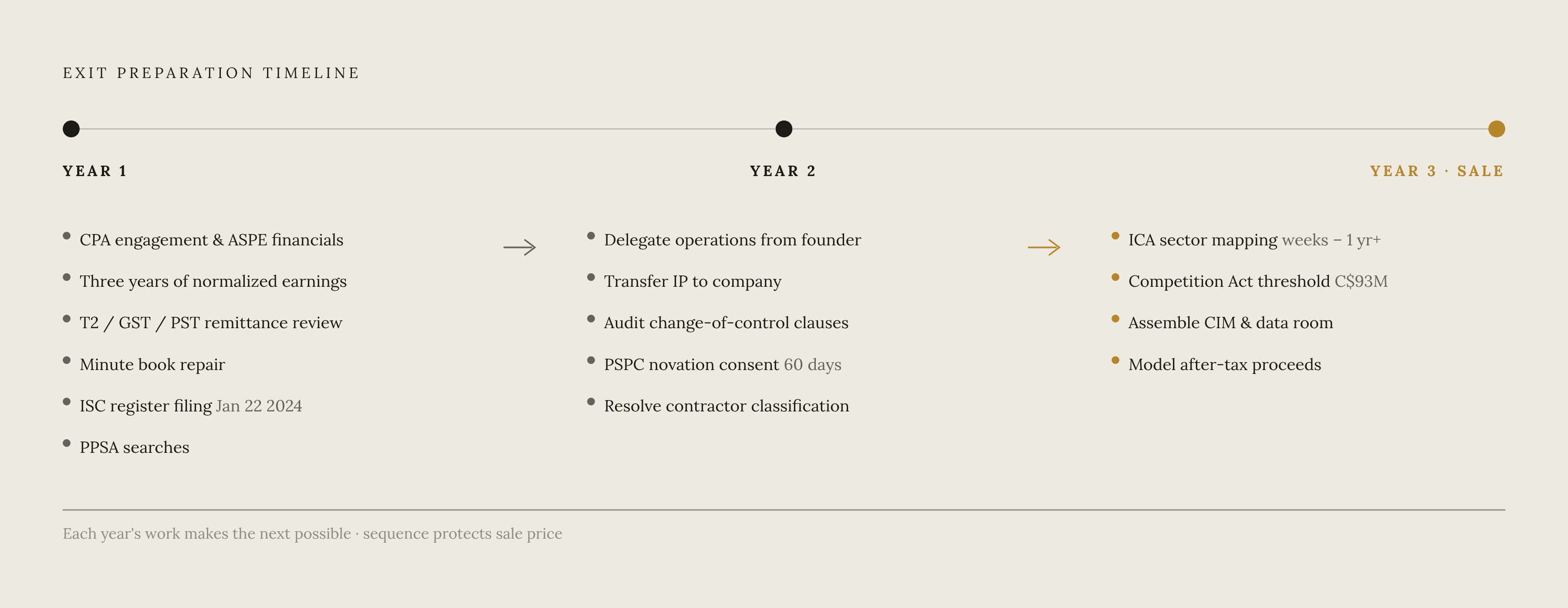
Begin with a CPA and the financial history. Engage the CPA to prepare or restate the current year’s financial statements under ASPE, and start documenting normalization adjustments as they occur. Buyers and their quality-of-earnings accountants need three years of consistently normalized financials. Separate personal and business expenses now. Receipts, explanations and board resolutions where needed back up addbacks in ways that piecing the records together later may fail to do.
Normalization distinguishes reported results from earnings under a new owner. Adjustments may cover owner compensation that is above or below market, related-party transactions, personal vehicles, family payroll and one-time revenues or costs. Not every adjustment increases earnings. A business valuator’s calculation of value can help identify which adjustments are most important for the particular business.
The tax work should proceed at the same time. Pull the last three years of T2 and provincial returns, have a tax advisor map out the business’s multi-province nexus and SR&ED positions, and expect buyers to ask for six years of T2 history. Review GST/HST, PST and payroll remittances, and document operating leases, director loans and inter-company guarantees. This work can bring welcome clarity. Properly supported addbacks often reveal earning power that the founder’s own accounts have obscured.
Year one continued: corporate records and governance that buyers treat as binary
The legal counterpart to clean financials is a complete minute book. Under the OBCA and CBCA, corporations must maintain it at the registered office or another designated location, within Ontario under the OBCA or within Canada under the CBCA. A corporate lawyer should address gaps early. Reconstruction can take weeks, and it is easier without a buyer waiting for answers.
The record should establish incorporation, amendments, bylaws, share ownership and transfer history, directors and officers, and applicable shareholders’ agreements. It should also contain meeting minutes for at least the past three years and evidence supporting share issuances, transfers and repurchases. The purpose is not decorative compliance. Buyers need an unbroken account of who owns the company and how corporate decisions were authorized.
For federal corporations, address the ISC register filing requirement introduced on January 22, 2024, and remedy an unfiled register immediately. Confirm extra-provincial registrations wherever the corporation conducts business outside its home jurisdiction. Run PPSA searches, or Quebec hypothec searches, in each province where it holds assets to identify undisclosed security registrations. These are solvable problems when handled early. Left unresolved, they turn basic ownership assurance into a closing condition.
Year two: reducing owner dependency and building a business that runs without you
Year two changes the task from repairing records to transferring capability. The company’s ability to run for two weeks without its founder provides a practical test. If it cannot, a buyer is acquiring something closer to the founder’s job than an independent operation. That explains the different prices for the identical profit statements considered earlier. The earnings may match, but their dependence on the seller does not.
For the founder, the lesson is to delegate visibly. Write down every task the owner does, set up standard operating procedures, and give a real second tier of management the power to make decisions. Letting go can be difficult after years of personal control. Still, managers need a track record before marketing begins, because a team put together just before listing looks staged.
Transfer key customer relationships to account managers or management, and diversify a concentrated customer base. Where the model allows, convert transactional revenue into contracts, retainers or subscriptions. Apply the same risk logic to single-source suppliers through diversification or long-term agreements with favourable change-of-control provisions. Shareholder alignment belongs here too. Disagreements among shareholders or family members discovered during diligence can lengthen negotiations and exhaust the parties before closing.
Year two continued: cleaning up IP, contracts, and employment before buyers find the problems
Intellectual property must belong to the business being sold. Use the required formal arrangements to transfer patents, trade-marks, software, domain names and social media accounts held by the founder to the company. For CIPO-registered IP, record the assignment with the registry. Ownership alone does not settle transferability. Review licences granted to or by the company for assignment and change-of-control restrictions.
Material contracts require similar attention before negotiating leverage narrows. Audit software licences and obtain assignment consent or substitutes where needed, while renegotiating unfavourable change-of-control clauses. Federal PSPC standing offer agreements need novation consent, so the plan should allow at least 60 days to get it. Waiting until after an LOI changes the conversation. The counterparty then knows that consent may be necessary to complete the sale.
The employment review should look at verbal agreements, termination clauses, contractor classification and non-solicitation agreements with key employees. Canadian common law reasonable notice can exceed 24 months for senior employees, and undisclosed liabilities transfer in a share sale. Contractor misclassification also exposes the buyer to CRA reassessment risk. Written arrangements make these obligations easier to assess.
Data privacy completes this legal cleanup. Gather the privacy policies, the breach register and data processing agreements before buyers ask for them. Resolving these issues in year two creates a record of remediation that can support disclosure, rather than a set of surprises discovered during year-three diligence.
Year three: regulatory readiness and the Canadian rules that stop deals at the finish line
A prepared company still needs an executable transaction. The Investment Canada Act, or ICA, makes buyer identity and sector exposure central to that question. After amendments in 2024–2025, national security review now covers minority stakes, joint ventures and asset purchases as well as full acquisitions. A clean notification can involve several weeks, while a full review can extend to a year or more. That difference belongs in buyer qualification.
The seller’s task is to map sector exposure early. In sensitive areas such as critical minerals, AI, quantum and defence, sellers need to take particular care with pre-closing filing obligations. Ownership chains, government contracts and sensitive data flows also enter the assessment. Buyer interest is not enough by itself. A credible process must distinguish appetite for the company from readiness to navigate its regulatory profile.
Competition Act exposure creates a separate filter. The C$93M notification threshold concerns Canadian assets or revenues from sales in, from, or into Canada, with a substantial combined size-of-parties threshold also relevant. Below the filing threshold, the Competition Bureau can still challenge a merger. Before marketing, check what the combined market positions would be for plausible buyers, especially in concentrated sectors, and ask provincial regulators to confirm what is needed for licence transfer or re-application. A domestic buyer may simplify ICA timing while still creating competition concerns.
Year three: assembling the marketing package that converts preparation into a premium
The Confidential Information Memorandum, or CIM, turns the preparation into an investment case that buyers can evaluate. It should show how the evidence already gathered backs up normalized earnings, recurring revenue, management depth and growth prospects. Populate the virtual data room before requests arrive. The CIM supports the initial bid, while the underlying documents allow buyers to test its claims without rebuilding the company’s history themselves.
Access should begin with a well-drafted M&A NDA. Its provisions should address confidential information, permitted use, employee non-solicitation, duration, and return or destruction obligations if the transaction fails. A typical term is two to three years.
The seller should also work out how much would be left after tax from share sales, asset sales, earnouts, vendor take-back financing and milestone-based payments. In 2026, deferred payment structures are standard ways to bridge valuation differences. Share sales that qualify may bring LCGE benefits, but past liabilities pass to the buyer too. Planning helps a share sale go ahead with fewer surprises, though some risks from the past remain.
Finally, year three needs a personal plan. Founders can devote so much attention to closing that they reach it without deciding what comes next, a commonly cited regret. Planning life after the sale belongs in the roadmap just as deliberately as preparing the company for transfer.
How AI-assisted buyer matching and investment banking advisory change what three years of preparation can achieve
Preparation makes a business easier to buy, but does not automatically produce qualified buyers. Systematic buyer access is a separate requirement. AI-assisted matching can help direct the CIM toward buyers predisposed to value recurring revenue, management depth and clean financials.
Investment banking support remains important for deal structure, ICA sector mapping, Competition Act exposure and negotiation of earnout or vendor take-back terms. Technology does not resolve those questions by itself. For mid-market founders considering Canadian and US buyers, access and execution expertise serve different parts of the same process.
Engage advisory support before finalizing the preparation roadmap. A valuation gap identified in year one leaves time to build evidence that closes it. Buyer matching can then connect that evidence to interested acquirers, while experienced advisors assess whether their proposed terms can actually deliver the intended outcome. The strongest offer is not merely the highest expression of interest, but one the prepared business and the proposed buyer can support through diligence and closing.
Sources
- M&A Due Diligence Checklist Canada - Hadri Law
- Comprehensive M&A Due Diligence Checklist for Ottawa SMEs - Dimitrov Law Professional Corporation
- What does 2026 have in store for M&A in Canada?
- Canadian M&A 2026: Certainty over Speed - Business Law Today from ABA
- Canadian M&A in the Second Half of 2025: Why Readiness and Speed Will Set the Winners Apart
- Canadian Mergers and Acquisitions (M&A) trends in 2026